
BuddhistCatholicContemplativeEvangelicalGeneral ChristianHinduJewishLatter-day SaintMuslimNew VisionsProgressive Christian
Beliefs
- Buddhist
- Catholic
- Contemplative
- Evangelical
- General Christian
- Hindu
- Jewish
- Latter-day Saint
- More Voices
- Muslim
- New Visions
- Pagan
- Progressive Christian
Topics
- Religion News
- Food and Religion
- Sports and Religion
- Religious Art
- Religious Music and Entertainment
- Religious Events
- History and Religion
- Style and Religion
- Politics and Religion
- Women in Religion
- Recreation Outdoors and Religion
- Business Finance and Religion
- Careers Workplace and Religion
- Education and Religion
- Family Parenting and Religion
- Health Fitness and Religion
- Home and Religion
- Relationships and Religion
- Technology and Religion
- Travel and Religion
Columnists
- Buddhist Columnists
- Business Finance and Religion Columnists
- Careers Workplace and Religion Columnists
- Catholic Columnists
- Contemplative Columnists
- Education and Religion Columnists
- Evangelists Columnists
- Family Parenting and Religion Columnists
- General Christian Columnists
- Health Fitness and Religion Columnists
- Hindu Columnists
- History and Religion Columnists
- Home and Religion Columnists
- Jewish Columnists
- More Voices Columnists
- Latter Day Columnists
- Muslim Columnists
- New Visions Columnists
- Nonreligious Columnists
- Pagan Columnists
- Politics and Religion Columnists
- Progressive Columnists
- Recreation Outdoors and Religion Columnists
- Relationships and Religion Columnists
- Religion News Columnists
- Religious Art Columnists
- Religious Events Columnists
- Religious Music and Entertainment Columnists
- Sports and Religion Columnists
- Style and Religion Columnists
- Technology and Religion Columnists
- Travel and Religion Columnists
- Women in Religion Columnists
Resource Library
- 2026 Calendar
- Library of World Religions
- The 100 Most Holy Places on Earth
- Patheos Answers
- Podcasts
- Videos
- Faith Leaders Database
- Anglican Episcopalian
- Bahai
- Baptist
- Buddhism
- Christianity
- Confucianism
- Eastern Orthodoxy
- Hinduism
- Holiness and Pentecostal
- ISKCON
- Islam
- Judaism
- Lutheran
- Methodist
- The Church of Jesus Christ of Latter-day Saints
- New Age
- Paganism
- Presbytarian and Reformed
- Protestantism
- Religion Behind the Scenes
- Roman Catholic
- Scientology
- Shia Islam
- Sikhism
- Sufism
- Sunni Islam
- Taoism
- Zen
- See all religions
Research Tools
 Ad-Free & Subscriber Log-In Subscription Support
Ad-Free & Subscriber Log-In Subscription Support
Follow Patheos 

- Trending:
- Forgiveness
- |
- Marriage
- |
- Consciousness
- |
- Death Penalty
- |
- Election
- |
- Halloween
 Muslimah Media Watch
- Home
- Muslim
- Religion News
- Not in Our Name: Muslim Women and the Quebec Charter
Not in Our Name: Muslim Women and the Quebec Charter
Last updated on: March 10, 2014 at 2:00 am by Krista
Not in Our Name: Muslim Women and the Quebec Charter 2014-03-09T23:46:15-04:00 Krista
Patheos Explore the world's faith through different perspectives on religion and spirituality! Patheos has the views of the prevalent religions and spiritualities of the world.
A few weeks ago, I spoke as part of a panel at the University of Ottawa about the Quebec Charter of Secularism, speaking both as Editor-in-Chief of Muslimah Media Watch and as a founding member of the Collective of Muslim Feminists of Quebec. This is an edited version of my talk, updated to reflect shifts in the political context in the time since it was first presented (notably the announcement last week that Quebec will be holding provincial elections on April 7). Many thanks to the Muslim Law Students Association at the University of Ottawa for inviting me to speak.
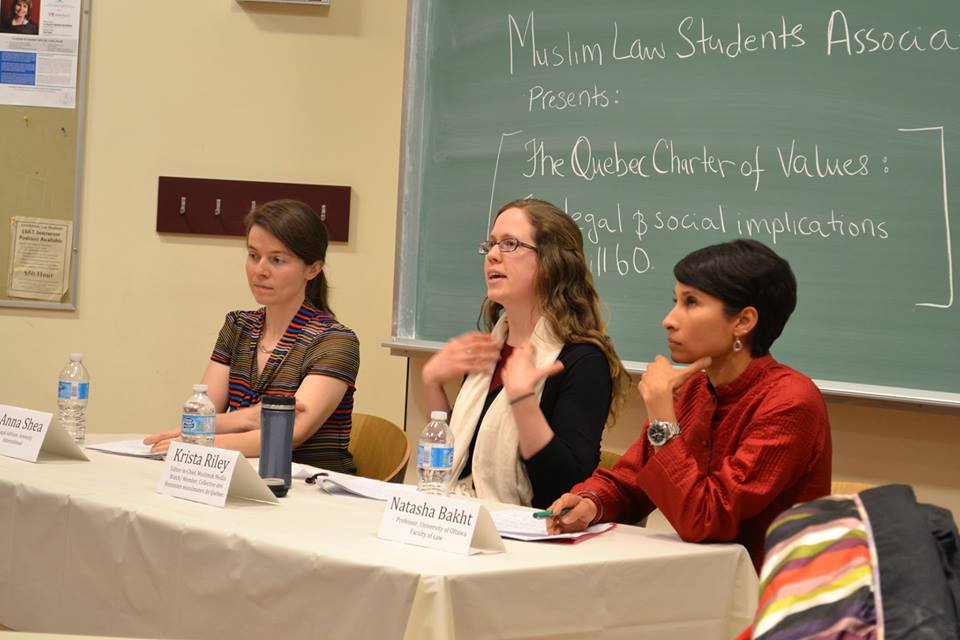
Answering questions after the panel, alongside Anna Shea of Amnesty International, and Professor Natasha Bakht of Ottawa University. Photo credit: Eren Cervantes.
I want to begin by acknowledging the Algonquin nation on whose territory we find ourselves today. I mean this not as a token acknowledgement but as a point that has fundamental relevance to the topic of this panel: specifically, that the regulation of bodies and religious practices is not a new phenomenon on this land, but instead has played an integral role in the colonial history of this country. So although we currently find ourselves in a moment of a specific crisis in a specific part of Canada, this is a moment that should be understood with reference to a longer history of colonisation and racism that has affected indigenous communities, as well as other racialised ethnic and religious minority communities, for hundreds of years.
Before I continue, I also want to talk about the challenges of discussing this topic outside of Quebec. On this issue and others, media in the rest of Canada have a tendency to frame it as yet another example of Quebec being weird and unreasonable, probably because of those sovereigntists. This is profoundly unhelpful. For those of us working inside Quebec, who are trying to engage in serious internal conversations about Quebec’s identity, the dismissal of the importance of these questions from those outside Quebec who claim to support us is often harmful and counterproductive. There is also a suggestion in some of the reactions that racism is unique to Quebec, letting other parts of Canada off the hook from having to examine their own uncomfortable systems and institutions that oppress and marginalise certain groups. In other words: yes, there are many unique things about Quebec, and this uniqueness needs to be taken seriously if we want to get anywhere in these discussions. At the same time, any attention to the particular example of Quebec should not become a distraction from other systemic forms of racism and discrimination that exist in other parts of Canada.
Let’s move on to talk about the Charter. One of the questions often posed with relation to this topic is how likely the Charter is to pass, and what the next steps are if it does. Although the specific proposed law that would bring about the Quebec Charter of Secularism is technically off the table at the moment now that elections have been called, it is clear that the Charter will be a major issue both during the elections themselves and in whatever follows, especially if the Parti Québécois, the party that proposed the bill as a minority government, ends up with a majority. Since it was first proposed, and long before the elections were actually called, the Charter has been widely seen as a strategy for the PQ to drum up support for the party; it is truly frightening to consider what that says about the kind of voter base that the PQ is trying to attract. It is hard to know at this point what will happen with regards to the Charter in terms of its potential to become law, and even if it were to pass in the National Assembly, there would be a number of court challenges brought to it. We can hope that it would not get very far.
However, as I hope to demonstrate within this talk, I think we are at a point where the question of whether the Charter passes or not is actually somewhat secondary. I do not want to suggest that the question of whether Bill 60 passes or not is irrelevant; were the bill to become law, as small as that possibility may be, its impact for many Quebecers who wear so-called religious symbols and work in the public service would be huge. However, in many other ways, the Charter’s damage has already been done, and this is what I want to focus on here, with a particular emphasis on the impact of the bill on Muslim women, an impact that began even before the charter was formally announced, and that has intensified in disturbing ways over the past few months.
It’s worth starting off with a look at how the Charter has been framed by those who promote it. Although its current name is significantly longer and more cumbersome, the initial name of the Charter that was announced in September was the Charter of Quebec Values, which defines both “Quebec” and its supposed “values” in a very specific way. The URL for the website where people could learn more about the Charter and leave their feedback begins with “nos valeurs,” “our values,” a phrase that permeated the early informational materials and public service announcements about the Charter. This language reflects an extremely careful and calculated construction of a particular “nous,” “us,” suggesting that those who disagree with the government’s understanding of these values are also not truly part of Quebec. This is also reflected in the particular signs that get designated as part of “our” history – such as the crucifix in the National Assembly – and those that are seen as irretrievably “religious” and thus not neutral, not part of “us” and not acceptable within state institutions. The polarised construction of both an “us” and an implicit “not us” has set the stage for other forms of discrimination and exclusion that minority groups, especially those associated with particular religious signs, are currently facing.
Moreover, the very idea of designating certain items of clothing as religious “signs” or “symbols” also reflects an imposition of a certain cultural and religious framework that is far from neutral. Although, for many Christians, wearing a cross may be primarily out of wanting to display it as a religious symbol (one that is entirely allowed under the proposed Charter, provided that it is not too “conspicuous”), this is not exactly analogous to other “religious symbols” targeted by the charter, such as the turban, kippah, headscarf, and niqab. The latter examples may be better understood as religious practices, and not simply as signs; by asking people not to wear these items, the government is not simply asking people not to display signs of their religion; rather, it is asking them to go against the practices that many people believe are required within their religion. In designating certain articles of clothing as religious symbols, the government is also inserting itself into processes of interpretation about the significance of these forms of religious dress, which is a curious action for a government that takes such a strong stance on the religious neutrality of the state.
Last November, the Muslim Council of Montreal reported that in the month following the first official announcement of the Charter, it had received reports of 117 cases of verbal or physical aggression against Muslims, 114 of those against Muslim women; this is compared to 25 reports in total for the first seven months of 2013. The possibility exists that some part of this is related to higher levels of reporting such incidents, but the intense increase is nonetheless disturbing and points to a clear link between the proposed charter and the targeting of Muslims for verbal and physical harassment. Social media has also been a site of vicious attacks against Muslims, as we saw, for example, with some of the recent reactions to the death of Naima Rharouity, whose death was initially attributed by some media outlets to her having been strangled by her hijab on an escalator in a metro station. Facebook comments arose quickly about how she deserved this fate, how her death meant one less terrorist, and how the Charter would have saved her. (A coroner’s report later found that she died from a traumatic brain injury and not from being strangled.) Daniel Weinstock, a professor of philosophy and law at McGill, was recently quoted as saying that “The boundaries of what is sayable and what isn’t have moved more in the last six months than I can ever remember in my lifetime in Quebec.” For some, there is a sense that a lot of this animosity has existed under the surface for a while, and that the Charter has opened a door and given people the licence to say these things out loud.
Of course, all of the attacks that have been publicly reported or that have received widespread attention are important ways of observing and measuring some of the impact of the Charter. That said, I am concerned that if we focus only on these, we miss other parts of the story. There are the cases of aggression or microaggression that people aren’t reporting: comments made in passing on the street or on public transit. These might be harder to measure or quantify, but anecdotal evidence suggests that they are increasing. Even for those who have not experienced overt hostility, there is a sense of frustration, fear, and alienation among Muslim women in Quebec, both those who wear headscarves and those who do not. I frequently hear comments like “I don’t know where home is anymore,” “it is getting harder to have hope,” and “things will never be the same.” This sense that so much has changed irreversibly is taking a psychological and emotional toll on Muslim women and others in Quebec that may be difficult to measure but will no doubt resonate for a long time, regardless of whether the Charter passes or not.
The everyday impact of the Charter on people’s lives can be seen in other ways too. I have spoken to one woman who has decided not to wear her headscarf in some areas of Montreal – not because she wants to remove it, but because she genuinely does not feel safe, and she has faced aggression in the past. Other women have reported avoiding certain parks, bus routes, or the metro, again because of safety concerns. Even though the Charter has not yet passed, and even if it never does, it has already had a very real impact on women’s lives and bodies, and on their relationship to particular spaces in their cities and communities.
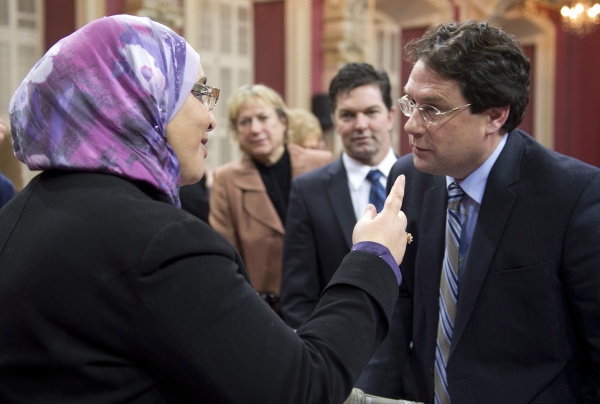
Activist Samira Laouni speaks to Bernard Drainville, Minister responsible for Democratic Institutions and Active Citizenship. [Source].
It should already be obvious, given everything I have just mentioned, that the claims that the Charter will help or liberate Muslim women are dubious at best. There has been little explanation or evidence from the perspective of the Quebec government about how this would happen, despite gender equality being one of the fundamental principles supposedly driving the Charter and much of the support for it. At least with relation to the Muslim community, the bill actually disadvantages women, in the sense that men who come from a religious perspective that holds the position that the headscarf is obligatory for women face no consequences for having this opinion, while women who share this perspective may be forced to decide between going against their religious beliefs and practices or risking the loss of their jobs.
Many Muslim women in Quebec who wear the headscarf have been very clear that they wear it out of their own volition and they are thus in no need of being saved from their clothing. Even in the rare cases where the headscarf is not chosen freely, it is difficult to understand how or why potentially depriving these women of job opportunities is seen as a solution. A 2009 report by the Fédération des femmes du Québec states that: “We know that the level of unemployment is already very high among immigrant women (the North African community has an unemployment rate of 33%) and that the annual revenue of immigrant women is lower than that of immigrant men. We also know that the State is the most important employer for women in Quebec.” Financial autonomy is understood as a key way for women to gain independence. For those women who do not experience their headscarf as a source of oppression, the bill represents an intrusion into their choices about how much clothing they want to wear, an invasion that seems hard to justify on grounds of gender equality. And for those women who are in oppressive situations, the bill threatens to rob them of a source of independence and income, which will do the opposite of promoting equality between women and men.
That said, it is unclear at this point exactly what will happen to people who refuse to remove their religious clothing at their workplaces. When asked directly about it in interviews, Minister Bernard Drainville has been evasive, mainly suggesting that the government will solve the problem by sitting down and talking with women to make them understand. The suggestion is that, for those who don’t “understand” and thus remove their scarves (or other religious clothing), it is a sign of extremism or fundamentalism, the kind of people that “we” shouldn’t bother negotiating with anyway.
Again, this is an area where the impact of the law is being felt before the Charter has even passed. I’ve seen some anecdotal evidence that workplaces are already deciding not to hire Muslim women who wear headscarves, because of the possibility that the Charter could pass. Another likely consequence of the law is that those who decide not to remove their religious clothing will seek employment in contexts where they can dress as they choose, although the example of what has happened in France in response to a similar ban suggests that many private companies are also refusing to hire women who wear headscarves, further limiting employment opportunities. The bill also punishes women who, by working in the public sector, are already integrated in Quebec society. In some cases, France’s veil ban has resulted in more people going to Muslim schools and daycares – I don’t mean to suggest that all Muslim schools and daycares are only ever a bad thing, but this is exactly the kind of ethnic and religious fragmentation and ghettoization that the proposed law claims to fight, which makes this potential effect especially ironic.
And yet the question of what will happen to people who refuse to take off their religious clothing is only one part of the picture. What will happen to people who do remove this clothing? Again, the example of France is instructive. I spoke recently with Roshan Jahangeer, a doctoral student at York University whose research focuses on policies related to the veil in both France and Quebec. In her interviews with women in France who had taken off their headscarves in order to work, she noted that many women found themselves in a profound conflict of identity, asking themselves whether they could still claim to be the kind of people they wanted to be if they were barred, for most of the day, from practicing this element of their religion according to their beliefs. France has been referred to repeatedly by the Quebec government as a model and a success story, and the number of women who have taken off their headscarves while at work is seen as one measure of this success. However, as Jahangeer explained, these numbers leave out the impact that this has on people’s lives: the internal negotiations, the psychological impact, the relationship of these women to their communities and to their faith. This measure of “success” ignores that the so-called “choice” to remove the headscarf is not made freely, and that its effects on women who do remove their scarves are far more complicated than the numbers suggest.

Quebecers protest the Charter of Secularism. [Source].
In September, as the Charter was first being announced, a group of us came together to form the Collective of Muslim Feminists of Quebec. I want to conclude by reading a translation of a statement that we published in a Montreal newspaperin response to the hijacking of feminist discourses in favour of the Charter, both because it summarises some of the major issues with the Charter, and because I think it’s important to conclude on a note of resistance, in recognition of the many individuals and groups who continue to fight against the Charter and its potential impact.
Not in Our Name!
Original French version available here.
The public debate raging in Quebec around the Quebec Charter of Values reminds us of the importance of reiterating our collective commitment to gender equality. As women and feminists, we applaud any measure that reaffirms the equality of sexes and genders. However, we are concerned about the ways that our hopes and struggles are being politically mobilised. As women and feminists, we say:
We, women and feminists, refuse to have our fellow citizens transformed into “enemies of the Nation”;
We, women and feminists, who have been engaged in struggles for social justice, will not accept that these struggles be used for the purposes of division and marginalisation;
We, women and feminists, refuse the importation of the French model of managing diversity and religious liberties into Quebec;
We, women and feminists, believe in secularism within our establishments and institutions without compromising the freedom of conscience and religion of the employees of the State;
We, women and feminists, who have struggled for years for women’s access to employment, denounce any measures that will exacerbate women’s exclusion and lead to further economic and social marginalisation;
We, women and feminists, believe that Quebec’s integrity is not threatened by the presence of religious signs on its territory;
We, women and feminists, refuse the stigmatisation of women who wear the headscarf and the creation of hierarchies among Quebec citizens;
We, women and feminists, invite the Marois government to act seriously and urgently on social inequalities, instead of fostering a climate of paranoia;
We, women and feminists, believe in equality through diversity: this Charter of “Quebec values” does not speak for us!
Collective of Muslim Feminists of Quebec
Previous Post

March 7, 2014
Friday Links | March 7, 2014
Browse Our Archives
Select a Category Advertisements Art/Theater Books/Magazines Cinema Comics/Cartoons Culture/Society Events Fashion Film Friday Links Merchandise/Commodities MMW Announcements MMW Highlights Music/Radio News Photography Politics Profile Ramadan 2012 Ramadan 2013 Ramadan 2014 Ramadan 2015 Roundtable Satire Social Media Sports Technology/Science Television Uncategorized Video Web
Select a Month November 2015 October 2015 September 2015 August 2015 July 2015 June 2015 May 2015 April 2015 March 2015 January 2015 December 2014 November 2014 October 2014 September 2014 July 2014 June 2014 May 2014 April 2014 March 2014 February 2014 January 2014 December 2013 November 2013 October 2013 September 2013 August 2013 July 2013 June 2013 May 2013 April 2013 March 2013 February 2013 January 2013 December 2012 November 2012 October 2012 September 2012 August 2012 July 2012 June 2012 May 2012 April 2012 March 2012 February 2012 January 2012 December 2011 November 2011 September 2011 August 2011 July 2011 June 2011 May 2011 April 2011 March 2011 February 2011 January 2011 December 2010 November 2010 October 2010 September 2010 August 2010 July 2010 June 2010 May 2010 April 2010 March 2010 February 2010 January 2010 December 2009 November 2009 October 2009 September 2009 August 2009 July 2009 June 2009 May 2009 April 2009 March 2009 February 2009 January 2009 December 2008 November 2008 October 2008 September 2008 August 2008 July 2008 June 2008 May 2008 April 2008 March 2008 February 2008 January 2008 December 2007 November 2007 October 2007 September 2007 August 2007
Follow Us!
TAKE THE
Religious Wisdom Quiz
Who was called by God to leave his home and go to a land God would show him?
Select your answer to see how you score.
Abram Moses Jacob Noah
Related posts from Muslimah Media Watch

#PrayforParis, Muslim Women and Third World Violence

Friday Links - American flag hijabs, hate crimes,...


TRENDING AT PATHEOS Muslim

25 Years Later: How Much Has Changed for...
As we approach the 25th anniversary of September 11th, I’ve found myself...

Podcast: Third Spaces & The Rise of Yemeni...
In the latest episode of The Artistic Foodies Podcast, hosts Abbas...

HalalFest Picks: Best 60 Halal Spots for Super...
Back in 2016, I came up with a list of 29...

Unity Is America’s Strength — Division Is Its...
by Hidayatullah Ahsan When Valentina Gomez, a Republican candidate for Congress in...

Zohran Mamdani and New York’s Fight Against Islamophobia
This past June, against all odds, Zohran Mamdani won the Democratic primary...

What the Fourth of July Means to a...
As we mark another Fourth of July, millions of Americans will celebrate...
view all Muslim blogs
Ad-Free & Subscriber Log-In Subscription Support
- About Us
- 2026 Calendar
- Videos
- Podcasts
- Library of World Religions
- Faith In Media Tracker
- Advertise With Us
- Write for Us
- Privacy Policy
- Terms of Service
- Do Not Sell My Data
- Contact Us
- Radiant Digital
- Manage Newsletter Subscriptions
- Unsubscribe From Notifications
- Sitemap
Copyright 2008-2026, Patheos. All rights reserved.
Subscription Support Ad-Free & Subscriber Log-In
Follow Patheos