
BuddhistCatholicContemplativeEvangelicalGeneral ChristianHinduJewishLatter-day SaintMuslimNew VisionsProgressive Christian
Beliefs
- Buddhist
- Catholic
- Contemplative
- Evangelical
- General Christian
- Hindu
- Jewish
- Latter-day Saint
- More Voices
- Muslim
- New Visions
- Pagan
- Progressive Christian
Topics
- Religion News
- Food and Religion
- Sports and Religion
- Religious Art
- Religious Music and Entertainment
- Religious Events
- History and Religion
- Style and Religion
- Politics and Religion
- Women in Religion
- Recreation Outdoors and Religion
- Business Finance and Religion
- Careers Workplace and Religion
- Education and Religion
- Family Parenting and Religion
- Health Fitness and Religion
- Home and Religion
- Relationships and Religion
- Technology and Religion
- Travel and Religion
Columnists
- Buddhist Columnists
- Business Finance and Religion Columnists
- Careers Workplace and Religion Columnists
- Catholic Columnists
- Contemplative Columnists
- Education and Religion Columnists
- Evangelists Columnists
- Family Parenting and Religion Columnists
- General Christian Columnists
- Health Fitness and Religion Columnists
- Hindu Columnists
- History and Religion Columnists
- Home and Religion Columnists
- Jewish Columnists
- More Voices Columnists
- Latter Day Columnists
- Muslim Columnists
- New Visions Columnists
- Nonreligious Columnists
- Pagan Columnists
- Politics and Religion Columnists
- Progressive Columnists
- Recreation Outdoors and Religion Columnists
- Relationships and Religion Columnists
- Religion News Columnists
- Religious Art Columnists
- Religious Events Columnists
- Religious Music and Entertainment Columnists
- Sports and Religion Columnists
- Style and Religion Columnists
- Technology and Religion Columnists
- Travel and Religion Columnists
- Women in Religion Columnists
Resource Library
- 2026 Calendar
- Library of World Religions
- The 100 Most Holy Places on Earth
- Patheos Answers
- Podcasts
- Videos
- Faith Leaders Database
- Anglican Episcopalian
- Bahai
- Baptist
- Buddhism
- Christianity
- Confucianism
- Eastern Orthodoxy
- Hinduism
- Holiness and Pentecostal
- ISKCON
- Islam
- Judaism
- Lutheran
- Methodist
- The Church of Jesus Christ of Latter-day Saints
- New Age
- Paganism
- Presbytarian and Reformed
- Protestantism
- Religion Behind the Scenes
- Roman Catholic
- Scientology
- Shia Islam
- Sikhism
- Sufism
- Sunni Islam
- Taoism
- Zen
- See all religions
Research Tools
 Ad-Free & Subscriber Log-In Subscription Support
Ad-Free & Subscriber Log-In Subscription Support
Follow Patheos 

- Trending:
- Forgiveness
- |
- Marriage
- |
- Consciousness
- |
- Death Penalty
- |
- Election
- |
- Halloween
 Muslimah Media Watch
- Home
- Muslim
- Religion News
- Muslim Anti-Racist Collaborative Centres Black Muslim Voices
Muslim Anti-Racist Collaborative Centres Black Muslim Voices
Last updated on: March 18, 2014 at 2:00 am by sharrae
Muslim Anti-Racist Collaborative Centres Black Muslim Voices 2014-03-17T15:16:38-04:00 sharrae
Patheos Explore the world's faith through different perspectives on religion and spirituality! Patheos has the views of the prevalent religions and spiritualities of the world.
Black Muslims took to Twitter last month in light of Black History Month, which is celebrated in February in North America. The Muslim Anti-Racist Collaborative (MuslimARC), a collaborative of diverse Muslims dedicated to combatting anti-Black racism, discrimination and exclusion within the Muslim community, launched a Twitter campaign that has opened the door to discussing anti-black racism within the Muslim community.
In an interview over email correspondence, Margari Hill, a member of MuslimARC, said that discussions began in 2013 about creating a Twitter campaign that would shed a spotlight on Black experience within the Muslim community. The call out was sent out in the second week of the month, notifying Black Muslims to participate in the live twitter conversations #BeingBlackandMuslim, #UmmahAntiBlackness, and #BlackMuslimFuture.
The #BeingBlackandMuslim campaign has situated Black Muslims as the drivers and leaders of the discussion that proceeded and was covered on Al Jazeera’s “The Stream.” One of the main events that prompted the creation of the Twitter campaign was CAIR- Michigan’s Executive Director Dawud Walid’s article entitled “Responses to my calling out the term ‘abeed’,” which denounced the use of the word, which means “slave” and has been used by both Christian and Muslim Arabs for Black people. As Margari told me in our email correspondence,
“Dawud Walid began to address the frequent use of the the Arabic slur word ab**d among Muslim and Christian Arabs. Several members of MuslimARC’s original core supported his Twitter campaign, and we were all shocked to see numerous Muslims who professed faith be so casually racist. Dawud Walid’s article on how individuals responded to his campaign went viral.”
Some key tweets from the #BeingBlackandMuslim conversation:
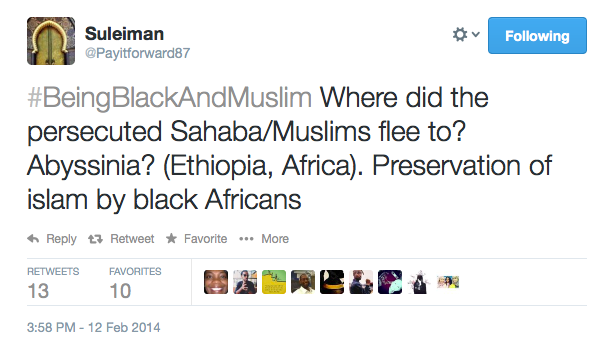
Tweet by @Payitforward87: #BeingBlackAndMuslim Where did the persecuted Sahaba/Muslims flee to? Abyssinia? (Ethiopia, Africa). Preservation of islam by black Africans
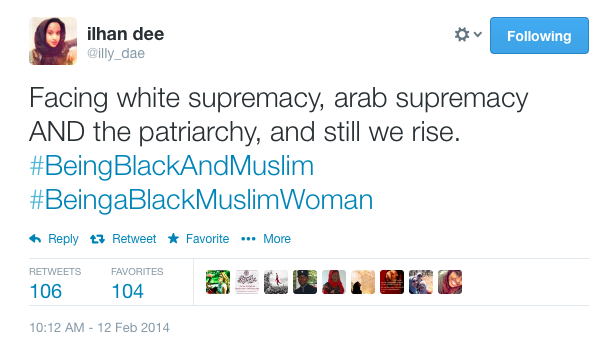
Tweet by @illy_dae: Facing white supremacy, arab supremacy AND the patriarchy, and still we rise. #BeingBlackAndMuslim #BeingaBlackMuslimWoman
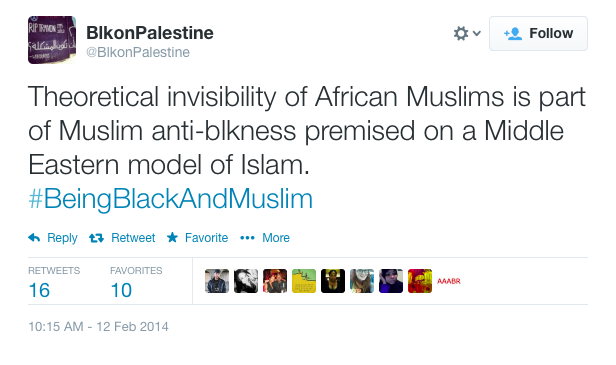
Tweet by @BlkonPalestine: Theoretical invisibility of African Muslims is part of Muslim anti-blkness premised on a Middle Eastern model of Islam. #BeingBlackAndMuslim
Non-Black Muslims also encouraged others to not derail the conversation and to allow Muslims who experience anti-black racism to voice their stories of both struggle and empowerment.
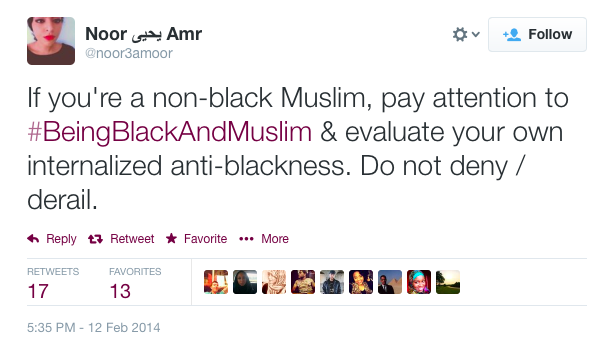
Tweet by @noor3amoor: If you’re a non-black Muslim, pay attention to #BeingBlackAndMuslim & evaluate your own internalized anti-blackness. Do not deny / derail.
Some Muslims engaged in the conversation with the notion that “We are all Muslim,” yet they were quickly met with responses that explained the particular and very real experience of marginalized Black voices in predominately South Asian and Arab Muslim communities.
“For Muslims to be engaging in anti-black racism is unacceptable given the main thread that connects us: a religion that is explicitly against racism,” says Namira Islam, another member of MuslimARC, about the importance of centering conversations about anti-blackness in the ummah.
Margari further explains,
“Muslims are long overdue for an internal conversation; we need to have a family meeting about this taboo topic. Stereotypes and discrimination have shaped the ways that we interact on a communal level. We are supposed to pretend that we are on a unified front in face of the onslaught of Islamophobia, but it is clear that there are fissures.”
I participated in the first conversation and was energized by joining in with other Black Muslims who have experienced marginalization and racism within the broader Muslim community. I had wanted to include and open a space for folks were identify as queer and Muslim, so I tweeted:
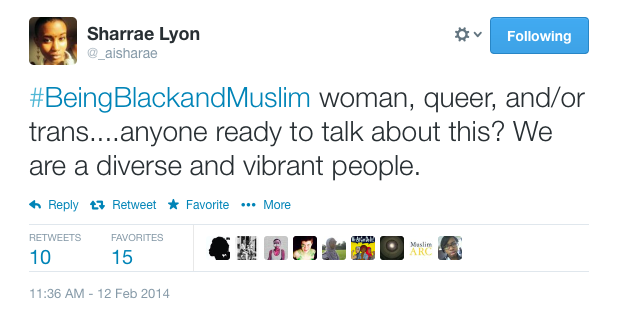
Tweet by @_aisharae: #BeingBlackandMuslim woman, queer, and/or trans….anyone ready to talk about this? We are a diverse and vibrant people.
There is always the need to ensure that we are not silencing the stories and experiences of others in our attempts to make pathways to our liberation. The added measure of being queer, along with a Black Muslim identity, contributes to further marginalization, isolation that needs to be addressed Although the tweet didn’t go far into discussions of queer experience, scholars, artists, students who identified both as Muslim and queer had an opportunity recognize and acknowledge each other and have side conversations on the struggle of resisting on multiple fronts beyond our race and faith.
Through using the social media platform, Namira and Margari and the folks at MuslimARC are sparking an international dialogue that could potentially inspire and influence a change in the relational dynamics between non-Black and Black Muslims.
“Islamophobia is external, and antiblack racism is internal. At the end of the day, they’re two separate issues […] it’s important to take care of our intrafamily issues.”
Let the family meeting continue.
Muslim Anti-Racist Collaborative
Previous Post

March 17, 2014
Rediscovering Noor Inayat Khan and the Good Muslim
Next Post

March 19, 2014 Mata Najwa: A Rare Glimpse of Real Journalism in Indonesia
Browse Our Archives
Select a Category Advertisements Art/Theater Books/Magazines Cinema Comics/Cartoons Culture/Society Events Fashion Film Friday Links Merchandise/Commodities MMW Announcements MMW Highlights Music/Radio News Photography Politics Profile Ramadan 2012 Ramadan 2013 Ramadan 2014 Ramadan 2015 Roundtable Satire Social Media Sports Technology/Science Television Uncategorized Video Web
Select a Month November 2015 October 2015 September 2015 August 2015 July 2015 June 2015 May 2015 April 2015 March 2015 January 2015 December 2014 November 2014 October 2014 September 2014 July 2014 June 2014 May 2014 April 2014 March 2014 February 2014 January 2014 December 2013 November 2013 October 2013 September 2013 August 2013 July 2013 June 2013 May 2013 April 2013 March 2013 February 2013 January 2013 December 2012 November 2012 October 2012 September 2012 August 2012 July 2012 June 2012 May 2012 April 2012 March 2012 February 2012 January 2012 December 2011 November 2011 September 2011 August 2011 July 2011 June 2011 May 2011 April 2011 March 2011 February 2011 January 2011 December 2010 November 2010 October 2010 September 2010 August 2010 July 2010 June 2010 May 2010 April 2010 March 2010 February 2010 January 2010 December 2009 November 2009 October 2009 September 2009 August 2009 July 2009 June 2009 May 2009 April 2009 March 2009 February 2009 January 2009 December 2008 November 2008 October 2008 September 2008 August 2008 July 2008 June 2008 May 2008 April 2008 March 2008 February 2008 January 2008 December 2007 November 2007 October 2007 September 2007 August 2007
Follow Us!
TAKE THE
Religious Wisdom Quiz
I am twelve stones taken from a riverbed and set up as a memorial to a miraculous crossing. What am I?
Select your answer to see how you score.
The memorial stones The Stones of remembrance Bethel Altar stones
Related posts from Muslimah Media Watch

#PrayforParis, Muslim Women and Third World Violence


Hate Crimes and Mother Tongues

Interview with Comedian Eman El Husseini
TRENDING AT PATHEOS Muslim

25 Years Later: How Much Has Changed for...
As we approach the 25th anniversary of September 11th, I’ve found myself...

Podcast: Third Spaces & The Rise of Yemeni...
In the latest episode of The Artistic Foodies Podcast, hosts Abbas...

HalalFest Picks: Best 60 Halal Spots for Super...
Back in 2016, I came up with a list of 29...

Unity Is America’s Strength — Division Is Its...
by Hidayatullah Ahsan When Valentina Gomez, a Republican candidate for Congress in...

Zohran Mamdani and New York’s Fight Against Islamophobia
This past June, against all odds, Zohran Mamdani won the Democratic primary...

What the Fourth of July Means to a...
As we mark another Fourth of July, millions of Americans will celebrate...
view all Muslim blogs
Ad-Free & Subscriber Log-In Subscription Support
- About Us
- 2026 Calendar
- Videos
- Podcasts
- Library of World Religions
- Faith In Media Tracker
- Advertise With Us
- Write for Us
- Privacy Policy
- Terms of Service
- Do Not Sell My Data
- Contact Us
- Radiant Digital
- Manage Newsletter Subscriptions
- Unsubscribe From Notifications
- Sitemap
Copyright 2008-2026, Patheos. All rights reserved.
Subscription Support Ad-Free & Subscriber Log-In
Follow Patheos