
BuddhistCatholicContemplativeEvangelicalGeneral ChristianHinduJewishLatter-day SaintMuslimNew VisionsProgressive Christian
Beliefs
- Buddhist
- Catholic
- Contemplative
- Evangelical
- General Christian
- Hindu
- Jewish
- Latter-day Saint
- More Voices
- Muslim
- New Visions
- Pagan
- Progressive Christian
Topics
- Religion News
- Food and Religion
- Sports and Religion
- Religious Art
- Religious Music and Entertainment
- Religious Events
- History and Religion
- Style and Religion
- Politics and Religion
- Women in Religion
- Recreation Outdoors and Religion
- Business Finance and Religion
- Careers Workplace and Religion
- Education and Religion
- Family Parenting and Religion
- Health Fitness and Religion
- Home and Religion
- Relationships and Religion
- Technology and Religion
- Travel and Religion
Columnists
- Buddhist Columnists
- Business Finance and Religion Columnists
- Careers Workplace and Religion Columnists
- Catholic Columnists
- Contemplative Columnists
- Education and Religion Columnists
- Evangelists Columnists
- Family Parenting and Religion Columnists
- General Christian Columnists
- Health Fitness and Religion Columnists
- Hindu Columnists
- History and Religion Columnists
- Home and Religion Columnists
- Jewish Columnists
- More Voices Columnists
- Latter Day Columnists
- Muslim Columnists
- New Visions Columnists
- Nonreligious Columnists
- Pagan Columnists
- Politics and Religion Columnists
- Progressive Columnists
- Recreation Outdoors and Religion Columnists
- Relationships and Religion Columnists
- Religion News Columnists
- Religious Art Columnists
- Religious Events Columnists
- Religious Music and Entertainment Columnists
- Sports and Religion Columnists
- Style and Religion Columnists
- Technology and Religion Columnists
- Travel and Religion Columnists
- Women in Religion Columnists
Resource Library
- 2026 Calendar
- Library of World Religions
- The 100 Most Holy Places on Earth
- Patheos Answers
- Podcasts
- Videos
- Faith Leaders Database
- Anglican Episcopalian
- Bahai
- Baptist
- Buddhism
- Christianity
- Confucianism
- Eastern Orthodoxy
- Hinduism
- Holiness and Pentecostal
- ISKCON
- Islam
- Judaism
- Lutheran
- Methodist
- The Church of Jesus Christ of Latter-day Saints
- New Age
- Paganism
- Presbytarian and Reformed
- Protestantism
- Religion Behind the Scenes
- Roman Catholic
- Scientology
- Shia Islam
- Sikhism
- Sufism
- Sunni Islam
- Taoism
- Zen
- See all religions
Research Tools
 Ad-Free & Subscriber Log-In Subscription Support
Follow Patheos 

- Trending:
- Advent
- |
- Forgiveness
- |
- Thanksgiving
- |
- Election
- |
- Seasonal Holidays
- |
- Marriage
 Muslimah Media Watch
- Home
- Muslim
- Religion News
- Am I Dressed Appropriately? Or Why That’s None of Your Business
Am I Dressed Appropriately? Or Why That’s None of Your Business
Last updated on: January 15, 2014 at 2:00 am by shireen
Am I Dressed Appropriately? Or Why That’s None of Your Business 2014-01-14T19:47:21-04:00 shireen
Patheos Explore the world's faith through different perspectives on religion and spirituality! Patheos has the views of the prevalent religions and spiritualities of the world.
Last Wednesday, social media was abuzz with the published findings of a recent study conducted in the “Muslim world” (Tunisia, Egypt, Iraq, Lebanon, Pakistan, Saudi Arabia and Turkey).
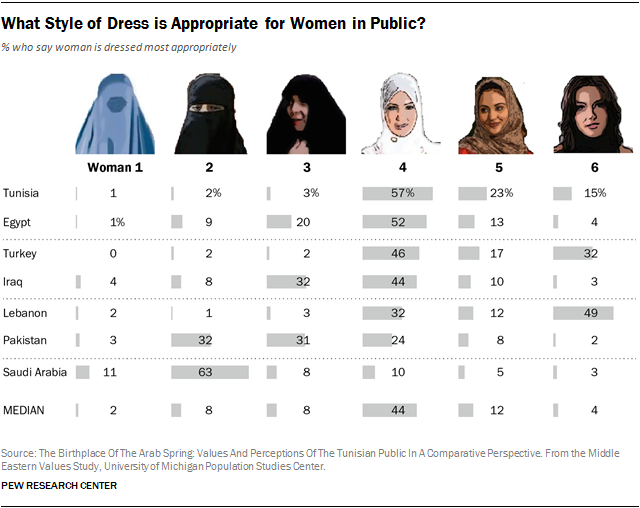
[Source].
The initial study was done by University of Michigan and looked at religious tolerance and secularism in Tunisia in comparison with six other nations. Although the initial poll covered a multitude of questions regarding political and religious situations in the Middle East, the focus of the poll, as presented by Pew Research Center,was “How people in Muslim countries prefer women to dress in public.” This is one of THE MOST FAVOURITE questions of Muslimah Media Watch.
Sarcasm aside, the discussion around Muslim women’s dress is an ongoing global obsession. The discussions persist in the West about hijab as we write about them, write about them more, and then some more.In fact, I (and many more Muslim women around the globe) am so eager to receive results on studies dedicated to what respondents think of our (un)veiling and attire. Even more exciting was the deep analysis by Max Fischer of the Washington Post (and the go-to man of mapping and charts of Muslim countries’ opinions on “everything”), who brings forth such brilliant and novel theories as “Veiling can be controversial in the Middle East.” White, non-Muslim men really have this all figured out. It’s mind-boggling that they even need to poll to inquire other men’s opinions in Muslim majority countries.
A few of the most pointed and obvious critiques of this study are as follows:
1) When one starts asking peoples’ opinion of how they “prefer” (GOD, I HATE THAT LANGUAGE) Muslim women to dress, they are validating a sense that that their opinion is necessary to the discussion. In fact, it is not. One of the biggest challenges for Muslim women vis-à-vis their clothing selection is that far too many people comment on it in the first place.
If a reputed research centre is keen to know the opinion of people and their preferences on clothing they are not wearing, then it in fact enables the public to feel as if their perspective is an integral part of Muslim society. It is not.
Any public opinion on how Muslimahs dress is problematic. And propelling the notion that such opinion is required or warranted is even more problematic.
2) The results of the study are biased and enforce the idea that covering is bad. The woman who is wearing a blue burqa has the lowest approval ratings. Ergo, covering fully is not the best choice according to “those polled.” Essentially this is a way to control the way a Muslim woman dresses. In providing these figures, an unknown group of people are declaring what they see fit and appropriate for Muslim women’s dress. If a woman wants to cover fully in a burqa or wear niqab or even not wear hijab at all, concerned pollsters do not need to inquire how everyone else feels about it.
The Pew article writes that “The survey treated the question of women’s dress as a visual preference.”
I am actually dumbfounded. This was considered a legitimate approach?
Next time Pew would like to consider a poll such as this, they should to save a lot of time and money and instead have men stand on street corners and rate the women passing by from 1- 10.
That might actually be more feasible and less arduous than an academic study.
3) No precise information was provided for those surveyed. No ages, genders, religions or demographic context was provided to explain who was polled. We have no idea who was polled, why they were polled or where they were polled. But the natural assumption is that they are conservative Muslims. And I presume most were men.
Pew shows a tremendous amount of bias in reporting these dodgy facts as if to point to the countries to say results are draconian and so are the mentalities behind them.
This is completely reductive and ridiculous.
4) The pictures of the women on the chart depicting various styles of hijab are inaccurate.
The blue burqa is the least popular, which is not surprising since it is not actually worn anywhere but Afghanistan and Northern Pakistan. The examples themselves are clearly skewed. And there are far more ways and styles in which women cover in those regions.

A different hijab style, worn by Egyptian actress Hala Shiha. [Source].

A hijab style commonly seen in Turkey. [Source].
The above styles are quite common. In fact, two of the countries that were polled (Egypt and Turkey) did not get to choose among styles that are most popular in their own country. Perhaps those conducting such studies ought to invest in more research, check out a Muslim fashion blog, or carry a handy copy of “Know Your Veils” to expand their range.
As expected, Twitter reacted quickly to the study and many wondered why this question would not be posed in the United States. There are millions of Muslims living in America who dress differently. Or why not even ask other communities how they “prefer to see their women dressed on the street”?
Well, because it is sexist and inappropriate. But according to Pew and others who publicised the study, it would be perfectly fine in the Middle East or Muslim majority countries. Disrespecting women, by hyperfocusing on their alleged objectification, is perfectly fine. The first line of the Pew article states: “An important issue in the Muslim world is how women should dress in public.” Above healthy, safety, education and access to basic services, it is Muslim women’s clothing. Women are far more concerned with what strangers think of their outfits than feeding and educating their families.
Right. Far beyond, health, safety education and other struggles and challenges: Muslim. Women’s. Dress.
Karl Sharro came up with a widely shared response to the study:

Screenshot via Twitter.
and @irevolt shared her reaction to the coverage of this story by Max Fischer:

Screenshot via Twitter.
Some of the other Twitter responses expressed frustration, disgust and non-surprise.
Immediately following the publication of said report were the mainstream media’s responses, thus far mainly written by non-Muslims and non-inhabitants of countries polled. There is little nuance or cultural understanding. Reflections of this study are more vapid (if possible) than the study itself. They analyze the results and make sweeping generalizations. They label the graphic as “illuminating.” I was silly enough to assume that at least one journalist would pick up that opinions of dress as a cultural determinant are racist and sexist. Guess not.
Then there is this gem from the Atlantic : “And while respondents in all of the countries rated their own country as more moral than the U.S., Tunisians were the most likely to say they’d want Americans as neighbors.”
Because that is exactly what the focal point of interviews with Muslims is, once we get past the question of women’s clothing. To extract their feelings and longing to befriend American.
At least one news outlet actually published some responses to the study as opposed to only lauding it for its findings.
One of the most obvious and problematic results of this study is how the chart is labelled “How people in Muslim countries prefer women to dress”. The actual header is a problem. It generalizes and assumes hundreds of millions of opinions. But that’s OK.
Perhaps the people who conducted this research might want to reinvest their millions into valid and relevant research projects that have a solid basis.
Or they can do some training into asking questions that are not offensive and ridiculous.
Or they can hand the money over to the Muslimah Media Watch team and we can offer them our writings, observations and commentaries on people’s opinions of how Muslim women should dress.
The answer for me is (un)surprisingly easy: I reject such discussions.
Previous Post

January 13, 2014
Bones of the #Mipsterz Debacle
Next Post

January 16, 2014 One-Dimensional Hijab Stories
Browse Our Archives
Select a Category Advertisements Art/Theater Books/Magazines Cinema Comics/Cartoons Culture/Society Events Fashion Film Friday Links Merchandise/Commodities MMW Announcements MMW Highlights Music/Radio News Photography Politics Profile Ramadan 2012 Ramadan 2013 Ramadan 2014 Ramadan 2015 Roundtable Satire Social Media Sports Technology/Science Television Uncategorized Video Web
Select a Month November 2015 October 2015 September 2015 August 2015 July 2015 June 2015 May 2015 April 2015 March 2015 January 2015 December 2014 November 2014 October 2014 September 2014 July 2014 June 2014 May 2014 April 2014 March 2014 February 2014 January 2014 December 2013 November 2013 October 2013 September 2013 August 2013 July 2013 June 2013 May 2013 April 2013 March 2013 February 2013 January 2013 December 2012 November 2012 October 2012 September 2012 August 2012 July 2012 June 2012 May 2012 April 2012 March 2012 February 2012 January 2012 December 2011 November 2011 September 2011 August 2011 July 2011 June 2011 May 2011 April 2011 March 2011 February 2011 January 2011 December 2010 November 2010 October 2010 September 2010 August 2010 July 2010 June 2010 May 2010 April 2010 March 2010 February 2010 January 2010 December 2009 November 2009 October 2009 September 2009 August 2009 July 2009 June 2009 May 2009 April 2009 March 2009 February 2009 January 2009 December 2008 November 2008 October 2008 September 2008 August 2008 July 2008 June 2008 May 2008 April 2008 March 2008 February 2008 January 2008 December 2007 November 2007 October 2007 September 2007 August 2007
Follow Us!
TAKE THE
Religious Wisdom Quiz
Cast your bread upon the waters and after many days you will find it again. What does this encourage?
Select your answer to see how you score.
Generosity Sharing Patience Fishing
Related posts from Muslimah Media Watch
#PrayforParis, Muslim Women and Third World Violence

Hate Crimes and Mother Tongues
Friday Links - American flag hijabs, hate crimes,...
TRENDING AT PATHEOS Muslim

25 Years Later: How Much Has Changed for...
As we approach the 25th anniversary of September 11th, I’ve found myself...

Podcast: Third Spaces & The Rise of Yemeni...
In the latest episode of The Artistic Foodies Podcast, hosts Abbas...

HalalFest Picks: Best 60 Halal Spots for Super...
Back in 2016, I came up with a list of 29...

Unity Is America’s Strength — Division Is Its...
by Hidayatullah Ahsan When Valentina Gomez, a Republican candidate for Congress in...

Zohran Mamdani and New York’s Fight Against Islamophobia
This past June, against all odds, Zohran Mamdani won the Democratic primary...

What the Fourth of July Means to a...
As we mark another Fourth of July, millions of Americans will celebrate...
view all Muslim blogs
Ad-Free & Subscriber Log-In Subscription Support
- About Us
- 2026 Calendar
- Videos
- Podcasts
- Library of World Religions
- Faith In Media Tracker
- Advertise With Us
- Write for Us
- Privacy Policy
- Terms of Service
- Do Not Sell My Data
- Contact Us
- Radiant Digital
- Manage Newsletter Subscriptions
- Unsubscribe From Notifications
- Sitemap
Copyright 2008-2026, Patheos. All rights reserved.
Subscription Support Ad-Free & Subscriber Log-In
Follow Patheos