
BuddhistCatholicContemplativeEvangelicalGeneral ChristianHinduJewishLatter-day SaintMuslimNew VisionsProgressive Christian
Beliefs
- Buddhist
- Catholic
- Contemplative
- Evangelical
- General Christian
- Hindu
- Jewish
- Latter-day Saint
- More Voices
- Muslim
- New Visions
- Pagan
- Progressive Christian
Topics
- Religion News
- Food and Religion
- Sports and Religion
- Religious Art
- Religious Music and Entertainment
- Religious Events
- History and Religion
- Style and Religion
- Politics and Religion
- Women in Religion
- Recreation Outdoors and Religion
- Business Finance and Religion
- Careers Workplace and Religion
- Education and Religion
- Family Parenting and Religion
- Health Fitness and Religion
- Home and Religion
- Relationships and Religion
- Technology and Religion
- Travel and Religion
Columnists
- Buddhist Columnists
- Business Finance and Religion Columnists
- Careers Workplace and Religion Columnists
- Catholic Columnists
- Contemplative Columnists
- Education and Religion Columnists
- Evangelists Columnists
- Family Parenting and Religion Columnists
- General Christian Columnists
- Health Fitness and Religion Columnists
- Hindu Columnists
- History and Religion Columnists
- Home and Religion Columnists
- Jewish Columnists
- More Voices Columnists
- Latter Day Columnists
- Muslim Columnists
- New Visions Columnists
- Nonreligious Columnists
- Pagan Columnists
- Politics and Religion Columnists
- Progressive Columnists
- Recreation Outdoors and Religion Columnists
- Relationships and Religion Columnists
- Religion News Columnists
- Religious Art Columnists
- Religious Events Columnists
- Religious Music and Entertainment Columnists
- Sports and Religion Columnists
- Style and Religion Columnists
- Technology and Religion Columnists
- Travel and Religion Columnists
- Women in Religion Columnists
Resource Library
- 2026 Calendar
- Library of World Religions
- The 100 Most Holy Places on Earth
- Patheos Answers
- Podcasts
- Videos
- Faith Leaders Database
- Anglican Episcopalian
- Bahai
- Baptist
- Buddhism
- Christianity
- Confucianism
- Eastern Orthodoxy
- Hinduism
- Holiness and Pentecostal
- ISKCON
- Islam
- Judaism
- Lutheran
- Methodist
- The Church of Jesus Christ of Latter-day Saints
- New Age
- Paganism
- Presbytarian and Reformed
- Protestantism
- Religion Behind the Scenes
- Roman Catholic
- Scientology
- Shia Islam
- Sikhism
- Sufism
- Sunni Islam
- Taoism
- Zen
- See all religions
Research Tools
 Ad-Free & Subscriber Log-In Subscription Support
Ad-Free & Subscriber Log-In Subscription Support
Follow Patheos 

- Trending:
- Forgiveness
- |
- Marriage
- |
- Consciousness
- |
- Death Penalty
- |
- Election
- |
- Halloween
 Muslimah Media Watch
- Home
- Muslim
- Religion News
- The Syrian Trojan Women
The Syrian Trojan Women
Last updated on: December 24, 2013 at 2:00 am by tasnim
The Syrian Trojan Women 2013-12-24T01:04:39-04:00 tasnim
Patheos Explore the world's faith through different perspectives on religion and spirituality! Patheos has the views of the prevalent religions and spiritualities of the world.
On the 18th of December, the Syrian Trojan Women project staged a production of Euripides’ tragedy The Trojan Women with a cast of Syrian refugee actors and crew in Amman. Their reinterpretation of this 2000-year-old play traces the parallels between the fates of the women of Troy and contemporary Syrian women refugees fleeing the violence in their country.
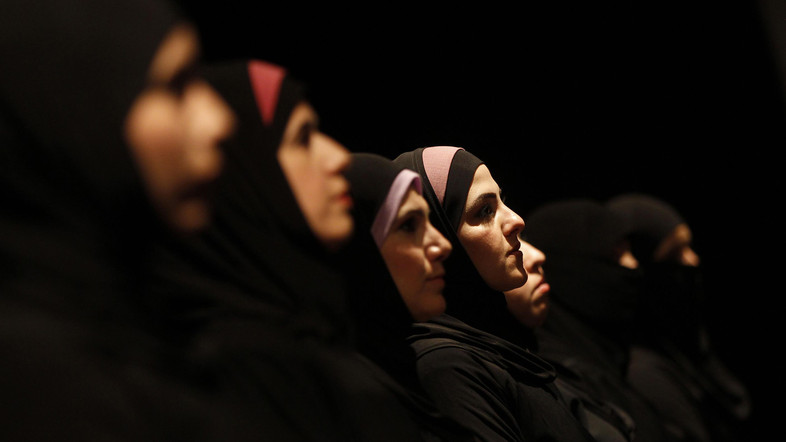
[Source].
As the project is described on the website:
“Euripides’ The Trojan Women is set at the fall of Troy. It is about the fate of the defeated and exiled. Weapons may change but war is eternal and there are enormous parallels between the fate of refugees from Syria today and that of the women of Troy. The women of Syria have seen their homes destroyed and their families wounded and killed, raped and brutalized, and have been forced to flee into exile.”
The website lists the aims behind the project, including raising awareness of the refugee crisis, providing employment and alleviating depression and boredom through holding drama groups and workshops. This poster states that entrance is free for Syrians registered with the UNHCR.
One of the women taking part in the project, Fatima (second name is not provided), described the sense of empowerment and focus she felt the workshops gave her, as well as her identification with the character of Hecuba, who she sees as having, like herself, lost everything, including her country:
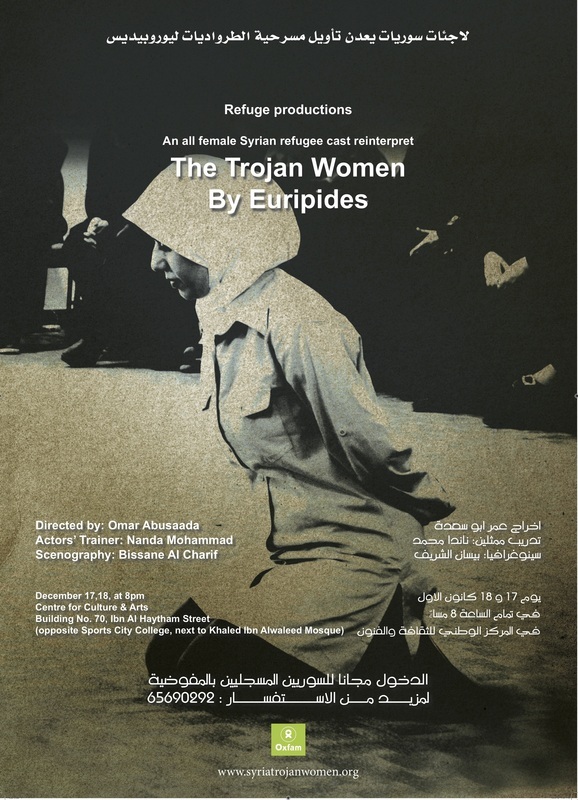
[Source].
The people involved in the project include producers Georgina Paget, William Stirling and Charlotte Eagar, Syrian actress Nanda Mohammad, director Omar Abusaada, documentary film maker Yasmin Fedaa, Palestinian director Annemarie Jacir, and Syrian filmmaker Itab Azzam. In an article in the Huffington Post, Charlotte Eagar describes the reason for the choice of the play:
“They can identify, of course, because the Trojan women is a play about refugees. It’s set just after the fall of Troy; the men of Troy are all dead, and the women, refugees, await their fate by tents of their new Greek overlords. Euripides wrote the play in 415 BC as a protest, after the Athenians’ took the island of Melos, killed all the men and sold the women into slavery.”
In the same article, though, Eagar also mentions that the choice of the play was questioned by some people who felt less identification with this classic play:
“The electrical engineer said aggressively, ‘But of course the case of Assad is entirely different to that of Troy! Why don’t you write a play about Syria?” I said I haven’t got time. And Euripides’ Trojan Women is a very famous play and people – with any luck – will give us money to put it on.”
The reasons for the choice of the play are represented here as lack of time to write original content, the familiarity of Euripides’ play, and the fact that people will give money to the project. Of course, money is central, since the project is described as “funded entirely by charitable donations” and in her article, Eager begins by describing herself standing in the Frontline Club behind the podium, “staring at the row of faces I was asking for money” with a projector running “a constant loop of harrowing images from the Syrian war.” The video of this event is available here:
Eren wrote a post last week about the inevitable power dynamics of fundraising. This is clearly a much more nuanced and collaborative project than the event Eren describes: there are Syrians involved in the project and in the fundraising; there is a sense of the history of this country and the politics behind the conflict; and the focus on the humanitarian efforts are placed in context. The project presents itself as one possible way to help alleviate the suffering of Syrian refugees until the resolution of the conflict, which the organizers see as coming through diplomatic negotiations, as in Bosnia.
Nevertheless, some of Eren’s points come through here. Those silent images projected on the screen behind the speaker are slightly jarring, given the aims of this project, which include giving the refugees a voice and a chance for them to tell their own stories. For example, the video of Fatima speaking about her identification with Hecuba would have made more sense than an image of an unnamed Syrian woman pointed out as the perfect Hecuba. There is an element of tragic inevitability in the description of “a man in long traditional robes with a face like Agammenon.” The most jarring part of this presentation, however, were these sentences:
“One might think that people in this situation would not necessarily be receptive to the idea of performing a 2,400 year old play. But when Oxfam’s Jordan-partner Voice, first introduced me to a group of black head-scarved, black robed women, the women’s faces lit up.”
Perhaps it’s just me, but at this point I was wondering why exactly this description of their clothing was relevant – also, although the women aren’t dressed all in black in the workshop images, they are all in black in the play.

[Source].
But all of this is more about the framing than what is being done and the truly inspiring work that this project aims to continue (depending on how much money they raise) as they seek to “expand the drama workshops to the refugee camps, involve more people. Perhaps even expand the project to other refugee crises.” This extends beyond limited drama workshops that run for a few weeks as the organizers hope to use the adaptation of this ancient play to create a sense of connection, “to open new opportunities to people who feel they have lost everything and are cut off from the world.”

Next Post

December 27, 2013 Friday Links | December 27, 2013
Browse Our Archives
Select a Category Advertisements Art/Theater Books/Magazines Cinema Comics/Cartoons Culture/Society Events Fashion Film Friday Links Merchandise/Commodities MMW Announcements MMW Highlights Music/Radio News Photography Politics Profile Ramadan 2012 Ramadan 2013 Ramadan 2014 Ramadan 2015 Roundtable Satire Social Media Sports Technology/Science Television Uncategorized Video Web
Select a Month November 2015 October 2015 September 2015 August 2015 July 2015 June 2015 May 2015 April 2015 March 2015 January 2015 December 2014 November 2014 October 2014 September 2014 July 2014 June 2014 May 2014 April 2014 March 2014 February 2014 January 2014 December 2013 November 2013 October 2013 September 2013 August 2013 July 2013 June 2013 May 2013 April 2013 March 2013 February 2013 January 2013 December 2012 November 2012 October 2012 September 2012 August 2012 July 2012 June 2012 May 2012 April 2012 March 2012 February 2012 January 2012 December 2011 November 2011 September 2011 August 2011 July 2011 June 2011 May 2011 April 2011 March 2011 February 2011 January 2011 December 2010 November 2010 October 2010 September 2010 August 2010 July 2010 June 2010 May 2010 April 2010 March 2010 February 2010 January 2010 December 2009 November 2009 October 2009 September 2009 August 2009 July 2009 June 2009 May 2009 April 2009 March 2009 February 2009 January 2009 December 2008 November 2008 October 2008 September 2008 August 2008 July 2008 June 2008 May 2008 April 2008 March 2008 February 2008 January 2008 December 2007 November 2007 October 2007 September 2007 August 2007
Follow Us!
TAKE THE
Religious Wisdom Quiz
What happened to Jezebel as prophesied by Elijah?
Select your answer to see how you score.
Drowned Eaten by dogs Burned alive Struck by lightning
Related posts from Muslimah Media Watch

Friday Links - American flag hijabs, hate crimes,...



When Arab Women Artists "Revisit The Harem"
TRENDING AT PATHEOS Muslim

25 Years Later: How Much Has Changed for...
As we approach the 25th anniversary of September 11th, I’ve found myself...

Podcast: Third Spaces & The Rise of Yemeni...
In the latest episode of The Artistic Foodies Podcast, hosts Abbas...

HalalFest Picks: Best 60 Halal Spots for Super...
Back in 2016, I came up with a list of 29...

Unity Is America’s Strength — Division Is Its...
by Hidayatullah Ahsan When Valentina Gomez, a Republican candidate for Congress in...

Zohran Mamdani and New York’s Fight Against Islamophobia
This past June, against all odds, Zohran Mamdani won the Democratic primary...

What the Fourth of July Means to a...
As we mark another Fourth of July, millions of Americans will celebrate...
view all Muslim blogs
Ad-Free & Subscriber Log-In Subscription Support
- About Us
- 2026 Calendar
- Videos
- Podcasts
- Library of World Religions
- Faith In Media Tracker
- Advertise With Us
- Write for Us
- Privacy Policy
- Terms of Service
- Do Not Sell My Data
- Contact Us
- Radiant Digital
- Manage Newsletter Subscriptions
- Unsubscribe From Notifications
- Sitemap
Copyright 2008-2026, Patheos. All rights reserved.
Subscription Support Ad-Free & Subscriber Log-In
Follow Patheos