
BuddhistCatholicContemplativeEvangelicalGeneral ChristianHinduJewishLatter-day SaintMuslimNew VisionsProgressive Christian
Beliefs
- Buddhist
- Catholic
- Contemplative
- Evangelical
- General Christian
- Hindu
- Jewish
- Latter-day Saint
- More Voices
- Muslim
- New Visions
- Pagan
- Progressive Christian
Topics
- Religion News
- Food and Religion
- Sports and Religion
- Religious Art
- Religious Music and Entertainment
- Religious Events
- History and Religion
- Style and Religion
- Politics and Religion
- Women in Religion
- Recreation Outdoors and Religion
- Business Finance and Religion
- Careers Workplace and Religion
- Education and Religion
- Family Parenting and Religion
- Health Fitness and Religion
- Home and Religion
- Relationships and Religion
- Technology and Religion
- Travel and Religion
Columnists
- Buddhist Columnists
- Business Finance and Religion Columnists
- Careers Workplace and Religion Columnists
- Catholic Columnists
- Contemplative Columnists
- Education and Religion Columnists
- Evangelists Columnists
- Family Parenting and Religion Columnists
- General Christian Columnists
- Health Fitness and Religion Columnists
- Hindu Columnists
- History and Religion Columnists
- Home and Religion Columnists
- Jewish Columnists
- More Voices Columnists
- Latter Day Columnists
- Muslim Columnists
- New Visions Columnists
- Nonreligious Columnists
- Pagan Columnists
- Politics and Religion Columnists
- Progressive Columnists
- Recreation Outdoors and Religion Columnists
- Relationships and Religion Columnists
- Religion News Columnists
- Religious Art Columnists
- Religious Events Columnists
- Religious Music and Entertainment Columnists
- Sports and Religion Columnists
- Style and Religion Columnists
- Technology and Religion Columnists
- Travel and Religion Columnists
- Women in Religion Columnists
Resource Library
- 2026 Calendar
- Library of World Religions
- The 100 Most Holy Places on Earth
- Patheos Answers
- Podcasts
- Videos
- Faith Leaders Database
- Anglican Episcopalian
- Bahai
- Baptist
- Buddhism
- Christianity
- Confucianism
- Eastern Orthodoxy
- Hinduism
- Holiness and Pentecostal
- ISKCON
- Islam
- Judaism
- Lutheran
- Methodist
- The Church of Jesus Christ of Latter-day Saints
- New Age
- Paganism
- Presbytarian and Reformed
- Protestantism
- Religion Behind the Scenes
- Roman Catholic
- Scientology
- Shia Islam
- Sikhism
- Sufism
- Sunni Islam
- Taoism
- Zen
- See all religions
Research Tools
 Ad-Free & Subscriber Log-In Subscription Support
Ad-Free & Subscriber Log-In Subscription Support
Follow Patheos 

- Trending:
- Forgiveness
- |
- Marriage
- |
- Consciousness
- |
- Death Penalty
- |
- Election
- |
- Halloween
 Muslimah Media Watch
- Home
- Muslim
- Religion News
- How Not to Discuss Sexual Violence against Third World Women
How Not to Discuss Sexual Violence against Third World Women
Last updated on: December 16, 2013 at 7:19 am by eren
How Not to Discuss Sexual Violence against Third World Women 2013-12-16T07:19:50-04:00 eren
Patheos Explore the world's faith through different perspectives on religion and spirituality! Patheos has the views of the prevalent religions and spiritualities of the world.
Last week I was invited to the Dutch embassy to celebrate the launching of the Nobel Women’s Initiative’s report on sexual violence against women in Sudan. The report is titled “Survivors Speak Out: Sexual Violence in Sudan,” and it is meant to address the situation of “mass rape” and other forms of sexual violence against Sudanese women of all religious, ethnic and cultural backgrounds.
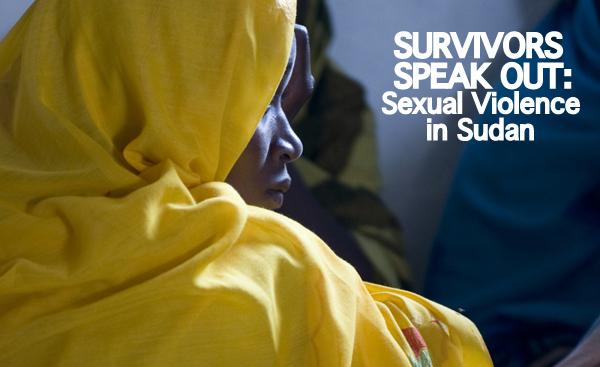
Via The International Campaign to Stop Rape and Gender Violence in Conflict.
As a Masters student interested in issues of gender and gendered violence, I was quite excited to be one of three students chosen to represent my university. I, a Mexican of indigenous background and a convert to Islam, was chosen alongside one Christian Lebanese PhD student and a second-year Masters student of Iraqi and Muslim background. Upon arrival to the embassy, the first thing we noticed was the demographic. We were three of the five minorities in a group of more than 50 people. There were only about four men, including the ambassador and a representative from Amnesty international. Whereas demographics may be irrelevant in some contexts, I think the demographics of this event set the tone for what would be an afternoon of drawing dichotomies, praising the big bucks coming from abroad, and presenting few recommendations to solve the issues. As three of the five minorities we were photographed constantly… My Iraqi friend, who is also a hijabi, attracted numerous people who kept asking to take a picture with her. It was like being in the zoo. Nonetheless, perhaps one of the most shocking (but not really) facts was that in an event celebrating the launching of a report about Sudanese women, there were no Sudanese people.
The speakers made a point in saying that the Sudanese government was against the work done by the organization; yet, no other Sudanese representatives from universities or NGOs were invited. There were no black people either… the report was surrounded by the whiteness that put it together and the money that funded it.
This report was presented in front of representatives of the Canadian senate, Canadian Foreign Affairs, the media and various NGOs yet it was more a mingling cocktail party than anything else. Among the three different speeches, the representative of Amnesty International had the most effect on me (and I don’t mean in a good way). He first recalled various issues of gender violence in Canada to try to appeal to the Canadian crowd and make the link to sexual violence in the Third World. However, the situation of the Stolen Sisters in Canada and sexual violence against indigenous women was not among the events mentioned. According to him, gender violence is non-existent in Canada or the Netherlands, which sharply contrasts with Amnesty’s own campaigns supporting the rights of indigenous women in Canada.
Nonetheless, he managed to make the link. He went on to tell us about the stories of “brave” Sudanese women who have been raped and abused, but who are looking to put an end to sexual violence. He described his role as one of a listener to horrible stories. The speaker also continued to praise the efforts of the First World, drawing a sharp dichotomy between the “us” and “them.” Sexual violence was described as a problem of the developing world and, in the Sudanese case, as a by-product of Islamic law. His suggestions continued to call the First World to pledge their support to end sexual violence in Sudan and to assist NGOs in the work in the Africa and in refugee camps. He then went on to thank the Dutch government for pledging a large amount of money to helping projects in Sudan, and to congratulate the crowd for another “successful” year in the area.
After the speech I felt uneasy, but I could not quite pinpoint what bothered me the most. Was it the lack of Sudanese people? Was it the dichotomy between the First and Third World? Or was it the idea that the First World is the solution?
When I went home and I read the report, I didn’t feel any better. The report compiles horrific statistics and stories of sexual violence in Sudanese provinces. Every couple of pages there is a picture of a woman, some of them in hijabs, working for NGOs or assisting refugees, but none of those women were present at the event, or even mentioned. Similarly, the report presents various examples on how Islamic law, as understood by the current regime, oppresses women. It also quotes Sudan’s president, Omar Al-Bashir, as saying: “It is not in the Sudanese culture or people of Darfur to rape. It doesn’t exist. We do not have it.”
Yet, the report offers no tangible policy recommendations. It tells people to call for Al-Bashir to be brought to justice to the International Criminal Court, where very few cases have been brought forward (most of them from Africa). Bringing a leader to trial in international settings is not an easy process or a neutral one. I think that examples from Latin America (i.e. Augusto Pinochet or Alberto Fujimori) show that no matter how horrible the human rights abuses are, political and economic interests often come before justice.
Furthermore, the report also suggests collecting more funds, but we do not know how the funds are used and how this benefits Sudanese women, especially when foreign NGOs are denied entrance in Sudan, and the report points out that human rights activists are also prosecuted in the country.
By the end of the report I felt hopeless. What is the solution to a situation when aid and development are so politicized both in Third World countries and in the West? What can be done if it is assumed that Islamic law is inherently bad towards women but we fail to acknowledge the legacies of colonialism and war? How can we make decisions without the women whose lives are at stake?
I am not an idealist. I happen to think that the parts of the world named “The West” or “the First World” can offer much needed help to countries in what is called the “Third World” or the “Global South” – but I believe that this help does not only come in the form of dollars and fancy speeches. Although financial aid may deliver something, it does not always come hand in hand with a real commitment to justice and peace. It can instead come with military interventions, like in Iraq and Afghanistan, or with financially assisting other governments or militias with arms and money that are used against civilians, or with a particular neoliberal pro-market form of development endorsed by organizations like the World Bank and the International Monetary Fund.
While it is true that at some point we (in the Third World) should get over the history of colonization, imperialism and military interventions, failing to acknowledge that history and its remnants does not benefit our communities in any way. The narrative has to change. The patently absurd idea of discussing sexual violence against Sudanese women without Sudanese women present has to become unthinkable. How can “Third World women” become empowered when the mainstream narratives say that they have to be saved from inept and violent brown men by Western countries with white majorities and big bucks?
Previous Post

December 13, 2013
Friday Links | December 13, 2013
Next Post
December 20, 2013 Friday Links | December 20, 2013
Browse Our Archives
Select a Category Advertisements Art/Theater Books/Magazines Cinema Comics/Cartoons Culture/Society Events Fashion Film Friday Links Merchandise/Commodities MMW Announcements MMW Highlights Music/Radio News Photography Politics Profile Ramadan 2012 Ramadan 2013 Ramadan 2014 Ramadan 2015 Roundtable Satire Social Media Sports Technology/Science Television Uncategorized Video Web
Select a Month November 2015 October 2015 September 2015 August 2015 July 2015 June 2015 May 2015 April 2015 March 2015 January 2015 December 2014 November 2014 October 2014 September 2014 July 2014 June 2014 May 2014 April 2014 March 2014 February 2014 January 2014 December 2013 November 2013 October 2013 September 2013 August 2013 July 2013 June 2013 May 2013 April 2013 March 2013 February 2013 January 2013 December 2012 November 2012 October 2012 September 2012 August 2012 July 2012 June 2012 May 2012 April 2012 March 2012 February 2012 January 2012 December 2011 November 2011 September 2011 August 2011 July 2011 June 2011 May 2011 April 2011 March 2011 February 2011 January 2011 December 2010 November 2010 October 2010 September 2010 August 2010 July 2010 June 2010 May 2010 April 2010 March 2010 February 2010 January 2010 December 2009 November 2009 October 2009 September 2009 August 2009 July 2009 June 2009 May 2009 April 2009 March 2009 February 2009 January 2009 December 2008 November 2008 October 2008 September 2008 August 2008 July 2008 June 2008 May 2008 April 2008 March 2008 February 2008 January 2008 December 2007 November 2007 October 2007 September 2007 August 2007
Follow Us!
TAKE THE
Religious Wisdom Quiz
What does James say we should be quick to do and slow to do?
Select your answer to see how you score.
Quick to obey, slow to question Quick to pray, slow to doubt Quick to forgive, slow to judge Quick to listen, slow to speak and slow to become angry
Related posts from Muslimah Media Watch

#PrayforParis, Muslim Women and Third World Violence


Hate Crimes and Mother Tongues

Interview with Comedian Eman El Husseini
TRENDING AT PATHEOS Muslim

25 Years Later: How Much Has Changed for...
As we approach the 25th anniversary of September 11th, I’ve found myself...

Podcast: Third Spaces & The Rise of Yemeni...
In the latest episode of The Artistic Foodies Podcast, hosts Abbas...

HalalFest Picks: Best 60 Halal Spots for Super...
Back in 2016, I came up with a list of 29...

Unity Is America’s Strength — Division Is Its...
by Hidayatullah Ahsan When Valentina Gomez, a Republican candidate for Congress in...

Zohran Mamdani and New York’s Fight Against Islamophobia
This past June, against all odds, Zohran Mamdani won the Democratic primary...

What the Fourth of July Means to a...
As we mark another Fourth of July, millions of Americans will celebrate...
view all Muslim blogs
Ad-Free & Subscriber Log-In Subscription Support
- About Us
- 2026 Calendar
- Videos
- Podcasts
- Library of World Religions
- Faith In Media Tracker
- Advertise With Us
- Write for Us
- Privacy Policy
- Terms of Service
- Do Not Sell My Data
- Contact Us
- Radiant Digital
- Manage Newsletter Subscriptions
- Unsubscribe From Notifications
- Sitemap
Copyright 2008-2026, Patheos. All rights reserved.
Subscription Support Ad-Free & Subscriber Log-In
Follow Patheos