
BuddhistCatholicContemplativeEvangelicalGeneral ChristianHinduJewishLatter-day SaintMuslimNew VisionsProgressive Christian
Beliefs
- Buddhist
- Catholic
- Contemplative
- Evangelical
- General Christian
- Hindu
- Jewish
- Latter-day Saint
- More Voices
- Muslim
- New Visions
- Pagan
- Progressive Christian
Topics
- Religion News
- Food and Religion
- Sports and Religion
- Religious Art
- Religious Music and Entertainment
- Religious Events
- History and Religion
- Style and Religion
- Politics and Religion
- Women in Religion
- Recreation Outdoors and Religion
- Business Finance and Religion
- Careers Workplace and Religion
- Education and Religion
- Family Parenting and Religion
- Health Fitness and Religion
- Home and Religion
- Relationships and Religion
- Technology and Religion
- Travel and Religion
Columnists
- Buddhist Columnists
- Business Finance and Religion Columnists
- Careers Workplace and Religion Columnists
- Catholic Columnists
- Contemplative Columnists
- Education and Religion Columnists
- Evangelists Columnists
- Family Parenting and Religion Columnists
- General Christian Columnists
- Health Fitness and Religion Columnists
- Hindu Columnists
- History and Religion Columnists
- Home and Religion Columnists
- Jewish Columnists
- More Voices Columnists
- Latter Day Columnists
- Muslim Columnists
- New Visions Columnists
- Nonreligious Columnists
- Pagan Columnists
- Politics and Religion Columnists
- Progressive Columnists
- Recreation Outdoors and Religion Columnists
- Relationships and Religion Columnists
- Religion News Columnists
- Religious Art Columnists
- Religious Events Columnists
- Religious Music and Entertainment Columnists
- Sports and Religion Columnists
- Style and Religion Columnists
- Technology and Religion Columnists
- Travel and Religion Columnists
- Women in Religion Columnists
Resource Library
- 2026 Calendar
- Library of World Religions
- The 100 Most Holy Places on Earth
- Patheos Answers
- Podcasts
- Videos
- Faith Leaders Database
- Anglican Episcopalian
- Bahai
- Baptist
- Buddhism
- Christianity
- Confucianism
- Eastern Orthodoxy
- Hinduism
- Holiness and Pentecostal
- ISKCON
- Islam
- Judaism
- Lutheran
- Methodist
- The Church of Jesus Christ of Latter-day Saints
- New Age
- Paganism
- Presbytarian and Reformed
- Protestantism
- Religion Behind the Scenes
- Roman Catholic
- Scientology
- Shia Islam
- Sikhism
- Sufism
- Sunni Islam
- Taoism
- Zen
- See all religions
Research Tools
 Ad-Free & Subscriber Log-In Subscription Support
Ad-Free & Subscriber Log-In Subscription Support
Follow Patheos 

- Trending:
- Forgiveness
- |
- Marriage
- |
- Consciousness
- |
- Death Penalty
- |
- Election
- |
- Halloween
 Muslimah Media Watch
- Home
- Muslim
- Religion News
- “I Wasn’t Always Dressed Like This”: A Documentary Exploring Hijab as a Choice
“I Wasn’t Always Dressed Like This”: A Documentary Exploring Hijab as a Choice
Last updated on: November 11, 2013 at 6:50 pm by samya
“I Wasn’t Always Dressed Like This”: A Documentary Exploring Hijab as a Choice 2013-11-11T18:50:26-04:00 samya
Patheos Explore the world's faith through different perspectives on religion and spirituality! Patheos has the views of the prevalent religions and spiritualities of the world.
The concept of wearing hijab tends to stir controversy around the world, especially in the media. For some, hijab may be a piece of cloth that women wear as part of social traditions; for some others, it is a form of religious devoutness; yet, for others, it is a symbol of oppression and injustice towards Muslim women.
While some women are forced to wear hijab by their husbands, brothers, or fathers, others do it voluntarily. This is the central theme of the documentary I Wasn’t Always Dressed Like This. Aiming to convey this notion of free choice, the documentary explores the experiences of three UK Muslim women who have chosen to put on hijab.
Director Betty Martins interviews three women in the 33-minute documentary, addressing mainly three themes: first, the journey that these three women have had to go through to make decisions on hijab; second, what hijab means personally for each one of them; and finally, how the surrounding community views those women as they opt to cover their hair, and in one case, her face.
The first lady is a French convert, who was raised accepting the mainstream French discourse about the hijab. She visited Palestine, and felt a need to answer the call to prayer in Jerusalem. That was when she decided to convert, and the idea of hijab became more appealing.
The second lady is a Syrian, who comes from an artistic family. Her father was not keen on his daughter wearing the headscarf, because “it will limit her choices,” especially that she was attending a music school.
The third is a British woman who was born Muslim, but knew nothing about Islam. Her interactions with people surrounding her, including an incident at school when she was 13, led her to ask questions about Islam and hijab in particular. Studying feminism led her to believe in the need to wear niqab as a way of hiding her face and body from the “unnecessary” glances of men around her.
The film takes an interesting approach, presenting stories of Muslim women who were free to make the choice to cover their heads. Putting on a headscarf was a way for these women to define their appearance in public, and try to change other people’s perspectives on hijab.
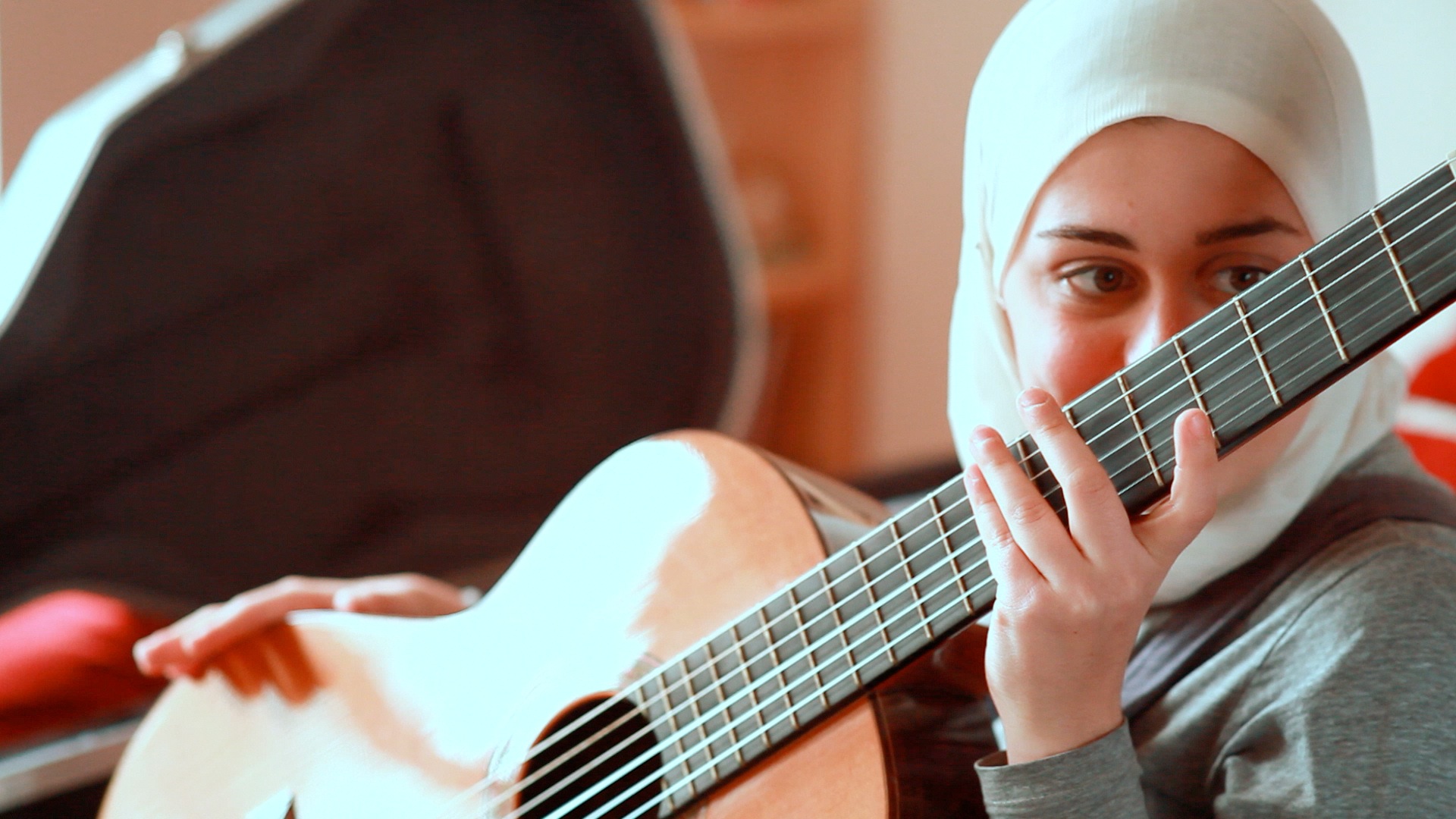
Scene from I Wasn’t Always Dressed Like This. [Source].
The film does not go into the concept of wearing hijab as a way of hiding beauty; it presents it as part of the beauty these women have. For example, the first lady admits to trying the hijab on before putting it on. She took time picking colors and designs that match her style, which, in return, adds up to her natural beauty. She even mentioned the idea that in France black hijab is always associated with fundamentalists; this is why she refrains from wearing headscarves with dark colors. In her case, the color and style of her hijab is not just for beauty purposes, but it is also meant to defeat any preconceived ideas of fundamentalism and extremism.
The three women concur that people should not be judging them on their looks; instead, people should get to know them better, because hijab is part of the identity they hold, and part of the choice they made. In an interview she gave to the University of East Angalia, Norwich, UK, Betty Martins said:
“In this film, we hear first-hand about their experiences as women, discover what freedom is to them and what beauty is for them. I want people to see these women as they want to be seen, not as people would like to see them.”
I was deeply touched by the three stories. The strength and resilience demonstrated by each one of these women as they face a community with little knowledge about or appreciation for hijab is quite inspiring. In some way, however, I found that the first two stories did not present a compelling turning point, as I had expected, to explain what drove the two women to embark on the hijab-wearing journey. For both women, it was more about “answering a spiritual call” than reacting to an incident or a series of incidents that brought forth curiosity about Islam and hijab. I had always thought that a woman who decides to cover her hair must have gone through an incident that is a life changer. I have seen many women in my life whose loved ones passed away, for example, and as a result of such incidents, they would put on hijab. But listening to those stories in the film, I was surprised to see women who could just put on hijab because of an inner call, or a different feeling they had.
The documentary has attracted much attention in the locations in which it was screened. In an interview she gave to the Emirati newspaper The National, Martins recalls someone making a comment about the film. She notes that “someone who saw (the documentary) told me that before she never agreed with the hijab. Now, after hearing the narratives in the film, she at least respected their choices as women.”
I believe the film’s message is incredibly powerful in these critical times where hijab has been at the center of clash of civilization debates around the world. If some women make the choice not to cover their hair, that free choice principle should equally apply to those who are willing to do it. That was what the three women in the film did, and they could still go on with their lives normally like any other person. At the end of the day, a woman wearing hijab should not be labelled in any ways; she is just a person who made a choice like any other choice in our lives.
I Wasn't Always Dressed Like This
Previous Post

November 8, 2013
Friday Links | November 8, 2013
Next Post
November 12, 2013 A Hijabi in Healthcare: The Story of Dr. Lailiyya
Browse Our Archives
Select a Category Advertisements Art/Theater Books/Magazines Cinema Comics/Cartoons Culture/Society Events Fashion Film Friday Links Merchandise/Commodities MMW Announcements MMW Highlights Music/Radio News Photography Politics Profile Ramadan 2012 Ramadan 2013 Ramadan 2014 Ramadan 2015 Roundtable Satire Social Media Sports Technology/Science Television Uncategorized Video Web
Select a Month November 2015 October 2015 September 2015 August 2015 July 2015 June 2015 May 2015 April 2015 March 2015 January 2015 December 2014 November 2014 October 2014 September 2014 July 2014 June 2014 May 2014 April 2014 March 2014 February 2014 January 2014 December 2013 November 2013 October 2013 September 2013 August 2013 July 2013 June 2013 May 2013 April 2013 March 2013 February 2013 January 2013 December 2012 November 2012 October 2012 September 2012 August 2012 July 2012 June 2012 May 2012 April 2012 March 2012 February 2012 January 2012 December 2011 November 2011 September 2011 August 2011 July 2011 June 2011 May 2011 April 2011 March 2011 February 2011 January 2011 December 2010 November 2010 October 2010 September 2010 August 2010 July 2010 June 2010 May 2010 April 2010 March 2010 February 2010 January 2010 December 2009 November 2009 October 2009 September 2009 August 2009 July 2009 June 2009 May 2009 April 2009 March 2009 February 2009 January 2009 December 2008 November 2008 October 2008 September 2008 August 2008 July 2008 June 2008 May 2008 April 2008 March 2008 February 2008 January 2008 December 2007 November 2007 October 2007 September 2007 August 2007
Follow Us!
TAKE THE
Religious Wisdom Quiz
Besides Samuel, Elkanah and Hannah had this many children.
Select your answer to see how you score.
5 2 8 0
Related posts from Muslimah Media Watch

#PrayforParis, Muslim Women and Third World Violence


Hate Crimes and Mother Tongues

Friday Links - American flag hijabs, hate crimes,...
TRENDING AT PATHEOS Muslim

25 Years Later: How Much Has Changed for...
As we approach the 25th anniversary of September 11th, I’ve found myself...

Podcast: Third Spaces & The Rise of Yemeni...
In the latest episode of The Artistic Foodies Podcast, hosts Abbas...

HalalFest Picks: Best 60 Halal Spots for Super...
Back in 2016, I came up with a list of 29...

Unity Is America’s Strength — Division Is Its...
by Hidayatullah Ahsan When Valentina Gomez, a Republican candidate for Congress in...

Zohran Mamdani and New York’s Fight Against Islamophobia
This past June, against all odds, Zohran Mamdani won the Democratic primary...

What the Fourth of July Means to a...
As we mark another Fourth of July, millions of Americans will celebrate...
view all Muslim blogs
Ad-Free & Subscriber Log-In Subscription Support
- About Us
- 2026 Calendar
- Videos
- Podcasts
- Library of World Religions
- Faith In Media Tracker
- Advertise With Us
- Write for Us
- Privacy Policy
- Terms of Service
- Do Not Sell My Data
- Contact Us
- Radiant Digital
- Manage Newsletter Subscriptions
- Unsubscribe From Notifications
- Sitemap
Copyright 2008-2026, Patheos. All rights reserved.
Subscription Support Ad-Free & Subscriber Log-In
Follow Patheos