
BuddhistCatholicContemplativeEvangelicalGeneral ChristianHinduJewishLatter-day SaintMuslimNew VisionsProgressive Christian
Beliefs
- Buddhist
- Catholic
- Contemplative
- Evangelical
- General Christian
- Hindu
- Jewish
- Latter-day Saint
- More Voices
- Muslim
- New Visions
- Pagan
- Progressive Christian
Topics
- Religion News
- Food and Religion
- Sports and Religion
- Religious Art
- Religious Music and Entertainment
- Religious Events
- History and Religion
- Style and Religion
- Politics and Religion
- Women in Religion
- Recreation Outdoors and Religion
- Business Finance and Religion
- Careers Workplace and Religion
- Education and Religion
- Family Parenting and Religion
- Health Fitness and Religion
- Home and Religion
- Relationships and Religion
- Technology and Religion
- Travel and Religion
Columnists
- Buddhist Columnists
- Business Finance and Religion Columnists
- Careers Workplace and Religion Columnists
- Catholic Columnists
- Contemplative Columnists
- Education and Religion Columnists
- Evangelists Columnists
- Family Parenting and Religion Columnists
- General Christian Columnists
- Health Fitness and Religion Columnists
- Hindu Columnists
- History and Religion Columnists
- Home and Religion Columnists
- Jewish Columnists
- More Voices Columnists
- Latter Day Columnists
- Muslim Columnists
- New Visions Columnists
- Nonreligious Columnists
- Pagan Columnists
- Politics and Religion Columnists
- Progressive Columnists
- Recreation Outdoors and Religion Columnists
- Relationships and Religion Columnists
- Religion News Columnists
- Religious Art Columnists
- Religious Events Columnists
- Religious Music and Entertainment Columnists
- Sports and Religion Columnists
- Style and Religion Columnists
- Technology and Religion Columnists
- Travel and Religion Columnists
- Women in Religion Columnists
Resource Library
- 2026 Calendar
- Library of World Religions
- The 100 Most Holy Places on Earth
- Patheos Answers
- Podcasts
- Videos
- Faith Leaders Database
- Anglican Episcopalian
- Bahai
- Baptist
- Buddhism
- Christianity
- Confucianism
- Eastern Orthodoxy
- Hinduism
- Holiness and Pentecostal
- ISKCON
- Islam
- Judaism
- Lutheran
- Methodist
- The Church of Jesus Christ of Latter-day Saints
- New Age
- Paganism
- Presbytarian and Reformed
- Protestantism
- Religion Behind the Scenes
- Roman Catholic
- Scientology
- Shia Islam
- Sikhism
- Sufism
- Sunni Islam
- Taoism
- Zen
- See all religions
Research Tools
 Ad-Free & Subscriber Log-In Subscription Support
Ad-Free & Subscriber Log-In Subscription Support
Follow Patheos 

- Trending:
- Forgiveness
- |
- Marriage
- |
- Consciousness
- |
- Death Penalty
- |
- Election
- |
- Halloween
 Muslimah Media Watch
- Home
- Muslim
- Religion News
- Effective Discussions on the Oppression of Women: Is the Burqa It?
Effective Discussions on the Oppression of Women: Is the Burqa It?
Last updated on: November 23, 2013 at 12:40 pm by eren
Effective Discussions on the Oppression of Women: Is the Burqa It? 2013-11-23T12:40:18-04:00 eren
Patheos Explore the world's faith through different perspectives on religion and spirituality! Patheos has the views of the prevalent religions and spiritualities of the world.
For a few years now, I have been observing depictions of the veil, the niqab and the burqa, not only in the media but in pop culture. Muslimah Media Watch has written extensively about these depictions because they are so prevalent everywhere. Just last week, Nicole wrote about a controversial ad featuring a niqabi woman and a soldier. Similarly, as I have discussed in another post, niqabs and hijabs have made it to stardom through famous people like Lady Gaga and Madonna. We also see a tendency to use the niqab in artwork as woodturtle has explored. Yet, often these depictions do not result in any positive discussions about Muslim women’s rights.
Depictions of the niqab and hijab in artwork continues to trouble me perhaps because I have always seen museum-type art as elitist. Not everyone can afford to go to a museum, nor is everyone exposed to this “fine art”. I do not mean to undermine the importance of the fine arts at all; on the contrary, I have an artistic background myself. But I believe that along with appreciating art we should be critical of the processes that are involved in making it. In my own experience, artistic settings can be very exclusive. Not everyone is welcome and not everyone is deemed to understand (minimalist art anyone?). Likewise, not just anyone walks into the door and is received as an artist. One needs more than just talent to get into the “clique.” As an observer, the experience is quite similar, how many of us can be said to hang out with “intellectual” people who make and “understand” art?
But the political context is also important. For instance, growing up in Mexico, art was prevalent when centrist parties were in power despite other problems like corruption. The government funded cultural activities, subsidized museums (in most cases students and teachers could access for free all the time) and provided public spaces for emerging artists through a number of initiatives. However, these projects stopped being funded when conservatives came along, so many artists decided to appeal to the new government’s sensitivities and we saw a rise in commercial art.
So why am I telling you all this?
Last week my two friends and I decided to visit the Ottawa Art Gallery. The gallery is a huge building that keeps important pieces of art including Inuit art, modern art and classical fine art. If you ask me, it is by no means the best art gallery; it is a bit disorganized and the museographic work is poorly done in comparison to that of other museums. However, the best/worst moment was when we visited the Canadian Art section. Then I was faced with Colleen Wolstenholme’s burqa women…
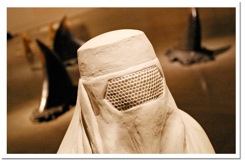
Picture depicting one of the three figures.- Via The Coast.
My friends and I walked into the “Canadian Art Section” and were immediately faced with a dimly-lit room. The spacious room did not feature any other sculptures, making the room too big for the three half-size statues. Since the gallery does not allow photographs, I have included pictures from other sources.
The collection features three sculptures that are ¾ the size of an average woman to represent, what the artist considers to be, the ¾ status of Muslim women according to Shari’ah. I walked into the empty, dimly-lit room featuring these cement- burqa- women and I was immediately confused. In a museum where no other images of Muslim women are displayed and the last thing one expected was to see three ¾ burqa women, there was no explanation of the sculptures and a guard stood by door indicating that people should not touch or take pictures. When I finally found the information about the pieces, I felt even more uncomfortable. The plaque indicated that these sculptures were meant to add to the discussion on the oppression of women (not Muslim women, just women).
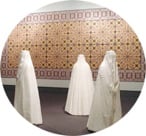
The three burqa women together.- Via colleenwolstenholme.com
One of my friends (a Ghanaian girl) commented that it was obvious that the artist was white and Western. My other friend (a Tunisian-Canadian girl) felt uncomfortable because the images were so out of context that they perpetrated a stereotype instead of producing meaningful discussions. And I… I decided to write a post.
Reading a bit about the artist, I confirmed that she is a Canadian white woman, who has a whole set of mini-burqa-women. Yet, her work is described as “outlaw” and “critical.” The racial aspect mentioned by my friend was not to imply that Caucasian people do not get it (because many do) or that all women of colour get it all the time (because not everyone does). Instead, it was a comment on “whiteness” as privilege and the naïve notion that, somehow, “whiteness” stands against women’s oppression.
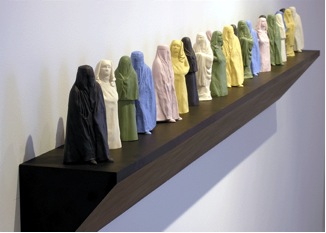
Miniature burqa and niqab women by the artist.-Via colleenwolstenholme.com
So I was left wondering… how critical is this? How critical is it to play with a stereotype and a limited understanding of Islamic law? How is it that women’s oppression is linked to the veil?
Then it hit me… this is what all the previously mentioned depictions have in common. They work with stereotypes and pretend to understand or explain something… But they bring no discussion. The discussion is shut down through a message that says “If you are a Muslim woman, especially one wearing the veil, then you are oppressed.”
So what entails an effective discussion on the oppression of women? Well, I think that depends on the particular communities. Yet, I can tell you, that three short cement women are not necessarily much of a discussion. It is a statement on what an outsider considers to be reality.
Previous Post
November 19, 2013
A Muslimah’s Guide to Rocking the World

Browse Our Archives
Select a Category Advertisements Art/Theater Books/Magazines Cinema Comics/Cartoons Culture/Society Events Fashion Film Friday Links Merchandise/Commodities MMW Announcements MMW Highlights Music/Radio News Photography Politics Profile Ramadan 2012 Ramadan 2013 Ramadan 2014 Ramadan 2015 Roundtable Satire Social Media Sports Technology/Science Television Uncategorized Video Web
Select a Month November 2015 October 2015 September 2015 August 2015 July 2015 June 2015 May 2015 April 2015 March 2015 January 2015 December 2014 November 2014 October 2014 September 2014 July 2014 June 2014 May 2014 April 2014 March 2014 February 2014 January 2014 December 2013 November 2013 October 2013 September 2013 August 2013 July 2013 June 2013 May 2013 April 2013 March 2013 February 2013 January 2013 December 2012 November 2012 October 2012 September 2012 August 2012 July 2012 June 2012 May 2012 April 2012 March 2012 February 2012 January 2012 December 2011 November 2011 September 2011 August 2011 July 2011 June 2011 May 2011 April 2011 March 2011 February 2011 January 2011 December 2010 November 2010 October 2010 September 2010 August 2010 July 2010 June 2010 May 2010 April 2010 March 2010 February 2010 January 2010 December 2009 November 2009 October 2009 September 2009 August 2009 July 2009 June 2009 May 2009 April 2009 March 2009 February 2009 January 2009 December 2008 November 2008 October 2008 September 2008 August 2008 July 2008 June 2008 May 2008 April 2008 March 2008 February 2008 January 2008 December 2007 November 2007 October 2007 September 2007 August 2007
Follow Us!
TAKE THE
Religious Wisdom Quiz
"Thou preparest a table for me in the presence of mine _____."
Select your answer to see how you score.
Friends Children Kinsmen Enemies
Related posts from Muslimah Media Watch


Women and Children First: How French Policies Impact...
TRENDING AT PATHEOS Muslim

25 Years Later: How Much Has Changed for...
As we approach the 25th anniversary of September 11th, I’ve found myself...

Podcast: Third Spaces & The Rise of Yemeni...
In the latest episode of The Artistic Foodies Podcast, hosts Abbas...

HalalFest Picks: Best 60 Halal Spots for Super...
Back in 2016, I came up with a list of 29...

Unity Is America’s Strength — Division Is Its...
by Hidayatullah Ahsan When Valentina Gomez, a Republican candidate for Congress in...

Zohran Mamdani and New York’s Fight Against Islamophobia
This past June, against all odds, Zohran Mamdani won the Democratic primary...

What the Fourth of July Means to a...
As we mark another Fourth of July, millions of Americans will celebrate...
view all Muslim blogs
Ad-Free & Subscriber Log-In Subscription Support
- About Us
- 2026 Calendar
- Videos
- Podcasts
- Library of World Religions
- Faith In Media Tracker
- Advertise With Us
- Write for Us
- Privacy Policy
- Terms of Service
- Do Not Sell My Data
- Contact Us
- Radiant Digital
- Manage Newsletter Subscriptions
- Unsubscribe From Notifications
- Sitemap
Copyright 2008-2026, Patheos. All rights reserved.
Subscription Support Ad-Free & Subscriber Log-In
Follow Patheos