
BuddhistCatholicContemplativeEvangelicalGeneral ChristianHinduJewishLatter-day SaintMuslimNew VisionsProgressive Christian
Beliefs
- Buddhist
- Catholic
- Contemplative
- Evangelical
- General Christian
- Hindu
- Jewish
- Latter-day Saint
- More Voices
- Muslim
- New Visions
- Pagan
- Progressive Christian
Topics
- Religion News
- Food and Religion
- Sports and Religion
- Religious Art
- Religious Music and Entertainment
- Religious Events
- History and Religion
- Style and Religion
- Politics and Religion
- Women in Religion
- Recreation Outdoors and Religion
- Business Finance and Religion
- Careers Workplace and Religion
- Education and Religion
- Family Parenting and Religion
- Health Fitness and Religion
- Home and Religion
- Relationships and Religion
- Technology and Religion
- Travel and Religion
Columnists
- Buddhist Columnists
- Business Finance and Religion Columnists
- Careers Workplace and Religion Columnists
- Catholic Columnists
- Contemplative Columnists
- Education and Religion Columnists
- Evangelists Columnists
- Family Parenting and Religion Columnists
- General Christian Columnists
- Health Fitness and Religion Columnists
- Hindu Columnists
- History and Religion Columnists
- Home and Religion Columnists
- Jewish Columnists
- More Voices Columnists
- Latter Day Columnists
- Muslim Columnists
- New Visions Columnists
- Nonreligious Columnists
- Pagan Columnists
- Politics and Religion Columnists
- Progressive Columnists
- Recreation Outdoors and Religion Columnists
- Relationships and Religion Columnists
- Religion News Columnists
- Religious Art Columnists
- Religious Events Columnists
- Religious Music and Entertainment Columnists
- Sports and Religion Columnists
- Style and Religion Columnists
- Technology and Religion Columnists
- Travel and Religion Columnists
- Women in Religion Columnists
Resource Library
- 2026 Calendar
- Library of World Religions
- The 100 Most Holy Places on Earth
- Patheos Answers
- Podcasts
- Videos
- Faith Leaders Database
- Anglican Episcopalian
- Bahai
- Baptist
- Buddhism
- Christianity
- Confucianism
- Eastern Orthodoxy
- Hinduism
- Holiness and Pentecostal
- ISKCON
- Islam
- Judaism
- Lutheran
- Methodist
- The Church of Jesus Christ of Latter-day Saints
- New Age
- Paganism
- Presbytarian and Reformed
- Protestantism
- Religion Behind the Scenes
- Roman Catholic
- Scientology
- Shia Islam
- Sikhism
- Sufism
- Sunni Islam
- Taoism
- Zen
- See all religions
Research Tools
 Ad-Free & Subscriber Log-In Subscription Support
Ad-Free & Subscriber Log-In Subscription Support
Follow Patheos 

- Trending:
- Forgiveness
- |
- Marriage
- |
- Consciousness
- |
- Death Penalty
- |
- Election
- |
- Halloween
 Muslimah Media Watch
- Home
- Muslim
- Religion News
- White Widows, Black Widows and Jihad Janes: What Does A Terrorist Look Like?
White Widows, Black Widows and Jihad Janes: What Does A Terrorist Look Like?
Last updated on: October 1, 2013 at 2:00 am by tasnim
White Widows, Black Widows and Jihad Janes: What Does A Terrorist Look Like? 2013-09-30T22:29:09-04:00 tasnim
Patheos Explore the world's faith through different perspectives on religion and spirituality! Patheos has the views of the prevalent religions and spiritualities of the world.
The recent arrest warrant issued by Interpol for Samantha Lewthwaite has fuelled media fuel speculation that she was involved in the attack that killed more than 60 people in Nairobi’s Westgate mall. Since speculation always makes a good story, there has been an overwhelming amount of coverage on the woman dubbed “The White Widow.” The stories seem eerily familiar. Perhaps because, like Colleen LaRose (aka Jihad Jane), Lewthwaite has her own alliterative alias. Or because like Katherine Russell (widow of Tamerlan Tsarnaev), Lewthwaite was once married to a man who became known as a terrorist. In fact, comparing the coverage of Lewthwaite in 2005 to the coverage of Russell, the parallels are striking.
As a CNN article on Lewthwaite puts it:
“British-born Samantha Lewthwaite was once seen as a kind of victim of the July 2005 London terror attacks — the pregnant wife of one of the suicide bombers who killed 52 people, now left alone to care for her children.”
Like Katherine Russell after the Boston bombing last April, Lewthwaite was perceived as a naïve kind-of-victim-widow of 7/7 suicide-bomber Germaine Lindsay following the attacks; however, this seems have changed, at least in the media landscape, in the wake of the confusing, fast-proliferating allegations that she was involved in the assault on the mall in Nairobi. According to Interpol, the warrant was issued in connection with terrorist offences in 2011. However, this seems to have been buried by suggestions that Lewthwaite was one of the leaders of the attack, coming from other sources such as Amina Mohamed, the Kenyan cabinet secretary for foreign affairs, who told the NewsHour program that:
“From the information that we have, two or three Americans [were involved] and I think, so far, I have heard of one Brit … a woman … and I think she has done this many times before.”
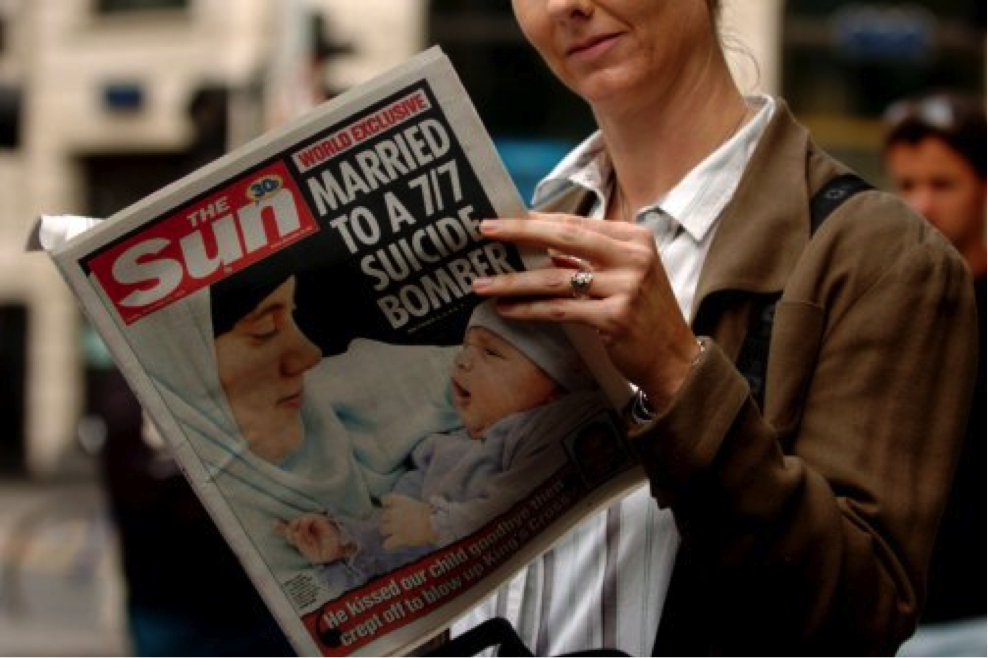
Samantha Lewthwaite pictured on the cover of a newspaper in 2005. [Source].
According to others, she has done it so many times (and gotten away) that she has now become a “mythical figure,” according to Raffaello Pantucci, a counterterrorism analyst at the Royal United Services Institute.
What makes this surge of media attention confusing is that beneath the vast amounts of biography and psychoanalysis it is difficult to find much beyond vague statements or tidbits of detail, such as Lewthwaite allegedly using a South African passport under the name Natalie Faye Webb. In media stories at least, this has now been identified as a pattern among terrorists seeking not to be identified as terrorists. Apparently “the perception of South Africa as a neutral country” means that South African passports are “not easily flagged compared with a country like Pakistan.” Who knew?
Reading some of these stories that attempt to come to terms with how intelligence agencies should deal with the threat of non-terrorist-seeming terrorists, I was reminded of a debate a few years ago in which the case of LaRose was discussed as a potential wrench in the works of smooth-flowing racial profiling. Here’s what one of the debaters against the motion identified as the “problem” with pulling people aside based on melanin levels:
“Here’s the problem, Colleen LaRose, 46-year-old, blonde hair, blue eyes, Philadelphia, radical extremist, sought to recruit others to blow up a cartoonist in Denmark. On the internet she said, “I can evade detection because I do not look like everybody’s conception of what an extremist is.” And then there was Jamie Paulin-Ramirez, her co-conspirator, another blonde woman, this one with a six-year-old child, who was pregnant…”
The side arguing for profiling was pretty sure that not only that most terrorists were Muslim but a particular demographic of Muslim: “Muslim men who are 18 to 35.” Since profiling for religion is difficult, age and gender were the solid parts of their case. CNN security analyst Peter Bergen appears to agree at least in part, pointing out that women’s involvement in such groups is “very unusual” since “their view is the woman should be in a home and shrouded in a body veil.”
Perhaps one reason for the question posed by this article, “why do female terrorists perplex us?,” is that when it comes to Muslim terrorism at least, women are meant to be the victims, not the perpetrators. The article that asks the question concludes honestly but somewhat redundantly that: “Why women choose to become terrorists depends on the individual, the organisation, and the political goal or aim of the group.” However, one of the causes identified was this: “In the case of some females – such as the Black Widows – it is to avenge the loss of a loved one such as a husband, brother, son or cousin.”
As Eren pointed out in a recent post, this reasoning is familiar, as “female violence is often attributed to the loss of male family members, emotional distress (which often goes unreported for their male counterparts) or brainwashing by male Islamists, especially when it comes to Muslim female converts or young Muslim brides.”
As was the case following the arrest of LaRose, described as being “a cause celebre of so-called “home-grown” terrorism,” allegations about Lethwaite’s involvement in the attack have prompted a deluge of articles probing the possible causes of her apparent radicalization, with one article in The Telegraph, for example, tracing it back to an unrequited schoolgirl crush on a Muslim boy:
“The boy, who was several years older, was apparently uninterested and so nothing came of it, but the brief summer holiday infatuation in Buckinghamshire perhaps foreshadowed her conversion to Islam, marriage to a suicide bomber and eventual emergence as one of the world’s most wanted terrorism suspects.”
I couldn’t help comparing this to the coverage of the radicalization of male converts, such as John Walker Lindh, Adam Yahiye Gadahn, José Padilla or Craig Baxam. Somehow, it’s difficult to imagine their conversion and terrorism being “foreshadowed” by a schoolboy crush.
Why do figures like LaRose and Lewthwaite inspire such reams of commentary? Perhaps because LaRose herself says, “I can evade detection because I do not look like everybody’s conception of what an extremist is.”As the side against racial profiling in the debate put it:
“The enemy is acutely aware of what we imagine a terrorist looks like. And unfortunately, they’re having no difficulty recruiting people in prisons or in Western Europe or in the United States, including blond-haired blue-eyed women, to carry out terrorist acts.”
Coming from an efficiency standpoint, this suggests that the reason to avoid racial profiling is that it will allow “the enemy” to slip beneath the radar, rather than because of any notion of civil rights issues. The consequences of this both support and subvert that familiar formula which balances the case for not profiling against “the information that we have—the knowledge that, while not all Muslims are terrorists, most terrorists are Muslim.” This “information” provides the reassurance that we know what a Muslim looks like, and thus, what most terrorists look like.
Previous Post

September 30, 2013
The Limits on the Professional Muslimah
Next Post
October 2, 2013 And the Hijabs and Niqabs Won’t Go Away!
Browse Our Archives
Select a Category Advertisements Art/Theater Books/Magazines Cinema Comics/Cartoons Culture/Society Events Fashion Film Friday Links Merchandise/Commodities MMW Announcements MMW Highlights Music/Radio News Photography Politics Profile Ramadan 2012 Ramadan 2013 Ramadan 2014 Ramadan 2015 Roundtable Satire Social Media Sports Technology/Science Television Uncategorized Video Web
Select a Month November 2015 October 2015 September 2015 August 2015 July 2015 June 2015 May 2015 April 2015 March 2015 January 2015 December 2014 November 2014 October 2014 September 2014 July 2014 June 2014 May 2014 April 2014 March 2014 February 2014 January 2014 December 2013 November 2013 October 2013 September 2013 August 2013 July 2013 June 2013 May 2013 April 2013 March 2013 February 2013 January 2013 December 2012 November 2012 October 2012 September 2012 August 2012 July 2012 June 2012 May 2012 April 2012 March 2012 February 2012 January 2012 December 2011 November 2011 September 2011 August 2011 July 2011 June 2011 May 2011 April 2011 March 2011 February 2011 January 2011 December 2010 November 2010 October 2010 September 2010 August 2010 July 2010 June 2010 May 2010 April 2010 March 2010 February 2010 January 2010 December 2009 November 2009 October 2009 September 2009 August 2009 July 2009 June 2009 May 2009 April 2009 March 2009 February 2009 January 2009 December 2008 November 2008 October 2008 September 2008 August 2008 July 2008 June 2008 May 2008 April 2008 March 2008 February 2008 January 2008 December 2007 November 2007 October 2007 September 2007 August 2007
Follow Us!
TAKE THE
Religious Wisdom Quiz
Who was the ruler of Egypt during Joseph's time?
Select your answer to see how you score.
Cyrus Nebuchadnezzar Caesar Pharaoh
Related posts from Muslimah Media Watch

#PrayforParis, Muslim Women and Third World Violence

Has Quantico got positive female Muslim roles covered?

Why British MP’s statements defending Muslim women do...

“Why Helpless?” Victims of Racist Attacks Are Not...
TRENDING AT PATHEOS Muslim

25 Years Later: How Much Has Changed for...
As we approach the 25th anniversary of September 11th, I’ve found myself...

Podcast: Third Spaces & The Rise of Yemeni...
In the latest episode of The Artistic Foodies Podcast, hosts Abbas...

HalalFest Picks: Best 60 Halal Spots for Super...
Back in 2016, I came up with a list of 29...

Unity Is America’s Strength — Division Is Its...
by Hidayatullah Ahsan When Valentina Gomez, a Republican candidate for Congress in...

Zohran Mamdani and New York’s Fight Against Islamophobia
This past June, against all odds, Zohran Mamdani won the Democratic primary...

What the Fourth of July Means to a...
As we mark another Fourth of July, millions of Americans will celebrate...
view all Muslim blogs
Ad-Free & Subscriber Log-In Subscription Support
- About Us
- 2026 Calendar
- Videos
- Podcasts
- Library of World Religions
- Faith In Media Tracker
- Advertise With Us
- Write for Us
- Privacy Policy
- Terms of Service
- Do Not Sell My Data
- Contact Us
- Radiant Digital
- Manage Newsletter Subscriptions
- Unsubscribe From Notifications
- Sitemap
Copyright 2008-2026, Patheos. All rights reserved.
Subscription Support Ad-Free & Subscriber Log-In
Follow Patheos