
BuddhistCatholicContemplativeEvangelicalGeneral ChristianHinduJewishLatter-day SaintMuslimNew VisionsProgressive Christian
Beliefs
- Buddhist
- Catholic
- Contemplative
- Evangelical
- General Christian
- Hindu
- Jewish
- Latter-day Saint
- More Voices
- Muslim
- New Visions
- Pagan
- Progressive Christian
Topics
- Religion News
- Food and Religion
- Sports and Religion
- Religious Art
- Religious Music and Entertainment
- Religious Events
- History and Religion
- Style and Religion
- Politics and Religion
- Women in Religion
- Recreation Outdoors and Religion
- Business Finance and Religion
- Careers Workplace and Religion
- Education and Religion
- Family Parenting and Religion
- Health Fitness and Religion
- Home and Religion
- Relationships and Religion
- Technology and Religion
- Travel and Religion
Columnists
- Buddhist Columnists
- Business Finance and Religion Columnists
- Careers Workplace and Religion Columnists
- Catholic Columnists
- Contemplative Columnists
- Education and Religion Columnists
- Evangelists Columnists
- Family Parenting and Religion Columnists
- General Christian Columnists
- Health Fitness and Religion Columnists
- Hindu Columnists
- History and Religion Columnists
- Home and Religion Columnists
- Jewish Columnists
- More Voices Columnists
- Latter Day Columnists
- Muslim Columnists
- New Visions Columnists
- Nonreligious Columnists
- Pagan Columnists
- Politics and Religion Columnists
- Progressive Columnists
- Recreation Outdoors and Religion Columnists
- Relationships and Religion Columnists
- Religion News Columnists
- Religious Art Columnists
- Religious Events Columnists
- Religious Music and Entertainment Columnists
- Sports and Religion Columnists
- Style and Religion Columnists
- Technology and Religion Columnists
- Travel and Religion Columnists
- Women in Religion Columnists
Resource Library
- 2026 Calendar
- Library of World Religions
- The 100 Most Holy Places on Earth
- Patheos Answers
- Podcasts
- Videos
- Faith Leaders Database
- Anglican Episcopalian
- Bahai
- Baptist
- Buddhism
- Christianity
- Confucianism
- Eastern Orthodoxy
- Hinduism
- Holiness and Pentecostal
- ISKCON
- Islam
- Judaism
- Lutheran
- Methodist
- The Church of Jesus Christ of Latter-day Saints
- New Age
- Paganism
- Presbytarian and Reformed
- Protestantism
- Religion Behind the Scenes
- Roman Catholic
- Scientology
- Shia Islam
- Sikhism
- Sufism
- Sunni Islam
- Taoism
- Zen
- See all religions
Research Tools
 Ad-Free & Subscriber Log-In Subscription Support
Ad-Free & Subscriber Log-In Subscription Support
Follow Patheos 

- Trending:
- Forgiveness
- |
- Marriage
- |
- Consciousness
- |
- Death Penalty
- |
- Election
- |
- Halloween
 Muslimah Media Watch
- Home
- Muslim
- Religion News
- What Should We Make of the Malala Issue?
What Should We Make of the Malala Issue?
Last updated on: October 24, 2013 at 6:41 am by eren
What Should We Make of the Malala Issue? 2013-10-24T06:41:46-04:00 eren
Patheos Explore the world's faith through different perspectives on religion and spirituality! Patheos has the views of the prevalent religions and spiritualities of the world.
Editor’s note: Malala Yousafzai has been extensively covered in media lately, and several MMW writers wanted to weigh in on the way she is being portrayed. This is the final post about her; see also Amina’s and Nicole’s posts from earlier this week.
Malala Yousafzai has figured in MMW’s posts since the Taliban attempted to kill her due to her activism, which was discussed by Merium last year. In another post, guest contributor Ossob described the difficulties that Malala’s figure posed not only to images of silent Muslim women, but also to narratives of imperialism. Today, these narratives permeate the news.
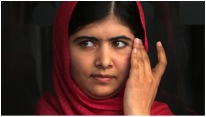
Malala Yousafzai – Via CBC.ca
In the past few weeks, Malala was granted honorary citizenship in Canada. She was also nominated for the Nobel Prize (which she did not win), and has been recently awarded the Basavashree award in India. Malala also had the chance to meet Barak Obama and discuss drone attacks. These developments have led Aljazeera to describe her as a “feminist.”
For a few weeks now I have been pondering the “Malala issue,” but I could not pinpoint what was bothering me about media coverage on her. Fortunately, in the past few days I have discovered I am not alone in my discomfort with portrayals of Malala. The issue is not Malala’s work per se. Her activism for girl’s education is empowering and important, but her image has become associated with the politics of “the West vs. Islam” since her attack. Malala in now portrayed as a star, a heroine of women’s rights and a symbol of everything that is wrong with “radical” Islam. At the same time she has been made into the “brown-next-door-girl” through her love of Twilight and American TV shows*.* But is Malala all those things?
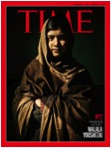
Malala featured in Time Magazine as the runner-up for person of the year.-Via Poynter.org
Supporters of Malala’s stardom in the Western world see her as the missing link between Islam and the West. On one hand, some sources report that conservatives have accused Malala of fabricating her attack to seek Western support. On the other, authors like Fouad Ajami see Malala as the path to Islamic modernity. Likewise, Aanya Niaz argues that Pakistan has not been able to support Malala, and other activists, but she sees opportunities within the Western world and she says:
“Rather than bashing the “developed” world’s efforts, albeit nuanced in its’ hospitality, perhaps we can turn this into an opportunity to point towards the million other Malalas and ask the UN, the elected peace-keeping force, and the Western world, to finally invest in something other than plain-yogurt foreign aid?”
Being the skeptic that I am, I can’t help but wonder why Malala is receiving all this attention. Without taking away from her work, Malala Yousaizaf is not the only child activist in Pakistan. Hina Khan, another young activist, was actually threatened by the Taliban a few weeks after Malala was attacked. Children around the world campaign for a number of causes. One can visit the International Children’s Peace Prize website to see those kids who have been recognized for their efforts since 2005, but who have not received even a fraction of the attention given to Malala.
While Assed Baig believes that Malala has become a tool of the West to justify their interventions in other countries, Taufiq Rahim contested this argument by saying that oppression comes from within Muslim countries as well. For Cristina Maza, in a recent piece for PolicyMic, the lack of inquiry into the Western agenda in promoting Malala is problematic. A similarly interesting opinion piece published in the Edmonton Journal by a fellow university classmate resonated a lot with me. In another piece, Mustafa Farooq argues that Malala’s image is challenging because it completely ignores the fact that education in Pakistan or lack thereof has a lot to do with international policy and conflict rather than just the Taliban. In other words, it ignores the Western role in war and military conflict.
As these articles suggest, Malala can be seen through many lenses; many of which she would likely not identify with. I truly believe that we have all made out of Malala what we want. Omid Safi recently wrote “How To Keep Malala from Being Appropriated: 5 points on Malala, Obama, and Jon Stewart,” in which he warns against making Malala something she is not, and he suggests, instead, learning to redefine justice in a holistic way.
Yet, Malala has already being appropriated. We see her as a feminist, as a Muslim champion, as a “brown” heroine and as a fighter against Western enemies. Her image has been appropriated not only by much of the mainstream media in the Western world but also by many Muslims. Her portrayals show the deep need to mediate Western and Muslim guilt and complexes over gender relations, patriarchy, imperialism and the extent to which we are truly concerned with children rights.
But what is left at the end?
One question that has received little attention is what is next for Malala? The hype will come to an end and the prizes will eventually stop. Western media sources will find their next star and concerns about women’s education in Pakistan will fade. Will Malala continue to pursue activism? Or will she pursue higher education in a context where she can expand her horizons?
By imposing roles on Malala we are not doing anyone any favours. And while today we want to see her as the “buffer” that mediates between Western blame and Muslim guilt over religious extremism, we need to wonder if it is ethical to place such a responsibility on any activist.
Previous Post

October 23, 2013
The Glorious and Not-So-Glorious Sounds Of Eid-ul-Adha
Next Post

October 25, 2013 Friday Links | October 25, 2013
Browse Our Archives
Select a Category Advertisements Art/Theater Books/Magazines Cinema Comics/Cartoons Culture/Society Events Fashion Film Friday Links Merchandise/Commodities MMW Announcements MMW Highlights Music/Radio News Photography Politics Profile Ramadan 2012 Ramadan 2013 Ramadan 2014 Ramadan 2015 Roundtable Satire Social Media Sports Technology/Science Television Uncategorized Video Web
Select a Month November 2015 October 2015 September 2015 August 2015 July 2015 June 2015 May 2015 April 2015 March 2015 January 2015 December 2014 November 2014 October 2014 September 2014 July 2014 June 2014 May 2014 April 2014 March 2014 February 2014 January 2014 December 2013 November 2013 October 2013 September 2013 August 2013 July 2013 June 2013 May 2013 April 2013 March 2013 February 2013 January 2013 December 2012 November 2012 October 2012 September 2012 August 2012 July 2012 June 2012 May 2012 April 2012 March 2012 February 2012 January 2012 December 2011 November 2011 September 2011 August 2011 July 2011 June 2011 May 2011 April 2011 March 2011 February 2011 January 2011 December 2010 November 2010 October 2010 September 2010 August 2010 July 2010 June 2010 May 2010 April 2010 March 2010 February 2010 January 2010 December 2009 November 2009 October 2009 September 2009 August 2009 July 2009 June 2009 May 2009 April 2009 March 2009 February 2009 January 2009 December 2008 November 2008 October 2008 September 2008 August 2008 July 2008 June 2008 May 2008 April 2008 March 2008 February 2008 January 2008 December 2007 November 2007 October 2007 September 2007 August 2007
Follow Us!
TAKE THE
Religious Wisdom Quiz
How many books are in the New Testament?
Select your answer to see how you score.
39 21 24 27
Related posts from Muslimah Media Watch

#PrayforParis, Muslim Women and Third World Violence


Book review: Jewels of Allah by Nina Ansary

Hate Crimes and Mother Tongues
TRENDING AT PATHEOS Muslim

25 Years Later: How Much Has Changed for...
As we approach the 25th anniversary of September 11th, I’ve found myself...

Podcast: Third Spaces & The Rise of Yemeni...
In the latest episode of The Artistic Foodies Podcast, hosts Abbas...

HalalFest Picks: Best 60 Halal Spots for Super...
Back in 2016, I came up with a list of 29...

Unity Is America’s Strength — Division Is Its...
by Hidayatullah Ahsan When Valentina Gomez, a Republican candidate for Congress in...

Zohran Mamdani and New York’s Fight Against Islamophobia
This past June, against all odds, Zohran Mamdani won the Democratic primary...

What the Fourth of July Means to a...
As we mark another Fourth of July, millions of Americans will celebrate...
view all Muslim blogs
Ad-Free & Subscriber Log-In Subscription Support
- About Us
- 2026 Calendar
- Videos
- Podcasts
- Library of World Religions
- Faith In Media Tracker
- Advertise With Us
- Write for Us
- Privacy Policy
- Terms of Service
- Do Not Sell My Data
- Contact Us
- Radiant Digital
- Manage Newsletter Subscriptions
- Unsubscribe From Notifications
- Sitemap
Copyright 2008-2026, Patheos. All rights reserved.
Subscription Support Ad-Free & Subscriber Log-In
Follow Patheos