
BuddhistCatholicContemplativeEvangelicalGeneral ChristianHinduJewishLatter-day SaintMuslimNew VisionsProgressive Christian
Beliefs
- Buddhist
- Catholic
- Contemplative
- Evangelical
- General Christian
- Hindu
- Jewish
- Latter-day Saint
- More Voices
- Muslim
- New Visions
- Pagan
- Progressive Christian
Topics
- Religion News
- Food and Religion
- Sports and Religion
- Religious Art
- Religious Music and Entertainment
- Religious Events
- History and Religion
- Style and Religion
- Politics and Religion
- Women in Religion
- Recreation Outdoors and Religion
- Business Finance and Religion
- Careers Workplace and Religion
- Education and Religion
- Family Parenting and Religion
- Health Fitness and Religion
- Home and Religion
- Relationships and Religion
- Technology and Religion
- Travel and Religion
Columnists
- Buddhist Columnists
- Business Finance and Religion Columnists
- Careers Workplace and Religion Columnists
- Catholic Columnists
- Contemplative Columnists
- Education and Religion Columnists
- Evangelists Columnists
- Family Parenting and Religion Columnists
- General Christian Columnists
- Health Fitness and Religion Columnists
- Hindu Columnists
- History and Religion Columnists
- Home and Religion Columnists
- Jewish Columnists
- More Voices Columnists
- Latter Day Columnists
- Muslim Columnists
- New Visions Columnists
- Nonreligious Columnists
- Pagan Columnists
- Politics and Religion Columnists
- Progressive Columnists
- Recreation Outdoors and Religion Columnists
- Relationships and Religion Columnists
- Religion News Columnists
- Religious Art Columnists
- Religious Events Columnists
- Religious Music and Entertainment Columnists
- Sports and Religion Columnists
- Style and Religion Columnists
- Technology and Religion Columnists
- Travel and Religion Columnists
- Women in Religion Columnists
Resource Library
- 2026 Calendar
- Library of World Religions
- The 100 Most Holy Places on Earth
- Patheos Answers
- Podcasts
- Videos
- Faith Leaders Database
- Anglican Episcopalian
- Bahai
- Baptist
- Buddhism
- Christianity
- Confucianism
- Eastern Orthodoxy
- Hinduism
- Holiness and Pentecostal
- ISKCON
- Islam
- Judaism
- Lutheran
- Methodist
- The Church of Jesus Christ of Latter-day Saints
- New Age
- Paganism
- Presbytarian and Reformed
- Protestantism
- Religion Behind the Scenes
- Roman Catholic
- Scientology
- Shia Islam
- Sikhism
- Sufism
- Sunni Islam
- Taoism
- Zen
- See all religions
Research Tools
 Ad-Free & Subscriber Log-In Subscription Support
Ad-Free & Subscriber Log-In Subscription Support
Follow Patheos 

- Trending:
- Forgiveness
- |
- Marriage
- |
- Consciousness
- |
- Death Penalty
- |
- Election
- |
- Halloween
 Muslimah Media Watch
- Home
- Muslim
- Religion News
- The H Word: A Piece of Cloth Loaded with More Than It Can Bear?
The H Word: A Piece of Cloth Loaded with More Than It Can Bear?
Last updated on: September 12, 2013 at 2:00 am by Yasmeen Nizamy
The H Word: A Piece of Cloth Loaded with More Than It Can Bear? 2013-09-10T22:25:50-04:00 Yasmeen Nizamy
Patheos Explore the world's faith through different perspectives on religion and spirituality! Patheos has the views of the prevalent religions and spiritualities of the world.
I have to admit that hijab narratives in media turn me off. Whether because it is exhaustively discussed or because most of these narratives rely heavily on clichés and fallacies, hijab is a subject that seems to me overloaded with notions that are not related in any way to what I see as the core of its true essence. However, being surrounded with multitudes of articles and reports on the topic, and being a Muslim woman living in a Muslim country that witnesses a shift in the way people perceive hijab makes the whole subject food for my mental engine and hence makes discussing it inevitable.
What amazes me the most about hijab is the different lenses through which a single religious practice is inspected and interpreted. Among the reasons behind this variance is the fact that Muslims are widespread across the globe, belonging to different ethnicities; some of them live as minorities, while Muslims are the majority in almost 50 countries. Here I will explore some of the different interpretations of hijab.
A sign of social conformity? Hijab revisited in the Muslim midlands
In a debate on atheism that took place in Cairo earlier this year, a remark on twitter by the journalist who documented the event has struck me: “It was interesting to see today girls wearing hijab for strictly social/familial reasons but being atheist/agnostic.” For these girls, a symbol that has been regarded as a symbol of religiosity is serving as something quite different.
For the last 15 years or so, the phenomenon of abandoning hijab in Egypt and the Arab world existed, but in small numbers and was mostly among those who belong to the liberal social circles. Things have changed since the revolutionary wave took over. Speaking about my social circle, I’ve witnessed at least one monthly announcement or incident of someone taking off Hijab among my friends, acquaintances or colleagues since the beginning of 2012.
Four months ago an Egyptian girl, Ghadeer, shared her story on Facebook after a year of “dejabbing” in which she mentioned that one of the main reasons for her decision is that “the veil started to be a social obligation rather than a religious practice.” She goes on and tells how she confronted her parents with her decision and how she replied to her father’s attempts to dissuade her: “Allah will not be pleased with me doing something that I feel forced to do [only for social reasons].”
Ghadeer’s story is neither the first nor the last. Last October, a Syrian woman named Dana Bakdounis shared her photo unveiled on a Facebook page supporting women’s rights in the Arab world. In the photo Dana was holding her passport with a photo of her veiled self along with the message: “I’m with the uprising of women in the Arab world because, for 20 years, I wasn’t allowed to feel the wind in my hair and my body.” Back then, the photo stirred controversy and debate on social media outlets and the drama intensified after Facebook’s ban of the photo and suspension of the accounts of the page admins for a couple of days.
It’s not anymore the choice only of those who come from liberal backgrounds; increasing number of girls and women who were raised in conservative backgrounds have started to challenge this religious practice. And this makes the community try to figure out the reasons. A religious authority in Lebanon blames the parents for the lack of well-rooted religious education for their kids over the years. A professor of educational sociology and social psychology at the Lebanese University puts the blame on the media and sees that it has huge role in encouraging abandonment of hijab by portraying it as a way of restricting women’s freedom.
Or maybe it’s more complicated than what any one report can encompass. As one blogger has written,
“Everyone is trying to save the Muslim woman; Western society must save her from Islam and Islamic society must save her from Western influence.
No one – NO ONE – assumes that the Muslim woman can make up her own mind about what is best for her.”
In Ghadeer’s story, her father gave her a hard time when she confronted him with her decision, while her sister was supportive and understanding. A year after her decision she feels grateful to those who stood by her side, especially her friends. Now Ghadeer feels “Free in every sense of the word”.
A symbol of the Muslim identity? Dilemmas of Muslim minorities in the West
The excellent report “Narratives of Conversion to Islam in Britain: Female Perspectives” examines the experiences of 50 British women who converted to Islam. One of the aspects explored of this report is the way the participants chose to appear as a Muslim. In this regard, one of the participants mentioned that “she had taken a strong stand to wear hijab, to declare who I was to other people through her dress code.” Personally, as a Muslim by birth who has been wearing hijab for more than 20 years now, this was novel to me: hijab as a visible Muslim identity. In my mental attempts to understand this position, I related this statement to a practice I’m familiar with, in which I find so much similarity: the tattoos of the cross over the wrists of some of Egypt’s (minority) Christians. You can hardly, if at all, find this particular tattoo among Christian Americans or Europeans, where Christianity is the dominant religion. Minorities always find formulas to stand out in their communities in order not to fade away in the process of fitting in.
But sometimes these formulas become obstacles to fit into the majority society; as the report explains, “For a white female British convert, wearing a headscarf in an Islamic style may be seen as an aberrant rejection of British cultural values, and evidence that there is something awry, such as eccentricity or weirdness, in the personality of the wearer.” Or as stated in another paragraph in the report: “The white convert is transformed from ‘us’ to ‘them.’” In their attempts not become alienated in their communities, some female converts try to come up with new forms of hijab that abide by the Islamic guidelines for modesty and suit the culture of the society as well: a hat, bandana or a scarf tied in style.
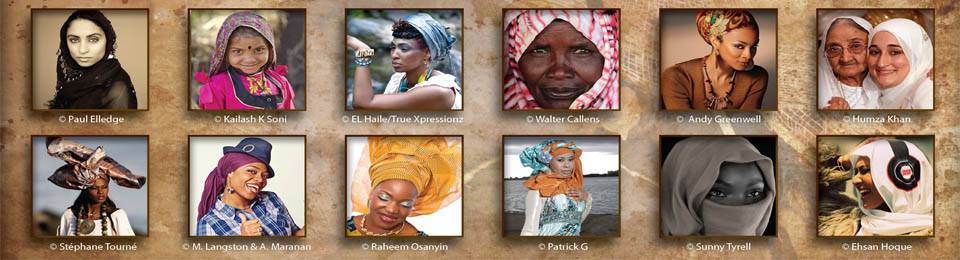
Different styles of hijab reflect the influence of different ethnicities. [Source].

Once I asked a Muslim scholar about the way the wives of the prophet Muhammad –peace be upon him – dressed, thinking that dressing exactly like them would me more pious. His answer amazed me: I don’t need to follow their way of dressing, and whatever a Muslim woman wears that meets the guidelines of modesty in Islam isan Islamic dress. I understand his remarks in this light: a certain way of wearing hijab as a form of Muslim identity is not itself needed, but rather, the way that you wear hijab can reflect your own identity and background: African, Arab, Indian, Western etc.
For someone who never stepped out of the Muslim world, living in places where hijab is the norm, and raised in a relatively conservative family – a hijab-friendly surrounding – and moreover has chosen to wear it for spiritual reason, hijab for me is simply a sign of submission to God manifested in a tangible form. But I wonder, what would have been my choice if I was in the shoes of one of the women mentioned above? What would hijab have resembled for me?
Well, maybe my turquoise scarf is more complex than I thought.
Previous Post

September 11, 2013
Budding Bedfellows: Islamists and Feminists against Beauty Pageants
Next Post
September 13, 2013 Friday Links | September 13, 2013
Browse Our Archives
Select a Category Advertisements Art/Theater Books/Magazines Cinema Comics/Cartoons Culture/Society Events Fashion Film Friday Links Merchandise/Commodities MMW Announcements MMW Highlights Music/Radio News Photography Politics Profile Ramadan 2012 Ramadan 2013 Ramadan 2014 Ramadan 2015 Roundtable Satire Social Media Sports Technology/Science Television Uncategorized Video Web
Select a Month November 2015 October 2015 September 2015 August 2015 July 2015 June 2015 May 2015 April 2015 March 2015 January 2015 December 2014 November 2014 October 2014 September 2014 July 2014 June 2014 May 2014 April 2014 March 2014 February 2014 January 2014 December 2013 November 2013 October 2013 September 2013 August 2013 July 2013 June 2013 May 2013 April 2013 March 2013 February 2013 January 2013 December 2012 November 2012 October 2012 September 2012 August 2012 July 2012 June 2012 May 2012 April 2012 March 2012 February 2012 January 2012 December 2011 November 2011 September 2011 August 2011 July 2011 June 2011 May 2011 April 2011 March 2011 February 2011 January 2011 December 2010 November 2010 October 2010 September 2010 August 2010 July 2010 June 2010 May 2010 April 2010 March 2010 February 2010 January 2010 December 2009 November 2009 October 2009 September 2009 August 2009 July 2009 June 2009 May 2009 April 2009 March 2009 February 2009 January 2009 December 2008 November 2008 October 2008 September 2008 August 2008 July 2008 June 2008 May 2008 April 2008 March 2008 February 2008 January 2008 December 2007 November 2007 October 2007 September 2007 August 2007
Follow Us!
TAKE THE
Religious Wisdom Quiz
What did Jesus say the sacrament bread symbolizes?
Select your answer to see how you score.
The Ark of the Covenant The Fish that Swallowed Jonah Noah's Ark His Body
Related posts from Muslimah Media Watch

#PrayforParis, Muslim Women and Third World Violence


Hate Crimes and Mother Tongues

Friday Links - American flag hijabs, hate crimes,...
TRENDING AT PATHEOS Muslim

25 Years Later: How Much Has Changed for...
As we approach the 25th anniversary of September 11th, I’ve found myself...

Podcast: Third Spaces & The Rise of Yemeni...
In the latest episode of The Artistic Foodies Podcast, hosts Abbas...

HalalFest Picks: Best 60 Halal Spots for Super...
Back in 2016, I came up with a list of 29...

Unity Is America’s Strength — Division Is Its...
by Hidayatullah Ahsan When Valentina Gomez, a Republican candidate for Congress in...

Zohran Mamdani and New York’s Fight Against Islamophobia
This past June, against all odds, Zohran Mamdani won the Democratic primary...

What the Fourth of July Means to a...
As we mark another Fourth of July, millions of Americans will celebrate...
view all Muslim blogs
Ad-Free & Subscriber Log-In Subscription Support
- About Us
- 2026 Calendar
- Videos
- Podcasts
- Library of World Religions
- Faith In Media Tracker
- Advertise With Us
- Write for Us
- Privacy Policy
- Terms of Service
- Do Not Sell My Data
- Contact Us
- Radiant Digital
- Manage Newsletter Subscriptions
- Unsubscribe From Notifications
- Sitemap
Copyright 2008-2026, Patheos. All rights reserved.
Subscription Support Ad-Free & Subscriber Log-In
Follow Patheos