
BuddhistCatholicContemplativeEvangelicalGeneral ChristianHinduJewishLatter-day SaintMuslimNew VisionsProgressive Christian
Beliefs
- Buddhist
- Catholic
- Contemplative
- Evangelical
- General Christian
- Hindu
- Jewish
- Latter-day Saint
- More Voices
- Muslim
- New Visions
- Pagan
- Progressive Christian
Topics
- Religion News
- Food and Religion
- Sports and Religion
- Religious Art
- Religious Music and Entertainment
- Religious Events
- History and Religion
- Style and Religion
- Politics and Religion
- Women in Religion
- Recreation Outdoors and Religion
- Business Finance and Religion
- Careers Workplace and Religion
- Education and Religion
- Family Parenting and Religion
- Health Fitness and Religion
- Home and Religion
- Relationships and Religion
- Technology and Religion
- Travel and Religion
Columnists
- Buddhist Columnists
- Business Finance and Religion Columnists
- Careers Workplace and Religion Columnists
- Catholic Columnists
- Contemplative Columnists
- Education and Religion Columnists
- Evangelists Columnists
- Family Parenting and Religion Columnists
- General Christian Columnists
- Health Fitness and Religion Columnists
- Hindu Columnists
- History and Religion Columnists
- Home and Religion Columnists
- Jewish Columnists
- More Voices Columnists
- Latter Day Columnists
- Muslim Columnists
- New Visions Columnists
- Nonreligious Columnists
- Pagan Columnists
- Politics and Religion Columnists
- Progressive Columnists
- Recreation Outdoors and Religion Columnists
- Relationships and Religion Columnists
- Religion News Columnists
- Religious Art Columnists
- Religious Events Columnists
- Religious Music and Entertainment Columnists
- Sports and Religion Columnists
- Style and Religion Columnists
- Technology and Religion Columnists
- Travel and Religion Columnists
- Women in Religion Columnists
Resource Library
- 2026 Calendar
- Library of World Religions
- The 100 Most Holy Places on Earth
- Patheos Answers
- Podcasts
- Videos
- Faith Leaders Database
- Anglican Episcopalian
- Bahai
- Baptist
- Buddhism
- Christianity
- Confucianism
- Eastern Orthodoxy
- Hinduism
- Holiness and Pentecostal
- ISKCON
- Islam
- Judaism
- Lutheran
- Methodist
- The Church of Jesus Christ of Latter-day Saints
- New Age
- Paganism
- Presbytarian and Reformed
- Protestantism
- Religion Behind the Scenes
- Roman Catholic
- Scientology
- Shia Islam
- Sikhism
- Sufism
- Sunni Islam
- Taoism
- Zen
- See all religions
Research Tools
 Ad-Free & Subscriber Log-In Subscription Support
Ad-Free & Subscriber Log-In Subscription Support
Follow Patheos 

- Trending:
- Forgiveness
- |
- Marriage
- |
- Consciousness
- |
- Death Penalty
- |
- Election
- |
- Halloween
 Muslimah Media Watch
- Home
- Muslim
- Religion News
- The Elephant in the Room: Niqabs in the Courtroom
The Elephant in the Room: Niqabs in the Courtroom
Last updated on: September 27, 2013 at 1:55 pm by eren
The Elephant in the Room: Niqabs in the Courtroom 2013-09-27T13:55:05-04:00 eren
Patheos Explore the world's faith through different perspectives on religion and spirituality! Patheos has the views of the prevalent religions and spiritualities of the world.
A couple of years ago I attended a lecture delivered by Dr. Natasha Bakht at the University of Alberta, who had come to advocate for women’s right to religious accommodation in the courtroom, a subject which proved to be quite divisive. I wrote a post about it on my personal blog, as I personally felt that her views on the issue were refreshing after all the anti-niqab brouhaha that was around back then.
Dr. Bakht’s speech focused on the now famous N.S. vs. the Queen case that took place in Ontario, Canada. The case, which brought a number of questions to Canadian court rooms, went from a sexual abuse issue to a discussion on the legality and appropriateness of the niqab in the court room, shifting from sexual assault charges in 2007 to a matter of N.S.’s niqab’s legality, and taking a few years to be addressed. Earlier this year the provincial judge reviewing the case (after the Supreme Court sent it back to the provincial level) concluded that N.S., a victim of sexual abuse, would have to remove her niqab to testify in court.
Earlier this year, after the judge’s decision in N.S.’s case was publicized, guest contributor Maria Salman wrote an excellent piece outlining the difficulties in dealing with religion, race and the niqab in the Canadian legal system. Yet, the niqab discussion has not left the courtrooms, which continues to trouble me.
This week The Guardian reported that a Muslim woman wearing a niqab was allowed to make a plea in a London court given that a female officer confirmed her identity. Whether or not she will be allowed to wear it during the full trial is still a question. The woman, who has been accused of witness intimidation, was initially refused the right to make a plea wearing niqab and later on was told that she may have to remove it once the trial begins in November. According to the Express, the judge “sparked fury” by letting the woman appear in court with a niqab, and one only has to read the comments in the above sources to realize that people continue to express anti-Muslim sentiments or ambivalent opinions towards the niqab.
While in the Canadian case the Supreme Court decided that cases involving niqabi women should be addressed on a case-to-case basis, I speculate that the British case could potentially represent a precedent for future dealings with women who wear niqab in the U.K. and other Commonwealth countries (although I don’t want to have too many expectations).
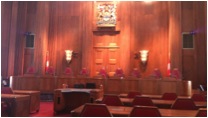
The Supreme Court of Canada. Guided Tour 2013.
Now, the reason why this issue of niqab in the courtroom, and other institutions (i.e. immigration, education and justice), continues to puzzle me is because much of the media and the people engaging with it debate the definitions of religious freedom, rights and national identity without actually looking at the institutional framework in which decisions regarding those terms are made.
After moving to the Canadian capital, Ottawa, three weeks ago I was bothered, but not surprised, by the discourses surrounding political and legal institutions. Probably the worst experience, so far, was my visit to the Supreme Court of Canada. The Supreme Court offers hourly tours, so my roommate and I decided to take one. Upon our arrival to the Supreme Court Building we noticed that although many minorities take the tour, virtually 90% of the employees were white and male.
My roommate and I spent a good half an hour looking through the pictures of the judges appointed to the Supreme Court only to discover that very few women have been appointed and that their definition of “visible minorities” (a term used by the Canadian government and the provinces to identify non-white peoples) has been reduced to a couple of members with Eastern European descent. No First Nations, Métis or Inuit, no Afro-Canadians, no Muslims, no Asians, no Latin Americans, no Africans or anything that is too “visible” as a minority.
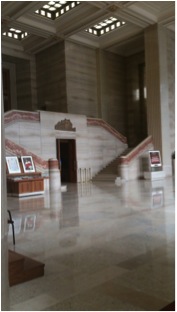
Supreme Court of Canada. Main Lobby. 2013
After that realization, which annoyed us, we decided to ask the tour guide for more information on the appointment policies. Our guide, who happened to be white and male, panicked when we asked these questions. In a room full of minorities, he ended up saying that “gender equality is not mandatory in the Supreme Court” and that they didn’t have an obligation to include minorities. We walked out of there feeling not only angry but disappointed.
No wonder we have so much trouble with niqabs! The problem I believe comes from the lack of representation not only of Muslims (who, by the way, are a big population in Ottawa and Canada in general), but of different groups that together could represent a more holistic worldview. I imagine the situation is similar in other Commonwealth countries, which really troubles me.
Are minorities, Muslim women among them, destined to have their fates decided by a bunch of middle-upper class white men and women who appeal to a “secular” sense of religious rights? Although minorities, as all other critizens, would have to abide by the secular rule of law and law-making, the inclusion of minorities could bring about a better understanding of race, religious rights and institutional discrimination. Canada has a reputation as a diverse, fair-minded society and ‘prides itself on being the first country in the world to adopt multiculturalism as an official policy, but as my visit to the Supreme Court suggests, there are many aspects where we are still far behind.
Previous Post
September 23, 2013
Beauty Pageants: Does Anyone Actually Win?
Browse Our Archives
Select a Category Advertisements Art/Theater Books/Magazines Cinema Comics/Cartoons Culture/Society Events Fashion Film Friday Links Merchandise/Commodities MMW Announcements MMW Highlights Music/Radio News Photography Politics Profile Ramadan 2012 Ramadan 2013 Ramadan 2014 Ramadan 2015 Roundtable Satire Social Media Sports Technology/Science Television Uncategorized Video Web
Select a Month November 2015 October 2015 September 2015 August 2015 July 2015 June 2015 May 2015 April 2015 March 2015 January 2015 December 2014 November 2014 October 2014 September 2014 July 2014 June 2014 May 2014 April 2014 March 2014 February 2014 January 2014 December 2013 November 2013 October 2013 September 2013 August 2013 July 2013 June 2013 May 2013 April 2013 March 2013 February 2013 January 2013 December 2012 November 2012 October 2012 September 2012 August 2012 July 2012 June 2012 May 2012 April 2012 March 2012 February 2012 January 2012 December 2011 November 2011 September 2011 August 2011 July 2011 June 2011 May 2011 April 2011 March 2011 February 2011 January 2011 December 2010 November 2010 October 2010 September 2010 August 2010 July 2010 June 2010 May 2010 April 2010 March 2010 February 2010 January 2010 December 2009 November 2009 October 2009 September 2009 August 2009 July 2009 June 2009 May 2009 April 2009 March 2009 February 2009 January 2009 December 2008 November 2008 October 2008 September 2008 August 2008 July 2008 June 2008 May 2008 April 2008 March 2008 February 2008 January 2008 December 2007 November 2007 October 2007 September 2007 August 2007
Follow Us!
TAKE THE
Religious Wisdom Quiz
Who built the first temple for God?
Select your answer to see how you score.
David Pilate Solomon Moses
Related posts from Muslimah Media Watch

#PrayforParis, Muslim Women and Third World Violence


Hate Crimes and Mother Tongues

Interview with Comedian Eman El Husseini
TRENDING AT PATHEOS Muslim

25 Years Later: How Much Has Changed for...
As we approach the 25th anniversary of September 11th, I’ve found myself...

Podcast: Third Spaces & The Rise of Yemeni...
In the latest episode of The Artistic Foodies Podcast, hosts Abbas...

HalalFest Picks: Best 60 Halal Spots for Super...
Back in 2016, I came up with a list of 29...

Unity Is America’s Strength — Division Is Its...
by Hidayatullah Ahsan When Valentina Gomez, a Republican candidate for Congress in...

Zohran Mamdani and New York’s Fight Against Islamophobia
This past June, against all odds, Zohran Mamdani won the Democratic primary...

What the Fourth of July Means to a...
As we mark another Fourth of July, millions of Americans will celebrate...
view all Muslim blogs
Ad-Free & Subscriber Log-In Subscription Support
- About Us
- 2026 Calendar
- Videos
- Podcasts
- Library of World Religions
- Faith In Media Tracker
- Advertise With Us
- Write for Us
- Privacy Policy
- Terms of Service
- Do Not Sell My Data
- Contact Us
- Radiant Digital
- Manage Newsletter Subscriptions
- Unsubscribe From Notifications
- Sitemap
Copyright 2008-2026, Patheos. All rights reserved.
Subscription Support Ad-Free & Subscriber Log-In
Follow Patheos