
BuddhistCatholicContemplativeEvangelicalGeneral ChristianHinduJewishLatter-day SaintMuslimNew VisionsProgressive Christian
Beliefs
- Buddhist
- Catholic
- Contemplative
- Evangelical
- General Christian
- Hindu
- Jewish
- Latter-day Saint
- More Voices
- Muslim
- New Visions
- Pagan
- Progressive Christian
Topics
- Religion News
- Food and Religion
- Sports and Religion
- Religious Art
- Religious Music and Entertainment
- Religious Events
- History and Religion
- Style and Religion
- Politics and Religion
- Women in Religion
- Recreation Outdoors and Religion
- Business Finance and Religion
- Careers Workplace and Religion
- Education and Religion
- Family Parenting and Religion
- Health Fitness and Religion
- Home and Religion
- Relationships and Religion
- Technology and Religion
- Travel and Religion
Columnists
- Buddhist Columnists
- Business Finance and Religion Columnists
- Careers Workplace and Religion Columnists
- Catholic Columnists
- Contemplative Columnists
- Education and Religion Columnists
- Evangelists Columnists
- Family Parenting and Religion Columnists
- General Christian Columnists
- Health Fitness and Religion Columnists
- Hindu Columnists
- History and Religion Columnists
- Home and Religion Columnists
- Jewish Columnists
- More Voices Columnists
- Latter Day Columnists
- Muslim Columnists
- New Visions Columnists
- Nonreligious Columnists
- Pagan Columnists
- Politics and Religion Columnists
- Progressive Columnists
- Recreation Outdoors and Religion Columnists
- Relationships and Religion Columnists
- Religion News Columnists
- Religious Art Columnists
- Religious Events Columnists
- Religious Music and Entertainment Columnists
- Sports and Religion Columnists
- Style and Religion Columnists
- Technology and Religion Columnists
- Travel and Religion Columnists
- Women in Religion Columnists
Resource Library
- 2026 Calendar
- Library of World Religions
- The 100 Most Holy Places on Earth
- Patheos Answers
- Podcasts
- Videos
- Faith Leaders Database
- Anglican Episcopalian
- Bahai
- Baptist
- Buddhism
- Christianity
- Confucianism
- Eastern Orthodoxy
- Hinduism
- Holiness and Pentecostal
- ISKCON
- Islam
- Judaism
- Lutheran
- Methodist
- The Church of Jesus Christ of Latter-day Saints
- New Age
- Paganism
- Presbytarian and Reformed
- Protestantism
- Religion Behind the Scenes
- Roman Catholic
- Scientology
- Shia Islam
- Sikhism
- Sufism
- Sunni Islam
- Taoism
- Zen
- See all religions
Research Tools
 Ad-Free & Subscriber Log-In Subscription Support
Ad-Free & Subscriber Log-In Subscription Support
Follow Patheos 

- Trending:
- Forgiveness
- |
- Marriage
- |
- Consciousness
- |
- Death Penalty
- |
- Election
- |
- Halloween
 Muslimah Media Watch
- Home
- Muslim
- Religion News
- Solitude and Family: The Best of Both Worlds
Solitude and Family: The Best of Both Worlds
Last updated on: July 22, 2013 at 11:56 am by Izzie
Solitude and Family: The Best of Both Worlds 2013-07-22T11:56:42-04:00 Izzie
Patheos Explore the world's faith through different perspectives on religion and spirituality! Patheos has the views of the prevalent religions and spiritualities of the world.
As a child, I once visited my aunt in her husband’s house during Ramadan. She had dark circles around her eyes due to lack of sleep, and she was haggard and toiling in the kitchen. She told us that her husband and his brothers all had “varied” food habits when it came to breaking the fast. And since her mother-in-law was too old to help, she had to do it all herself. This image became nightmarish for me. What about Ramadan’s spiritual benefits? In this case, won’t women dread Ramadan, if it means getting no sleep and the multiplication of housework? Why is a month that is about refraining from food, made ABOUT food? Are all the spiritual benefits and group prayers exclusive to men, while women should be there tending to all their needs? It broke my heart, and worried me incessantly. Does Ramadan for adult women mean increased manual labor? I was pretty adamant that my life was not going to turn out like hers. That my Ramadan is not going to be spent serving men.
And my adult life did have something different in store for me. I started working, and moved to a different city away from my family right after college. I was single for five years after this (which is a rarity where I come from). During these years, I started to enjoy fasting in Ramadan alone. I know it’s a Sunnah to break our fast with fellow Muslims. At work, I did see these gatherings of Muslims, who didn’t usually eat together on other days, break their fast together. But I rarely joined them. The one time I did join them, they were too keen to point out everything I did as a mistake. They said I shouldn’t be drinking too much water, and most of them didn’t usually pray, so they sat and spoke for long during Iftaar, while I was aching to pray Maghrib and get back to work. So I stopped. And I broke my fast alone, drinking a huge bottle of water and praying Maghrib within 5-10 mins of iftaar. Just the way I liked it. I never had to worry about societal expectations or norms that had to be followed. Since I was in office till night, I prayed my Tarawih alone, in my office prayer room. I loved it. I had learnt to celebrate Ramadan, on my own. It helped that I had great colleagues who would never ask me to attend a meeting when it was Iftaar time, and who didn’t question if I was away for half hour during Tarawih. There were days I wished for a refrigerator or a microwave, in the place I stayed, and some company to push me to pray, on the few days that I didn’t “feel” like it. But that was about it. I believed I was blessed that I got to observe Ramadan on my own terms. I knew it was a rare privilege, especially for an adult woman.

The 100% homemade iftar.
Now that I am married, life is different. I have a refrigerator. I have a microwave. My suhoors aren’t store-bought from the day before, but home-cooked food. The biggest blessing is that I still follow my Ramadan office routine. Iftaar and four of my daily prayers I pray at work by myself. I stay in Sujood for much longer, for as much time as I want. It’s my one-on-one time with Allah.
However, my weekends have become drastically different. I have visitors, usually from my husband’s family coming over for Iftaar and sometimes staying for the whole weekend. In my year and a half of marriage, I have largely dreaded this. Dreaded visitors, dreaded having to cook sumptuous meals. Houseguests didn’t seem to bring me any joy; they only appeared to me as too much work. So last Ramadan, on weekends, I was crunched for time. My disciplined way of spending Ramadan didn’t happen, and I usually tried my best to avoid having people over. Somewhere down the line, trying hard to not be the haggard housewife, I was being unreasonable. I started to worry that I was set in my ways, and that I have been single for so long that I have forgotten to co-exist and that I have forgotten to accommodate anybody (other than my husband). This worried me.This Ramadan, I realize that conquering my fears is also an integral part of faith. On the few days when I have to let go of my personal balance, and cater to family, I try to do it to the best of my ability. I know that it is the way my prayers and faith translate into the person that I have to be. I try to find pleasure in providing for the guests who visit and stay, and I pray to Allah to give me the strength to gracefully accommodate them. I am still in the initial years of my marriage, and I am still trying hard to break-free from the single woman I have been for long. And Allah has blessed me with a great husband. So on the few days we do have visitors, I believe with Allah’s blessing that I can continue to be patient, and work hard at making a pleasing meal.
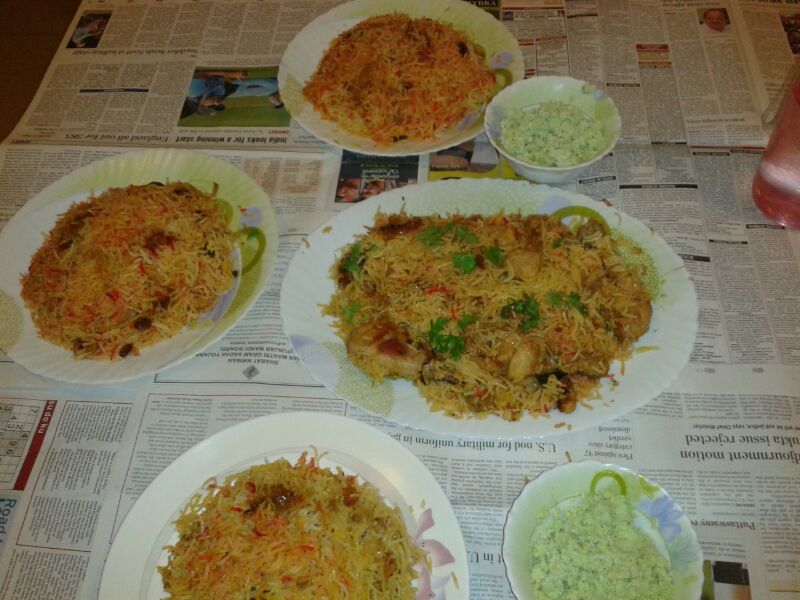
Chicken biryani.
I still believe that Ramadan shouldn’t be a burden to the women in the family. I still vouch for simpler foods, and lighter Iftaars, and I am still against the posh extravagant Iftaar parties. But in trying hard NOT to become like one of those overworked haggard housewives, had also taken me away from my joy and sense of accomplishment of preparing Iftaar and Suhoor for my extended family. Yes, I am more exhausted on such days, but I have realized that being more patient, and working harder on my domestic skills, is only going to add up to my spiritual experience, and not take away from it.
I believe Allah has blessed me with the best of both worlds: my solitary Ramadan on my working days, and my family Ramadan on weekends.
This is dedicated to my amazing team at work, who has allowed me to work from home, on account of Ramadan, this week, while I support my client during the night.
For more on MMW’s Ramadan series, and to read the rest of this year’s Ramadan posts, click here.
Previous Post

July 19, 2013
Friday Links | July 19, 2013
Next Post
July 23, 2013 In the Halls of the Hospital: My Decision Not to Fast this Ramadan
Browse Our Archives
Select a Category Advertisements Art/Theater Books/Magazines Cinema Comics/Cartoons Culture/Society Events Fashion Film Friday Links Merchandise/Commodities MMW Announcements MMW Highlights Music/Radio News Photography Politics Profile Ramadan 2012 Ramadan 2013 Ramadan 2014 Ramadan 2015 Roundtable Satire Social Media Sports Technology/Science Television Uncategorized Video Web
Select a Month November 2015 October 2015 September 2015 August 2015 July 2015 June 2015 May 2015 April 2015 March 2015 January 2015 December 2014 November 2014 October 2014 September 2014 July 2014 June 2014 May 2014 April 2014 March 2014 February 2014 January 2014 December 2013 November 2013 October 2013 September 2013 August 2013 July 2013 June 2013 May 2013 April 2013 March 2013 February 2013 January 2013 December 2012 November 2012 October 2012 September 2012 August 2012 July 2012 June 2012 May 2012 April 2012 March 2012 February 2012 January 2012 December 2011 November 2011 September 2011 August 2011 July 2011 June 2011 May 2011 April 2011 March 2011 February 2011 January 2011 December 2010 November 2010 October 2010 September 2010 August 2010 July 2010 June 2010 May 2010 April 2010 March 2010 February 2010 January 2010 December 2009 November 2009 October 2009 September 2009 August 2009 July 2009 June 2009 May 2009 April 2009 March 2009 February 2009 January 2009 December 2008 November 2008 October 2008 September 2008 August 2008 July 2008 June 2008 May 2008 April 2008 March 2008 February 2008 January 2008 December 2007 November 2007 October 2007 September 2007 August 2007
Follow Us!
TAKE THE
Religious Wisdom Quiz
What does James say we should be quick to do and slow to do?
Select your answer to see how you score.
Quick to obey, slow to question Quick to pray, slow to doubt Quick to forgive, slow to judge Quick to listen, slow to speak and slow to become angry
Related posts from Muslimah Media Watch

There is Baraka in Receiving the Gift: On...


Ramadan Thoughts On Muslimness and Indigeneity
TRENDING AT PATHEOS Muslim

25 Years Later: How Much Has Changed for...
As we approach the 25th anniversary of September 11th, I’ve found myself...

Podcast: Third Spaces & The Rise of Yemeni...
In the latest episode of The Artistic Foodies Podcast, hosts Abbas...

HalalFest Picks: Best 60 Halal Spots for Super...
Back in 2016, I came up with a list of 29...

Unity Is America’s Strength — Division Is Its...
by Hidayatullah Ahsan When Valentina Gomez, a Republican candidate for Congress in...

Zohran Mamdani and New York’s Fight Against Islamophobia
This past June, against all odds, Zohran Mamdani won the Democratic primary...

What the Fourth of July Means to a...
As we mark another Fourth of July, millions of Americans will celebrate...
view all Muslim blogs
Ad-Free & Subscriber Log-In Subscription Support
- About Us
- 2026 Calendar
- Videos
- Podcasts
- Library of World Religions
- Faith In Media Tracker
- Advertise With Us
- Write for Us
- Privacy Policy
- Terms of Service
- Do Not Sell My Data
- Contact Us
- Radiant Digital
- Manage Newsletter Subscriptions
- Unsubscribe From Notifications
- Sitemap
Copyright 2008-2026, Patheos. All rights reserved.
Subscription Support Ad-Free & Subscriber Log-In
Follow Patheos