
BuddhistCatholicContemplativeEvangelicalGeneral ChristianHinduJewishLatter-day SaintMuslimNew VisionsProgressive Christian
Beliefs
- Buddhist
- Catholic
- Contemplative
- Evangelical
- General Christian
- Hindu
- Jewish
- Latter-day Saint
- More Voices
- Muslim
- New Visions
- Pagan
- Progressive Christian
Topics
- Religion News
- Food and Religion
- Sports and Religion
- Religious Art
- Religious Music and Entertainment
- Religious Events
- History and Religion
- Style and Religion
- Politics and Religion
- Women in Religion
- Recreation Outdoors and Religion
- Business Finance and Religion
- Careers Workplace and Religion
- Education and Religion
- Family Parenting and Religion
- Health Fitness and Religion
- Home and Religion
- Relationships and Religion
- Technology and Religion
- Travel and Religion
Columnists
- Buddhist Columnists
- Business Finance and Religion Columnists
- Careers Workplace and Religion Columnists
- Catholic Columnists
- Contemplative Columnists
- Education and Religion Columnists
- Evangelists Columnists
- Family Parenting and Religion Columnists
- General Christian Columnists
- Health Fitness and Religion Columnists
- Hindu Columnists
- History and Religion Columnists
- Home and Religion Columnists
- Jewish Columnists
- More Voices Columnists
- Latter Day Columnists
- Muslim Columnists
- New Visions Columnists
- Nonreligious Columnists
- Pagan Columnists
- Politics and Religion Columnists
- Progressive Columnists
- Recreation Outdoors and Religion Columnists
- Relationships and Religion Columnists
- Religion News Columnists
- Religious Art Columnists
- Religious Events Columnists
- Religious Music and Entertainment Columnists
- Sports and Religion Columnists
- Style and Religion Columnists
- Technology and Religion Columnists
- Travel and Religion Columnists
- Women in Religion Columnists
Resource Library
- 2026 Calendar
- Library of World Religions
- The 100 Most Holy Places on Earth
- Patheos Answers
- Podcasts
- Videos
- Faith Leaders Database
- Anglican Episcopalian
- Bahai
- Baptist
- Buddhism
- Christianity
- Confucianism
- Eastern Orthodoxy
- Hinduism
- Holiness and Pentecostal
- ISKCON
- Islam
- Judaism
- Lutheran
- Methodist
- The Church of Jesus Christ of Latter-day Saints
- New Age
- Paganism
- Presbytarian and Reformed
- Protestantism
- Religion Behind the Scenes
- Roman Catholic
- Scientology
- Shia Islam
- Sikhism
- Sufism
- Sunni Islam
- Taoism
- Zen
- See all religions
Research Tools
 Ad-Free & Subscriber Log-In Subscription Support
Ad-Free & Subscriber Log-In Subscription Support
Follow Patheos 

- Trending:
- Forgiveness
- |
- Marriage
- |
- Consciousness
- |
- Death Penalty
- |
- Election
- |
- Halloween
 Muslimah Media Watch
- Home
- Muslim
- Religion News
- A Tale of Two Ramadans
A Tale of Two Ramadans
Last updated on: July 15, 2013 at 3:07 am by emaan
A Tale of Two Ramadans 2013-07-15T03:07:23-04:00 emaan
Patheos Explore the world's faith through different perspectives on religion and spirituality! Patheos has the views of the prevalent religions and spiritualities of the world.
My grandmother set down a plate of six or seven parathas with determination in her eyes, as though warning us we had no choice but to finish all of them. From the kitchen, pots and pans clacked as our cook constructed omelet after omelet at a pace that could, conceivably, break the sound barrier. My cousins yawned loudly between scavenging mouthfuls. From the couch, my grandfather disapprovingly surveyed the scene. “Ruby,” he said, peeking out from behind yesterday’s copy of The Express-Tribune, “You really shouldn’t have such large sehris. It’s not sunnat.”
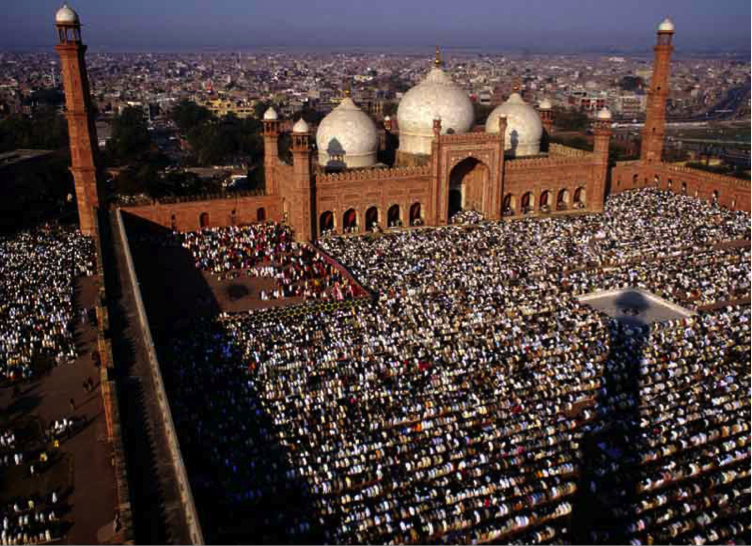
Badshadi mosque in Lahore, Pakistan. Source: National Geographic.
We all stared innocently at the table spread where parathas, jam, scrambled eggs, omelets, kebabs, fruit cake, and the greater part of last night’s dinner lay. “Nonsense,” my grandmother snapped back in fast and hard Punjabi, the kind reserved especially for telling-offs. “Do you want them to starve?” She pushed a glass of mango juice into my hands “Are you trying to kill them? Are you trying to kill the children?” The room full of people laughed as my grandfather shook his head and ducked back behind his newspaper.
In Dallas, I wake up not by my grandmother’s shouting greetings or my cousins’ merciless shakes, but by my alarm. The morning is cold, which is odd, for July, but early mornings always seem to have this chill stillness about them. I stumble sleepily downstairs. Grabbing my phone, I text my friends who are up for sehri for some companionship. In the kitchen, I tread lightly, pouring myself a bowl of excessively sugary cereal – my favorite. The cabinet door slams shut, and I wince – I don’t want to wake the rest of my sleeping family up. They’re not fasting for reasons ranging from sickness to sloth. After my cereal, I gulp down cups of water until I think I’ll explode. Sitting at the table, I look out the window at my neighborhood. A few lonely cars rush by, carrying no doubt overtaxed commuters. Mostly, though, Dallas is at peace.
Despite my constant protestations in favor of secularism, my dirty little secret was that I quite enjoyed the azaan ringing out over Lahore’s busy streets five times a day. It bound the blinding city together. The first azaan for Fajr woke the pearl of the Punjab up, little by little, each day. Today, it found my five cousins and me restlessly crowding around two jahnamaazs. As the namaaz started, we fell into hushed silence. From the corner of my eye, I caught one of the young ones clinging to my grandmother’s feet as she did a remarkable job of steadfastly ignoring him and praying.
I spread out a similarly beautifully patterned jahanamaaz. I bought it in a bustling bazaar in Pakistan, wanting a touch of home for my prayers. Praying alone is different from being surrounded by people, but I think I may enjoy it more. It gives me more time to muse on my own spirituality and just talk, me and Allah. There’s something magical about namaaz that makes me feel like an enchanted child again. I finish just as the hectic day begins; I have, sadly, a Saturday full of errands to run. I stop first at the bank, then the post office and mall. There is, understandably, no sense of Islamic community among the folks in my conservative Dallas suburb. It’s not necessarily a bad thing. I keep the knowledge and feel of Ramadan in myself, tucked into my belly like a light. The rest of the world around me may not be fasting, but Allah is as omnipresent as ever. It’s four o’ clock before the hunger starts setting in. My brother goes to prayer at our small local mosque, but it’s not a place where I feel particularly welcome, so I return home to pray Asr.
By the time Asr hits, I’m slumped on a couch in my grandmother’s living room, thinking that if this goes on any longer, this not-eating business, I might cry. My cousins are in equal states of disrepair. Soon, we’re dragged out to the market together, in an attempt on the adults’ part to 1) shake us out of our whininess and 2) make the time pass quicker. If silence is loud, a Pakistani market on a day during Ramadan is absolutely deafening. The fast is everywhere, on everyone’s minds, even in wordless interactions like buying meat or brushing by strangers. Ramadan is like an all-encompassing haze, settling comfortable and agreeably over the city.
When the fast gets hard, usually in the hour or so before it breaks, I think back to the Pakistani market and the workers I always saw there: young men spending their whole day preparing jalebis and samosas over hot stoves and worn shopkeepers constantly on their feet. All of these people were also fasting, but they didn’t have the luxury of accommodating their fast with large (and possibly excessive) amounts of downtime and like my family and I do. At iftar, I miss the samosa and jalebi tradition briefly but remind myself how blessed I am, to be surrounded by family, food, and faith. My parents and brother eat with me and I eagerly bite into dinner as soon as the clock hits the right number.
One of my more food-happy cousins once confessed to me that iftar was no less than 75% of the reason he kept fasts. It was a reasonable feeling; the iftaris put together by my grandmother were nothing less than a gift from heaven. Excited tension seized the house as the countdown to iftar begun, and when the azaan rung we gulped down our dates while exchanging ear to ear smiles. Then, we set upon eating the table worth of treats in front of us.
Ramadan as a kid and teenager in Pakistan, enveloped by scores of family members and the special atmosphere that hung over the country, was undoubtedly different from my experience of Ramadan in America. Different, but not necessarily better. While I appreciated the comforting sense of community ever present in Lahore, I know now that it’s not always needed to feel close to Islam. I can be alone, I can be isolated, and still Islam will light up my heart just as it did in Pakistan. As I’ve learned, God may not be always be seen, but that does not mean that He is not still everywhere.
For more on MMW’s Ramadan series, and to read the rest of this year’s Ramadan posts, click here.
Previous Post

July 12, 2013
Friday Links | July 12, 2013
Next Post
July 16, 2013 My Ramadan Media
Browse Our Archives
Select a Category Advertisements Art/Theater Books/Magazines Cinema Comics/Cartoons Culture/Society Events Fashion Film Friday Links Merchandise/Commodities MMW Announcements MMW Highlights Music/Radio News Photography Politics Profile Ramadan 2012 Ramadan 2013 Ramadan 2014 Ramadan 2015 Roundtable Satire Social Media Sports Technology/Science Television Uncategorized Video Web
Select a Month November 2015 October 2015 September 2015 August 2015 July 2015 June 2015 May 2015 April 2015 March 2015 January 2015 December 2014 November 2014 October 2014 September 2014 July 2014 June 2014 May 2014 April 2014 March 2014 February 2014 January 2014 December 2013 November 2013 October 2013 September 2013 August 2013 July 2013 June 2013 May 2013 April 2013 March 2013 February 2013 January 2013 December 2012 November 2012 October 2012 September 2012 August 2012 July 2012 June 2012 May 2012 April 2012 March 2012 February 2012 January 2012 December 2011 November 2011 September 2011 August 2011 July 2011 June 2011 May 2011 April 2011 March 2011 February 2011 January 2011 December 2010 November 2010 October 2010 September 2010 August 2010 July 2010 June 2010 May 2010 April 2010 March 2010 February 2010 January 2010 December 2009 November 2009 October 2009 September 2009 August 2009 July 2009 June 2009 May 2009 April 2009 March 2009 February 2009 January 2009 December 2008 November 2008 October 2008 September 2008 August 2008 July 2008 June 2008 May 2008 April 2008 March 2008 February 2008 January 2008 December 2007 November 2007 October 2007 September 2007 August 2007
Follow Us!
TAKE THE
Religious Wisdom Quiz
What was the name of the disciple who doubted Jesus' resurrection?
Select your answer to see how you score.
Thomas John Peter James
Related posts from Muslimah Media Watch

Making Sense of “the Other”: A Review of...

Review of Brick Walls by Saadia Faruqi

There is Baraka in Receiving the Gift: On...

TRENDING AT PATHEOS Muslim

25 Years Later: How Much Has Changed for...
As we approach the 25th anniversary of September 11th, I’ve found myself...

Podcast: Third Spaces & The Rise of Yemeni...
In the latest episode of The Artistic Foodies Podcast, hosts Abbas...

HalalFest Picks: Best 60 Halal Spots for Super...
Back in 2016, I came up with a list of 29...

Unity Is America’s Strength — Division Is Its...
by Hidayatullah Ahsan When Valentina Gomez, a Republican candidate for Congress in...

Zohran Mamdani and New York’s Fight Against Islamophobia
This past June, against all odds, Zohran Mamdani won the Democratic primary...

What the Fourth of July Means to a...
As we mark another Fourth of July, millions of Americans will celebrate...
view all Muslim blogs
Ad-Free & Subscriber Log-In Subscription Support
- About Us
- 2026 Calendar
- Videos
- Podcasts
- Library of World Religions
- Faith In Media Tracker
- Advertise With Us
- Write for Us
- Privacy Policy
- Terms of Service
- Do Not Sell My Data
- Contact Us
- Radiant Digital
- Manage Newsletter Subscriptions
- Unsubscribe From Notifications
- Sitemap
Copyright 2008-2026, Patheos. All rights reserved.
Subscription Support Ad-Free & Subscriber Log-In
Follow Patheos