
BuddhistCatholicContemplativeEvangelicalGeneral ChristianHinduJewishLatter-day SaintMuslimNew VisionsProgressive Christian
Beliefs
- Buddhist
- Catholic
- Contemplative
- Evangelical
- General Christian
- Hindu
- Jewish
- Latter-day Saint
- More Voices
- Muslim
- New Visions
- Pagan
- Progressive Christian
Topics
- Religion News
- Food and Religion
- Sports and Religion
- Religious Art
- Religious Music and Entertainment
- Religious Events
- History and Religion
- Style and Religion
- Politics and Religion
- Women in Religion
- Recreation Outdoors and Religion
- Business Finance and Religion
- Careers Workplace and Religion
- Education and Religion
- Family Parenting and Religion
- Health Fitness and Religion
- Home and Religion
- Relationships and Religion
- Technology and Religion
- Travel and Religion
Columnists
- Buddhist Columnists
- Business Finance and Religion Columnists
- Careers Workplace and Religion Columnists
- Catholic Columnists
- Contemplative Columnists
- Education and Religion Columnists
- Evangelists Columnists
- Family Parenting and Religion Columnists
- General Christian Columnists
- Health Fitness and Religion Columnists
- Hindu Columnists
- History and Religion Columnists
- Home and Religion Columnists
- Jewish Columnists
- More Voices Columnists
- Latter Day Columnists
- Muslim Columnists
- New Visions Columnists
- Nonreligious Columnists
- Pagan Columnists
- Politics and Religion Columnists
- Progressive Columnists
- Recreation Outdoors and Religion Columnists
- Relationships and Religion Columnists
- Religion News Columnists
- Religious Art Columnists
- Religious Events Columnists
- Religious Music and Entertainment Columnists
- Sports and Religion Columnists
- Style and Religion Columnists
- Technology and Religion Columnists
- Travel and Religion Columnists
- Women in Religion Columnists
Resource Library
- 2026 Calendar
- Library of World Religions
- The 100 Most Holy Places on Earth
- Patheos Answers
- Podcasts
- Videos
- Faith Leaders Database
- Anglican Episcopalian
- Bahai
- Baptist
- Buddhism
- Christianity
- Confucianism
- Eastern Orthodoxy
- Hinduism
- Holiness and Pentecostal
- ISKCON
- Islam
- Judaism
- Lutheran
- Methodist
- The Church of Jesus Christ of Latter-day Saints
- New Age
- Paganism
- Presbytarian and Reformed
- Protestantism
- Religion Behind the Scenes
- Roman Catholic
- Scientology
- Shia Islam
- Sikhism
- Sufism
- Sunni Islam
- Taoism
- Zen
- See all religions
Research Tools
 Ad-Free & Subscriber Log-In Subscription Support
Ad-Free & Subscriber Log-In Subscription Support
Follow Patheos 

- Trending:
- Forgiveness
- |
- Marriage
- |
- Consciousness
- |
- Death Penalty
- |
- Election
- |
- Halloween
 Muslimah Media Watch
- Home
- Muslim
- Religion News
- A Ramadan Journey through Sri Lanka
A Ramadan Journey through Sri Lanka
Last updated on: July 29, 2013 at 2:00 am by Guest Contributor
A Ramadan Journey through Sri Lanka 2013-07-23T11:14:29-04:00 Guest Contributor
Patheos Explore the world's faith through different perspectives on religion and spirituality! Patheos has the views of the prevalent religions and spiritualities of the world.
This post was written by guest contributor Hafsa.

The “Golden Canopy” of the Temple of the Tooth visible from the Kandy Lake.
Last summer, I was on a journey spanning the northern, eastern and the south-western parts of Sri Lanka. On the first day of Ramadan, I found myself in the heart of the country: Kandy, the site of the middle Kingdom.
Tamil and Muslim Minorities make up almost 20% of Kandy City. Most of the former are hill-country Tamils who have endured a history of discrimination. The British initially brought Tamils from India to work in the tea plantations, and since the post-colonial period this community was considered a colonial import and denied citizenship rights by the state. Later political developments restored these rights in the early 1960s.
As I spoke to some of the hill-country men and women who were working at a plantation, my first day of Ramadan was filled with stories of everyday struggles for better standards of living, and hope for a brighter future. When time came for me and my team of colleagues to leave, it started raining quite hard outside the small meeting area within the tea factory where we had gathered. We bade lingering farewells and well-wishes and dashed out to the awaiting minivan. One of the managers ran after us and gave me a bag of freshly baked goods. I was mildly surprised, since I never told anyone what day it was.
It was a few minutes before sunset; I hadn’t quite realized.
As we drove back to the mansion lodging where we were staying, the van took a dip at a gully and braved a sharp bend. We braced ourselves every single time it took a turn, since a plunge into the abyss of a nameless valley awaited us if the turn wasn’t successful. It didn’t help that what any sane driver would consider one-way lanes were turned into two-way lanes depending on the whims of the roadway gods – which sometimes put us in the path of oncoming traffic.
Despite the all of this, we could still see these roads, meandering through the hills and through field after field of luscious tea groves, as they seemed to hang out off the heavens in the downpour.
Something else sprung me out of the simultaneous reverie and moments of trepidation and I sat bolt upright on my seat, as the driver tuned the radio to a station from which the adhan, the call to prayer, sounded. It took me a decade back, to my childhood. One of the local community guides who had been escorting us around town, turned around to look at me. She had a knowing smile, and a twinkling in her eye, as if to say – it is time now, isn’t it?
Was this home? Maybe this is what it feels like.
Here we were – a van full of Sri Lankans and Canadians, a Sinhalese Buddhist, two Catholics, four Tamils, two Muslims – not just tolerating a tradition, but enabling it, making space for it. Letting it breathe and live. This was the Sri Lanka of my childhood, the one I knew and was hard pressed to find in many of the narratives I’ve read since.
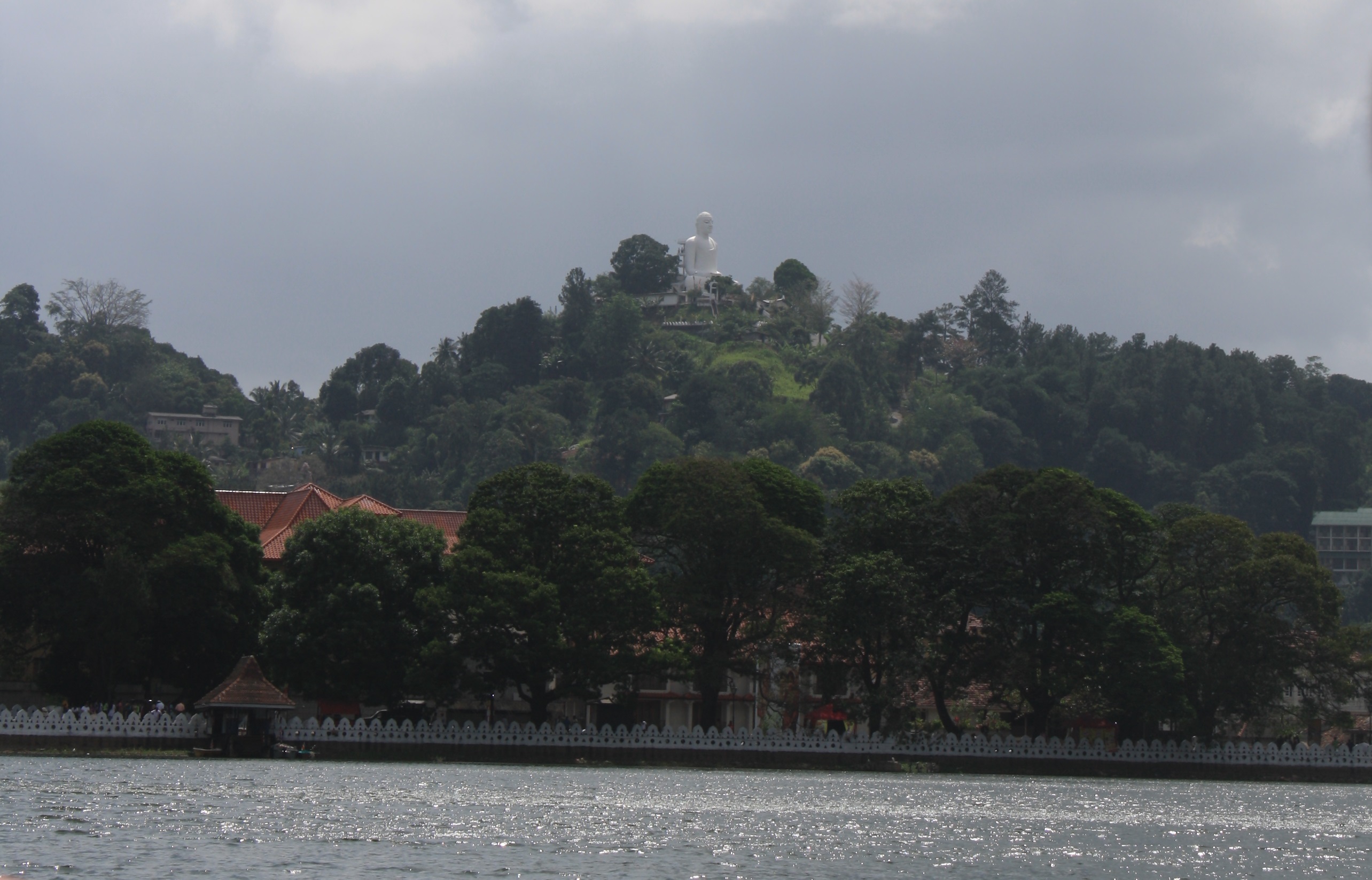
A statue of Lord Buddha on top of a hill top in the vicinity of the Temple of the Tooth.
While in Kandy, we had the opportunity to visit one of the most celebrated sites in the Island’s Buddhist tradition, the Dalada Maligawa or the Temple of the Tooth. It is located within the City’s royal palace complex, and houses the relic of the tooth of Buddha. Needless to say, I was pretty stoked to visit this place.
As we approached the gates, one of the guard-ladies promptly let us know that one must remove head coverings before entering the temple. It sounds reasonable enough in retrospect, but at the time it was a little hard to process.
Coming from Quebec, where the question of “Reasonable Accommodation” loomed large over our heads some years ago, I immediately associated such sentiments with misplaced political concerns and Islamophobia. I’ve never felt more uncomfortable in my own skin, and out-of-place.
Some of my colleagues – a bunch of amazing young Sri Lankan Canadians – tried to explain and finally resorted to either leaving the premises or entering it to seek the counsel of a Thero (the term for a fully ordained Buddhist monk or nun). I have since come to understand that this has always been the rule at the temple, and that my aunt, when she was a schoolgirl, had to remove her hijab, along with her schoolmates, in order to enter this sacred premise. It was quite the norm, apparently.
I guess I might never come to see the grand interior of the Temple of the Tooth.
As we journeyed down south to the scenic port-city of Galle, we took a walking tour around the famous Galle Fort, a must for any visitor. As we moved through the charming old-city in its proximity, a grand old mosque materialized, complete with pristine white walls, and curves hinting at colonial architecture.
Unfortunately, here was another sacred space that I would not be allowed to step into, with or without a hijab. While there are mosques, particularly in certain rural parts of the country, where women are “accommodated,” the adopted norm in the Island is for women to pray at home, making most mosques almost exclusively male-only spaces.
It was Asr time. Thank God, I had shortened it to pray earlier, before I left for this leg of the journey.
“The past is a foreign country: they do things differently there,” said L.P. Hartley. It certainly was the case that the more I explored my country of birth, the more foreign it – or I – seemed to become.
Rest assured that this is not a sad manifesto of abandonment. I remain loyal to the incomparable lavariya (sweet string hoppers) and buffalo curd start to the fasting day and the umpteen amount of fried cutlets and rolls during its break. Not to mention the wattalappam, awaiting at the end of it all.
However, I spent much of the rest of Ramadan unpacking how “they do things differently” and coming to terms with why “they” are not always “I”. I came to the conclusion that the condition of cultural hybridity, inevitably, makes one a visitor in her own home sometimes – and the seeming incommensurabilities are not there to be overcome, but to be worked through and negotiated, constantly.
For more on MMW’s Ramadan series, and to read the rest of this year’s Ramadan posts, click here.
Previous Post

July 26, 2013
Friday Links | July 26, 2013
Next Post

July 29, 2013 Introspection: On Ramadan Solitude, Gratitude, and Goals
Browse Our Archives
Select a Category Advertisements Art/Theater Books/Magazines Cinema Comics/Cartoons Culture/Society Events Fashion Film Friday Links Merchandise/Commodities MMW Announcements MMW Highlights Music/Radio News Photography Politics Profile Ramadan 2012 Ramadan 2013 Ramadan 2014 Ramadan 2015 Roundtable Satire Social Media Sports Technology/Science Television Uncategorized Video Web
Select a Month November 2015 October 2015 September 2015 August 2015 July 2015 June 2015 May 2015 April 2015 March 2015 January 2015 December 2014 November 2014 October 2014 September 2014 July 2014 June 2014 May 2014 April 2014 March 2014 February 2014 January 2014 December 2013 November 2013 October 2013 September 2013 August 2013 July 2013 June 2013 May 2013 April 2013 March 2013 February 2013 January 2013 December 2012 November 2012 October 2012 September 2012 August 2012 July 2012 June 2012 May 2012 April 2012 March 2012 February 2012 January 2012 December 2011 November 2011 September 2011 August 2011 July 2011 June 2011 May 2011 April 2011 March 2011 February 2011 January 2011 December 2010 November 2010 October 2010 September 2010 August 2010 July 2010 June 2010 May 2010 April 2010 March 2010 February 2010 January 2010 December 2009 November 2009 October 2009 September 2009 August 2009 July 2009 June 2009 May 2009 April 2009 March 2009 February 2009 January 2009 December 2008 November 2008 October 2008 September 2008 August 2008 July 2008 June 2008 May 2008 April 2008 March 2008 February 2008 January 2008 December 2007 November 2007 October 2007 September 2007 August 2007
Follow Us!
TAKE THE
Religious Wisdom Quiz
What did God make on the fourth day of creation?
Select your answer to see how you score.
Man Sun, moon, and stars Plants Fish and birds
Related posts from Muslimah Media Watch

There is Baraka in Receiving the Gift: On...

Ramadan Thoughts On Muslimness and Indigeneity
TRENDING AT PATHEOS Muslim

25 Years Later: How Much Has Changed for...
As we approach the 25th anniversary of September 11th, I’ve found myself...

Podcast: Third Spaces & The Rise of Yemeni...
In the latest episode of The Artistic Foodies Podcast, hosts Abbas...

HalalFest Picks: Best 60 Halal Spots for Super...
Back in 2016, I came up with a list of 29...

Unity Is America’s Strength — Division Is Its...
by Hidayatullah Ahsan When Valentina Gomez, a Republican candidate for Congress in...

Zohran Mamdani and New York’s Fight Against Islamophobia
This past June, against all odds, Zohran Mamdani won the Democratic primary...

What the Fourth of July Means to a...
As we mark another Fourth of July, millions of Americans will celebrate...
view all Muslim blogs
Ad-Free & Subscriber Log-In Subscription Support
- About Us
- 2026 Calendar
- Videos
- Podcasts
- Library of World Religions
- Faith In Media Tracker
- Advertise With Us
- Write for Us
- Privacy Policy
- Terms of Service
- Do Not Sell My Data
- Contact Us
- Radiant Digital
- Manage Newsletter Subscriptions
- Unsubscribe From Notifications
- Sitemap
Copyright 2008-2026, Patheos. All rights reserved.
Subscription Support Ad-Free & Subscriber Log-In
Follow Patheos