
BuddhistCatholicContemplativeEvangelicalGeneral ChristianHinduJewishLatter-day SaintMuslimNew VisionsProgressive Christian
Beliefs
- Buddhist
- Catholic
- Contemplative
- Evangelical
- General Christian
- Hindu
- Jewish
- Latter-day Saint
- More Voices
- Muslim
- New Visions
- Pagan
- Progressive Christian
Topics
- Religion News
- Food and Religion
- Sports and Religion
- Religious Art
- Religious Music and Entertainment
- Religious Events
- History and Religion
- Style and Religion
- Politics and Religion
- Women in Religion
- Recreation Outdoors and Religion
- Business Finance and Religion
- Careers Workplace and Religion
- Education and Religion
- Family Parenting and Religion
- Health Fitness and Religion
- Home and Religion
- Relationships and Religion
- Technology and Religion
- Travel and Religion
Columnists
- Buddhist Columnists
- Business Finance and Religion Columnists
- Careers Workplace and Religion Columnists
- Catholic Columnists
- Contemplative Columnists
- Education and Religion Columnists
- Evangelists Columnists
- Family Parenting and Religion Columnists
- General Christian Columnists
- Health Fitness and Religion Columnists
- Hindu Columnists
- History and Religion Columnists
- Home and Religion Columnists
- Jewish Columnists
- More Voices Columnists
- Latter Day Columnists
- Muslim Columnists
- New Visions Columnists
- Nonreligious Columnists
- Pagan Columnists
- Politics and Religion Columnists
- Progressive Columnists
- Recreation Outdoors and Religion Columnists
- Relationships and Religion Columnists
- Religion News Columnists
- Religious Art Columnists
- Religious Events Columnists
- Religious Music and Entertainment Columnists
- Sports and Religion Columnists
- Style and Religion Columnists
- Technology and Religion Columnists
- Travel and Religion Columnists
- Women in Religion Columnists
Resource Library
- 2026 Calendar
- Library of World Religions
- The 100 Most Holy Places on Earth
- Patheos Answers
- Podcasts
- Videos
- Faith Leaders Database
- Anglican Episcopalian
- Bahai
- Baptist
- Buddhism
- Christianity
- Confucianism
- Eastern Orthodoxy
- Hinduism
- Holiness and Pentecostal
- ISKCON
- Islam
- Judaism
- Lutheran
- Methodist
- The Church of Jesus Christ of Latter-day Saints
- New Age
- Paganism
- Presbytarian and Reformed
- Protestantism
- Religion Behind the Scenes
- Roman Catholic
- Scientology
- Shia Islam
- Sikhism
- Sufism
- Sunni Islam
- Taoism
- Zen
- See all religions
Research Tools
 Ad-Free & Subscriber Log-In Subscription Support
Ad-Free & Subscriber Log-In Subscription Support
Follow Patheos 

- Trending:
- Forgiveness
- |
- Marriage
- |
- Consciousness
- |
- Death Penalty
- |
- Election
- |
- Halloween
 Muslimah Media Watch
- Home
- Muslim
- Religion News
- The Art of Airing Dirty Laundry: A Deeper Look at the Muslims for White Ribbon Campaign
The Art of Airing Dirty Laundry: A Deeper Look at the Muslims for White Ribbon Campaign
Last updated on: June 12, 2013 at 2:00 am by amina
The Art of Airing Dirty Laundry: A Deeper Look at the Muslims for White Ribbon Campaign 2013-06-10T23:37:57-04:00 amina
Patheos Explore the world's faith through different perspectives on religion and spirituality! Patheos has the views of the prevalent religions and spiritualities of the world.
Having survived a father who used religion to justify his violence, I’ve spent a lot of time grappling with faith. The process of grappling has taught me the value of difficult, uncomfortable questions and conversations, through which I’ve learned about myself, my ummah, and Islam. But Muslims in the West rarely have the luxury of having difficult conversations that are privy exclusively to the ears of our own communities. And so, difficult discussions, like the ones about domestic violence within Muslim families living in the West, become synonymous with “airing dirty laundry,” a phrase that refers to dealing with personal and often damaging problems in public. We, as Muslims, often resist airing dirty laundry, fearing Islamophobia. These fears aren’t baseless. In this post, I explore the issues associated with airing dirty laundry in the context of domestic violence and suggest that complex, critical conversations are necessary to maintain relevance to our ummah despite the risks.
In 2007, when 16-year-old Aqsa Parvez was killed by her father and brother in Mississauga, Ontario, the media frenzy focused on the status of women in Islam. Google Aqsa Parvez’s name and the first site to pop up is a Wikipedia link entitled “Honor killing of Aqsa Parvez.” Two years later, the Shafia sisters, Zainab, Sahar, and Geeti, along with their father’s first wife, were murdered by their father, brother, and mother. Their bodies were found in a car dumped at the bottom of a canal in Kingston, Ontario. The mainstream media analysis of these murders was virtually identical to when Aqsa Parvez was killed. In the same way, the Shafia murders were instantly discussed as “honor killings,” attributing sole culpability to the presumed monolith that is Islam and putting expectations on Muslims to “grapple” with the guilty verdicts.
Clearly, the mainstream media discourse would like me to believe that Islam is inherently sexist. Never mind that the prevalence of domestic violence among Muslim communities is roughly comparable to those in non-Muslim communities. But domestic violence in Muslim communities can look different and is, at times, heavily shaped by poverty, racism, culture, and stresses related to immigration, in addition to the structural patriarchy and misogyny that also exists in the West. The differences warrant that we, within the ummah, have conversations about domestic violence in terms that are relevant to our own communities. Airing that dirty laundry, however, can be a risky proposition, as evident from the backlash experienced by Muslims in reaction to the deaths of Aqsa Parvez and the Shafia family.
The Muslims for White Ribbon Campaign attempts a public discourse about domestic violence. The initiative coincides with the broader White Ribbon Campaign that occurs annually in November and is a grassroots effort by men working towards ending violence against women. The website includes a list of articles, features a khutba campaign, and includes a long list of signatories largely made of Imams from Ontario.
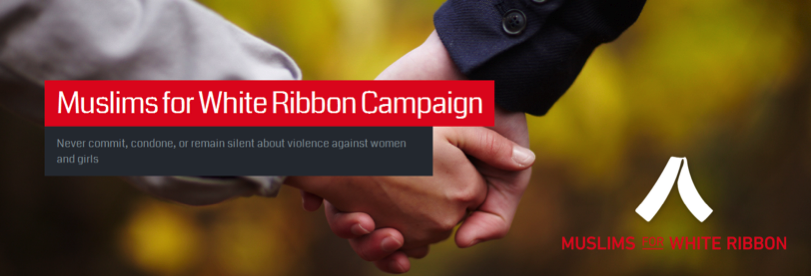
Banner for the Muslims for White Ribbon Campaign. Via muslimsforwhiteribbon.com.
Clicking through the site, I can’t help but feel it’s figuratively vacant. I can appreciate the immense challenge creating a campaign about domestic violence that is relevant to a dynamic, culturally diverse community of Muslims. Instead, what exists is a superficial acknowledgement that domestic violence is bad, with no real, meaningful discourse about its origins or plans to address it. The site includes, for example, the white ribbon pledge to “never commit, condone, or remain silent about violence against women and girls” and objectives that include breaking the silence on violence, promoting healthy relationships, and creating partnerships among Mosques, women’s organizations, and social agencies. While laudable, in the absence of an operational, sustainable set of strategies, the pledge and objectives remain largely theoretical. My mother is deeply engaged within the Muslim community in Toronto and wasn’t aware of the campaign. So it leaves me to ask, who is the Muslims for White Ribbon Campaign really for? Is this is genuine attempt at engaging the Muslim ummah on domestic violence or an apologetic response to incidents of domestic violence that are xenophobically labelled as “honor killings”? Eren posed a similar set of questions when Canadian Muslim leaders and organizations responded to media coverage of the Shafia case in November 2011.
As a survivor of domestic violence, I can tell you my father used faith to justify his abuse. Yes, without a doubt, he misapplied verses from the Quran and hadiths from the Prophet. But the 17 year-old me didn’t realize that, and in the absence of an appropriate, religiously and culturally relevant media discourse on domestic violence, this fractured my relationship with God. The Muslims for White Ribbon Campaign has the potential for facilitating those hard conversations. Instead, a resource from the campaign page provides a simple set of khutba notes, including a set of Quranic verses, hadiths, and sunnah that address the status of women in Islam. It reminds me of bad poetry slam; while some Imam duels out all the verses and hadiths that support the equality of women in one corner, an Islamophobe at the other end thumps out all quotes that try to prove otherwise.
We have to genuinely acknowledge the origins of domestic violence in our communities and risk airing the dirty laundry to maintain relevance to our ummah. We have to, for example, somehow explicitly reconcile that people use Verse 4:34 from the Quran, often referred to as the “beating verse,” to justify domestic violence. In her brilliant article, “In the Book We have Left out Nothing’: The Ethical Problem of the Existence of Verse 4:34 in the Qur’an,” Professor Laury Silvers does just that; she theologically and ethically unpacks the verse to challenge its traditional interpretations and commentary. In other words, rather than cherry picking parts of Islamic scripture that serve our purposes, we must also deliberately deconstruct difficult, uncomfortable texts as a means of meaningfully addressing domestic violence within the ummah.
When we, as Muslims, try to have complex, critical conversations about issues like domestic violence, we also worry about being misinterpreted, misunderstood, and creating Islamophobic backlashes within the Western media. But by being seized with fear and in failing to air the dirty laundry, initiatives like the Muslims for White Ribbon Campaign are, at best, ineffective. At worst, we also risk losing opportunities for preventing domestic violence within our communities and cultivating deeper, richer understandings of our own faith. Instead of being reactive to tragic incidents like the murders of Aqsa Parvez and the Shafia family, we should harness our own narrative. Airing dirty laundry through critical discourse in the media, in other words, can be the key to claiming and maintaining our agency as Muslims in the West.
Muslims for White Ribbon Campaign
Previous Post

June 11, 2013
Pride Parades, Hijabs and Muslim Lesbians
Next Post
June 14, 2013 Friday Links | June 14, 2013
Browse Our Archives
Select a Category Advertisements Art/Theater Books/Magazines Cinema Comics/Cartoons Culture/Society Events Fashion Film Friday Links Merchandise/Commodities MMW Announcements MMW Highlights Music/Radio News Photography Politics Profile Ramadan 2012 Ramadan 2013 Ramadan 2014 Ramadan 2015 Roundtable Satire Social Media Sports Technology/Science Television Uncategorized Video Web
Select a Month November 2015 October 2015 September 2015 August 2015 July 2015 June 2015 May 2015 April 2015 March 2015 January 2015 December 2014 November 2014 October 2014 September 2014 July 2014 June 2014 May 2014 April 2014 March 2014 February 2014 January 2014 December 2013 November 2013 October 2013 September 2013 August 2013 July 2013 June 2013 May 2013 April 2013 March 2013 February 2013 January 2013 December 2012 November 2012 October 2012 September 2012 August 2012 July 2012 June 2012 May 2012 April 2012 March 2012 February 2012 January 2012 December 2011 November 2011 September 2011 August 2011 July 2011 June 2011 May 2011 April 2011 March 2011 February 2011 January 2011 December 2010 November 2010 October 2010 September 2010 August 2010 July 2010 June 2010 May 2010 April 2010 March 2010 February 2010 January 2010 December 2009 November 2009 October 2009 September 2009 August 2009 July 2009 June 2009 May 2009 April 2009 March 2009 February 2009 January 2009 December 2008 November 2008 October 2008 September 2008 August 2008 July 2008 June 2008 May 2008 April 2008 March 2008 February 2008 January 2008 December 2007 November 2007 October 2007 September 2007 August 2007
Follow Us!
TAKE THE
Religious Wisdom Quiz
What is the book of songs and prayers in the Bible called?
Select your answer to see how you score.
Matthew Genesis Psalms Proverbs
Related posts from Muslimah Media Watch

#PrayforParis, Muslim Women and Third World Violence


Hate Crimes and Mother Tongues

Interview with Comedian Eman El Husseini
TRENDING AT PATHEOS Muslim

25 Years Later: How Much Has Changed for...
As we approach the 25th anniversary of September 11th, I’ve found myself...

Podcast: Third Spaces & The Rise of Yemeni...
In the latest episode of The Artistic Foodies Podcast, hosts Abbas...

HalalFest Picks: Best 60 Halal Spots for Super...
Back in 2016, I came up with a list of 29...

Unity Is America’s Strength — Division Is Its...
by Hidayatullah Ahsan When Valentina Gomez, a Republican candidate for Congress in...

Zohran Mamdani and New York’s Fight Against Islamophobia
This past June, against all odds, Zohran Mamdani won the Democratic primary...

What the Fourth of July Means to a...
As we mark another Fourth of July, millions of Americans will celebrate...
view all Muslim blogs
Ad-Free & Subscriber Log-In Subscription Support
- About Us
- 2026 Calendar
- Videos
- Podcasts
- Library of World Religions
- Faith In Media Tracker
- Advertise With Us
- Write for Us
- Privacy Policy
- Terms of Service
- Do Not Sell My Data
- Contact Us
- Radiant Digital
- Manage Newsletter Subscriptions
- Unsubscribe From Notifications
- Sitemap
Copyright 2008-2026, Patheos. All rights reserved.
Subscription Support Ad-Free & Subscriber Log-In
Follow Patheos