
BuddhistCatholicContemplativeEvangelicalGeneral ChristianHinduJewishLatter-day SaintMuslimNew VisionsProgressive Christian
Beliefs
- Buddhist
- Catholic
- Contemplative
- Evangelical
- General Christian
- Hindu
- Jewish
- Latter-day Saint
- More Voices
- Muslim
- New Visions
- Pagan
- Progressive Christian
Topics
- Religion News
- Food and Religion
- Sports and Religion
- Religious Art
- Religious Music and Entertainment
- Religious Events
- History and Religion
- Style and Religion
- Politics and Religion
- Women in Religion
- Recreation Outdoors and Religion
- Business Finance and Religion
- Careers Workplace and Religion
- Education and Religion
- Family Parenting and Religion
- Health Fitness and Religion
- Home and Religion
- Relationships and Religion
- Technology and Religion
- Travel and Religion
Columnists
- Buddhist Columnists
- Business Finance and Religion Columnists
- Careers Workplace and Religion Columnists
- Catholic Columnists
- Contemplative Columnists
- Education and Religion Columnists
- Evangelists Columnists
- Family Parenting and Religion Columnists
- General Christian Columnists
- Health Fitness and Religion Columnists
- Hindu Columnists
- History and Religion Columnists
- Home and Religion Columnists
- Jewish Columnists
- More Voices Columnists
- Latter Day Columnists
- Muslim Columnists
- New Visions Columnists
- Nonreligious Columnists
- Pagan Columnists
- Politics and Religion Columnists
- Progressive Columnists
- Recreation Outdoors and Religion Columnists
- Relationships and Religion Columnists
- Religion News Columnists
- Religious Art Columnists
- Religious Events Columnists
- Religious Music and Entertainment Columnists
- Sports and Religion Columnists
- Style and Religion Columnists
- Technology and Religion Columnists
- Travel and Religion Columnists
- Women in Religion Columnists
Resource Library
- 2026 Calendar
- Library of World Religions
- The 100 Most Holy Places on Earth
- Patheos Answers
- Podcasts
- Videos
- Faith Leaders Database
- Anglican Episcopalian
- Bahai
- Baptist
- Buddhism
- Christianity
- Confucianism
- Eastern Orthodoxy
- Hinduism
- Holiness and Pentecostal
- ISKCON
- Islam
- Judaism
- Lutheran
- Methodist
- The Church of Jesus Christ of Latter-day Saints
- New Age
- Paganism
- Presbytarian and Reformed
- Protestantism
- Religion Behind the Scenes
- Roman Catholic
- Scientology
- Shia Islam
- Sikhism
- Sufism
- Sunni Islam
- Taoism
- Zen
- See all religions
Research Tools
 Ad-Free & Subscriber Log-In Subscription Support
Ad-Free & Subscriber Log-In Subscription Support
Follow Patheos 

- Trending:
- Forgiveness
- |
- Marriage
- |
- Consciousness
- |
- Death Penalty
- |
- Election
- |
- Halloween
 Muslimah Media Watch
- Home
- Muslim
- Religion News
- Women and Democracy in Pakistan: How Dreams are Stronger than Fear
Women and Democracy in Pakistan: How Dreams are Stronger than Fear
Last updated on: May 26, 2013 at 9:22 am by Guest
Women and Democracy in Pakistan: How Dreams are Stronger than Fear 2013-05-26T09:22:19-04:00 Guest
Patheos Explore the world's faith through different perspectives on religion and spirituality! Patheos has the views of the prevalent religions and spiritualities of the world.
This post was written by guest contributor Maria Salman.
Defiance. In light of a recent landmark election, this is the one word dominating the media’s rhetoric on the civic engagement of Pakistani women. On May 11, scores of Pakistanis came out to exercise their right to vote – many for the first time in their lives. As the world apprehensively eyes a crucial geopolitical region against the backdrop of what was once called the War on Terror, it was inevitable perhaps that when the focus was on Pakistani women, they were depicted as caught between competing forces of modernity and tradition as they took to the polls or ran as candidates.
An overview of media coverage on the topic of women and the Pakistani election reveal the obstacles inhibiting women from active participation in the election. These include: threats from the Taliban, frequent bomb blasts targeting polling stations, voter intimidation, long lines in sweltering heat and the failure of law enforcement to provide adequate security. Many news outlets profiled women, who were involved in campaigns or running for a position (here, here, here and here). Interestingly, almost of all of these profiles were of women originating from the North West tribal regions of Pakistan, which are notorious for their high profile reputation of being home to the Pakistani Taliban. The articles framed these women as incredibly courageous in their fight for empowerment and pitted them against the evils of patriarchal misogyny embodied in the obligatory mention of Taliban death threats.
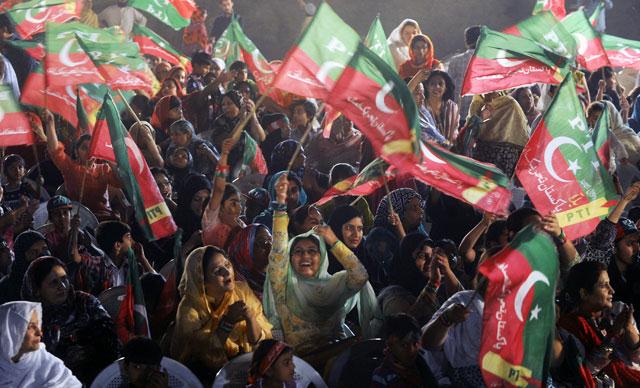
Women gather to support Imran Khan at an election rally. Source.
In particular, aside from mainstream news outlets providing coverage of the election, popular feminist blogs such as The Frisky and Jezebel went beyond their celebrity gossip, fashion and relationship advice taglines to pick up the story. Both websites emphasized Mateela, one of the small villages where men came under a joint agreement to not allow women to vote since it went against ‘local tradition’. Another focus was on the threat of sexual harassment near polling stations, which was one of the primary reasons given by the village male elders for their decision. However, these factors did not stop a significant and unprecedented number of Pakistani women who came forward to exercise their right to vote and engage in the elections as candidates.
At first glance, there doesn’t seem to be anything wrong with showcasing the real struggles of Pakistani women participating in elections. However, while it is encouraging to see news coverage of women in Pakistan as agents of change, it is important to critically examine why and how the media frames the factors influencing their decisions and actions, given the not-so stellar reputation of most media (particularly mainstream Western media) in accurately looking at Muslim women’s denial or violation of rights.
The common thread tying these articles together is an image. It is an image that has gained considerable traction in the past couple of years and can be summed up in one individual: Malala Yousafzai. She is the ultimate icon of the defiant Muslim woman who bravely challenges the authority of oppressive Muslim men (For more on this image, see MMW writer Emaan’s excellent analysis).
This emerging image fails to cover all levels of marginalization and disempowerment experienced by Pakistani women. It perpetuates a rather simplistic understanding of what motivates these women to enact positive change. The problem, here, is the construction of religion as a source of oppression and ignoring other equally if not more vital factors contributing to the rise of Pakistani women in elevating their social, economic and political status. By zeroing in on ‘ultra conservative’, ‘tribal’, ‘fundamentalist Islamic’ attitudes of Pakistani culture that confine women to the domestic sphere, the media is quite successful in detracting attention away from a complex web of influences: chronic poverty, uneven access to water or electricity, high unemployment rates, poor health care provision, lack of education, corruption, and insecurity.
Why do these factors fail to illicit the same level of righteous outrage as traditional culture? Often, it is the toxic mix of this set of factors that promotes the violation of women’s rights in Pakistan, which is unfairly packaged by the media as an authentic expression of culture. Of course, this type of superficial attention to the welfare of Pakistani women serves as a justification for the War on Terror. The main point is that Pakistani women are not solely motivated by a need to defy tradition but by a need to see a marked improvement in all aspects of their lives, as suggested by this Guardian article.
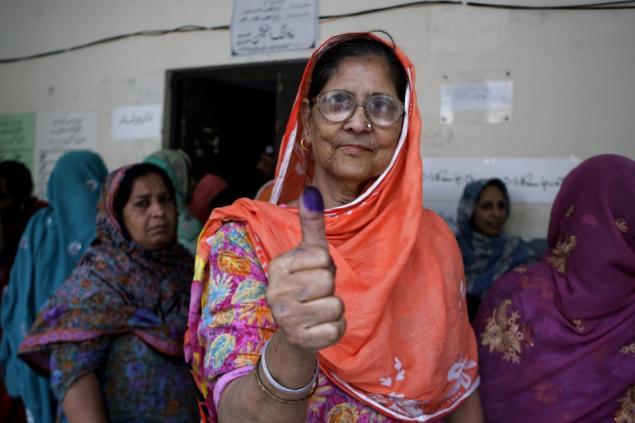
A Pakistani woman shows off her ink stained thumb after casting her vote. Source.
Unpacking the discourse of tradition versus human rights prevalent in these media depictions reveals another problematic assumption: the lumping of rural/urban, poor/middle class/rich, and feudal/non-feudal Pakistani women as one homogenous group experiencing the same forms of disempowerment at a consistent level. Often, the articles mention the struggles of prominent female politicians such as Benazir Bhutto and Hina Rabbani Khar but they do not elaborate on the privilege enjoyed by these elite women in being able to access Pakistan’s political system. The ruling feudal (land-owning) class derives its wealth and power on the backs of subordinate classes, placing the majority of Pakistani women at an utter and deep disadvantage. Gender equality in Pakistan cannot be achieved if these contradictions are not realized.
But all is not lost. There is an undeniable surge in Pakistani women becoming agents of change on their own terms, in their own rights. The positive informative gem gleaned from this media narrative is the revitalization of the civic spirit of women in Pakistan. Ever hopeful amidst chaos, the resilience apparent in these stories is truly remarkable and a testament to the strength of human nature in withstanding adversity.
Previous Post

May 13, 2013
Running for Boston in Jakarta
Browse Our Archives
Select a Category Advertisements Art/Theater Books/Magazines Cinema Comics/Cartoons Culture/Society Events Fashion Film Friday Links Merchandise/Commodities MMW Announcements MMW Highlights Music/Radio News Photography Politics Profile Ramadan 2012 Ramadan 2013 Ramadan 2014 Ramadan 2015 Roundtable Satire Social Media Sports Technology/Science Television Uncategorized Video Web
Select a Month November 2015 October 2015 September 2015 August 2015 July 2015 June 2015 May 2015 April 2015 March 2015 January 2015 December 2014 November 2014 October 2014 September 2014 July 2014 June 2014 May 2014 April 2014 March 2014 February 2014 January 2014 December 2013 November 2013 October 2013 September 2013 August 2013 July 2013 June 2013 May 2013 April 2013 March 2013 February 2013 January 2013 December 2012 November 2012 October 2012 September 2012 August 2012 July 2012 June 2012 May 2012 April 2012 March 2012 February 2012 January 2012 December 2011 November 2011 September 2011 August 2011 July 2011 June 2011 May 2011 April 2011 March 2011 February 2011 January 2011 December 2010 November 2010 October 2010 September 2010 August 2010 July 2010 June 2010 May 2010 April 2010 March 2010 February 2010 January 2010 December 2009 November 2009 October 2009 September 2009 August 2009 July 2009 June 2009 May 2009 April 2009 March 2009 February 2009 January 2009 December 2008 November 2008 October 2008 September 2008 August 2008 July 2008 June 2008 May 2008 April 2008 March 2008 February 2008 January 2008 December 2007 November 2007 October 2007 September 2007 August 2007
Follow Us!
TAKE THE
Religious Wisdom Quiz
What Persian king chose Esther as queen?
Select your answer to see how you score.
Cyrus Artaxerxes Xerxes (Ahasuerus) Darius
Related posts from Muslimah Media Watch



Why British MP’s statements defending Muslim women do...
Niqab as an #Elxn42 Issue? Ridiculous
TRENDING AT PATHEOS Muslim

25 Years Later: How Much Has Changed for...
As we approach the 25th anniversary of September 11th, I’ve found myself...

Podcast: Third Spaces & The Rise of Yemeni...
In the latest episode of The Artistic Foodies Podcast, hosts Abbas...

HalalFest Picks: Best 60 Halal Spots for Super...
Back in 2016, I came up with a list of 29...

Unity Is America’s Strength — Division Is Its...
by Hidayatullah Ahsan When Valentina Gomez, a Republican candidate for Congress in...

Zohran Mamdani and New York’s Fight Against Islamophobia
This past June, against all odds, Zohran Mamdani won the Democratic primary...

What the Fourth of July Means to a...
As we mark another Fourth of July, millions of Americans will celebrate...
view all Muslim blogs
Ad-Free & Subscriber Log-In Subscription Support
- About Us
- 2026 Calendar
- Videos
- Podcasts
- Library of World Religions
- Faith In Media Tracker
- Advertise With Us
- Write for Us
- Privacy Policy
- Terms of Service
- Do Not Sell My Data
- Contact Us
- Radiant Digital
- Manage Newsletter Subscriptions
- Unsubscribe From Notifications
- Sitemap
Copyright 2008-2026, Patheos. All rights reserved.
Subscription Support Ad-Free & Subscriber Log-In
Follow Patheos