
BuddhistCatholicContemplativeEvangelicalGeneral ChristianHinduJewishLatter-day SaintMuslimNew VisionsProgressive Christian
Beliefs
- Buddhist
- Catholic
- Contemplative
- Evangelical
- General Christian
- Hindu
- Jewish
- Latter-day Saint
- More Voices
- Muslim
- New Visions
- Pagan
- Progressive Christian
Topics
- Religion News
- Food and Religion
- Sports and Religion
- Religious Art
- Religious Music and Entertainment
- Religious Events
- History and Religion
- Style and Religion
- Politics and Religion
- Women in Religion
- Recreation Outdoors and Religion
- Business Finance and Religion
- Careers Workplace and Religion
- Education and Religion
- Family Parenting and Religion
- Health Fitness and Religion
- Home and Religion
- Relationships and Religion
- Technology and Religion
- Travel and Religion
Columnists
- Buddhist Columnists
- Business Finance and Religion Columnists
- Careers Workplace and Religion Columnists
- Catholic Columnists
- Contemplative Columnists
- Education and Religion Columnists
- Evangelists Columnists
- Family Parenting and Religion Columnists
- General Christian Columnists
- Health Fitness and Religion Columnists
- Hindu Columnists
- History and Religion Columnists
- Home and Religion Columnists
- Jewish Columnists
- More Voices Columnists
- Latter Day Columnists
- Muslim Columnists
- New Visions Columnists
- Nonreligious Columnists
- Pagan Columnists
- Politics and Religion Columnists
- Progressive Columnists
- Recreation Outdoors and Religion Columnists
- Relationships and Religion Columnists
- Religion News Columnists
- Religious Art Columnists
- Religious Events Columnists
- Religious Music and Entertainment Columnists
- Sports and Religion Columnists
- Style and Religion Columnists
- Technology and Religion Columnists
- Travel and Religion Columnists
- Women in Religion Columnists
Resource Library
- 2026 Calendar
- Library of World Religions
- The 100 Most Holy Places on Earth
- Patheos Answers
- Podcasts
- Videos
- Faith Leaders Database
- Anglican Episcopalian
- Bahai
- Baptist
- Buddhism
- Christianity
- Confucianism
- Eastern Orthodoxy
- Hinduism
- Holiness and Pentecostal
- ISKCON
- Islam
- Judaism
- Lutheran
- Methodist
- The Church of Jesus Christ of Latter-day Saints
- New Age
- Paganism
- Presbytarian and Reformed
- Protestantism
- Religion Behind the Scenes
- Roman Catholic
- Scientology
- Shia Islam
- Sikhism
- Sufism
- Sunni Islam
- Taoism
- Zen
- See all religions
Research Tools
 Ad-Free & Subscriber Log-In Subscription Support
Ad-Free & Subscriber Log-In Subscription Support
Follow Patheos 

- Trending:
- Forgiveness
- |
- Marriage
- |
- Consciousness
- |
- Death Penalty
- |
- Election
- |
- Halloween
 Muslimah Media Watch
- Home
- Muslim
- Religion News
- Saudi Women at the Helm: Beneficiaries of the Arab Spring
Saudi Women at the Helm: Beneficiaries of the Arab Spring
Last updated on: May 1, 2013 at 2:00 am by merium
Saudi Women at the Helm: Beneficiaries of the Arab Spring 2013-04-30T23:34:23-04:00 merium
Patheos Explore the world's faith through different perspectives on religion and spirituality! Patheos has the views of the prevalent religions and spiritualities of the world.
For the past two years, sweeping political changes in parts of the Middle East have had a profound impact on socio-cultural and legal traditions. Arab women have been at the forefront of this change, exercising their rights as political citizens and raising their voices against injustices within their own countries and in support of others across the region. Recent developments, however, suggest that while the Gulf states (excluding Bahrain) have remained largely untouched by revolutionary antics, Saudi Arabia appears to have supported credible changes at the policy level which might suggest a softening of attitudes towards women’s role in society. This sudden shift towards affecting democratic change appears to also have spurred increased activism (and civil society engagement) with regards to women’s rights in this conservative country.
One of the most crucial changes to take place is the announcement in 2011 by King Abdullah that women will finally be allowed to vote and run as candidates in municipal elections to be held in 2015. In a country where women navigate public space through an intense system of guardianship founded on a restrictive social code of separation of sexes, this policy announcement is an important step towards political and economic empowerment of women. This announcement occurred several days before the all-male 2011 municipal elections were to take place in the country. Further, potentially spurring this announcement was the “Baladi” campaign, launched in response to women being banned women from voting in the 2011 elections, allegedly on account of lack of institutional preparedness by the government. Independent national ID cards will also be issued to women on the basis of a phased plan, within a seven-year period. This, however, raises an obvious question: how are women expected to “independently” register to vote or stand as candidates in the upcoming municipal elections without the above-mentioned ID cards?
A more recent development this past February was the swearing-in of 30 new female members to the previously all-male Shura or Consultative Council by King Abdullah. It is important to note that Saudi Arabia does not have a written constitution per se or an elected parliament other than a council (Consultative Council) of appointed officials who serve as advisors to the King. A constitution in the form of a Decree (Decree A/90) serves as a framework for legislation, the basis of which is founded entirely in religious jurisprudence. It is no wonder that the appointment of women to an important decision-making and leadership post has been criticized by some clerics. Also joining the council members for the very first time will be female news reporters reporting on Council sessions. Women journalists were previously not allowed to cover these sessions.
Although women are still not legally allowed to drive (despite considerable attempts to the contrary), Prince Alwaleed bin Talal used Twitter to make a case for allowing women to drive, by indicating that such a pronouncement will save approximately 500,000 jobs in the Kingdom. His argument was that allowing women to drive could potentially cut down on the country’s reliance on foreign workers. Whether the aforementioned will actually propel authorities to push to repeal the driving ban is not clear. Other recent achievements include female athletes representing Saudi Arabia at the Olympics in London which despite being criticized by a minority is largely seen as a triumph for women participating in sports in the Kingdom. A ban on female cashiers at supermarkets was also lifted, and women have replaced male sales clerks at lingerie stores across the country.
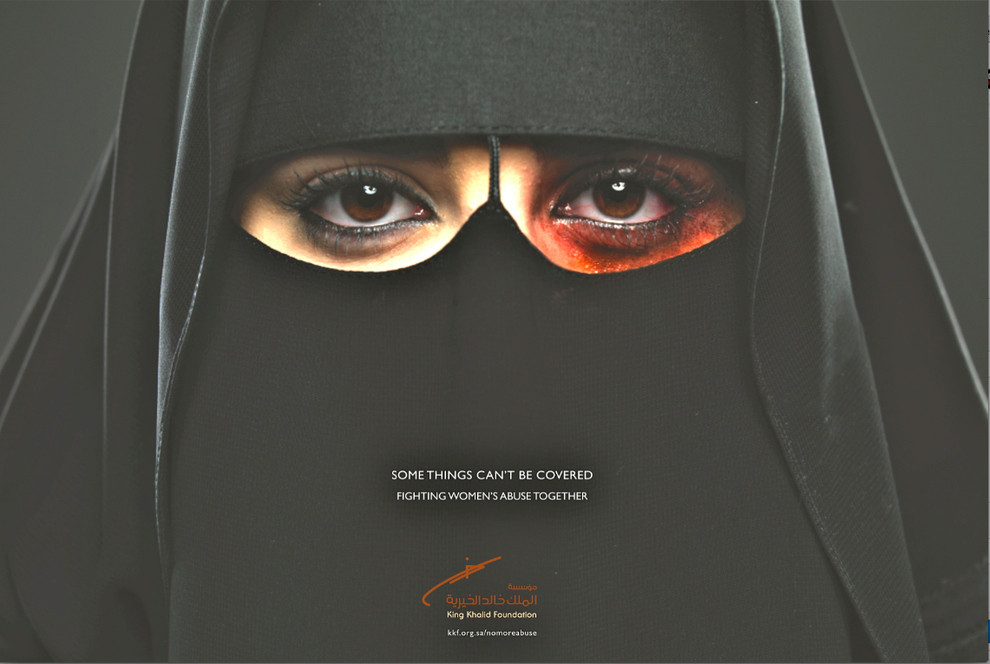
A Saudi ad against domestic abuse. [Source].
Finally, an image posted on Imgur is receiving considerable attention for raising awareness about violence against women. The image (an ad), created by the King Khalid Foundation for their No More Abuse campaign, which depicts a woman in a niqab with a bruised eye, is a stark reminder of the stigma surrounding violence against women. While studies on the nature and extent of domestic violence in the country is limited, a reportby Freedom House indicates that in Saudi Arabia, guardianship laws make it very difficult for battered wives to find shelter. Additionally, the police are not always willing to get involved in what they perceive is entirely private, family matter. Advocacy on reporting domestic violence incidences is a belated, first step towards addressing the lack of legal recourse and support for women under such duress.
Civil society engagement and activism is still comparatively limited within Saudi Arabia (and in many GCC countries except Bahrain). The country hosts numerous CSOs but most are government affiliated and monitored and therefore lack the independence to effectively serve as a counterbalance to the power and influence of the state. Many instances of activism over the past two years however suggest that not only is civil society engagement particularly on women’s rights (which receive considerable media attention) alive and well but has in some respect been influenced by the “uprisings” and “revolutions” taking place across the region. For instance, the Baladi campaign, which I referred to earlier in this post, exemplifies non-violent activism, which may have contributed (the last straw, so to speak) to the increase of women’s political rights in the country. Others, like Manal Al Sharif or the group of women arrested for driving in various cities of Saudi Arabia are part of an even larger number of women hoping to overturn the law that stifles their freedom of movement. Dozens of women have been arrested protesting the incarceration of their male relatives who, as political activists have been held without access to due process for years. Finally, one cannot speak of CSOs without mentioning Wajeha Al Huwaider, the co-founder of the Association for the Protection and Defense of Women’s Rights in Saudi Arabia, an activist and vocal opponent of the country’s guardianship system.
Whether the monarchy is paying lip service to growing civil society discontent, or if these are a series of initiatives spearheaded by a select group of power brokers to manage the country’s image internationally, is unclear. What is becoming increasingly obvious is that Saudi women have joined the chorus of Muslim women’s voices across the region, protesting against oppressive and discriminatory policies both at home and across the region. Ultimately, any legal amendments towards women’s advancement in Saudi Arabia cannot be undertaken without the support of strong government leadership with the political will and commitment to take the necessary political risks (gender being a sensitive issue at best) to implement necessary change. I believe the time leading up to the 2015 municipal elections will be critical in this regard. The purported lack of institutional arrangements which curtailed women’s participation in the 2011 municipal elections will no longer be a valid reason to deny women the right to vote or stand for elections. The signs, however, do suggest that (regardless of the reasons behind them) the present regime is taking measures that will improve women’s role in society, and with the King gaining a reputation for being reform-minded, a golden age for Saudi women could actually be closer than we imagined.
Previous Post

April 30, 2013
Introducing MMW's Newest Writers!
Next Post

May 2, 2013 Propelling Iran's Bad Rep
Browse Our Archives
Select a Category Advertisements Art/Theater Books/Magazines Cinema Comics/Cartoons Culture/Society Events Fashion Film Friday Links Merchandise/Commodities MMW Announcements MMW Highlights Music/Radio News Photography Politics Profile Ramadan 2012 Ramadan 2013 Ramadan 2014 Ramadan 2015 Roundtable Satire Social Media Sports Technology/Science Television Uncategorized Video Web
Select a Month November 2015 October 2015 September 2015 August 2015 July 2015 June 2015 May 2015 April 2015 March 2015 January 2015 December 2014 November 2014 October 2014 September 2014 July 2014 June 2014 May 2014 April 2014 March 2014 February 2014 January 2014 December 2013 November 2013 October 2013 September 2013 August 2013 July 2013 June 2013 May 2013 April 2013 March 2013 February 2013 January 2013 December 2012 November 2012 October 2012 September 2012 August 2012 July 2012 June 2012 May 2012 April 2012 March 2012 February 2012 January 2012 December 2011 November 2011 September 2011 August 2011 July 2011 June 2011 May 2011 April 2011 March 2011 February 2011 January 2011 December 2010 November 2010 October 2010 September 2010 August 2010 July 2010 June 2010 May 2010 April 2010 March 2010 February 2010 January 2010 December 2009 November 2009 October 2009 September 2009 August 2009 July 2009 June 2009 May 2009 April 2009 March 2009 February 2009 January 2009 December 2008 November 2008 October 2008 September 2008 August 2008 July 2008 June 2008 May 2008 April 2008 March 2008 February 2008 January 2008 December 2007 November 2007 October 2007 September 2007 August 2007
Follow Us!
TAKE THE
Religious Wisdom Quiz
What river did the Israelites cross to enter the Promised Land?
Select your answer to see how you score.
Tigris River Euphrates River Jordan River Nile River
Related posts from Muslimah Media Watch

#PrayforParis, Muslim Women and Third World Violence


Hate Crimes and Mother Tongues

Interview with Comedian Eman El Husseini
TRENDING AT PATHEOS Muslim

25 Years Later: How Much Has Changed for...
As we approach the 25th anniversary of September 11th, I’ve found myself...

Podcast: Third Spaces & The Rise of Yemeni...
In the latest episode of The Artistic Foodies Podcast, hosts Abbas...

HalalFest Picks: Best 60 Halal Spots for Super...
Back in 2016, I came up with a list of 29...

Unity Is America’s Strength — Division Is Its...
by Hidayatullah Ahsan When Valentina Gomez, a Republican candidate for Congress in...

Zohran Mamdani and New York’s Fight Against Islamophobia
This past June, against all odds, Zohran Mamdani won the Democratic primary...

What the Fourth of July Means to a...
As we mark another Fourth of July, millions of Americans will celebrate...
view all Muslim blogs
Ad-Free & Subscriber Log-In Subscription Support
- About Us
- 2026 Calendar
- Videos
- Podcasts
- Library of World Religions
- Faith In Media Tracker
- Advertise With Us
- Write for Us
- Privacy Policy
- Terms of Service
- Do Not Sell My Data
- Contact Us
- Radiant Digital
- Manage Newsletter Subscriptions
- Unsubscribe From Notifications
- Sitemap
Copyright 2008-2026, Patheos. All rights reserved.
Subscription Support Ad-Free & Subscriber Log-In
Follow Patheos