
BuddhistCatholicContemplativeEvangelicalGeneral ChristianHinduJewishLatter-day SaintMuslimNew VisionsProgressive Christian
Beliefs
- Buddhist
- Catholic
- Contemplative
- Evangelical
- General Christian
- Hindu
- Jewish
- Latter-day Saint
- More Voices
- Muslim
- New Visions
- Pagan
- Progressive Christian
Topics
- Religion News
- Food and Religion
- Sports and Religion
- Religious Art
- Religious Music and Entertainment
- Religious Events
- History and Religion
- Style and Religion
- Politics and Religion
- Women in Religion
- Recreation Outdoors and Religion
- Business Finance and Religion
- Careers Workplace and Religion
- Education and Religion
- Family Parenting and Religion
- Health Fitness and Religion
- Home and Religion
- Relationships and Religion
- Technology and Religion
- Travel and Religion
Columnists
- Buddhist Columnists
- Business Finance and Religion Columnists
- Careers Workplace and Religion Columnists
- Catholic Columnists
- Contemplative Columnists
- Education and Religion Columnists
- Evangelists Columnists
- Family Parenting and Religion Columnists
- General Christian Columnists
- Health Fitness and Religion Columnists
- Hindu Columnists
- History and Religion Columnists
- Home and Religion Columnists
- Jewish Columnists
- More Voices Columnists
- Latter Day Columnists
- Muslim Columnists
- New Visions Columnists
- Nonreligious Columnists
- Pagan Columnists
- Politics and Religion Columnists
- Progressive Columnists
- Recreation Outdoors and Religion Columnists
- Relationships and Religion Columnists
- Religion News Columnists
- Religious Art Columnists
- Religious Events Columnists
- Religious Music and Entertainment Columnists
- Sports and Religion Columnists
- Style and Religion Columnists
- Technology and Religion Columnists
- Travel and Religion Columnists
- Women in Religion Columnists
Resource Library
- 2026 Calendar
- Library of World Religions
- The 100 Most Holy Places on Earth
- Patheos Answers
- Podcasts
- Videos
- Faith Leaders Database
- Anglican Episcopalian
- Bahai
- Baptist
- Buddhism
- Christianity
- Confucianism
- Eastern Orthodoxy
- Hinduism
- Holiness and Pentecostal
- ISKCON
- Islam
- Judaism
- Lutheran
- Methodist
- The Church of Jesus Christ of Latter-day Saints
- New Age
- Paganism
- Presbytarian and Reformed
- Protestantism
- Religion Behind the Scenes
- Roman Catholic
- Scientology
- Shia Islam
- Sikhism
- Sufism
- Sunni Islam
- Taoism
- Zen
- See all religions
Research Tools
 Ad-Free & Subscriber Log-In Subscription Support
Ad-Free & Subscriber Log-In Subscription Support
Follow Patheos 

- Trending:
- Forgiveness
- |
- Marriage
- |
- Consciousness
- |
- Death Penalty
- |
- Election
- |
- Halloween
 Muslimah Media Watch
- Home
- Muslim
- Religion News
- Muslim Women and Graffiti: Taking Art, Politics and Gender to the Streets
Muslim Women and Graffiti: Taking Art, Politics and Gender to the Streets
Last updated on: May 30, 2013 at 2:00 am by eren
Muslim Women and Graffiti: Taking Art, Politics and Gender to the Streets 2013-05-29T19:03:13-04:00 eren
Patheos Explore the world's faith through different perspectives on religion and spirituality! Patheos has the views of the prevalent religions and spiritualities of the world.
When I was a teenager, my dad and I used to enjoy looking at the graffiti painted all over Mexico City. While my dad was a critic of the graffiti that was just scribbles and swear words and obscene signs, we enjoyed those graffitos that were not only truly artistic but also political. Graffiti was, and continues to be, widely spread through Mexico as political and economic turmoil were the themes of the 90s and the early 2000’s.
Graffiti, which remains illegal in most states in Mexico, is a dangerous activity that is associated with “gangs” and mostly men that have “nothing better to do.” Nonetheless, even in my teen years, I saw in many graffiti pieces meaningful lessons of change and hope.
Although I completely acknowledge the challenges that come along with having private property damaged with graffiti and the like, I see graffiti art as a powerful way of expression that resembles that of political cartoons, which I discussed last year. Whereas graffiti has also been used to intimidate others, including Muslim women these days, it has a lot of value when used to deliver positive messages.
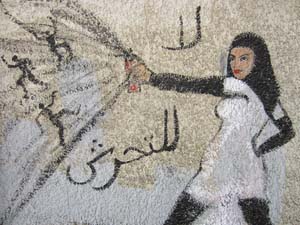
Graffiti against sexual harassment Via Amnesty International

Graffiti is not only a medium designed to reach even the most oblivious audiences, but it also infiltrates the political sphere by questioning and mocking authority. The question of whether graffiti is art or just pure vandalism that affects the public interest continues to be debated (for example, here, here and here).
In the past few weeks, Muslim women have appeared in media stories that depict them as rebel agents that are instigating change through graffiti. Not only are these women challenging social expectations by stepping into an all-male dominated sphere, but they are also bringing along strong messages against problems that affect mostly female populations (sexual harassment, rape, political participation, etc.). Women are entering the public sphere, through the artists and through the walls on which women are depicted.
Recently, graffiti artists in Afghanistan and Egypt are being featured in the Western media for their accomplishments in challenging the authorities in their respective countries. For instance, Malina Suliman is said to be one of the few female graffiti artists in “the most dangerous country in the world,” Afghanistan. She teaches, paints and goes out to paint graffiti around the country despite societal restrictions and her family’s opposition. Similarly, the Women on Walls (WOW) organization has draw attention because of their artistic approach in the world of graffiti, which targets women’s difficulties in post-Arab Spring societies.
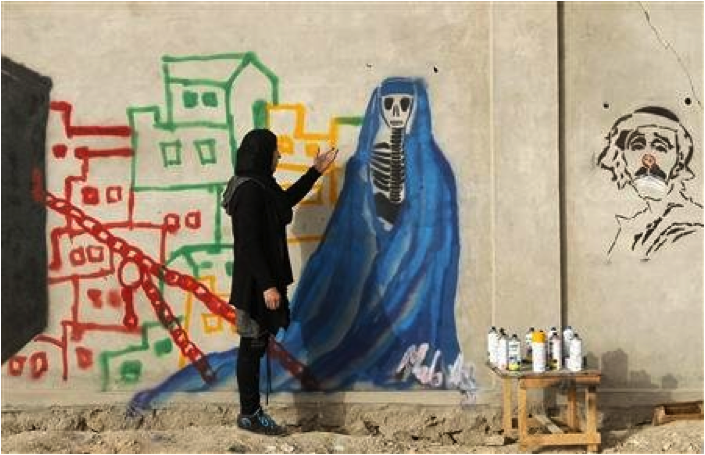
Malina Suliman. Via greenprophet.com.
Some media sources highlight graffiti artists in the Middle Eastern context as agents of change partly because they defy Western views on Muslim women as passive and oppressed. On the one hand, women in hijabs and graffiti are not usually what the Western media expects. On the other, these women have been successful in getting away with drawing in public spaces in what Western media sources consider to be oppressive and more-than-dangerous societies.
Yet, I think that what comes along with Muslim women’s graffiti is not only agency, but also a way to attract attention to a message rather than the messenger. In that regard, Hannah Habibi’s phrase resonates with me:
“I feel that if only the voices of Muslim women were presented a little more by the media, rather than simply being talked about, we would benefit and become a little more understanding of one another.”
And that’s exactly what I feel is missing in the coverage of Muslim female graffiti artists… what are they saying? How? And why? The walls in which these women draw use strong symbolism and messages, giving voice to their feelings. Graffiti, unlike many other forms of art, is not the art of the elite. It often speaks of challenges of ordinary people, faced in this case, by middle-class and lower-class women. It invites the observer or the passerbys to see those challenges
The stories being told on the walls by Muslim women remind me of my teen years, when I easily connected with the words in the walls. Graffiti may be either inviting or repulsive depending on who you are, but you are forced to look at the message.
After reading few stories on Muslim women and graffiti however, I think the question is fair: can we go beyond looking, to really listen to the messages?
Previous Post

May 29, 2013
Black Muslim Lesbians Find Community in Atlanta’s Gay Mecca: Part 2
Next Post
May 31, 2013 Friday Links | May 31, 2013
Browse Our Archives
Select a Category Advertisements Art/Theater Books/Magazines Cinema Comics/Cartoons Culture/Society Events Fashion Film Friday Links Merchandise/Commodities MMW Announcements MMW Highlights Music/Radio News Photography Politics Profile Ramadan 2012 Ramadan 2013 Ramadan 2014 Ramadan 2015 Roundtable Satire Social Media Sports Technology/Science Television Uncategorized Video Web
Select a Month November 2015 October 2015 September 2015 August 2015 July 2015 June 2015 May 2015 April 2015 March 2015 January 2015 December 2014 November 2014 October 2014 September 2014 July 2014 June 2014 May 2014 April 2014 March 2014 February 2014 January 2014 December 2013 November 2013 October 2013 September 2013 August 2013 July 2013 June 2013 May 2013 April 2013 March 2013 February 2013 January 2013 December 2012 November 2012 October 2012 September 2012 August 2012 July 2012 June 2012 May 2012 April 2012 March 2012 February 2012 January 2012 December 2011 November 2011 September 2011 August 2011 July 2011 June 2011 May 2011 April 2011 March 2011 February 2011 January 2011 December 2010 November 2010 October 2010 September 2010 August 2010 July 2010 June 2010 May 2010 April 2010 March 2010 February 2010 January 2010 December 2009 November 2009 October 2009 September 2009 August 2009 July 2009 June 2009 May 2009 April 2009 March 2009 February 2009 January 2009 December 2008 November 2008 October 2008 September 2008 August 2008 July 2008 June 2008 May 2008 April 2008 March 2008 February 2008 January 2008 December 2007 November 2007 October 2007 September 2007 August 2007
Follow Us!
TAKE THE
Religious Wisdom Quiz
What does James say shows someone their faith by?
Select your answer to see how you score.
Their deeds (works) Their words Their worship Their knowledge
Related posts from Muslimah Media Watch

#PrayforParis, Muslim Women and Third World Violence


Hate Crimes and Mother Tongues

Interview with Comedian Eman El Husseini
TRENDING AT PATHEOS Muslim

25 Years Later: How Much Has Changed for...
As we approach the 25th anniversary of September 11th, I’ve found myself...

Podcast: Third Spaces & The Rise of Yemeni...
In the latest episode of The Artistic Foodies Podcast, hosts Abbas...

HalalFest Picks: Best 60 Halal Spots for Super...
Back in 2016, I came up with a list of 29...

Unity Is America’s Strength — Division Is Its...
by Hidayatullah Ahsan When Valentina Gomez, a Republican candidate for Congress in...

Zohran Mamdani and New York’s Fight Against Islamophobia
This past June, against all odds, Zohran Mamdani won the Democratic primary...

What the Fourth of July Means to a...
As we mark another Fourth of July, millions of Americans will celebrate...
view all Muslim blogs
Ad-Free & Subscriber Log-In Subscription Support
- About Us
- 2026 Calendar
- Videos
- Podcasts
- Library of World Religions
- Faith In Media Tracker
- Advertise With Us
- Write for Us
- Privacy Policy
- Terms of Service
- Do Not Sell My Data
- Contact Us
- Radiant Digital
- Manage Newsletter Subscriptions
- Unsubscribe From Notifications
- Sitemap
Copyright 2008-2026, Patheos. All rights reserved.
Subscription Support Ad-Free & Subscriber Log-In
Follow Patheos