
BuddhistCatholicContemplativeEvangelicalGeneral ChristianHinduJewishLatter-day SaintMuslimNew VisionsProgressive Christian
Beliefs
- Buddhist
- Catholic
- Contemplative
- Evangelical
- General Christian
- Hindu
- Jewish
- Latter-day Saint
- More Voices
- Muslim
- New Visions
- Pagan
- Progressive Christian
Topics
- Religion News
- Food and Religion
- Sports and Religion
- Religious Art
- Religious Music and Entertainment
- Religious Events
- History and Religion
- Style and Religion
- Politics and Religion
- Women in Religion
- Recreation Outdoors and Religion
- Business Finance and Religion
- Careers Workplace and Religion
- Education and Religion
- Family Parenting and Religion
- Health Fitness and Religion
- Home and Religion
- Relationships and Religion
- Technology and Religion
- Travel and Religion
Columnists
- Buddhist Columnists
- Business Finance and Religion Columnists
- Careers Workplace and Religion Columnists
- Catholic Columnists
- Contemplative Columnists
- Education and Religion Columnists
- Evangelists Columnists
- Family Parenting and Religion Columnists
- General Christian Columnists
- Health Fitness and Religion Columnists
- Hindu Columnists
- History and Religion Columnists
- Home and Religion Columnists
- Jewish Columnists
- More Voices Columnists
- Latter Day Columnists
- Muslim Columnists
- New Visions Columnists
- Nonreligious Columnists
- Pagan Columnists
- Politics and Religion Columnists
- Progressive Columnists
- Recreation Outdoors and Religion Columnists
- Relationships and Religion Columnists
- Religion News Columnists
- Religious Art Columnists
- Religious Events Columnists
- Religious Music and Entertainment Columnists
- Sports and Religion Columnists
- Style and Religion Columnists
- Technology and Religion Columnists
- Travel and Religion Columnists
- Women in Religion Columnists
Resource Library
- 2026 Calendar
- Library of World Religions
- The 100 Most Holy Places on Earth
- Patheos Answers
- Podcasts
- Videos
- Faith Leaders Database
- Anglican Episcopalian
- Bahai
- Baptist
- Buddhism
- Christianity
- Confucianism
- Eastern Orthodoxy
- Hinduism
- Holiness and Pentecostal
- ISKCON
- Islam
- Judaism
- Lutheran
- Methodist
- The Church of Jesus Christ of Latter-day Saints
- New Age
- Paganism
- Presbytarian and Reformed
- Protestantism
- Religion Behind the Scenes
- Roman Catholic
- Scientology
- Shia Islam
- Sikhism
- Sufism
- Sunni Islam
- Taoism
- Zen
- See all religions
Research Tools
 Ad-Free & Subscriber Log-In Subscription Support
Ad-Free & Subscriber Log-In Subscription Support
Follow Patheos 

- Trending:
- Forgiveness
- |
- Marriage
- |
- Consciousness
- |
- Death Penalty
- |
- Election
- |
- Halloween
 Muslimah Media Watch
- Home
- Muslim
- Religion News
- The Colourful Hijab of the African Muslimah
The Colourful Hijab of the African Muslimah
Last updated on: April 22, 2013 at 2:00 am by anike
The Colourful Hijab of the African Muslimah 2013-04-17T00:11:47-04:00 anike
Patheos Explore the world's faith through different perspectives on religion and spirituality! Patheos has the views of the prevalent religions and spiritualities of the world.
The Darfur Sartorialist is an exhibition launched by Portuguese urban engineer, humanitarian and photographer Pedro Matos to showcase the colourful clothing and trendy fashion sense of women in Darfur, Sudan.
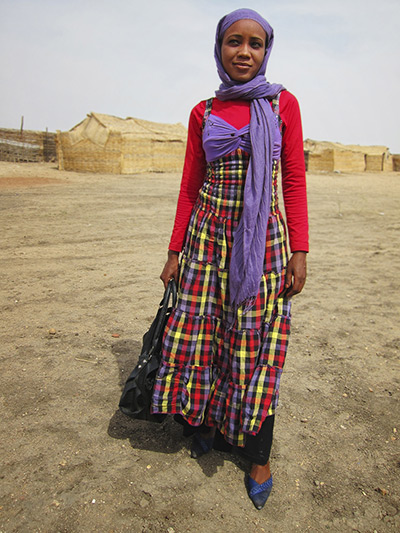
Photo from the Darfur Sartorialist (source).
Matos was in Darfur for three and a half years with the World Food Programme when he started taking these photographs in a country where it is apparently forbidden to do so. Initially surprised by the style and fashion that thrives in Darfur, contrary to Western images of the region as poor and suffering, as well as the freedom women enjoyed in Darfur, some of which he witnessed in the easy way men and women flirted with each other, Matos realised that fashion is not exclusive to Rome or New York. It took the fashion of Darfuri women to enable Matos to realise that reality is more complex than the cliché of the oppressed, conservatively dressed and constantly fearful Muslim woman or of Darfur as a region associated with war, refugees and tragedy.
Upon confronting his personal conceptions of refugees, and of oppressed Muslim women, Matos began taking photos and was further surprised by the “Western gestures” some women took when posing for photographs. He was driven to sharing these photographs with fellow Westerners under the banner of the Darfur Sartorialist, loosely based on Scott Schuman’s The Sartorialist, a blog dedicated to the intersection between fashion and “daily life”. With the tagline “Darfur is fashionable. Beyond the conflict and the images engraved in our minds lies a proud people wearing colour combinations unlikely in the trendy West”, the Darfur Sartorialist aims to counter Western stereotypes of Muslim and African women. At once, the photos of fashionably dressed women in Darfur should lead viewers to question perceived notions of the oppressed Muslim women and the hopeless African continent. We are meant to see that African Muslim women, like Western women, are also concerned about how they look, and on a wider scale Africans are similar to Westerners despite the issues in the Islamic world.
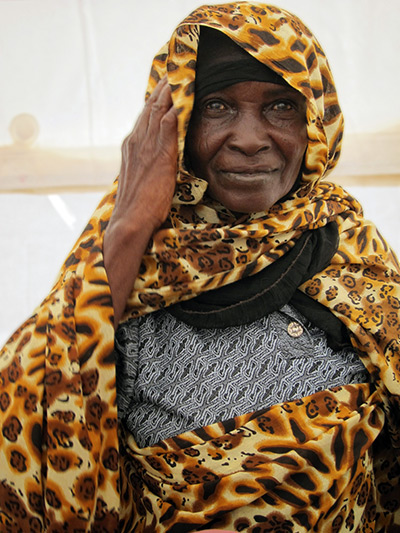
Photo from the Darfur Sartorialist (source).
Good intentions of the Darfur Sartorialist aside, some of the reporting show examples of how not to write about Africa, with a Muslim twist. In the land of suffering, a European is surprised to see smiling faces and so much colour. He then starts taking photographs and amasses a large number over time which he wants to share to other Westerners so that they can challenge their ideas of Sudan and Muslim women’s clothing. It should not be unusual that style and fashion can be found inDarfur, or there are people in refugee camps who smile and are hopeful for the future.
It is interesting that when the subject of African Muslim women and fashion reaches the West, colours becomes a central theme. Last year in reporting the Dakar Fashion Week 2012, Yahoo! News suggested that colourful fashion was too much for the Islamists who had captured several towns in northern Mali, and enforced a strict version of Sharia law. Eren analysed this as a case of women fromMali using fashion as a form of resistance. Although in Mali, the fashion of Muslim women may have been too colourful for the Islamists, the surprise that struck Pedro Matos, when he encountered Darfuri women dressed in colourful clothes, suggests that the hijab of Sudanese women is too colourful for Western ideas of a Muslim woman’s clothing.
Before being shocked that Muslim women wear colourful clothes, it is necessary to bear in mind that interpretations on what counts as modesty are very much based on culture.
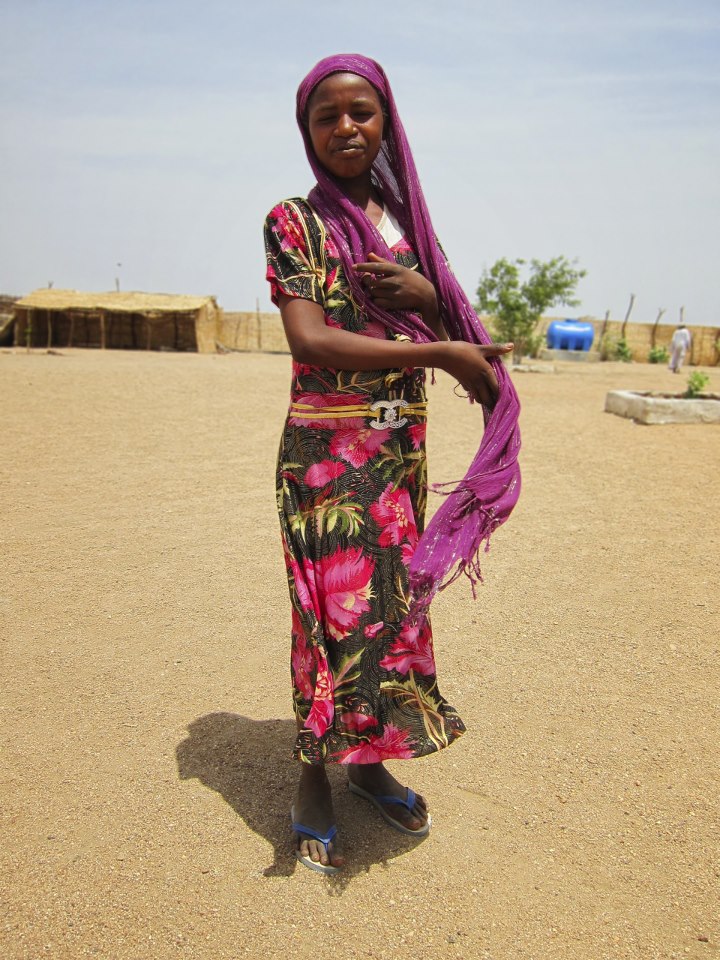
Photo from the Darfur Sartorialist (source).
From the perspective of this Nigerian Muslim, colourful clothes are not necessarily unconservative for Muslim women and colourfully dressed African Muslim women are not new or strange. In Nigeria, where most people dress in flashy colours and shiny jewellery, Muslim women are not to be left aside. Standard clothing that identifies a woman as a Muslim in Nigeria, if not the hijab as influenced by Middle Eastern styles, would be skirts and blouses sewn from West African wax printed fabric in elaborate and varied designs, usually accompanied with equally colourful veils wrapped around the shoulders and/or head.
The colourful, stylish clothing of (non-Muslim) Africans has attracted Western attention in places like the Democratic Republic of Congo, and the streets of West Africa, for example. Now we are seeing the same Western amazement, except with Muslim women. Muslim women can be found wearing colorful clothing in really any African country; to have expected that Muslim women in Sudan would wear clothes that were conservative reveals that African Muslimahs are not free from stereotypes attached to Muslim women’s clothing in other parts of the world that assumes all head covering are oppressive and monochrome coloured.
Could there be something about colourfully clothed Muslimahs that makes Westerners think that Muslim women are not as oppressed at they thought? The Darfur Sartorialist seems to suggest so. In this case, colour seems to be a sign of a liberated Muslim woman, and bold fashion styles reveal the complex realities of poor Africans, specifically poor African Muslims.
Previous Post

April 19, 2013
Friday Links | April 19, 2013
Next Post
April 23, 2013 Colours and Voices: The International Museum of Women Muslima
Browse Our Archives
Select a Category Advertisements Art/Theater Books/Magazines Cinema Comics/Cartoons Culture/Society Events Fashion Film Friday Links Merchandise/Commodities MMW Announcements MMW Highlights Music/Radio News Photography Politics Profile Ramadan 2012 Ramadan 2013 Ramadan 2014 Ramadan 2015 Roundtable Satire Social Media Sports Technology/Science Television Uncategorized Video Web
Select a Month November 2015 October 2015 September 2015 August 2015 July 2015 June 2015 May 2015 April 2015 March 2015 January 2015 December 2014 November 2014 October 2014 September 2014 July 2014 June 2014 May 2014 April 2014 March 2014 February 2014 January 2014 December 2013 November 2013 October 2013 September 2013 August 2013 July 2013 June 2013 May 2013 April 2013 March 2013 February 2013 January 2013 December 2012 November 2012 October 2012 September 2012 August 2012 July 2012 June 2012 May 2012 April 2012 March 2012 February 2012 January 2012 December 2011 November 2011 September 2011 August 2011 July 2011 June 2011 May 2011 April 2011 March 2011 February 2011 January 2011 December 2010 November 2010 October 2010 September 2010 August 2010 July 2010 June 2010 May 2010 April 2010 March 2010 February 2010 January 2010 December 2009 November 2009 October 2009 September 2009 August 2009 July 2009 June 2009 May 2009 April 2009 March 2009 February 2009 January 2009 December 2008 November 2008 October 2008 September 2008 August 2008 July 2008 June 2008 May 2008 April 2008 March 2008 February 2008 January 2008 December 2007 November 2007 October 2007 September 2007 August 2007
Follow Us!
TAKE THE
Religious Wisdom Quiz
According to 1 John, what commandment have we had from the beginning?
Select your answer to see how you score.
To keep the Sabbath holy To forgive our enemies To believe in Jesus Christ To love one another
Related posts from Muslimah Media Watch
Is H&M’s first Muslim model a positive move...

When Arab Women Artists "Revisit The Harem"


TRENDING AT PATHEOS Muslim

25 Years Later: How Much Has Changed for...
As we approach the 25th anniversary of September 11th, I’ve found myself...

Podcast: Third Spaces & The Rise of Yemeni...
In the latest episode of The Artistic Foodies Podcast, hosts Abbas...

HalalFest Picks: Best 60 Halal Spots for Super...
Back in 2016, I came up with a list of 29...

Unity Is America’s Strength — Division Is Its...
by Hidayatullah Ahsan When Valentina Gomez, a Republican candidate for Congress in...

Zohran Mamdani and New York’s Fight Against Islamophobia
This past June, against all odds, Zohran Mamdani won the Democratic primary...

What the Fourth of July Means to a...
As we mark another Fourth of July, millions of Americans will celebrate...
view all Muslim blogs
Ad-Free & Subscriber Log-In Subscription Support
- About Us
- 2026 Calendar
- Videos
- Podcasts
- Library of World Religions
- Faith In Media Tracker
- Advertise With Us
- Write for Us
- Privacy Policy
- Terms of Service
- Do Not Sell My Data
- Contact Us
- Radiant Digital
- Manage Newsletter Subscriptions
- Unsubscribe From Notifications
- Sitemap
Copyright 2008-2026, Patheos. All rights reserved.
Subscription Support Ad-Free & Subscriber Log-In
Follow Patheos