
BuddhistCatholicContemplativeEvangelicalGeneral ChristianHinduJewishLatter-day SaintMuslimNew VisionsProgressive Christian
Beliefs
- Buddhist
- Catholic
- Contemplative
- Evangelical
- General Christian
- Hindu
- Jewish
- Latter-day Saint
- More Voices
- Muslim
- New Visions
- Pagan
- Progressive Christian
Topics
- Religion News
- Food and Religion
- Sports and Religion
- Religious Art
- Religious Music and Entertainment
- Religious Events
- History and Religion
- Style and Religion
- Politics and Religion
- Women in Religion
- Recreation Outdoors and Religion
- Business Finance and Religion
- Careers Workplace and Religion
- Education and Religion
- Family Parenting and Religion
- Health Fitness and Religion
- Home and Religion
- Relationships and Religion
- Technology and Religion
- Travel and Religion
Columnists
- Buddhist Columnists
- Business Finance and Religion Columnists
- Careers Workplace and Religion Columnists
- Catholic Columnists
- Contemplative Columnists
- Education and Religion Columnists
- Evangelists Columnists
- Family Parenting and Religion Columnists
- General Christian Columnists
- Health Fitness and Religion Columnists
- Hindu Columnists
- History and Religion Columnists
- Home and Religion Columnists
- Jewish Columnists
- More Voices Columnists
- Latter Day Columnists
- Muslim Columnists
- New Visions Columnists
- Nonreligious Columnists
- Pagan Columnists
- Politics and Religion Columnists
- Progressive Columnists
- Recreation Outdoors and Religion Columnists
- Relationships and Religion Columnists
- Religion News Columnists
- Religious Art Columnists
- Religious Events Columnists
- Religious Music and Entertainment Columnists
- Sports and Religion Columnists
- Style and Religion Columnists
- Technology and Religion Columnists
- Travel and Religion Columnists
- Women in Religion Columnists
Resource Library
- 2026 Calendar
- Library of World Religions
- The 100 Most Holy Places on Earth
- Patheos Answers
- Podcasts
- Videos
- Faith Leaders Database
- Anglican Episcopalian
- Bahai
- Baptist
- Buddhism
- Christianity
- Confucianism
- Eastern Orthodoxy
- Hinduism
- Holiness and Pentecostal
- ISKCON
- Islam
- Judaism
- Lutheran
- Methodist
- The Church of Jesus Christ of Latter-day Saints
- New Age
- Paganism
- Presbytarian and Reformed
- Protestantism
- Religion Behind the Scenes
- Roman Catholic
- Scientology
- Shia Islam
- Sikhism
- Sufism
- Sunni Islam
- Taoism
- Zen
- See all religions
Research Tools
 Ad-Free & Subscriber Log-In Subscription Support
Ad-Free & Subscriber Log-In Subscription Support
Follow Patheos 

- Trending:
- Forgiveness
- |
- Marriage
- |
- Consciousness
- |
- Death Penalty
- |
- Election
- |
- Halloween
 Muslimah Media Watch
- Home
- Muslim
- Religion News
- Visibility: On Muslim Women in Performance Arts
Visibility: On Muslim Women in Performance Arts
Last updated on: March 5, 2013 at 2:00 am by Guest Contributor
Visibility: On Muslim Women in Performance Arts 2013-03-04T18:20:03-04:00 Guest Contributor
Patheos Explore the world's faith through different perspectives on religion and spirituality! Patheos has the views of the prevalent religions and spiritualities of the world.
This post was written by guest contributor Rana Nazzal.
I had the honour of speaking with three local Ottawa artists about their identity as Muslim women in relation to performance arts.
A few years ago, I noticed a dramatic increase in the presence of Muslim women on stages in Ottawa, particularly in the fields of spoken word and slam poetry. I found their presence both welcoming and encouraging in a scene that may have otherwise been uncomfortable for myself and other Muslim women.
The reality is not necessarily that we are directly ousted from the arts. Rather, our invisibility in public spaces and media in the West is self-perpetuating. It is difficult to enter a space where we are not represented. As Muslim women break these boundaries and our visibility grows, others are encouraged to do the same. This is what has happened, at least, in the Ottawa poetry community.
Hodan Ibrahim and Sarah Musa are two prominent performance poets who have been active members of Ottawa’s spoken word and slam poetry scenes.
Hodan, in introducing herself, says, “I’m an innovator and an inspiring entrepreneur, but I think ‘artist’ is the most encompassing term to describe myself.” Sarah tells me that every aspect of her identity inspires her art: “the fact that I consider myself to be a feminist, to be a Muslim woman who is of the Somali-Canadian diaspora, that I’m Black … my educational background, my love for music, poetry, and writing, and various other things.”
I also wanted to hear the perspective of a Muslim woman performer outside the protective environment of the slam poetry scene. I spoke to Anastasia Filippova, a well-established singer who has released an album of self-written songs. In her own words, Anastasia identifies as “a singer, songwriter, teacher, woman, Muslim, and activist – in no particular order.”
Islam’s influences
In Ottawa, Islam has had a visible effect on the slam poetry communities. “Islam has an underlying influence in the poetry scene, in the sense that people are not afraid to express their spirituality through their poetry,” says Sarah.
Hodan says this was not the case before 2009. Things changed in 2010 when Urban Legends (UL), a new slam series, was launched. “Its founders are Muslim, Black, minorities, and they presented an alternative,” she says. The most notable feature of UL, which distinguished it from the other leading poetry collective, is that it is not hosted in a bar. Hodan adds that the identity of its founders played a role in creating a welcoming space for Muslims and other marginalized groups. In the year of UL’s founding, Hodan competed and secured a spot on the four-member UL team that would compete on a national level. In its second year, Sarah became one of the coordinators of Urban Legends.
http://www.youtube.com/watch?v=z41L2beggbo
Struggles
Like most forms of media, the performance arts are male-dominated. “Being a woman,” says Hodan, “all I can say is that when I started slam, it was 95 percent men.” The reasons vary, she says, and have been changing.
Hodan says that much of the opposition she faced came from her own community. “I think a lot of us, people who are Muslim and female and who come from disadvantaged backgrounds, when we first saw older women of colour poets, were shocked.” Her experience highlights restrictions that Muslim women and women of colour may be internalizing as a result of the prejudices against us that abound in the mainstream. “I definitely feel a different reception from the audiences,” agrees Sarah, although she does not consider it discrimination. “I haven’t felt objectified per se, rather, I felt like, depending on the venues, some people did not take me as seriously as if they were to see a male poet.” She says that as women began taking to the stage, things became easier.
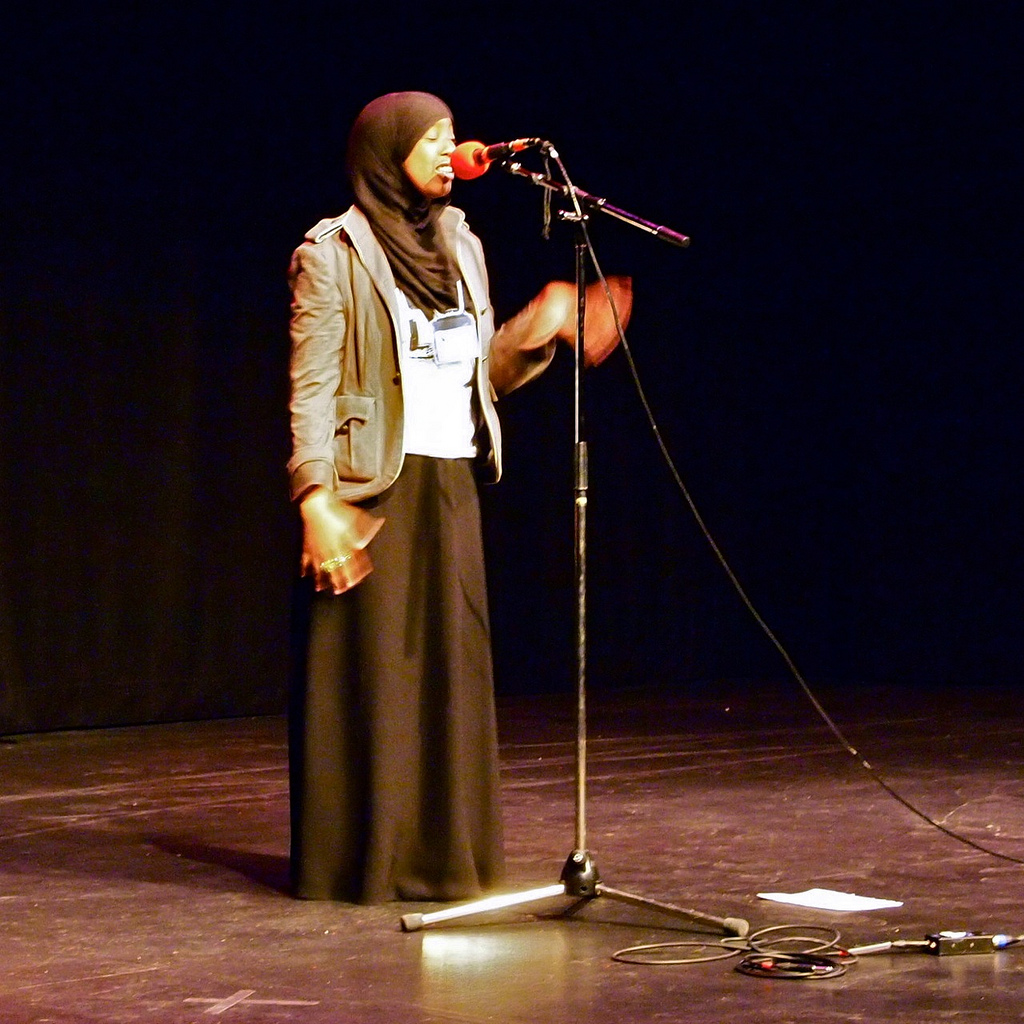
Sarah Musa performing. [Source].
“It’s interesting that the [poetry] space is open for anyone to say anything but the fact that a woman, who is covered, is speaking, it creates a reaction from generally everybody,” says Hodan. Many of those reactions became positive, however. Her universal message has allowed her to transcend boundaries with her audience. “When I speak,” says Hodan, “every word that I say, I feel like God is working through me and I try to represent the Truth through my work,” She says she has never received as much respect as she did when she began performing her art. Sarah says that although she feels her audience receives her differently as a result of being a Muslim woman, the poetry scene is not discriminatory in the ways she has faced in other environments. “Discrimination I have ever faced has been outside of the poetry scene, generally in work place environments,” says Sarah.
Anastasia, as a singer, says she faces opposition in the Muslim community because her performance is highly disputed in Islam. “It’s not necessarily because Muslim events and record labels disagree with a woman performing. I think it’s because they believe they will lose a great deal of their followers. It’s a very controversial issue in our community,” argues Anastasia. As such, she often finds herself performing for events that are not related to Islam. “It gets tricky because then my content is looked at as ‘too Muslim’, or too ‘faith’-centred, or not wild enough for the mainstream.” Anastasia says her art is both inspired and disciplined by “the merciful messages and boundaries of my religion.” If any aspect of that happened to defer opportunities away from her, Anastasia says she would not change: “I don’t mind at all not being invited to certain events based on what I say or who I am. It is part of being an activist. It would be an honour.”
Moving Forward
All three women agreed that as an under-represented group, it was up to them to create their own spaces. “If there’s anything that I’ve learned,” says Sarah, “it is that that no one will create venues for you. You will have to create them yourself.”
The identifying of “Muslim-friendly” spaces sends a problematic message in itself about the needs of our communities. “The fact that we need to have Muslim-centric shows is an issue,” says Hodan. “It demonstrates that this community needs a space to be created because they are not being served.” The women agreed that in the performance arts there is no great difference between a Muslim and a non-Muslim who both deliver a strong and truthful message. As such, there should be no need to differentiate between the religious identities of its participants, but, the reality is that racist, sexist, colonialist, and orientalist perceptions in greater Canadian society still affect us and our understandings of ourselves. Particularly as Muslim women, we are forced to contemplate our identity in the socio-political context of these challenges. The three women I spoke to, however, made it clear that their identities in terms of religion, race, and gender, have been inspirations and empowering to their art, rather than a hindrance.
Previous Post

March 4, 2013
Rise of the Niqabi Criminal: Balaclavas, Burkas and Bank Robberies
Browse Our Archives
Select a Category Advertisements Art/Theater Books/Magazines Cinema Comics/Cartoons Culture/Society Events Fashion Film Friday Links Merchandise/Commodities MMW Announcements MMW Highlights Music/Radio News Photography Politics Profile Ramadan 2012 Ramadan 2013 Ramadan 2014 Ramadan 2015 Roundtable Satire Social Media Sports Technology/Science Television Uncategorized Video Web
Select a Month November 2015 October 2015 September 2015 August 2015 July 2015 June 2015 May 2015 April 2015 March 2015 January 2015 December 2014 November 2014 October 2014 September 2014 July 2014 June 2014 May 2014 April 2014 March 2014 February 2014 January 2014 December 2013 November 2013 October 2013 September 2013 August 2013 July 2013 June 2013 May 2013 April 2013 March 2013 February 2013 January 2013 December 2012 November 2012 October 2012 September 2012 August 2012 July 2012 June 2012 May 2012 April 2012 March 2012 February 2012 January 2012 December 2011 November 2011 September 2011 August 2011 July 2011 June 2011 May 2011 April 2011 March 2011 February 2011 January 2011 December 2010 November 2010 October 2010 September 2010 August 2010 July 2010 June 2010 May 2010 April 2010 March 2010 February 2010 January 2010 December 2009 November 2009 October 2009 September 2009 August 2009 July 2009 June 2009 May 2009 April 2009 March 2009 February 2009 January 2009 December 2008 November 2008 October 2008 September 2008 August 2008 July 2008 June 2008 May 2008 April 2008 March 2008 February 2008 January 2008 December 2007 November 2007 October 2007 September 2007 August 2007
Follow Us!
TAKE THE
Religious Wisdom Quiz
What does the Greek word 'Christos' mean?
Select your answer to see how you score.
Redeemer Savior Lord Anointed One
Related posts from Muslimah Media Watch

#PrayforParis, Muslim Women and Third World Violence


Hate Crimes and Mother Tongues

Interview with Comedian Eman El Husseini
TRENDING AT PATHEOS Muslim

25 Years Later: How Much Has Changed for...
As we approach the 25th anniversary of September 11th, I’ve found myself...

Podcast: Third Spaces & The Rise of Yemeni...
In the latest episode of The Artistic Foodies Podcast, hosts Abbas...

HalalFest Picks: Best 60 Halal Spots for Super...
Back in 2016, I came up with a list of 29...

Unity Is America’s Strength — Division Is Its...
by Hidayatullah Ahsan When Valentina Gomez, a Republican candidate for Congress in...

Zohran Mamdani and New York’s Fight Against Islamophobia
This past June, against all odds, Zohran Mamdani won the Democratic primary...

What the Fourth of July Means to a...
As we mark another Fourth of July, millions of Americans will celebrate...
view all Muslim blogs
Ad-Free & Subscriber Log-In Subscription Support
- About Us
- 2026 Calendar
- Videos
- Podcasts
- Library of World Religions
- Faith In Media Tracker
- Advertise With Us
- Write for Us
- Privacy Policy
- Terms of Service
- Do Not Sell My Data
- Contact Us
- Radiant Digital
- Manage Newsletter Subscriptions
- Unsubscribe From Notifications
- Sitemap
Copyright 2008-2026, Patheos. All rights reserved.
Subscription Support Ad-Free & Subscriber Log-In
Follow Patheos