
BuddhistCatholicContemplativeEvangelicalGeneral ChristianHinduJewishLatter-day SaintMuslimNew VisionsProgressive Christian
Beliefs
- Buddhist
- Catholic
- Contemplative
- Evangelical
- General Christian
- Hindu
- Jewish
- Latter-day Saint
- More Voices
- Muslim
- New Visions
- Pagan
- Progressive Christian
Topics
- Religion News
- Food and Religion
- Sports and Religion
- Religious Art
- Religious Music and Entertainment
- Religious Events
- History and Religion
- Style and Religion
- Politics and Religion
- Women in Religion
- Recreation Outdoors and Religion
- Business Finance and Religion
- Careers Workplace and Religion
- Education and Religion
- Family Parenting and Religion
- Health Fitness and Religion
- Home and Religion
- Relationships and Religion
- Technology and Religion
- Travel and Religion
Columnists
- Buddhist Columnists
- Business Finance and Religion Columnists
- Careers Workplace and Religion Columnists
- Catholic Columnists
- Contemplative Columnists
- Education and Religion Columnists
- Evangelists Columnists
- Family Parenting and Religion Columnists
- General Christian Columnists
- Health Fitness and Religion Columnists
- Hindu Columnists
- History and Religion Columnists
- Home and Religion Columnists
- Jewish Columnists
- More Voices Columnists
- Latter Day Columnists
- Muslim Columnists
- New Visions Columnists
- Nonreligious Columnists
- Pagan Columnists
- Politics and Religion Columnists
- Progressive Columnists
- Recreation Outdoors and Religion Columnists
- Relationships and Religion Columnists
- Religion News Columnists
- Religious Art Columnists
- Religious Events Columnists
- Religious Music and Entertainment Columnists
- Sports and Religion Columnists
- Style and Religion Columnists
- Technology and Religion Columnists
- Travel and Religion Columnists
- Women in Religion Columnists
Resource Library
- 2026 Calendar
- Library of World Religions
- The 100 Most Holy Places on Earth
- Patheos Answers
- Podcasts
- Videos
- Faith Leaders Database
- Anglican Episcopalian
- Bahai
- Baptist
- Buddhism
- Christianity
- Confucianism
- Eastern Orthodoxy
- Hinduism
- Holiness and Pentecostal
- ISKCON
- Islam
- Judaism
- Lutheran
- Methodist
- The Church of Jesus Christ of Latter-day Saints
- New Age
- Paganism
- Presbytarian and Reformed
- Protestantism
- Religion Behind the Scenes
- Roman Catholic
- Scientology
- Shia Islam
- Sikhism
- Sufism
- Sunni Islam
- Taoism
- Zen
- See all religions
Research Tools
 Ad-Free & Subscriber Log-In Subscription Support
Ad-Free & Subscriber Log-In Subscription Support
Follow Patheos 

- Trending:
- Forgiveness
- |
- Marriage
- |
- Consciousness
- |
- Death Penalty
- |
- Election
- |
- Halloween
 Muslimah Media Watch
- Home
- Muslim
- Religion News
- Unmasking Unmosqued: Finding a Space for Women
Unmasking Unmosqued: Finding a Space for Women
Last updated on: March 13, 2013 at 2:00 am by sana
Unmasking Unmosqued: Finding a Space for Women 2013-03-12T23:04:26-04:00 sana
Patheos Explore the world's faith through different perspectives on religion and spirituality! Patheos has the views of the prevalent religions and spiritualities of the world.
As many of our loyal and long-time readers are well aware of, we’ve often covered the issue of women’s space and place in mosques. Whether we were looking at Chinese female imams and all-women mosques or the effect of mosque space on women’s love lives and, well, humanity, we’ve explored the various issues of gender, sexuality and politics found between the walls of many mosques. Mosques, much like any other space, are complicated meeting points of identity, belief, and mores, with potential to inform, impact and change not only our individual lives but also our social relations and standing. For this reason, the discussion of mosque space, not just as a physical space but also as the point of arrival of Muslims into their respective communities, and the formation of their relationships with one another, remains a conversation that requires to not only be heard but amplified.
Recently, a trailer made rounds in the Muslim online circles for an upcoming documentary, entitled UnMosqued, on the role of mosques in American Muslim communities.
http://www.youtube.com/watch?feature=player_embedded&v=58QD0HEpujc
From the film’s website:
“UnMosqued is a documentary film which aims to highlight the growing need for reform in many of the mosques found in America. The purpose of the documentary is to engage a group of people who have been disconnected from their local mosque and explore the various reasons that have led to this sentiment. (…) Masajid may not be doing enough to attract and retain the youth, which further alienates the future members of the community from using the mosque space for their spiritual growth.”
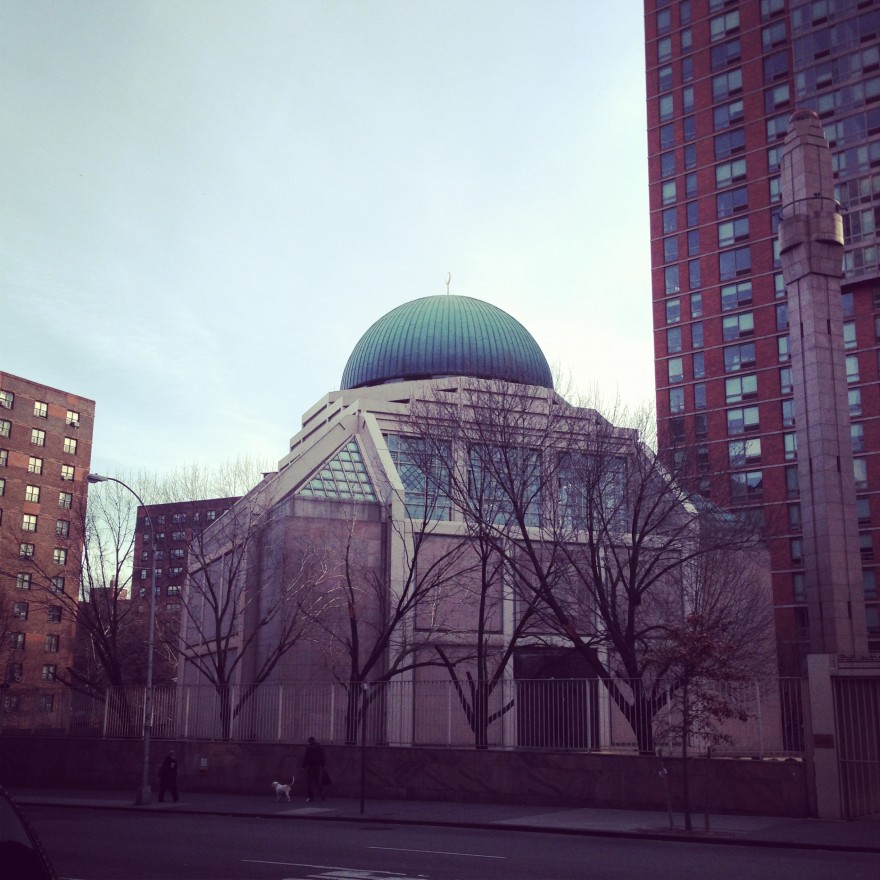
New York City’s 96th Street Mosque. Image via the Unmosqued movie website.
From what has been made available to audiences, it seems the documentary is interview-based, featuring primarily New York and New Jersey-based religious community leaders. Despite the strong response to the documentary from many Muslims in online spaces and despite the resonance of what is being said in the documentary’s trailer itself, it does seem as though there are some key oversights as well as some misrepresentations. I discuss these misrepresentations and issues in length on my personal blog, in a different form of this article, with the biggest takeaway being that the 2011 American mosque survey cited by the filmmakers on their website actually describes mosque and community trends that counter the claims being made both explicitly and implicitly by the filmmakers – as well as claims and “matter-of-fact” attitudes that many young Muslims may have about the form of mosques in America. Ethnic domination at American mosques has actually decreased since 1994, according to the survey, and mosque attendance has increased steadily. This, paired with the exponential increase in mosques in America since 2000 (by a whopping 74%), seems to indicate that the American mosque is not an empty and culturally reclusive building – but rather a growing spiritual and social center. This does not, of course, negate the countless negative, “unmosquing” experiences of Muslim Americans but it does offer a challenge to generalizations being assumed about the nature of the American mosque.
Yet, what is most fundamentally and strikingly missing from the documentary is the role, treatment and participation of American Muslim women in American mosques.
American Muslim women are amongst a handful of demographics within the Muslim community who have consistently faced varying degrees of marginalization and discrimination. The trailer only mentions women twice: once, a testimony by an actual woman (who has not been profiled on the website as an interviewee) and the second time by Mohammad Langston, who mentions being asked “why women are treated like dogs in mosques,” without any real expansion or clarification on that thought. In a couple of the interviews on the website, women’s issues and roles are discussed, however briefly, in terms of just “women’s rights,” and still not by women themselves. It’s important to have men acknowledge the lack of physical and social space afforded to women in our mosques – but without including women leaders and speakers in the documentary, what message is being sent to the audience?
While there is yet to be any survey on female participation in mosques from which we can gather some cold, hard survey numbers, we know that the physical space, alone, afforded to Muslim women in mosques speaks loudly about the perception of what their role in the mosque is seen to be. Women’s bodies, their purity, and their ability to contribute to their community are all under the constant gaze of many mosques. Maryam Eskandari is a visionary American Muslim architect focusing on re-building and re-thinking Islamic architecture and places of worship. In her 2011 Master’s thesis, “Women Places and Spaces in Contemporary American Mosque,” she writes, after surveying 32 mosques out of over 100 visited mosques in 2010:
“Through the numerous case studies and investigations of the American Mosques that I documented, it is clear that the community does not provide adequate spaces for their women members…A lack of attention to the needs of American Muslim women in the states has caused a gender conflict over the adequacy of spaces for Muslim women within American mosques.” (Abstract)
and
“Cultural convention is lost in translation particularly in allowing women the access to attend the mosque. Misinterpretation of legal practices become a nuisance when space and gender “clash with time” (Donald L. Millers) and becomes visible through religious practice. “Many Muslim [men] do not see any need for a woman to go to a mosque when she can stay at home with the children and pray, even though a mosque may be within a block of her house” (Kahera 2002, 122). In his book Deconstructing the America Mosque, Kahera explains that the medieval Muslim world “developed a legal discourse that was cognizant of the use of public space with regard to age, sex and gender but gave preference to men…many contemporary Muslim jurists share the same medieval views”( Kahera 2002, 124). Therefore, the distorted medieval view that women need to stay at home is still debated.” (pg. 100)
In a conversation I had with Eskandari, she vividly recalled not only finding very few mosques in the United States, out of the almost 400 she’s visited, that provide any sort of safe space for all Muslims, but also running into archaic attitudes from mosque boards of directors about her role as a mosque architect.
By marginalizing the obstacles faced by Muslim women in American mosques, the documentary Unmosqued misses a crucial opportunity to address this issue in the context of a (popularly perceived?) larger problem of community direction and growth, and thereby acknowledge that the situations of many Muslim women across the US in their mosques is not just a “women’s issue” but a community issue. When any part of our community hurts, the entire community hurts. In addition to this, by offering very little commentary on the issue of women in mosques, the documentary also frames the mosque as the space of the Muslim male, trivializing of women’s space. If we’re going to have this conversation – and we must – then we must also acknowledge that the majority of our mosques are not, as Eskandari put it, safe spaces: they are not places where just any Muslim can go and pray.
And just as there are absolutely awful mosque experiences, there are also absolutely amazing experiences as well. And then there are those experiences that fall in between the nooks and crannies of good and bad. Additionally, despite the centrality of the mosque to Muslim communities across the world for centuries, there are other avenues for our communities to grow spiritually and socially. In some contexts, Muslim Students’ Associations have garnered a particular culture of religious community and social centricity, which parallels a community’s mosque, in the college and university settings. Despite the popularly acknowledged exclusivity that can come with many MSAs (or not!), they have become integral for many Muslims as areas of spiritual growth and signify that we have more avenues for addressing relevant, social issues than maybe some of our local mosques.
As Muslim American religious space, in all of its forms, increases and expands, so too does the need for a conversation that does not, in its character, prioritize the needs of some Muslims over other Muslims – be these immigrants, ethnic minorities, women, LGBTQ, youth, or converts. We’re building the structures, but we’re lacking the foundation. And this foundation cannot be complete without every part of the community. It comes down a very simple but incredibly powerful sentence by Amina Jabbar in a recent MMW post: Muslim men don’t know how to relate to Muslim women. Our mosques have created rigid barriers between men and women and in turn these barriers have led us to see women as almost “separate” from the community as a whole.
I hope that the filmmakers, who are still working on the documentary, take this great opportunity to bring in significant voices from the gendered underbelly of our community and our mosques. And I hope they do so in such a way that we know that when a woman (or anyone else!) has no place to pray, it is the responsibility of our entire community to find and give her that place.
Previous Post

March 12, 2013
‘Real’ Dutch Muslimas Tackle Migration and Islamophobia
Next Post

March 14, 2013 Telling the Stories of Street Children in Cairo
Browse Our Archives
Select a Category Advertisements Art/Theater Books/Magazines Cinema Comics/Cartoons Culture/Society Events Fashion Film Friday Links Merchandise/Commodities MMW Announcements MMW Highlights Music/Radio News Photography Politics Profile Ramadan 2012 Ramadan 2013 Ramadan 2014 Ramadan 2015 Roundtable Satire Social Media Sports Technology/Science Television Uncategorized Video Web
Select a Month November 2015 October 2015 September 2015 August 2015 July 2015 June 2015 May 2015 April 2015 March 2015 January 2015 December 2014 November 2014 October 2014 September 2014 July 2014 June 2014 May 2014 April 2014 March 2014 February 2014 January 2014 December 2013 November 2013 October 2013 September 2013 August 2013 July 2013 June 2013 May 2013 April 2013 March 2013 February 2013 January 2013 December 2012 November 2012 October 2012 September 2012 August 2012 July 2012 June 2012 May 2012 April 2012 March 2012 February 2012 January 2012 December 2011 November 2011 September 2011 August 2011 July 2011 June 2011 May 2011 April 2011 March 2011 February 2011 January 2011 December 2010 November 2010 October 2010 September 2010 August 2010 July 2010 June 2010 May 2010 April 2010 March 2010 February 2010 January 2010 December 2009 November 2009 October 2009 September 2009 August 2009 July 2009 June 2009 May 2009 April 2009 March 2009 February 2009 January 2009 December 2008 November 2008 October 2008 September 2008 August 2008 July 2008 June 2008 May 2008 April 2008 March 2008 February 2008 January 2008 December 2007 November 2007 October 2007 September 2007 August 2007
Follow Us!
TAKE THE
Religious Wisdom Quiz
Who killed Goliath?
Select your answer to see how you score.
Samson David Saul Jonathan
Related posts from Muslimah Media Watch

#PrayforParis, Muslim Women and Third World Violence


Hate Crimes and Mother Tongues

Interview with Comedian Eman El Husseini
TRENDING AT PATHEOS Muslim

25 Years Later: How Much Has Changed for...
As we approach the 25th anniversary of September 11th, I’ve found myself...

Podcast: Third Spaces & The Rise of Yemeni...
In the latest episode of The Artistic Foodies Podcast, hosts Abbas...

HalalFest Picks: Best 60 Halal Spots for Super...
Back in 2016, I came up with a list of 29...

Unity Is America’s Strength — Division Is Its...
by Hidayatullah Ahsan When Valentina Gomez, a Republican candidate for Congress in...

Zohran Mamdani and New York’s Fight Against Islamophobia
This past June, against all odds, Zohran Mamdani won the Democratic primary...

What the Fourth of July Means to a...
As we mark another Fourth of July, millions of Americans will celebrate...
view all Muslim blogs
Ad-Free & Subscriber Log-In Subscription Support
- About Us
- 2026 Calendar
- Videos
- Podcasts
- Library of World Religions
- Faith In Media Tracker
- Advertise With Us
- Write for Us
- Privacy Policy
- Terms of Service
- Do Not Sell My Data
- Contact Us
- Radiant Digital
- Manage Newsletter Subscriptions
- Unsubscribe From Notifications
- Sitemap
Copyright 2008-2026, Patheos. All rights reserved.
Subscription Support Ad-Free & Subscriber Log-In
Follow Patheos