
BuddhistCatholicContemplativeEvangelicalGeneral ChristianHinduJewishLatter-day SaintMuslimNew VisionsProgressive Christian
Beliefs
- Buddhist
- Catholic
- Contemplative
- Evangelical
- General Christian
- Hindu
- Jewish
- Latter-day Saint
- More Voices
- Muslim
- New Visions
- Pagan
- Progressive Christian
Topics
- Religion News
- Food and Religion
- Sports and Religion
- Religious Art
- Religious Music and Entertainment
- Religious Events
- History and Religion
- Style and Religion
- Politics and Religion
- Women in Religion
- Recreation Outdoors and Religion
- Business Finance and Religion
- Careers Workplace and Religion
- Education and Religion
- Family Parenting and Religion
- Health Fitness and Religion
- Home and Religion
- Relationships and Religion
- Technology and Religion
- Travel and Religion
Columnists
- Buddhist Columnists
- Business Finance and Religion Columnists
- Careers Workplace and Religion Columnists
- Catholic Columnists
- Contemplative Columnists
- Education and Religion Columnists
- Evangelists Columnists
- Family Parenting and Religion Columnists
- General Christian Columnists
- Health Fitness and Religion Columnists
- Hindu Columnists
- History and Religion Columnists
- Home and Religion Columnists
- Jewish Columnists
- More Voices Columnists
- Latter Day Columnists
- Muslim Columnists
- New Visions Columnists
- Nonreligious Columnists
- Pagan Columnists
- Politics and Religion Columnists
- Progressive Columnists
- Recreation Outdoors and Religion Columnists
- Relationships and Religion Columnists
- Religion News Columnists
- Religious Art Columnists
- Religious Events Columnists
- Religious Music and Entertainment Columnists
- Sports and Religion Columnists
- Style and Religion Columnists
- Technology and Religion Columnists
- Travel and Religion Columnists
- Women in Religion Columnists
Resource Library
- 2026 Calendar
- Library of World Religions
- The 100 Most Holy Places on Earth
- Patheos Answers
- Podcasts
- Videos
- Faith Leaders Database
- Anglican Episcopalian
- Bahai
- Baptist
- Buddhism
- Christianity
- Confucianism
- Eastern Orthodoxy
- Hinduism
- Holiness and Pentecostal
- ISKCON
- Islam
- Judaism
- Lutheran
- Methodist
- The Church of Jesus Christ of Latter-day Saints
- New Age
- Paganism
- Presbytarian and Reformed
- Protestantism
- Religion Behind the Scenes
- Roman Catholic
- Scientology
- Shia Islam
- Sikhism
- Sufism
- Sunni Islam
- Taoism
- Zen
- See all religions
Research Tools
 Ad-Free & Subscriber Log-In Subscription Support
Ad-Free & Subscriber Log-In Subscription Support
Follow Patheos 

- Trending:
- Forgiveness
- |
- Marriage
- |
- Consciousness
- |
- Death Penalty
- |
- Election
- |
- Halloween
 Muslimah Media Watch
- Home
- Muslim
- Religion News
- Strictly Soulmates: The Trials and Tribulations of British Muslim ‘Singletons’
Strictly Soulmates: The Trials and Tribulations of British Muslim ‘Singletons’
Last updated on: March 11, 2013 at 11:08 am by Guest Contributor
Strictly Soulmates: The Trials and Tribulations of British Muslim ‘Singletons’ 2013-03-11T11:08:57-04:00 Guest Contributor
Patheos Explore the world's faith through different perspectives on religion and spirituality! Patheos has the views of the prevalent religions and spiritualities of the world.
This post was written by guest contributor Maria Salman.
Marriage: The one word on the tip of the tongue for many young Muslims. The difficulties in searching for the elusive One experienced by the Muslim diaspora is a phenomenon that is well documented. Google the phrase “Muslim marriage crisis,” and a substantial number of hits comes up – especially about the dearth of eligible Muslim bachelors and the struggles of over-30 professional Muslim women in finding a suitable mate who is on par with their educational background. Judging by the flooded comment sections in almost every blog post or article discussing the search for a spouse, the topic definitely hits a nerve amongst the Muslim community living in the “West.”
Recently, a friend sent me a link for a BBC Three documentary titled Strictly Soulmates, a four part series that aired in February 2012. The series briefly chronicles the adventures of “religious” young British singletons as explained by this introductory summary on its YouTube page:
“Looking for love is tough at the best of times and it can be even harder when your pool of potential partners is small. Welcome to the world of being young, single and religious. This is looking for love as it’s rarely been seen on TV before – with religion in play there are a whole new set of rules and it can be seriously tough to find ‘the one’. Strictly Soulmates takes a fun, entertaining and emotional look at the real life trials and tribulations of a group of singletons trying to find their perfect match from four different religions: Evangelical Christian, Hindu, Muslim and Jewish.”
Reading this synopsis, I was both intrigued and apprehensive about watching the documentary, particularly the Muslim episode. Intrigued because the documentary showcased individuals navigating primarily religious expectations while finding a life partner – reflecting processes that my friends and I are currently undergoing as well. Apprehensive because BBC Three does not exactly have the best history in representing Muslims and tends to develop simplistic caricatures of Muslims – as evidenced by their Make Me a Muslim documentary so ingeniously critiqued on MMW recently by wood turtle.
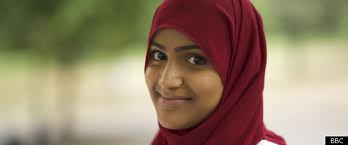
Naila. [Source].
The Muslim episode of Strictly Soulmatestakes a look at three young British Muslims in a narrated format peppered with interviews from different Muslim men and women: 23-year-old Zubair, a fresh engineering grad from Manchester University with the goal of returning to Pakistan (and with no experience of talking to women, as the narrator keeps pointing out); Naila, an accounting student who just turned 22 and has begun the process of an arranged marriage with the help of her mother; and Tabassum (otherwise known as Dimpy), a 32-year-old doctor who has turned down numerous suitors in the persistent hope of marrying a doctor. Although I appreciated the stories of these three smart, confident individuals, the documentary had several shortcomings in how it depicted Muslims.
After being introduced to the Muslim singletons, I noticed that all three of them were of Pakistani background, born and bred in the U.K. It was disappointing to see the lack of diversity in the documentary when it attempts to showcase a religion with more than a billion followers. The narrator never explicitly highlights the cultural background of Zubair, Naila and Tabassum – it is only when the participants mention Pakistan or speak in Urdu that one realizes all three are Pakistani.
There is nothing wrong with displaying the experiences of three British-Pakistani Muslims but when the documentary employs definitive phrases of what Islam is and what Muslims believe, it fails to acknowledge the multiplicities of Islamic beliefs and practices. The show unfortunately squanders an opportunity to represent diverse perspectives by failing to ensure participants from all walks of life in terms of ethnicity, nationality, sexuality or sect.
The obvious lack of diversity is made worse when the narrator makes highly problematic, sweeping generalizations about Muslims and their religious mandates. In one instance, the narrator states that most Muslim girls marry young, which is not only a generalizing characteristic of a vast group of women but an unfounded assumption. There are quite a few scenes that are edited in a way which enforce stereotypes about Muslims, particularly the traditional, strict ones in opposition to the modern ones.
At a marriage event, as Zubair discloses to a group of singles how uncomfortable he would be if his wife did not wear the hijab, the camera flashes to a woman’s gold studded high-heeled sandals. The narrator notes that Zubair is the “most traditional male’ at the event, at which the point the camera does a close-up of another male participant in a pink shirt with a faux hawk haircut. In this way, the documentary’s editing implicitly encourages the audience to make assumptions about an individual’s religious identity based on physical appearance.
Another segment of the documentary involves interviews with other Muslims (mostly men) who speak assuredly about gender relations in Islam, as if no other point of view exists. Again, a limited version of Islam emerges when one man, quite matter-of-factly states that the Quran “actually, specifically” stipulates that men and women cannot exist in the same space. The men also strongly imply that Muslim individuals who have ever engaged in drinking alcohol or going to pubs are not actually Muslims at all.
The issue with these little interview snippets is not about the validity of these statements but that there is no deeper discussion about the social realities of what it means to be a Muslim in a predominantly non-Muslim environment. Instead, the men come off as being highly judgemental and narrow-minded. There is no attempt to explain that these interpretations are just one in a broad spectrum of Islamic beliefs; that these activities or beliefs are unacceptable to some Muslims, not all. Hence, the depictions of religiosity are seen as something static and fixed.

Dimpy. [Source].
In presenting a Muslim woman who wore the hijab (Naila) and a Muslim woman who did not wear the hijab (Dimpy), the show keeps perpetuating stereotypes associated with the overused media trope of Traditional versus Modern when describing Muslims. Dimpy explains that, although she has a very strong faith in Allah, she is not a very “practising” Muslim in terms of praying five times a day. There is also a great deal of close-up footage highlighting Dimpy’s consumerist indulgence, from her knee-high leather boots and colourful dresses to her designer bag shaped birthday cake.
In contrast, the documentary follows Naila as she performs prayers, goes to the mosque and helps her mother in domestic tasks. There is no mention of how Naila practises her faith – the viewer is led to assume that she rightfully adheres to Islamic practices because of her visible status as a hijabi woman. On the opposite end, a similar approach is applied to Zubair, whose beard serves as a consistent reminder that he is a “strict” Muslim man.
The term “practising Muslim” implies a hierarchy of authenticity, which places Naila over Dimpy as the more devout Muslim woman. The show implies that outward appearances are sufficient in determining whether one is an authentic Muslim or not. The reality is more complex and nuanced, for there is no single, monolithic understanding of Islam. How a billion people from varying cultural and ethnic contexts practise their beliefs is significantly more complex and nuanced than what is depicted by the documentary.
Overall, Strictly Soulmates provides interesting insights into the lived experiences of three British-Pakistani Muslim individuals negotiating religious and cultural boundaries when searching for a marital mate. However, it does have its limitations, since it fails to represent diverse experiences and fall backs into perpetuating superficial binaries. I have yet to watch the other episodes but it would be interesting to see if the show delves into the complexities of different religious beliefs in the Jewish, Hindu or Christian episodes. I am not holding my breath.
Previous Post

March 8, 2013
Friday Links | March 8, 2013
Next Post
March 12, 2013 ‘Real’ Dutch Muslimas Tackle Migration and Islamophobia
Browse Our Archives
Select a Category Advertisements Art/Theater Books/Magazines Cinema Comics/Cartoons Culture/Society Events Fashion Film Friday Links Merchandise/Commodities MMW Announcements MMW Highlights Music/Radio News Photography Politics Profile Ramadan 2012 Ramadan 2013 Ramadan 2014 Ramadan 2015 Roundtable Satire Social Media Sports Technology/Science Television Uncategorized Video Web
Select a Month November 2015 October 2015 September 2015 August 2015 July 2015 June 2015 May 2015 April 2015 March 2015 January 2015 December 2014 November 2014 October 2014 September 2014 July 2014 June 2014 May 2014 April 2014 March 2014 February 2014 January 2014 December 2013 November 2013 October 2013 September 2013 August 2013 July 2013 June 2013 May 2013 April 2013 March 2013 February 2013 January 2013 December 2012 November 2012 October 2012 September 2012 August 2012 July 2012 June 2012 May 2012 April 2012 March 2012 February 2012 January 2012 December 2011 November 2011 September 2011 August 2011 July 2011 June 2011 May 2011 April 2011 March 2011 February 2011 January 2011 December 2010 November 2010 October 2010 September 2010 August 2010 July 2010 June 2010 May 2010 April 2010 March 2010 February 2010 January 2010 December 2009 November 2009 October 2009 September 2009 August 2009 July 2009 June 2009 May 2009 April 2009 March 2009 February 2009 January 2009 December 2008 November 2008 October 2008 September 2008 August 2008 July 2008 June 2008 May 2008 April 2008 March 2008 February 2008 January 2008 December 2007 November 2007 October 2007 September 2007 August 2007
Follow Us!
TAKE THE
Religious Wisdom Quiz
What is the book of songs and prayers in the Bible called?
Select your answer to see how you score.
Matthew Genesis Psalms Proverbs
Related posts from Muslimah Media Watch


Has Quantico got positive female Muslim roles covered?
When Invisibility is a Superpower: Farah Nazan in...
Are we Truly Breaking Stereotypes about Muslim Women?
TRENDING AT PATHEOS Muslim

25 Years Later: How Much Has Changed for...
As we approach the 25th anniversary of September 11th, I’ve found myself...

Podcast: Third Spaces & The Rise of Yemeni...
In the latest episode of The Artistic Foodies Podcast, hosts Abbas...

HalalFest Picks: Best 60 Halal Spots for Super...
Back in 2016, I came up with a list of 29...

Unity Is America’s Strength — Division Is Its...
by Hidayatullah Ahsan When Valentina Gomez, a Republican candidate for Congress in...

Zohran Mamdani and New York’s Fight Against Islamophobia
This past June, against all odds, Zohran Mamdani won the Democratic primary...

What the Fourth of July Means to a...
As we mark another Fourth of July, millions of Americans will celebrate...
view all Muslim blogs
Ad-Free & Subscriber Log-In Subscription Support
- About Us
- 2026 Calendar
- Videos
- Podcasts
- Library of World Religions
- Faith In Media Tracker
- Advertise With Us
- Write for Us
- Privacy Policy
- Terms of Service
- Do Not Sell My Data
- Contact Us
- Radiant Digital
- Manage Newsletter Subscriptions
- Unsubscribe From Notifications
- Sitemap
Copyright 2008-2026, Patheos. All rights reserved.
Subscription Support Ad-Free & Subscriber Log-In
Follow Patheos