
BuddhistCatholicContemplativeEvangelicalGeneral ChristianHinduJewishLatter-day SaintMuslimNew VisionsProgressive Christian
Beliefs
- Buddhist
- Catholic
- Contemplative
- Evangelical
- General Christian
- Hindu
- Jewish
- Latter-day Saint
- More Voices
- Muslim
- New Visions
- Pagan
- Progressive Christian
Topics
- Religion News
- Food and Religion
- Sports and Religion
- Religious Art
- Religious Music and Entertainment
- Religious Events
- History and Religion
- Style and Religion
- Politics and Religion
- Women in Religion
- Recreation Outdoors and Religion
- Business Finance and Religion
- Careers Workplace and Religion
- Education and Religion
- Family Parenting and Religion
- Health Fitness and Religion
- Home and Religion
- Relationships and Religion
- Technology and Religion
- Travel and Religion
Columnists
- Buddhist Columnists
- Business Finance and Religion Columnists
- Careers Workplace and Religion Columnists
- Catholic Columnists
- Contemplative Columnists
- Education and Religion Columnists
- Evangelists Columnists
- Family Parenting and Religion Columnists
- General Christian Columnists
- Health Fitness and Religion Columnists
- Hindu Columnists
- History and Religion Columnists
- Home and Religion Columnists
- Jewish Columnists
- More Voices Columnists
- Latter Day Columnists
- Muslim Columnists
- New Visions Columnists
- Nonreligious Columnists
- Pagan Columnists
- Politics and Religion Columnists
- Progressive Columnists
- Recreation Outdoors and Religion Columnists
- Relationships and Religion Columnists
- Religion News Columnists
- Religious Art Columnists
- Religious Events Columnists
- Religious Music and Entertainment Columnists
- Sports and Religion Columnists
- Style and Religion Columnists
- Technology and Religion Columnists
- Travel and Religion Columnists
- Women in Religion Columnists
Resource Library
- 2026 Calendar
- Library of World Religions
- The 100 Most Holy Places on Earth
- Patheos Answers
- Podcasts
- Videos
- Faith Leaders Database
- Anglican Episcopalian
- Bahai
- Baptist
- Buddhism
- Christianity
- Confucianism
- Eastern Orthodoxy
- Hinduism
- Holiness and Pentecostal
- ISKCON
- Islam
- Judaism
- Lutheran
- Methodist
- The Church of Jesus Christ of Latter-day Saints
- New Age
- Paganism
- Presbytarian and Reformed
- Protestantism
- Religion Behind the Scenes
- Roman Catholic
- Scientology
- Shia Islam
- Sikhism
- Sufism
- Sunni Islam
- Taoism
- Zen
- See all religions
Research Tools
 Ad-Free & Subscriber Log-In Subscription Support
Ad-Free & Subscriber Log-In Subscription Support
Follow Patheos 

- Trending:
- Forgiveness
- |
- Marriage
- |
- Consciousness
- |
- Death Penalty
- |
- Election
- |
- Halloween
 Muslimah Media Watch
- Home
- Muslim
- Religion News
- Muslimahs in Beauty Pageants
Muslimahs in Beauty Pageants
Last updated on: March 27, 2013 at 2:00 am by eren
Muslimahs in Beauty Pageants 2013-03-26T21:44:43-04:00 eren
Patheos Explore the world's faith through different perspectives on religion and spirituality! Patheos has the views of the prevalent religions and spiritualities of the world.
When I was a kid, I must confess, I used to love to watch Miss Universe on TV. Despite my mom’s dislike for the show, she would let me watch it (not without swearing at the TV once in a while). Beauty pageants in the 90’s gained popularity in Mexico after Lupita Jones won the title of Miss Universe in 1991. Although previous title-holders were Latin American, Jones was the first Mexican to win such a pageant and her success in the American pageant seemed to me kind of an acknowledgement of the fact that beauty could come from anywhere in the world – as long as it conformed to the beauty standards endorsed by Western industries. Jones, and the most recent Mexican title-holder, Ximena Navarrete, looked nothing like the average Mexican woman (and nothing like most women in the world).

Miss Universe Lupita Jones 1991- Via Critical Beauty.
Beauty pageants in all their variety have been broadly criticized for a number of reasons. American feminists in the 60’s saw them as the pinnacle of female objectification. Tibetan critics have recently questioned the principles of “beauty” as defined in these contests. Other critiques have focused on the gender roles that beauty pageants promote, where women are defined by their femininity and domesticity. And race has also been identified as playing an important role in the beauty pageant industry. Pioneer Miss Universe title-holders were white (from Europe and the U.S.), and even when women from other countries started to win early in the 50’s, they were either from white ancestry or where mixed to the point that they were not racially representative of their countries (i.e. Gladys Zender from Peru and Luz Marina Zuluaga from Colombia).
Pageants endorse such an unrealistic idea of beauty that not only are most women excluded from being “the most beautiful woman in the world,” but even those who fit the standards need to be “fixed.” The documentary Beauty Factory explores this in the Venezuelan setting, where contestants undergo “Olympic training” and extensive makeovers before competing in beauty pageants resulting in six Miss Universe titles.
But despite all this, and all the bad things that come along with beauty pageants, they continue to flourish. Today we have kid beauty pageants as depicted in Toddlers in Tiaras (which I personally think should be banned), regional contests such as Miss Arab World, and an increasing number of contests that aim to include women from a variety of ethnic backgrounds and body shapes.
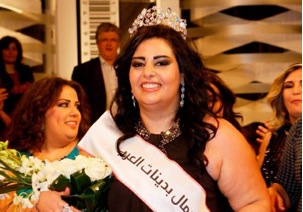
Miss Big Arabian Beauty 2013- Via AlJazeera.
A recent example is found in Al Jazeera’s coverage of the first Arab plus-size pageant. The contest took place in Lebanon and awarded Eliana Neama the title of “Miss Big Arabian Beauty.” Similar to the claims of other beauty pageants, this contest aspired to “give overweight Arabian women a chance to feel more confident about their looks and encourage their self-esteem” according to Al-Arabiyah News.
While it is unclear whether or not any Muslim women participated in this contest, Muslim representatives from all around the world have been present in other pageants, most notoriously Rima Fakih (Miss USA 2010), who Sara wrote about in 2010.
Muslims have come up with their own list of criticisms against the industry, which range from the exposure of women and issues of modesty to the Westernization of the concept of beauty, femininity and perhaps even womanhood. Beauty pageants are so widely spread around the world that many Muslim women compete in Western countries, and countries with Muslim majorities hold their own (for example, Miss Egypt, which was first held in 1929, Miss Bahrain and Miss Indonesia, established in 2005).
Western Muslim women competing in Western beauty pageants are heavily featured in media sources due to their religious background and the clashes that this seems to bring along. For instance, contestant Shanna Bukhari was reported as having received death threats whereas other non-white runner-ups have gotten caught up between what their Muslim communities think of pageants and what others think of their background.
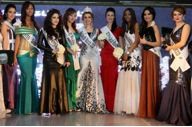
Miss Arab World 2012- Via Gulf News.
Yet, despite the challenges that Muslim women face within the industry and the critiques that scholars, clerics and feminists bring, beauty contests seem to be here to stay and women around the world will continue to demand pageants that include them, such as in plus-size contests.
Just like Saudi Arabia’s “Miss Congeniality” contest or the Muslimah Beauty Competition, Lebanon’s Plus-Size variation shows that contests may be shaped and tweaked to meet certain social expectations or push some agendas but they are, nonetheless, beauty pageants that define beauty, health, femininity and womanhood.
For many women these contests mean, above all, recognition. And in some instances they also come with monetary goods that can’t be easily ignored.
Although these days I have a conflicted relationship with these pageants and the beauty industry in general, I recognize that many women see in these contests an opportunity to transcend the status quo. Minorities, including Lebanese plus-size women or hijabis, are demanding a space that for some critics would seem unnecessary. On the other hand, some would claim they provide our communities with a sense of “having options” and “access.” If so, what is exactly that we are getting out of these contests? Are Miss Big Arabian Beauty or Miss Congeniality better than Miss Universe? Do they really grant women in our communities options, recognition and access?
Previous Post

March 26, 2013
More than Breast Friends: Kinship and Muslim Milk Banks
Next Post
March 28, 2013 Intersections: Where Do We Go From Here?
Browse Our Archives
Select a Category Advertisements Art/Theater Books/Magazines Cinema Comics/Cartoons Culture/Society Events Fashion Film Friday Links Merchandise/Commodities MMW Announcements MMW Highlights Music/Radio News Photography Politics Profile Ramadan 2012 Ramadan 2013 Ramadan 2014 Ramadan 2015 Roundtable Satire Social Media Sports Technology/Science Television Uncategorized Video Web
Select a Month November 2015 October 2015 September 2015 August 2015 July 2015 June 2015 May 2015 April 2015 March 2015 January 2015 December 2014 November 2014 October 2014 September 2014 July 2014 June 2014 May 2014 April 2014 March 2014 February 2014 January 2014 December 2013 November 2013 October 2013 September 2013 August 2013 July 2013 June 2013 May 2013 April 2013 March 2013 February 2013 January 2013 December 2012 November 2012 October 2012 September 2012 August 2012 July 2012 June 2012 May 2012 April 2012 March 2012 February 2012 January 2012 December 2011 November 2011 September 2011 August 2011 July 2011 June 2011 May 2011 April 2011 March 2011 February 2011 January 2011 December 2010 November 2010 October 2010 September 2010 August 2010 July 2010 June 2010 May 2010 April 2010 March 2010 February 2010 January 2010 December 2009 November 2009 October 2009 September 2009 August 2009 July 2009 June 2009 May 2009 April 2009 March 2009 February 2009 January 2009 December 2008 November 2008 October 2008 September 2008 August 2008 July 2008 June 2008 May 2008 April 2008 March 2008 February 2008 January 2008 December 2007 November 2007 October 2007 September 2007 August 2007
Follow Us!
TAKE THE
Religious Wisdom Quiz
According to Isaiah 53, how would the Messiah be treated by people?
Select your answer to see how you score.
Despised and rejected Worshiped and adored Ignored and forgotten Feared and honored
Related posts from Muslimah Media Watch

#PrayforParis, Muslim Women and Third World Violence


Hate Crimes and Mother Tongues

Interview with Comedian Eman El Husseini
TRENDING AT PATHEOS Muslim

25 Years Later: How Much Has Changed for...
As we approach the 25th anniversary of September 11th, I’ve found myself...

Podcast: Third Spaces & The Rise of Yemeni...
In the latest episode of The Artistic Foodies Podcast, hosts Abbas...

HalalFest Picks: Best 60 Halal Spots for Super...
Back in 2016, I came up with a list of 29...

Unity Is America’s Strength — Division Is Its...
by Hidayatullah Ahsan When Valentina Gomez, a Republican candidate for Congress in...

Zohran Mamdani and New York’s Fight Against Islamophobia
This past June, against all odds, Zohran Mamdani won the Democratic primary...

What the Fourth of July Means to a...
As we mark another Fourth of July, millions of Americans will celebrate...
view all Muslim blogs
Ad-Free & Subscriber Log-In Subscription Support
- About Us
- 2026 Calendar
- Videos
- Podcasts
- Library of World Religions
- Faith In Media Tracker
- Advertise With Us
- Write for Us
- Privacy Policy
- Terms of Service
- Do Not Sell My Data
- Contact Us
- Radiant Digital
- Manage Newsletter Subscriptions
- Unsubscribe From Notifications
- Sitemap
Copyright 2008-2026, Patheos. All rights reserved.
Subscription Support Ad-Free & Subscriber Log-In
Follow Patheos