
BuddhistCatholicContemplativeEvangelicalGeneral ChristianHinduJewishLatter-day SaintMuslimNew VisionsProgressive Christian
Beliefs
- Buddhist
- Catholic
- Contemplative
- Evangelical
- General Christian
- Hindu
- Jewish
- Latter-day Saint
- More Voices
- Muslim
- New Visions
- Pagan
- Progressive Christian
Topics
- Religion News
- Food and Religion
- Sports and Religion
- Religious Art
- Religious Music and Entertainment
- Religious Events
- History and Religion
- Style and Religion
- Politics and Religion
- Women in Religion
- Recreation Outdoors and Religion
- Business Finance and Religion
- Careers Workplace and Religion
- Education and Religion
- Family Parenting and Religion
- Health Fitness and Religion
- Home and Religion
- Relationships and Religion
- Technology and Religion
- Travel and Religion
Columnists
- Buddhist Columnists
- Business Finance and Religion Columnists
- Careers Workplace and Religion Columnists
- Catholic Columnists
- Contemplative Columnists
- Education and Religion Columnists
- Evangelists Columnists
- Family Parenting and Religion Columnists
- General Christian Columnists
- Health Fitness and Religion Columnists
- Hindu Columnists
- History and Religion Columnists
- Home and Religion Columnists
- Jewish Columnists
- More Voices Columnists
- Latter Day Columnists
- Muslim Columnists
- New Visions Columnists
- Nonreligious Columnists
- Pagan Columnists
- Politics and Religion Columnists
- Progressive Columnists
- Recreation Outdoors and Religion Columnists
- Relationships and Religion Columnists
- Religion News Columnists
- Religious Art Columnists
- Religious Events Columnists
- Religious Music and Entertainment Columnists
- Sports and Religion Columnists
- Style and Religion Columnists
- Technology and Religion Columnists
- Travel and Religion Columnists
- Women in Religion Columnists
Resource Library
- 2026 Calendar
- Library of World Religions
- The 100 Most Holy Places on Earth
- Patheos Answers
- Podcasts
- Videos
- Faith Leaders Database
- Anglican Episcopalian
- Bahai
- Baptist
- Buddhism
- Christianity
- Confucianism
- Eastern Orthodoxy
- Hinduism
- Holiness and Pentecostal
- ISKCON
- Islam
- Judaism
- Lutheran
- Methodist
- The Church of Jesus Christ of Latter-day Saints
- New Age
- Paganism
- Presbytarian and Reformed
- Protestantism
- Religion Behind the Scenes
- Roman Catholic
- Scientology
- Shia Islam
- Sikhism
- Sufism
- Sunni Islam
- Taoism
- Zen
- See all religions
Research Tools
 Ad-Free & Subscriber Log-In Subscription Support
Ad-Free & Subscriber Log-In Subscription Support
Follow Patheos 

- Trending:
- Forgiveness
- |
- Marriage
- |
- Consciousness
- |
- Death Penalty
- |
- Election
- |
- Halloween
 Muslimah Media Watch
- Home
- Muslim
- Religion News
- More than Breast Friends: Kinship and Muslim Milk Banks
More than Breast Friends: Kinship and Muslim Milk Banks
Last updated on: March 26, 2013 at 6:23 am by woodturtle
More than Breast Friends: Kinship and Muslim Milk Banks 2013-03-26T06:23:40-04:00 woodturtle
Patheos Explore the world's faith through different perspectives on religion and spirituality! Patheos has the views of the prevalent religions and spiritualities of the world.
Breastfeeding may seem like the most natural thing in the world, but for a percentage of women it can be terribly challenging — especially if they cannot produce enough milk or refrain from breastfeeding due to medical reasons such as severe illness, accident, HIV infection, or taking certain medications that can harm the baby through breast milk.
As I’ve mentioned in another post on breastfeeding in Guinea, it’s widely accepted by health organizations that breast milk is the optimal food for infants and, when done exclusively, helps guard against infant mortality. The World Health Organization recommends exclusive breastfeeding for the first six months of life and continued breastfeeding for up to two years. But in cases where the mother cannot breastfeed, the WHO’s recommended choice of alternative is breast milk from a healthy wet-nurse or from a human milk bank.
There are currently 13 milk banks in North America, almost 200 banks in Europe, 210 in Brazil, and several hospital neonatal and intensive care unit-affiliated banks worldwide. Recently in a two-minute video, the BBC covered a new government milk bank in a Muslim majority country — set to open in the port city of Izmir, Turkey.
“If successful, this pilot will help feed babies whose mothers have passed away and help mothers who cannot produce enough breast milk.”
Despite the fact that health authorities have taken special care to recognize and address the religious conditions necessary for a milk bank to work within an Islamic context, the BBC stresses that the project could, “face resistance as traditional Islam forbids marriage between people who have been fed with milk from the same woman.”

Source: thestar.com.my
Rooted in the Qur’an (4:23), fostering sibling kinship through breastfeeding has a long tradition in Muslim communities. Classical and contemporary Islamic legal discourse outlines the many ways this kinship is established — and includes a number of varying conditions, such as requiring a family familiar wet-nurse or none at all, the nursling feeding directly from the breast or from a cup, and that feedings instating kinship range from a one time deal, to 10 sessions before the infant reaches the age of two (source). Once fulfilled, regardless of legal differences of opinion requiring the bond, a milk kinship is permanent and bars marriage between milk siblings.
Unlike other milk bank initiatives found in so-called “Western” countries, the program in Turkey has additional conditions to help ensure the quality of the milk. A soundbite from the Minister of Health, Mehmet Müezzinoğlu, explains that donors and recipients will be paired — so that the milk from a volunteering mother always goes to the same infant. The milk will also be tested, and only consumed with the approval of both the donating mother and the infant’s legal guardians.
Turkish media is also following this issue closely, highlighting the fact that this project plays a role in the Health Ministry’s aim to reduce infant mortality, listing the benefits of breast milk over substitutes like formula or cow’s milk, further detailing the conditions for donation and sibling registration by amending Citizenship law, and covering a recent statement from the Health Ministry celebrating the Turkish milk bank model as “a unique endeavour, distinct from models found in European countries.”
According to the Hurriyet Daily News, the Health Ministry also heard from Jewish and Christian community leaders, saying that they asked for the “opinions of religious groups in order to remove any worries on the part of the public, adding that they were aware of the risks in the project and that they would take criticisms very seriously.”
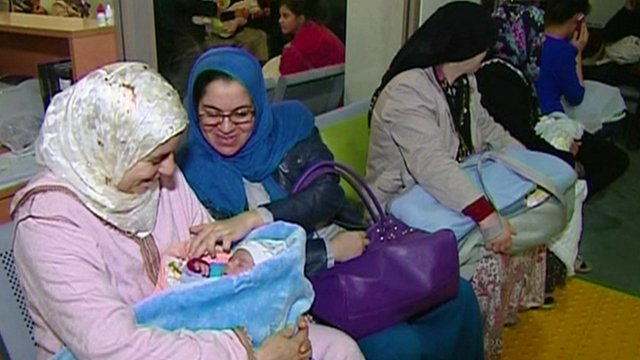
Source: BBC

Despite the intention of the Turkish model to create a system that would safeguard religious sensitivities, some theologians argue that the milk bank system is incompatible with Islam and the government would have done better to set up a “wet nurse” program instead. One cleric even suggests the milk bank dilutes Islamic values.
Opposition to milk banks by theologians isn’t new. In 1983, the Egyptian theologian Yusuf al-Qaradawi gave a fatwa in response to a medical question presented by the Islamic Organization for Medical Sciences, who asked if it was permissible to establish milk banks to feed premature babies and infants whose mothers have died. He answered yes, due to the juristic reasoning that milk banks do not facilitate nursing directly from the breast, the absence (or doubt) of a donor record means that kinship is void, and that overall, the banks have a noble aim that should be considered for the good of society.
His fatwa was opposed by other theologians at the time, based largely on the argument that milk banks are irrelevant in Muslim and Arab countries — since Muslim women clearly breastfeed or have wet-nurses. And in a later fatwa by the International Islamic Fiqh Academy, it was deemed that “the establishment of milk banks should be prohibited in the Muslim world” and that “it is prohibited to feed a Muslim child from these banks.”
It took almost two decades before Qaradawi’s fatwa was fully supported, this time by the European Council for Fatwa and Research in 2004. The council argued that milk banks were now more widespread and that having access to milk through these banks was of great concern for Muslims minorities living in “Western” countries — something the previous ruling overlooked. (Please read Mohammed Ghaly’s riveting article explaining the history and finer details behind this legal discourse.)
What I find interesting in these discussions is reliance on the idealized image of the breastfeeding Muslim woman. Yes, Islam encourages breastfeeding for up to two years (or more), and the blessings and honour bestowed upon the role of the wet nurse extends back to the early life of the Prophet. But this notion that Muslim women are inherently nursing their children or relying upon wet nurses across the board, overlooks breastfeeding rates in Muslim countries over the last 40 years.
A quick snapshot illustrates the current breastfeeding rate is far below the global average with 24% of women exclusively breastfeeding in Saudi Arabia, 10% in Kuwait, 14% in Indonesia, and a shocking 1.3% in Turkey.
Globally there has been a decline in breastfeeding due in part to lifestyle changes, family dynamics, a lack of intrinsic pro-breastfeeding support in hospitals and by governments, and due to the aggressive marketing of formula companies. So while yes, Islam and Muslim culture encourages breastfeeding, it may not be able to actually support it. Which is why I feel it’s an amazing step to have a government in a Muslim country recognize the importance of breastfeeding, and at the very least attempt to support mothers in obtaining breast milk. Because women are already finding solutions to benefit themselves and their children despite popular religious concerns.
Over a decade ago, women with premature babies in the neonatal and intensive care unit of the Adan hospital in Kuwait requested donated milk for the health and well-being of their infants. The hospital complied and worked with the women on individual bases to come up with religiously sensitive, ethical and healthy solutions to their requests. And in other Muslim countries, women are forming “milk sharing” networks, “facilitating mother-to-mother connections for the purpose of providing human milk for human children.” These networks are currently active in Indonesia, Malaysia, Kuwait, Lebanon, Qatar, the United Arab Emirates, Saudi Arabia — and are giving mothers the opportunity to find support as well as healthy alternatives for their infants. Over Facebook!
As for the still emerging story out of Turkey, the pilot project may indeed face resistance due to religious opinion — but it would also be nice to hear more opinions from women, to learn if there are already milk sharing organizations, wet nurses and breastfeeding support groups, if the government is prepared to work with them, and what kinds of pro-breastfeeding supports and information campaigns are already in use in the country.
Previous Post

March 25, 2013
Sisters Magazine Review
Next Post
March 27, 2013 Muslimahs in Beauty Pageants
Browse Our Archives
Select a Category Advertisements Art/Theater Books/Magazines Cinema Comics/Cartoons Culture/Society Events Fashion Film Friday Links Merchandise/Commodities MMW Announcements MMW Highlights Music/Radio News Photography Politics Profile Ramadan 2012 Ramadan 2013 Ramadan 2014 Ramadan 2015 Roundtable Satire Social Media Sports Technology/Science Television Uncategorized Video Web
Select a Month November 2015 October 2015 September 2015 August 2015 July 2015 June 2015 May 2015 April 2015 March 2015 January 2015 December 2014 November 2014 October 2014 September 2014 July 2014 June 2014 May 2014 April 2014 March 2014 February 2014 January 2014 December 2013 November 2013 October 2013 September 2013 August 2013 July 2013 June 2013 May 2013 April 2013 March 2013 February 2013 January 2013 December 2012 November 2012 October 2012 September 2012 August 2012 July 2012 June 2012 May 2012 April 2012 March 2012 February 2012 January 2012 December 2011 November 2011 September 2011 August 2011 July 2011 June 2011 May 2011 April 2011 March 2011 February 2011 January 2011 December 2010 November 2010 October 2010 September 2010 August 2010 July 2010 June 2010 May 2010 April 2010 March 2010 February 2010 January 2010 December 2009 November 2009 October 2009 September 2009 August 2009 July 2009 June 2009 May 2009 April 2009 March 2009 February 2009 January 2009 December 2008 November 2008 October 2008 September 2008 August 2008 July 2008 June 2008 May 2008 April 2008 March 2008 February 2008 January 2008 December 2007 November 2007 October 2007 September 2007 August 2007
Follow Us!
TAKE THE
Religious Wisdom Quiz
In 1 Peter, what did the prophets search intently and with great care about?
Select your answer to see how you score.
The salvation of Israel The day of the Lord The end times The sufferings of the Messiah and the glories that would follow
Related posts from Muslimah Media Watch

#PrayforParis, Muslim Women and Third World Violence


Hate Crimes and Mother Tongues

Interview with Comedian Eman El Husseini
TRENDING AT PATHEOS Muslim

25 Years Later: How Much Has Changed for...
As we approach the 25th anniversary of September 11th, I’ve found myself...

Podcast: Third Spaces & The Rise of Yemeni...
In the latest episode of The Artistic Foodies Podcast, hosts Abbas...

HalalFest Picks: Best 60 Halal Spots for Super...
Back in 2016, I came up with a list of 29...

Unity Is America’s Strength — Division Is Its...
by Hidayatullah Ahsan When Valentina Gomez, a Republican candidate for Congress in...

Zohran Mamdani and New York’s Fight Against Islamophobia
This past June, against all odds, Zohran Mamdani won the Democratic primary...

What the Fourth of July Means to a...
As we mark another Fourth of July, millions of Americans will celebrate...
view all Muslim blogs
Ad-Free & Subscriber Log-In Subscription Support
- About Us
- 2026 Calendar
- Videos
- Podcasts
- Library of World Religions
- Faith In Media Tracker
- Advertise With Us
- Write for Us
- Privacy Policy
- Terms of Service
- Do Not Sell My Data
- Contact Us
- Radiant Digital
- Manage Newsletter Subscriptions
- Unsubscribe From Notifications
- Sitemap
Copyright 2008-2026, Patheos. All rights reserved.
Subscription Support Ad-Free & Subscriber Log-In
Follow Patheos