
BuddhistCatholicContemplativeEvangelicalGeneral ChristianHinduJewishLatter-day SaintMuslimNew VisionsProgressive Christian
Beliefs
- Buddhist
- Catholic
- Contemplative
- Evangelical
- General Christian
- Hindu
- Jewish
- Latter-day Saint
- More Voices
- Muslim
- New Visions
- Pagan
- Progressive Christian
Topics
- Religion News
- Food and Religion
- Sports and Religion
- Religious Art
- Religious Music and Entertainment
- Religious Events
- History and Religion
- Style and Religion
- Politics and Religion
- Women in Religion
- Recreation Outdoors and Religion
- Business Finance and Religion
- Careers Workplace and Religion
- Education and Religion
- Family Parenting and Religion
- Health Fitness and Religion
- Home and Religion
- Relationships and Religion
- Technology and Religion
- Travel and Religion
Columnists
- Buddhist Columnists
- Business Finance and Religion Columnists
- Careers Workplace and Religion Columnists
- Catholic Columnists
- Contemplative Columnists
- Education and Religion Columnists
- Evangelists Columnists
- Family Parenting and Religion Columnists
- General Christian Columnists
- Health Fitness and Religion Columnists
- Hindu Columnists
- History and Religion Columnists
- Home and Religion Columnists
- Jewish Columnists
- More Voices Columnists
- Latter Day Columnists
- Muslim Columnists
- New Visions Columnists
- Nonreligious Columnists
- Pagan Columnists
- Politics and Religion Columnists
- Progressive Columnists
- Recreation Outdoors and Religion Columnists
- Relationships and Religion Columnists
- Religion News Columnists
- Religious Art Columnists
- Religious Events Columnists
- Religious Music and Entertainment Columnists
- Sports and Religion Columnists
- Style and Religion Columnists
- Technology and Religion Columnists
- Travel and Religion Columnists
- Women in Religion Columnists
Resource Library
- 2026 Calendar
- Library of World Religions
- The 100 Most Holy Places on Earth
- Patheos Answers
- Podcasts
- Videos
- Faith Leaders Database
- Anglican Episcopalian
- Bahai
- Baptist
- Buddhism
- Christianity
- Confucianism
- Eastern Orthodoxy
- Hinduism
- Holiness and Pentecostal
- ISKCON
- Islam
- Judaism
- Lutheran
- Methodist
- The Church of Jesus Christ of Latter-day Saints
- New Age
- Paganism
- Presbytarian and Reformed
- Protestantism
- Religion Behind the Scenes
- Roman Catholic
- Scientology
- Shia Islam
- Sikhism
- Sufism
- Sunni Islam
- Taoism
- Zen
- See all religions
Research Tools
 Ad-Free & Subscriber Log-In Subscription Support
Ad-Free & Subscriber Log-In Subscription Support
Follow Patheos 

- Trending:
- Forgiveness
- |
- Marriage
- |
- Consciousness
- |
- Death Penalty
- |
- Election
- |
- Halloween
 Muslimah Media Watch
- Home
- Muslim
- Religion News
- Zero Dark Thirty: A Tale of Bias and Burqas
Zero Dark Thirty: A Tale of Bias and Burqas
Last updated on: February 27, 2013 at 5:00 am by Guest Contributor
Zero Dark Thirty: A Tale of Bias and Burqas 2013-02-27T05:00:43-04:00 Guest Contributor
Patheos Explore the world's faith through different perspectives on religion and spirituality! Patheos has the views of the prevalent religions and spiritualities of the world.
This post was written by guest contributor Emaan Majed.
The scene opens on a bustling Peshawar market. The street vendors peddle ripe oranges and bananas. Decorated rickshaws bustle through busy streets as Maya, the determined female protagonist of Zero Dark Thirty, makes her way to her destination. But in contrast to actual Peshawar markets, the only Muslim women on the movie screen are two briefly seen, unnamed extras wearing sky blue Afghan chadris.
The central narrative of Zero Dark Thirty surrounds the 2011 capture of Osama Bin Laden by a Navy Seal team. In this rendering the seal team is led to OBL by Maya, portrayed by Jessica Chastain. Maya and her colleagues go through many leads, breezily torturing each suspect until he breaks. Much has been said on the graphic torture of Muslim men the movie glorifies. But what most mainstream outlets and Westerners in general have ignored is the effect this torture has on Muslim women. The devastating effect the torture, capture, and murder of Muslim men has on their wives is overlooked by the movie and by the larger American foreign policy it emulates. The American military and government are eager to wage a war on terrorism in the name of women’s rights and show kindness to little girls whose fathers are suspects. However, their brutal treatment of Muslim men threatens the families and economic situations of many of those little girls by destroying their communities. Gayatri Spivak’s famous quote “white men saving brown women from brown men” is the framework this movie operates on, but it does not seem to realize that these white men are doing brown women more harm than good.
For a movie set in an Islamic republic, Zero Dark Thirty boasts a worryingly small number of Muslim women. In 150 minutes spent exploring Lahore, Peshawar, Rawalpindi, Abottabad, Northern Pakistan, and Kuwait, Muslim women are visible in 13 scenes, several of which take place at Osama Bin Laden’s compound as his wives protect him and are shot. The screenplay’s only acknowledgment of Muslim women’s existence is a CIA officer noting that “Observing Muslim females live with their families or with their husbands,” to explain why a third female in OBL’s compound is alarming. This brief dialogue serves only to back up the movie’s central belief that all the millions of Muslim women are one thing, and that one thing is oppressed by Islam. The few Muslim women that we do see serve to prop up Western constructs of Muslimahs. They function as background props and wives of extremists, and are used to establish a foreign, “other” setting. Nearly every Muslim woman in the movie wears some sort of head covering. This is in stark contrast to the real Pakistan, where you are as likely to see women with no head coverings on the street as you are to see hijabis, and where chadris and abayas are a rare spectacle. The sky-blue chadris seen multiple times in the movie would normally be observed only in Afghanistan, and while abayas are worn in Pakistan’s remote northern tribal areas, they are seen only sporadically in Peshawar, Rawalpindi, Islamabad, and Abbottabad. But for Zero Dark Thirty, one type of Muslim women, one understandable stereotype, is enough. It represents Muslim women not as the diverse plethora of people they are but as a monolith of suspicious, miserable, burqa-wearing abettors of terrorists.
This otherization of Muslim women as dangerous, suspicious and not to be trusted burqa-wearers is further cemented by the use of the headscarf in Zero Dark Thirty. One scene, also seen in the trailer, sees a suspected terrorist walking into a building where women in black abayas sit in the garden. Quickly, the figures in abayas pull out guns and corner the man, revealing themselves to be disguised soldiers. While these men are instruments of the CIA as opposed to al-Qaeda, they nonetheless further the idea that Muslim women’s clothing is a suspicious hiding place for violence. On a few occasions while in Pakistan, Maya herself dons a headscarf, presumably to match the standard decorum of women in Pakistan, regardless of the fact that the hijab is rarely a requirement for actual Pakistani women. One scene finds Maya coming home clothed in an abaya, which she promptly flips open when she is alone. The camera quickly pans to her beat-up Converse shoes, as if to reassure the viewers of her American-ness.
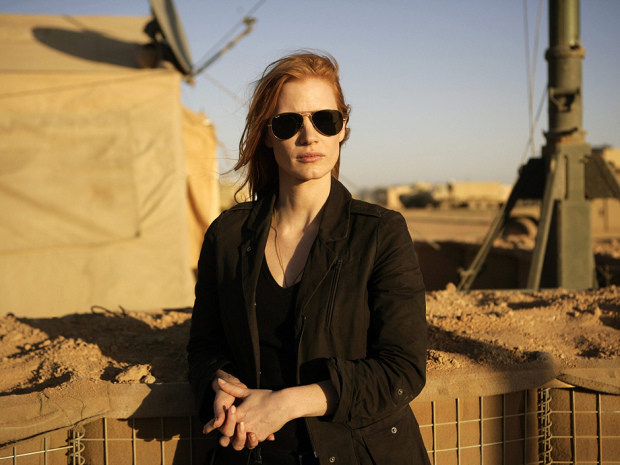
Zero Dark Thirty‘s Maya, played by Jessica Chastain. [Source].
Despite all this, Zero Dark Thirty has been hailed as a feminist landmark. Slate magazine praised its director, Katherine Bigelow, as a “feminist folk hero”. Both Jessica Chastain and Katherine Bigelow have echoed decidedly feminist themes when promoting the movie, which features a strong female lead. It is in its supposedly pro-women defense, however, that Zero Dark Thirty’s imperialist undoing can be found. Bigelow, in an interview with Slate, discussed how Osama Bin Laden is captured by Maya, a “liberated Western women,” as though liberation is a phenomenon exclusively available to Western women. Zero Dark Thirty’s brand of faux-feminism espouses the erasure and marginalization of non-Western Muslim women, whom it regards as the oppressed counterparts of terrorists. It, in a none-too-rare action for western feminism of its kind, sacrifices the voices of Muslimahs at the altar of white women doing things.
The oppressive treatment of Muslim women is not restricted to Zero Dark Thirty this awards season. Argo is another movie centered in the Muslim world, focused on Ben Affleck rallying a team to carry out a CIA rescue mission in 1979 Iran. Of three Muslim women appearing onscreen, only one, Sahar, the Canadian ambassador’s maid, is a notable character. Sahar has three lines but ensures the success of the American operation by leaking information about the hostages. Despite her refreshingly anti-terrorist leanings, Sahar is still regarded with wariness by the Americans and is initially thought to be a suspect. The suspicious over Sahar is due to her being an Iranian Muslim women, which to Argo and Zero Dark Thirty means being other, perilous, and unknown. Even in her heroism, she is portrayed as a dangerous Muslim woman “other.”
Zero Dark Thirty and Argo have twelve Oscar nods between them. There has been much heated discussion on their portrayal of Muslims and how much of it ought to be excused do to artistic message. In the end, though, their many accolades serve as one more example of anti-Muslim women dialogues in Western society being fervently rewarded.
Previous Post

February 22, 2013
Friday Links | February 22, 2013
Next Post

February 25, 2013 Would the Real Muslim Woman Please Stand Up?
Browse Our Archives
Select a Category Advertisements Art/Theater Books/Magazines Cinema Comics/Cartoons Culture/Society Events Fashion Film Friday Links Merchandise/Commodities MMW Announcements MMW Highlights Music/Radio News Photography Politics Profile Ramadan 2012 Ramadan 2013 Ramadan 2014 Ramadan 2015 Roundtable Satire Social Media Sports Technology/Science Television Uncategorized Video Web
Select a Month November 2015 October 2015 September 2015 August 2015 July 2015 June 2015 May 2015 April 2015 March 2015 January 2015 December 2014 November 2014 October 2014 September 2014 July 2014 June 2014 May 2014 April 2014 March 2014 February 2014 January 2014 December 2013 November 2013 October 2013 September 2013 August 2013 July 2013 June 2013 May 2013 April 2013 March 2013 February 2013 January 2013 December 2012 November 2012 October 2012 September 2012 August 2012 July 2012 June 2012 May 2012 April 2012 March 2012 February 2012 January 2012 December 2011 November 2011 September 2011 August 2011 July 2011 June 2011 May 2011 April 2011 March 2011 February 2011 January 2011 December 2010 November 2010 October 2010 September 2010 August 2010 July 2010 June 2010 May 2010 April 2010 March 2010 February 2010 January 2010 December 2009 November 2009 October 2009 September 2009 August 2009 July 2009 June 2009 May 2009 April 2009 March 2009 February 2009 January 2009 December 2008 November 2008 October 2008 September 2008 August 2008 July 2008 June 2008 May 2008 April 2008 March 2008 February 2008 January 2008 December 2007 November 2007 October 2007 September 2007 August 2007
Follow Us!
TAKE THE
Religious Wisdom Quiz
Who saw a burning bush that was not consumed?
Select your answer to see how you score.
Jacob Abraham Isaiah Moses
Related posts from Muslimah Media Watch

#PrayforParis, Muslim Women and Third World Violence



Why British MP’s statements defending Muslim women do...
TRENDING AT PATHEOS Muslim

25 Years Later: How Much Has Changed for...
As we approach the 25th anniversary of September 11th, I’ve found myself...

Podcast: Third Spaces & The Rise of Yemeni...
In the latest episode of The Artistic Foodies Podcast, hosts Abbas...

HalalFest Picks: Best 60 Halal Spots for Super...
Back in 2016, I came up with a list of 29...

Unity Is America’s Strength — Division Is Its...
by Hidayatullah Ahsan When Valentina Gomez, a Republican candidate for Congress in...

Zohran Mamdani and New York’s Fight Against Islamophobia
This past June, against all odds, Zohran Mamdani won the Democratic primary...

What the Fourth of July Means to a...
As we mark another Fourth of July, millions of Americans will celebrate...
view all Muslim blogs
Ad-Free & Subscriber Log-In Subscription Support
- About Us
- 2026 Calendar
- Videos
- Podcasts
- Library of World Religions
- Faith In Media Tracker
- Advertise With Us
- Write for Us
- Privacy Policy
- Terms of Service
- Do Not Sell My Data
- Contact Us
- Radiant Digital
- Manage Newsletter Subscriptions
- Unsubscribe From Notifications
- Sitemap
Copyright 2008-2026, Patheos. All rights reserved.
Subscription Support Ad-Free & Subscriber Log-In
Follow Patheos