
BuddhistCatholicContemplativeEvangelicalGeneral ChristianHinduJewishLatter-day SaintMuslimNew VisionsProgressive Christian
Beliefs
- Buddhist
- Catholic
- Contemplative
- Evangelical
- General Christian
- Hindu
- Jewish
- Latter-day Saint
- More Voices
- Muslim
- New Visions
- Pagan
- Progressive Christian
Topics
- Religion News
- Food and Religion
- Sports and Religion
- Religious Art
- Religious Music and Entertainment
- Religious Events
- History and Religion
- Style and Religion
- Politics and Religion
- Women in Religion
- Recreation Outdoors and Religion
- Business Finance and Religion
- Careers Workplace and Religion
- Education and Religion
- Family Parenting and Religion
- Health Fitness and Religion
- Home and Religion
- Relationships and Religion
- Technology and Religion
- Travel and Religion
Columnists
- Buddhist Columnists
- Business Finance and Religion Columnists
- Careers Workplace and Religion Columnists
- Catholic Columnists
- Contemplative Columnists
- Education and Religion Columnists
- Evangelists Columnists
- Family Parenting and Religion Columnists
- General Christian Columnists
- Health Fitness and Religion Columnists
- Hindu Columnists
- History and Religion Columnists
- Home and Religion Columnists
- Jewish Columnists
- More Voices Columnists
- Latter Day Columnists
- Muslim Columnists
- New Visions Columnists
- Nonreligious Columnists
- Pagan Columnists
- Politics and Religion Columnists
- Progressive Columnists
- Recreation Outdoors and Religion Columnists
- Relationships and Religion Columnists
- Religion News Columnists
- Religious Art Columnists
- Religious Events Columnists
- Religious Music and Entertainment Columnists
- Sports and Religion Columnists
- Style and Religion Columnists
- Technology and Religion Columnists
- Travel and Religion Columnists
- Women in Religion Columnists
Resource Library
- 2026 Calendar
- Library of World Religions
- The 100 Most Holy Places on Earth
- Patheos Answers
- Podcasts
- Videos
- Faith Leaders Database
- Anglican Episcopalian
- Bahai
- Baptist
- Buddhism
- Christianity
- Confucianism
- Eastern Orthodoxy
- Hinduism
- Holiness and Pentecostal
- ISKCON
- Islam
- Judaism
- Lutheran
- Methodist
- The Church of Jesus Christ of Latter-day Saints
- New Age
- Paganism
- Presbytarian and Reformed
- Protestantism
- Religion Behind the Scenes
- Roman Catholic
- Scientology
- Shia Islam
- Sikhism
- Sufism
- Sunni Islam
- Taoism
- Zen
- See all religions
Research Tools
 Ad-Free & Subscriber Log-In Subscription Support
Ad-Free & Subscriber Log-In Subscription Support
Follow Patheos 

- Trending:
- Forgiveness
- |
- Marriage
- |
- Consciousness
- |
- Death Penalty
- |
- Election
- |
- Halloween
 Muslimah Media Watch
- Home
- Muslim
- Religion News
- Malala and the Media: Not Black and White
Malala and the Media: Not Black and White
Last updated on: February 27, 2013 at 2:00 am by Guest Contributor
Malala and the Media: Not Black and White 2013-02-25T15:53:46-04:00 Guest Contributor
Patheos Explore the world's faith through different perspectives on religion and spirituality! Patheos has the views of the prevalent religions and spiritualities of the world.
This post was written by guest contributor Ossob.
Looking back at recent media attention on Muslim women, the story of Malala Yousafzai stands out because it simultaneously inspired and frustrated me. A young Muslim woman had captured the attention of the global media for, it would appear, all the right reasons. Malala Yousafzai, the bright 14-year-old activist brutally attacked by the Taliban, has not fit neatly into the dominant narrative of Muslim women as oppressed, feeble, and silent. Her triumphs and trials have inspired the world and elevated her to near sainthood. But the ensuing media frenzy has buried the complexities and nuances of her story under mounds of simplification and speculation. Major Western news networks have taken the lead in conveniently glossing over contextual realities. In response, many have rejected the feel-good story to expose the hypocrisy of Western selective outrage and to bring a more critical perspective to the coverage.
Elements of the Western media took a particular liking to Malala’s story, which could be attributed to their weakness for headliners involving brown women of the global south overcoming adversity. Malala’s story was probably even more appealing because the adversity was none other than the Taliban, the west’s sworn enemy and the epitome of Islamic barbarity. It was the perfect recipe for a story to go viral and soon enough, campaigns and funds, were dedicated to Malala’s heroism. Celebrities and renowned political figures were also paying homage. Former prime minister of the UK Gordon Brown has written several articles on her. His articles rarely (if at all) take into consideration the effects of the war on terror in which his country is still actively engaged. Madonna gave a shout out to Malala during a concert and then dedicated a striptease to her, which was alleged to be a “naked publicity stunt,” aside from also being glaringly inappropriate and narcissistic.
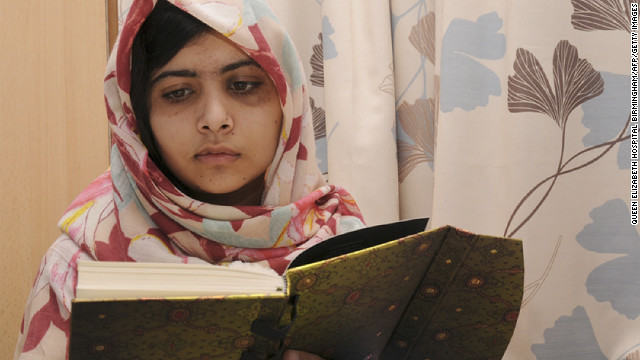
Malala Yousafzai. [Source].
But some people have resisted the urge to be consumed by mainstream fervor and have written more critically, with the risk of being branded a Taliban sympathizer or hopeless cynic. Unfortunately, their analysis has received little attention in comparison. One interesting article in The Feminist Wire explores whether Malala’s story is being used to justify US imperialism. Malala’s attack exposed the evil nature of the Taliban and thereby the necessity of American intervention, however violent, to ensure women’s rights. Another article in Open Democracy takes a look at how the coverage of Malala fails to contextualize the rise of the Taliban, which many argue is because of historical and continued external aggression especially of the US. Both pieces problematize the use of women’s bodies as a battleground for the ulterior motives of powerful internal and external forces. An intriguing critique of the Malala coverage is found on Tanqeed, a magazine on politics and culture. Tanqeed presents a conversation series in which six writers, including one from Swat (Malala’s hometown) “interrogate the troubling assumptions” of the dominant Western media. The central question running throughout the commentaries is: how is Malala’s story being instrumentalized by various groups and for what aims? These articles bring a refreshing and intelligent approach to what is inherently a complex issue.
Regarding how Pakistani media are processing the coverage of Malala, here is an interesting article critiquing the accusation that Malala’s attack is a foreign conspiracy to insult Pakistan and to bolster the US. This article also addresses questions that many in Pakistan and beyond have considered. Why did Malala’s plight create such a buzz while similar children who have died from American drones are ignored? Why did Malala get special treatment in a UK hospital while others suffer without any treatment at all? One Pakistani writer expresses how such questions can lead to sensational and unhelpful distractions from the serious problem of the Taliban and girls’ education. The same writer condemns “inject[ions] [of] complexity” as inappropriate and that more energy should be spent on protecting and providing for Pakistan’s children rather than scapegoating Pakistan’s problems on the west. As this MMW post aptly shows, there has been a lively and diverse debate on what Malala’s story means for Pakistan. But it is understandable why there is controversy. The simple truth is that if Malala were injured by a drone instead, her fate would have been very different. Powerful networks of Western media (such as CNN which has been criticized for being a mouthpiece for US foreign policy) seem to love this story because it fits theirs: “The Taliban is the ultimate villain here; please continue to ignore our own role!”
The politicization and simplification of Malala by both Western and non-Western media equally serves to obscure the full story. Drones and aggressive US foreign policy have been underplayed despite being significant factors in the general Pakistani socio-political landscape, which Malala is a part of. But conspiracy theories have been used to dismiss the real struggles of girls to lead dignified lives in Pakistan. Overall, the mainstream media has failed to be investigative, which is its job. Many of those in power, including the US, Pakistan and the Taliban, are not interested in exposing (much less engaging with) the realities that Malala’s story reveals. The Taliban’s extremism, the Pakistan government’s corruption and subservience to US military whims and the US’s dangerous interventions are all implicated in those realities. It is much easier to portray Malala’s story in whatever way most deflects that blame and responsibility. Thus, it is left to us to add the gray into a story deceivingly, and intentionally, made black and white.
Previous Post

February 26, 2013
Are “Latina” Muslim Women the New Face of Islam?
Next Post

February 27, 2013 Of Indian Marriage Laws and Conversions: The Case of Saifeena
Browse Our Archives
Select a Category Advertisements Art/Theater Books/Magazines Cinema Comics/Cartoons Culture/Society Events Fashion Film Friday Links Merchandise/Commodities MMW Announcements MMW Highlights Music/Radio News Photography Politics Profile Ramadan 2012 Ramadan 2013 Ramadan 2014 Ramadan 2015 Roundtable Satire Social Media Sports Technology/Science Television Uncategorized Video Web
Select a Month November 2015 October 2015 September 2015 August 2015 July 2015 June 2015 May 2015 April 2015 March 2015 January 2015 December 2014 November 2014 October 2014 September 2014 July 2014 June 2014 May 2014 April 2014 March 2014 February 2014 January 2014 December 2013 November 2013 October 2013 September 2013 August 2013 July 2013 June 2013 May 2013 April 2013 March 2013 February 2013 January 2013 December 2012 November 2012 October 2012 September 2012 August 2012 July 2012 June 2012 May 2012 April 2012 March 2012 February 2012 January 2012 December 2011 November 2011 September 2011 August 2011 July 2011 June 2011 May 2011 April 2011 March 2011 February 2011 January 2011 December 2010 November 2010 October 2010 September 2010 August 2010 July 2010 June 2010 May 2010 April 2010 March 2010 February 2010 January 2010 December 2009 November 2009 October 2009 September 2009 August 2009 July 2009 June 2009 May 2009 April 2009 March 2009 February 2009 January 2009 December 2008 November 2008 October 2008 September 2008 August 2008 July 2008 June 2008 May 2008 April 2008 March 2008 February 2008 January 2008 December 2007 November 2007 October 2007 September 2007 August 2007
Follow Us!
TAKE THE
Religious Wisdom Quiz
What was the name of the disciple who replaced Judas Iscariot?
Select your answer to see how you score.
Barnabas Matthias Timothy Silas
Related posts from Muslimah Media Watch

#PrayforParis, Muslim Women and Third World Violence



Why British MP’s statements defending Muslim women do...
TRENDING AT PATHEOS Muslim

25 Years Later: How Much Has Changed for...
As we approach the 25th anniversary of September 11th, I’ve found myself...

Podcast: Third Spaces & The Rise of Yemeni...
In the latest episode of The Artistic Foodies Podcast, hosts Abbas...

HalalFest Picks: Best 60 Halal Spots for Super...
Back in 2016, I came up with a list of 29...

Unity Is America’s Strength — Division Is Its...
by Hidayatullah Ahsan When Valentina Gomez, a Republican candidate for Congress in...

Zohran Mamdani and New York’s Fight Against Islamophobia
This past June, against all odds, Zohran Mamdani won the Democratic primary...

What the Fourth of July Means to a...
As we mark another Fourth of July, millions of Americans will celebrate...
view all Muslim blogs
Ad-Free & Subscriber Log-In Subscription Support
- About Us
- 2026 Calendar
- Videos
- Podcasts
- Library of World Religions
- Faith In Media Tracker
- Advertise With Us
- Write for Us
- Privacy Policy
- Terms of Service
- Do Not Sell My Data
- Contact Us
- Radiant Digital
- Manage Newsletter Subscriptions
- Unsubscribe From Notifications
- Sitemap
Copyright 2008-2026, Patheos. All rights reserved.
Subscription Support Ad-Free & Subscriber Log-In
Follow Patheos