
BuddhistCatholicContemplativeEvangelicalGeneral ChristianHinduJewishLatter-day SaintMuslimNew VisionsProgressive Christian
Beliefs
- Buddhist
- Catholic
- Contemplative
- Evangelical
- General Christian
- Hindu
- Jewish
- Latter-day Saint
- More Voices
- Muslim
- New Visions
- Pagan
- Progressive Christian
Topics
- Religion News
- Food and Religion
- Sports and Religion
- Religious Art
- Religious Music and Entertainment
- Religious Events
- History and Religion
- Style and Religion
- Politics and Religion
- Women in Religion
- Recreation Outdoors and Religion
- Business Finance and Religion
- Careers Workplace and Religion
- Education and Religion
- Family Parenting and Religion
- Health Fitness and Religion
- Home and Religion
- Relationships and Religion
- Technology and Religion
- Travel and Religion
Columnists
- Buddhist Columnists
- Business Finance and Religion Columnists
- Careers Workplace and Religion Columnists
- Catholic Columnists
- Contemplative Columnists
- Education and Religion Columnists
- Evangelists Columnists
- Family Parenting and Religion Columnists
- General Christian Columnists
- Health Fitness and Religion Columnists
- Hindu Columnists
- History and Religion Columnists
- Home and Religion Columnists
- Jewish Columnists
- More Voices Columnists
- Latter Day Columnists
- Muslim Columnists
- New Visions Columnists
- Nonreligious Columnists
- Pagan Columnists
- Politics and Religion Columnists
- Progressive Columnists
- Recreation Outdoors and Religion Columnists
- Relationships and Religion Columnists
- Religion News Columnists
- Religious Art Columnists
- Religious Events Columnists
- Religious Music and Entertainment Columnists
- Sports and Religion Columnists
- Style and Religion Columnists
- Technology and Religion Columnists
- Travel and Religion Columnists
- Women in Religion Columnists
Resource Library
- 2026 Calendar
- Library of World Religions
- The 100 Most Holy Places on Earth
- Patheos Answers
- Podcasts
- Videos
- Faith Leaders Database
- Anglican Episcopalian
- Bahai
- Baptist
- Buddhism
- Christianity
- Confucianism
- Eastern Orthodoxy
- Hinduism
- Holiness and Pentecostal
- ISKCON
- Islam
- Judaism
- Lutheran
- Methodist
- The Church of Jesus Christ of Latter-day Saints
- New Age
- Paganism
- Presbytarian and Reformed
- Protestantism
- Religion Behind the Scenes
- Roman Catholic
- Scientology
- Shia Islam
- Sikhism
- Sufism
- Sunni Islam
- Taoism
- Zen
- See all religions
Research Tools
 Ad-Free & Subscriber Log-In Subscription Support
Ad-Free & Subscriber Log-In Subscription Support
Follow Patheos 

- Trending:
- Forgiveness
- |
- Marriage
- |
- Consciousness
- |
- Death Penalty
- |
- Election
- |
- Halloween
 Muslimah Media Watch
- Home
- Muslim
- Religion News
- Not All Designations Are Equal: Representing Women in the Arab Revolutions and Beyond
Not All Designations Are Equal: Representing Women in the Arab Revolutions and Beyond
Last updated on: January 3, 2013 at 2:00 am by sana
Not All Designations Are Equal: Representing Women in the Arab Revolutions and Beyond 2013-01-02T13:08:25-04:00 sana
Patheos Explore the world's faith through different perspectives on religion and spirituality! Patheos has the views of the prevalent religions and spiritualities of the world.
Two years ago, Mohammad Bouazizi’s self-immolation set an inferno across parts of the Middle East and North Africa, changing the course of the region’s assumed history. We know what happened and we know what has been happening since. Egypt, Tunisia and Libya, despite having removed the bodies of dictators, continue to struggle to maintain control over the next phase of revolution. Yemenis and Bahrainis, albeit generally absent from headlines, are still fighting against authoritarian and oppressive governance and state violence. Syria, in perhaps the most precarious position, has descended into a bloody war with many local, national, regional and global fronts. As those of us with a privileged positionality of sitting spectatorship celebrate and commemorate – with some misplaced sense of entitlement – the two-year anniversary of the Arab revolutions, it is worth considering how we also have “celebrated” and “commemorated” the women of these revolutions and of these countries, who have received considerable attention. And it is further worth considering how we pick and choose which “brand” of Muslim women’s bodies, in particular, we’re interested in covering and how.
In a previous post, I quoted Lila Abu-Lughod on representations of Muslim women in political and advocacy rhetoric as well as, by extension, media when discussing certain regions and conflicts:
“Plastering neat cultural icons like “the Muslim woman” over messier historical and political narratives doesn’t get you anywhere. What does this substitution accomplish? Why, one has to ask, didn’t people rush to ask about Guatemalan women, Vietnamese women (or Buddhist women), Palestinian women, or Bosnian women when trying to understand those conflicts? The problem gets framed as one about another culture or religion, and the blame for the problems in the world placed on Muslim men, now neatly branded as patriarchal.”
It’s worth noting that while we will often find issues of “Muslim women” plastered all over our newsfeeds and television screens, these are almost always, with few exceptions, cavorted in narrow frames and with negative undertones. In these narratives, “Muslim women” face oppressions, and Islam and regional cultures play key roles in these oppressions. But when “Muslim women” are fighting against their oppressions, their religion and culture become irrelevant to their actions. The problem here isn’t the absence of religion and culture as positive tools – the problem is how religion and culture are selected for only one part of the story and ignored for the rest. The problem is how Muslim women’s bodies are swept into one shadow and made to single-handedly characterize an entire conflict and history.
Since the start of the Arab revolutions, women have received coverage in which they have been imagined as both purveyors and victims of the political tectonic shifts. When they’re not on hunger strikes, their freedom to express themselves is (maybe, kinda, not entirely) under threat. When they’re not asserting their freedom to mobility, or winning Nobel Peace prizes or posting videos that helped start one of the biggest revolutionary movements in recent history, they’re busy being hated on by anything with a phallic inclination (sigh). These are Bahraini, Syrian, Egyptian, Yemeni and Tunisian women – they are never just “Muslim women,” a noteworthy departure from usual Western engagement with female Muslim bodies which are usually merged into a single amorphous image. While there has been a specific branding of Muslim and Arab women’s bodies into their individual regional parts and a separation of their fights and struggles, there has also been an acknowledgment of a particular unity in the context of events. Strikingly, this interest in the women of revolution highlights the interest in the individual parts of The Muslim Woman insofar as feel-good headlines, articles and tweets are published and no feathers are ruffled.
Muslim and Arab women’s resistance against oppression, gendered state violence and authoritarianism did not start with Bouazizi’s flames. Contrary to the way the “women of the Arab Spring” have been depicted and imagined, women of the South have been integral to longer-term resistance against colonialism, authoritarian governance and socio-economic violences and oppressions. Amongst the most persistent of these women have been Palestinian women who have yet to receive the nod of acknowledgement of their daily resistance against occupation and apartheid by our (general) Western sentiments. Perhaps unsurprising as we still have yet to offer a nod of acknowledgement towards the effect of Israeli occupation and apartheid on the health, rights and bodies of Palestinian women, specifically refugees and those internally displaced.
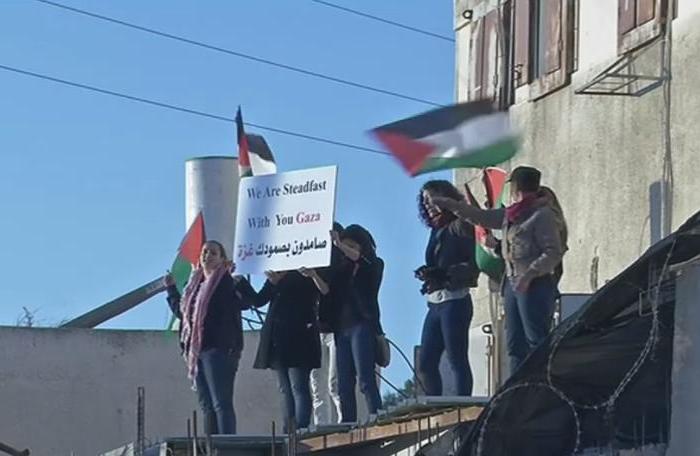
Palestinian women at the Occupy Beit El protest. Via Al Jazeera.
A recent example points to the disparity of representation and reporting even in the age of the “revolutionary Arab/Muslim woman.” On November 14th of this past year, the Israeli government launched Operation Pillar of Defense in the Gaza Strip. In what quickly felt like repeat of January 2009, the offensive, tucked under the rhetoric of self-defense, lasted eight days and claimed the lives of 160 Palestinians, of whom 105 were civilians, including 34 children and 13 women, and left a staggering one thousand wounded. Buildings were flattened, media centers and journalists were targeted and the hospitals were overwhelmed. While headlines roared of social media war tactics, noticeably ignored were a group of Palestinian women trying to break into an IDF military post outside the settlement of Beit El in the West Bank. The protest was a day after the Israeli “surgical” offensive had begun and in tandem with ongoing protests against the “symbol of the presence of Israeli occupation and military rule inside the [West Bank].” The women were arrested and save for some tweets and a mention on AJE’s The Stream (previously linked), the situation was ignored.
Arab women are fighting against tyranny of their own shade are the exemplars of a two-fold revolution: one against state tyranny and the other against patriarchy. But when Arab women are fighting against imperialist and neo-colonialist state narratives and tanks, such as Palestinian women against Israeli occupation and apartheid, they just so happen to miss the mark of grazing a headline or an article topic.
Beyond the Arab World, there lies a greater and far more problematically represented (when represented) Muslim world; its diverse women are equally reduced to a narrow range of representations. We are quick to latch onto the brave Malalas and subversive, even if cliché, Aliaas (image in that link contains nudity) in order to appropriate them and fit their struggles into our set lenses of good and evil. But we rarely mention the names, let alone acknowledge the existence, of all the women resisting occupation, rape as a weapon, foreign attacks and poverty on a daily basis. FEMEN parades its White Woman’s Burden feminism under naked skin as though its 1960s-esque fleshly protests are not only attention-grabbing but revolutionary. Yet in 2004, mothers in the Indian state of Manipur (albeit not Muslim), stripped themselves naked (ditto on nudity in the image) to protest against the sexual violence perpetrated against them by Indian military forces. They were protesting rape and security sexual violence (yes—protests in India against rape have been happening for time now against sexual violence in Manipur, Assam, Kashmir, Gujarat). These protests, shocking in India at the time, made little to no international headlines. Maybe it is because there was no Facebook, no Twitter. No clogging internet information sharing to make us all momentarily and selectively care about other things in the world. And it was 2004, which was truly a whole other time. But there was Mukhtaran Bibi (Mukhtar Mai) in 2004, who seemed to have made more than just a few headlines, going viral on the social opinion circuits after becoming the face of “resistance” against Pakistani tribal patriarchy. What was the difference between the Manipur protests and Mukhtar Mai? Why do the actions of citizens ignite flames of condemnation within us in a way that we don’t always necessarily seem to find when the same horrendous actions, perhaps at an even grander scale, are carried out by state actors or are state-sanctioned? And why does this seem to be especially the case when the states in question are our allies in ideology and strategic regional interest? There was much condemnation from the West of the targeting of Malala Yousafzai whilst ignoring the deaths, widowing and orphaning of Pakistani women and girls at the hands of U.S. drones, “our” economic and political policies.
Something is a bit uneasy here.
Those bundled up in the perspective of the dominant colonialist-imperial glory of power and race like Muslim and brown women best when they are resisting against their own societies and their own colored patriarchies, but when they are the victims – directly or indirectly – of our misdeeds, or the misdeeds of our ideological and military allies in the form of state apparatuses, then we lose interest in their struggles. We may hold empathy, but we lack the zeal a single face of a “revolution,” sold to us, can bring.
Not all women of the global South, Muslim and not, have one single face we can propagate onto our headlines and our screens. They also do not have “one” struggle nor a single cause for their differing plights. They are not all separate from their regional histories and the billowing struggles of their fellow countrymen. Our opportunistic representations fall short of giving them any semblance of justice. We forget that they, much like many women all over the world, exist through resistance. Small or big. Daily and hourly.
Seen and unseen; heard and unheard.
Previous Post

January 2, 2013
Reading Between the Lines: Two Takes on British Women’s Unemployment
Next Post
January 4, 2013 Friday Links | January 4, 2013
Browse Our Archives
Select a Category Advertisements Art/Theater Books/Magazines Cinema Comics/Cartoons Culture/Society Events Fashion Film Friday Links Merchandise/Commodities MMW Announcements MMW Highlights Music/Radio News Photography Politics Profile Ramadan 2012 Ramadan 2013 Ramadan 2014 Ramadan 2015 Roundtable Satire Social Media Sports Technology/Science Television Uncategorized Video Web
Select a Month November 2015 October 2015 September 2015 August 2015 July 2015 June 2015 May 2015 April 2015 March 2015 January 2015 December 2014 November 2014 October 2014 September 2014 July 2014 June 2014 May 2014 April 2014 March 2014 February 2014 January 2014 December 2013 November 2013 October 2013 September 2013 August 2013 July 2013 June 2013 May 2013 April 2013 March 2013 February 2013 January 2013 December 2012 November 2012 October 2012 September 2012 August 2012 July 2012 June 2012 May 2012 April 2012 March 2012 February 2012 January 2012 December 2011 November 2011 September 2011 August 2011 July 2011 June 2011 May 2011 April 2011 March 2011 February 2011 January 2011 December 2010 November 2010 October 2010 September 2010 August 2010 July 2010 June 2010 May 2010 April 2010 March 2010 February 2010 January 2010 December 2009 November 2009 October 2009 September 2009 August 2009 July 2009 June 2009 May 2009 April 2009 March 2009 February 2009 January 2009 December 2008 November 2008 October 2008 September 2008 August 2008 July 2008 June 2008 May 2008 April 2008 March 2008 February 2008 January 2008 December 2007 November 2007 October 2007 September 2007 August 2007
Follow Us!
TAKE THE
Religious Wisdom Quiz
What does the Bible say about pride?
Select your answer to see how you score.
It is harmless It goes before a fall It always wins It is a virtue
Related posts from Muslimah Media Watch

#PrayforParis, Muslim Women and Third World Violence


Hate Crimes and Mother Tongues

Interview with Comedian Eman El Husseini
TRENDING AT PATHEOS Muslim

25 Years Later: How Much Has Changed for...
As we approach the 25th anniversary of September 11th, I’ve found myself...

Podcast: Third Spaces & The Rise of Yemeni...
In the latest episode of The Artistic Foodies Podcast, hosts Abbas...

HalalFest Picks: Best 60 Halal Spots for Super...
Back in 2016, I came up with a list of 29...

Unity Is America’s Strength — Division Is Its...
by Hidayatullah Ahsan When Valentina Gomez, a Republican candidate for Congress in...

Zohran Mamdani and New York’s Fight Against Islamophobia
This past June, against all odds, Zohran Mamdani won the Democratic primary...

What the Fourth of July Means to a...
As we mark another Fourth of July, millions of Americans will celebrate...
view all Muslim blogs
Ad-Free & Subscriber Log-In Subscription Support
- About Us
- 2026 Calendar
- Videos
- Podcasts
- Library of World Religions
- Faith In Media Tracker
- Advertise With Us
- Write for Us
- Privacy Policy
- Terms of Service
- Do Not Sell My Data
- Contact Us
- Radiant Digital
- Manage Newsletter Subscriptions
- Unsubscribe From Notifications
- Sitemap
Copyright 2008-2026, Patheos. All rights reserved.
Subscription Support Ad-Free & Subscriber Log-In
Follow Patheos