
BuddhistCatholicContemplativeEvangelicalGeneral ChristianHinduJewishLatter-day SaintMuslimNew VisionsProgressive Christian
Beliefs
- Buddhist
- Catholic
- Contemplative
- Evangelical
- General Christian
- Hindu
- Jewish
- Latter-day Saint
- More Voices
- Muslim
- New Visions
- Pagan
- Progressive Christian
Topics
- Religion News
- Food and Religion
- Sports and Religion
- Religious Art
- Religious Music and Entertainment
- Religious Events
- History and Religion
- Style and Religion
- Politics and Religion
- Women in Religion
- Recreation Outdoors and Religion
- Business Finance and Religion
- Careers Workplace and Religion
- Education and Religion
- Family Parenting and Religion
- Health Fitness and Religion
- Home and Religion
- Relationships and Religion
- Technology and Religion
- Travel and Religion
Columnists
- Buddhist Columnists
- Business Finance and Religion Columnists
- Careers Workplace and Religion Columnists
- Catholic Columnists
- Contemplative Columnists
- Education and Religion Columnists
- Evangelists Columnists
- Family Parenting and Religion Columnists
- General Christian Columnists
- Health Fitness and Religion Columnists
- Hindu Columnists
- History and Religion Columnists
- Home and Religion Columnists
- Jewish Columnists
- More Voices Columnists
- Latter Day Columnists
- Muslim Columnists
- New Visions Columnists
- Nonreligious Columnists
- Pagan Columnists
- Politics and Religion Columnists
- Progressive Columnists
- Recreation Outdoors and Religion Columnists
- Relationships and Religion Columnists
- Religion News Columnists
- Religious Art Columnists
- Religious Events Columnists
- Religious Music and Entertainment Columnists
- Sports and Religion Columnists
- Style and Religion Columnists
- Technology and Religion Columnists
- Travel and Religion Columnists
- Women in Religion Columnists
Resource Library
- 2026 Calendar
- Library of World Religions
- The 100 Most Holy Places on Earth
- Patheos Answers
- Podcasts
- Videos
- Faith Leaders Database
- Anglican Episcopalian
- Bahai
- Baptist
- Buddhism
- Christianity
- Confucianism
- Eastern Orthodoxy
- Hinduism
- Holiness and Pentecostal
- ISKCON
- Islam
- Judaism
- Lutheran
- Methodist
- The Church of Jesus Christ of Latter-day Saints
- New Age
- Paganism
- Presbytarian and Reformed
- Protestantism
- Religion Behind the Scenes
- Roman Catholic
- Scientology
- Shia Islam
- Sikhism
- Sufism
- Sunni Islam
- Taoism
- Zen
- See all religions
Research Tools
 Ad-Free & Subscriber Log-In Subscription Support
Ad-Free & Subscriber Log-In Subscription Support
Follow Patheos 

- Trending:
- Forgiveness
- |
- Marriage
- |
- Consciousness
- |
- Death Penalty
- |
- Election
- |
- Halloween
 Muslimah Media Watch
- Home
- Muslim
- Religion News
- Muslim Women’s Stories in the Kerala Gulf Boom
Muslim Women’s Stories in the Kerala Gulf Boom
Last updated on: December 5, 2012 at 2:00 am by Izzie
Muslim Women’s Stories in the Kerala Gulf Boom 2012-12-04T23:17:00-04:00 Izzie
Patheos Explore the world's faith through different perspectives on religion and spirituality! Patheos has the views of the prevalent religions and spiritualities of the world.
The Kerala “Gulf Boom” refers to the mass migration of a large number of people from the Indian state of Kerala to the Gulf Countries from 1972 to 1983. The movement of many migrant workers from Kerala to the Gulf Countries continues to the present day. By 2008, the Gulf countries contained a total Keralite population of more than 2.5 million, who annually send home a sum of around $ 6.81 billion (US), which was more than 15% of the total Remittance to India in 2008. And were 15 to 18 times the size of foreign exchange earned from the export of cashew and marine products. Forty-two per cent of Malayalis in the Gulf countries are Muslims.
Director Kamal, in two of his critically acclaimed movies, based on true stories, gives us the Muslim women’s side of the Gulf Boom story, from both sides.
Gadhamma (“Housemaid”) showcases the life of a Muslim woman who is employed as maid-servant in a wealthy Arab household and falls prey to Saudi Arabia’s modern slavery. Perumazhakkalam (“The season of heavy rains”) depicts the plight of Gulf wives, predominantly Muslims, who are left behind in Kerala, while their husbands work abroad.
Both the movies have Saudi Arabia, and its Shariah rule, as their background.
Gadhamma
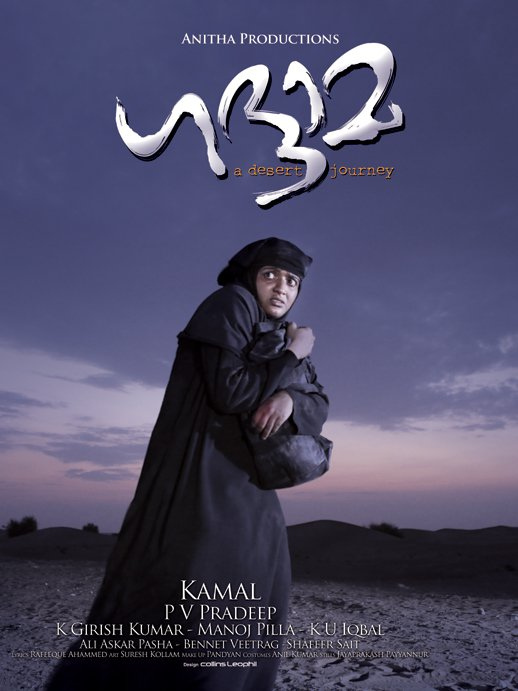
Poster for the film Gadhamma.
In this film, a lower-middle-class Malayali widow, Aswathy, reaches Saudi Arabia, to work as a housemaid. Her employers are abusive, make her discard all contacts with her family back in Kerala, and stop paying her salary.
She escapes the house but lands up with a bunch of goons, from whom she is saved and given abode by a fellow Malayali only to be imprisoned by the Mutaween (Saudi Arabia’s moral police), and flagellated for living with an non-mahram man. Once she serves out her sentence, she is deported back home. What happens to Ashwathy once she returns is unclear, as most maids return back to Gulf when they realize they have no means of survival back in Kerala.
As director, Kamal states in an interview that he “mellowed down” the plight of an expatriate maidservant (which, he says, “is worse than what is portrayed”), and that takes away a little bit from the impact the movie could have made. This being said, it brings light to the extensive violation of human rights which takes place in the lower class expatriate society in Middle Eastern countries. For example, the vulnerability of the unskilled laborers, under the Kafala system, which is likened to modern day slavery. The system requires all laborers to have an in-country sponsor, usually their employer, who is responsible for their visa and legal status. This makes it possible for the employers to abuse and confine their housemaids, and exploit them with no legal consequences.
In one scene, Ashwathy is dressed in a hijab and niqab, while she is kidnapped by goons, on the pretext of giving her a lift in their vehicle. They discuss among themselves about sexually abusing her, which breaks the common notion that wearing a hijab necessarily asexualizes women.
The movie was banned for viewing across all Middle Eastern countries, due to its negative depiction of all Gulf countries.
Perumazhakkalam
While Gadhamma primarily shows the life of an expatriate, Perumazhakkalam, shows the other side of the spectrum, the plight of the Gulf wife, the woman who lives separately from her husband, who is employed in a Gulf country, returning usually for a short vacation once every two or three years. Here, the protagonist Gulf wife is Razia, also known as Mailanji, because of her expertise in applying Mehndi hand designs. Her husband Akbar works in Saudi Arabia, and news reaches her that Akbar is charged with murder of a fellow Malayali expatriate, Raghu, a Hindu, while in Saudi Arabia, and is facing the death penalty.
Akbar’s friend, Jose, visits from Saudi Arabia, and brings Razia a ray of hope, when he mentions that under the Sharia law for murder, Akbar could be freed if they could get a letter of mercy from Raghu’s wife, Ganga, saying that she forgives her husband’s murderer.
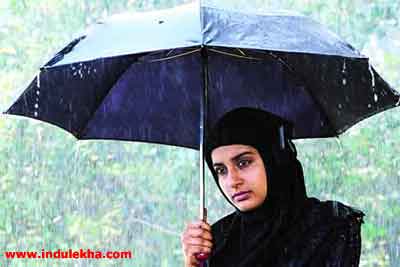
A scene from the movie Perumazhakkalam. Via Indulekha.com.
Following this, starts Razia’s unrelenting effort to get Ganga to sign the mercy petition. While Raghu’s parents and brothers are not willing to sign the petition, Ganga, out of kindness, goes out of her way to sign the document, only to be ostracized from her Brahmin society and husband’s home. Akbar is spared his death sentence and is relieved from prison during Ramadan, as is a practice in Middle Eastern countries . He returns home to thank Ganga for her mercy. Ganga is seen as an independent woman, who runs a humble snacks business, but is happier there than within the confines of her husband’s home.
The movie stands out in many respects, as it is shown solely from the women’s perspective.
Razia is a Muslim woman, while Ganga is a Brahmin Hindu woman. These are two religions, which though live in tolerance in Kerala, are poles apart when it comes to rituals and beliefs. While Islam is widely considered to be oppressive to women, this movie depicts Hinduism to be much harsher, especially to widows. Ganga’s bangles are broken, and her ornaments are removed, and she is only supposed to dress in white after her husband’s death. She is also prohibited from attending auspicious occasions like marriages, and secluded to live within the confines of her husband’s home.
The patriarchal system leaves her with much less support than her Muslim counterpart Razia, who, though in a black burkha, is wholeheartedly supported by her family. Razia also enjoys the privilege of living in her parents’ house, as against the common practice in India, where wives are supposed to stay in the husband’s house post-marriage. This practice was built to protect Gulf wives, who spent most of their young adult life separated from their husbands, to live in the security of their own homes.
Kamal depicts Muslim women as they are, in both his movies, as true to life as it can get. The movies felt like a mirror held to the society in which I have lived and grown up. They have their plights and sorrows, but they are resilient, as are all women. Both Razia and Aswathy spend most of their life waiting. Waiting for their husbands to return, or waiting to return home for their lives to start. Most of the women in my home are Gulf wives, hence this movie strongly resonated with me, personally. Most of these women are sometimes only known for their Mehndi skills like Razia and/or for their domestic skills like Aswathy, but tragedy brings out their strength.
Previous Post

December 4, 2012
Recent Good News Out of Switzerland
Next Post

December 6, 2012 China’s Women’s Mosques: Claiming Women’s Space in the Mosque
Browse Our Archives
Select a Category Advertisements Art/Theater Books/Magazines Cinema Comics/Cartoons Culture/Society Events Fashion Film Friday Links Merchandise/Commodities MMW Announcements MMW Highlights Music/Radio News Photography Politics Profile Ramadan 2012 Ramadan 2013 Ramadan 2014 Ramadan 2015 Roundtable Satire Social Media Sports Technology/Science Television Uncategorized Video Web
Select a Month November 2015 October 2015 September 2015 August 2015 July 2015 June 2015 May 2015 April 2015 March 2015 January 2015 December 2014 November 2014 October 2014 September 2014 July 2014 June 2014 May 2014 April 2014 March 2014 February 2014 January 2014 December 2013 November 2013 October 2013 September 2013 August 2013 July 2013 June 2013 May 2013 April 2013 March 2013 February 2013 January 2013 December 2012 November 2012 October 2012 September 2012 August 2012 July 2012 June 2012 May 2012 April 2012 March 2012 February 2012 January 2012 December 2011 November 2011 September 2011 August 2011 July 2011 June 2011 May 2011 April 2011 March 2011 February 2011 January 2011 December 2010 November 2010 October 2010 September 2010 August 2010 July 2010 June 2010 May 2010 April 2010 March 2010 February 2010 January 2010 December 2009 November 2009 October 2009 September 2009 August 2009 July 2009 June 2009 May 2009 April 2009 March 2009 February 2009 January 2009 December 2008 November 2008 October 2008 September 2008 August 2008 July 2008 June 2008 May 2008 April 2008 March 2008 February 2008 January 2008 December 2007 November 2007 October 2007 September 2007 August 2007
Follow Us!
TAKE THE
Religious Wisdom Quiz
Who had a dream of a ladder reaching to heaven?
Select your answer to see how you score.
Abraham Joseph Daniel Jacob
Related posts from Muslimah Media Watch


Review of Desert Dancer (2015)


On Hany Abu Asad’s Omar and the “Missing...
TRENDING AT PATHEOS Muslim

25 Years Later: How Much Has Changed for...
As we approach the 25th anniversary of September 11th, I’ve found myself...

Podcast: Third Spaces & The Rise of Yemeni...
In the latest episode of The Artistic Foodies Podcast, hosts Abbas...

HalalFest Picks: Best 60 Halal Spots for Super...
Back in 2016, I came up with a list of 29...

Unity Is America’s Strength — Division Is Its...
by Hidayatullah Ahsan When Valentina Gomez, a Republican candidate for Congress in...

Zohran Mamdani and New York’s Fight Against Islamophobia
This past June, against all odds, Zohran Mamdani won the Democratic primary...

What the Fourth of July Means to a...
As we mark another Fourth of July, millions of Americans will celebrate...
view all Muslim blogs
Ad-Free & Subscriber Log-In Subscription Support
- About Us
- 2026 Calendar
- Videos
- Podcasts
- Library of World Religions
- Faith In Media Tracker
- Advertise With Us
- Write for Us
- Privacy Policy
- Terms of Service
- Do Not Sell My Data
- Contact Us
- Radiant Digital
- Manage Newsletter Subscriptions
- Unsubscribe From Notifications
- Sitemap
Copyright 2008-2026, Patheos. All rights reserved.
Subscription Support Ad-Free & Subscriber Log-In
Follow Patheos