
BuddhistCatholicContemplativeEvangelicalGeneral ChristianHinduJewishLatter-day SaintMuslimNew VisionsProgressive Christian
Beliefs
- Buddhist
- Catholic
- Contemplative
- Evangelical
- General Christian
- Hindu
- Jewish
- Latter-day Saint
- More Voices
- Muslim
- New Visions
- Pagan
- Progressive Christian
Topics
- Religion News
- Food and Religion
- Sports and Religion
- Religious Art
- Religious Music and Entertainment
- Religious Events
- History and Religion
- Style and Religion
- Politics and Religion
- Women in Religion
- Recreation Outdoors and Religion
- Business Finance and Religion
- Careers Workplace and Religion
- Education and Religion
- Family Parenting and Religion
- Health Fitness and Religion
- Home and Religion
- Relationships and Religion
- Technology and Religion
- Travel and Religion
Columnists
- Buddhist Columnists
- Business Finance and Religion Columnists
- Careers Workplace and Religion Columnists
- Catholic Columnists
- Contemplative Columnists
- Education and Religion Columnists
- Evangelists Columnists
- Family Parenting and Religion Columnists
- General Christian Columnists
- Health Fitness and Religion Columnists
- Hindu Columnists
- History and Religion Columnists
- Home and Religion Columnists
- Jewish Columnists
- More Voices Columnists
- Latter Day Columnists
- Muslim Columnists
- New Visions Columnists
- Nonreligious Columnists
- Pagan Columnists
- Politics and Religion Columnists
- Progressive Columnists
- Recreation Outdoors and Religion Columnists
- Relationships and Religion Columnists
- Religion News Columnists
- Religious Art Columnists
- Religious Events Columnists
- Religious Music and Entertainment Columnists
- Sports and Religion Columnists
- Style and Religion Columnists
- Technology and Religion Columnists
- Travel and Religion Columnists
- Women in Religion Columnists
Resource Library
- 2026 Calendar
- Library of World Religions
- The 100 Most Holy Places on Earth
- Patheos Answers
- Podcasts
- Videos
- Faith Leaders Database
- Anglican Episcopalian
- Bahai
- Baptist
- Buddhism
- Christianity
- Confucianism
- Eastern Orthodoxy
- Hinduism
- Holiness and Pentecostal
- ISKCON
- Islam
- Judaism
- Lutheran
- Methodist
- The Church of Jesus Christ of Latter-day Saints
- New Age
- Paganism
- Presbytarian and Reformed
- Protestantism
- Religion Behind the Scenes
- Roman Catholic
- Scientology
- Shia Islam
- Sikhism
- Sufism
- Sunni Islam
- Taoism
- Zen
- See all religions
Research Tools
 Ad-Free & Subscriber Log-In Subscription Support
Ad-Free & Subscriber Log-In Subscription Support
Follow Patheos 

- Trending:
- Forgiveness
- |
- Marriage
- |
- Consciousness
- |
- Death Penalty
- |
- Election
- |
- Halloween
 Muslimah Media Watch
- Home
- Muslim
- Religion News
- Booby-Traps and Breastfeeding in Guinea
Booby-Traps and Breastfeeding in Guinea
Last updated on: October 22, 2012 at 2:00 am by woodturtle
Booby-Traps and Breastfeeding in Guinea 2012-10-21T22:19:26-04:00 woodturtle
Patheos Explore the world's faith through different perspectives on religion and spirituality! Patheos has the views of the prevalent religions and spiritualities of the world.
My daughter Ivy devours bananas. She can finish off half a banana in minutes and screams if you take it away from her before she’s done. In fact, at five months old she has already tasted bagels, figs and chicken – stuffing anything within reach on my plate into her mouth. At birth, my other daughter Eryn absolutely refused to nurse, and I spent the first 48 hours of her life desperately feeding her a mixture of colostrum and water and eventually turned to formula when she lost too much weight. But we persevered and I successfully nursed her for three years.
For both babies, my intention was to follow the World Health Organization’s recommendation to exclusively breastfeed for the first six months of their lives. The girls, of course, had something else in mind – and I ended up joining the statistics of mothers who, for whatever reason, fail at following this important medical advice.
Despite the fact that health authorities around the world support the WHO’s recommendation, only 37% of mothers around the world exclusively breast feed for the recommended time. It’s 39% in the developing world, 25.9% in Canada, 14% in Australia, 8% in Brazil, and France doesn’t even register, with negligible breastfeeding statistics past two months post-partum.
Recently, IRIN released a report on the “shocking” decline of exclusive breastfeeding in the West African country of Guinea. Apparently, Muslim women and families are offering newborn infants water that’s been blessed by inscriptions of the Holy Qur’an, and will forgo initiating breastfeeding until this water treatment is administered:
“Countless babies in Guinea are not given their first breast milk for hours – however long it takes a designated family member to bring water that is used to rinse special Koranic verses inscribed on a wooden tablet. This symbolic liquid, the first thing many babies ingest, is just one example of a custom believed to protect children but that can instead jeopardize their health.”
Exclusive breastfeeding rates in Guinea have been cut in half over the past four years, declining to 18.5% in 2012 – and the report spends a lot of time making it sound like this ritual is the culprit, even though other forms of supplementation are mentioned. According to the report, families who administer water, shea butter, or a local tea along with breast milk to their infants, are doing so based on the misinformation that newborns need more than just breast milk to survive and thrive.
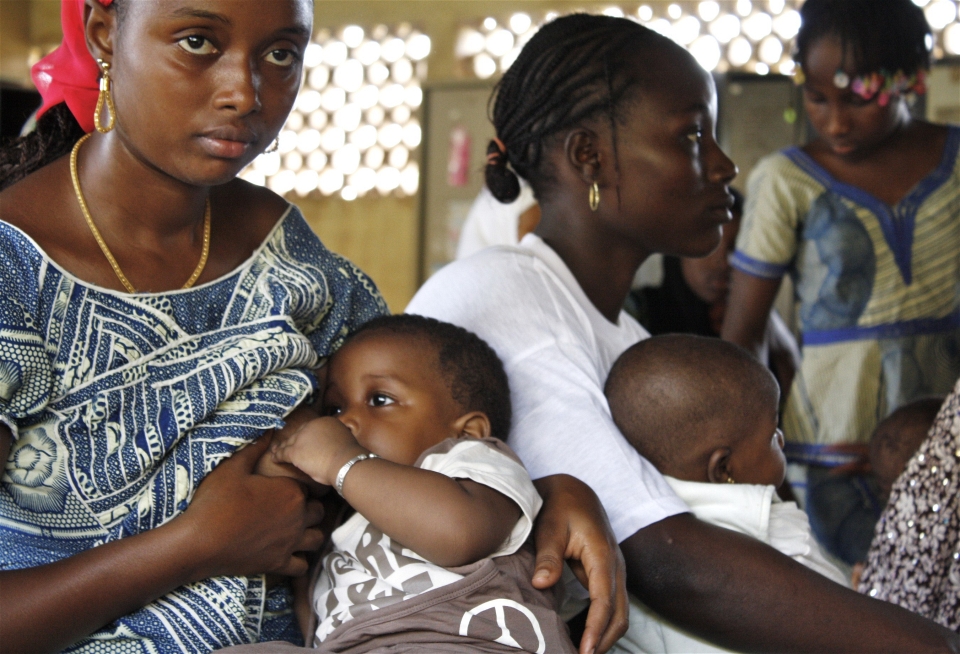
Women with their babies at a community health centre in Conakry, Guinea. Image via IRIN.
Also highlighted is an anti-breastfeeding attitude that if an infant dies, the mother’s milk is blamed. The woman is then discouraged from breastfeeding later children and could even be stigmatized. According to Mamady Kaba, head of maternal and infant health and nutrition with the international NGO Terre des Hommes-Lausanne, “some people use an age-old ‘test’ — pouring some of the woman’s breast milk on an ant. If the ant dies, people say that it proves the milk is bad.”
As a lactivist, I found this report to be incredibly interesting, but also problematic at times. There seems to be a thread of subtle mother-blaming and culture wars behind a seemingly informative and factual report, which for all intents and purposes is attempting to further a specific agenda, namely, adherence to the WHO recommendation of exclusive breastfeeding for the first six months. Now there’s nothing inherently wrong with this agenda. Health authorities give a lot of importance to exclusive breastfeeding — and for good reason. Not only is breast milk the most optimal food for infants, but there is also a long list of benefits for both mother and baby, and exclusive breast-feeding can prevent diseases like diarrhoea and pneumonia.
But the report clearly presents the Qur’anic water ritual as being a “problem,” “misinformation,” and “potentially harmful” – in other words, a barrier to ensuring infant health in the region. Apparently, health workers are going to war against mothers, sisters, mother-in-laws and village elders to protect infants from cultural beliefs against breastfeeding. It’s science versus religion, and literally, “breastfeeding versus old wives tales.” This ritual works against the WHO recommendation, and is nothing more than a dangerous superstition in need of correction. Unfortunately, no statistics are offered to support just how many families administer the ritual or to illustrate how many infants have actually been harmed because of it.
In fact, the report contradicts itself by including an interview with a woman whose family administered the ritual to her son – and now at one-month old, he’s thriving on breast milk. This is later juxtaposed with the story of an ailing infant who, at five months, is still at its birth weight. In this case, the mother turned to “store-bought milk products,” believing she didn’t have enough breast milk to feed her infant.
There is a long history of aggressive marketing of breast milk substitutes, correlating alarmingly with rising infant mortality rates in developing countries. So I find it strange that IRIN presents an Islamic-inspired tradition as “seriously harming infants,” when the more likely source of a change in cultural attitudes toward breastfeeding is the aggressive marketing of formula.
A point that is subtly buried near the end of the report:
“[UNICEF] says the decline is probably due to three factors: aggressive marketing of milk products has some women adding them to their babies’ diet; the 2008 study might have overstated the rate of exclusive breastfeeding; and socio-political instability in Guinea has hit community nutrition education activities.”
So there you have it. There is no conclusive evidence that mothers and families who participate in this religious ritual are actually harming their infants. But cultural imperialism and mother-blaming sure makes for a great story and headline.
What I did like about the report was the focus on educating families on breast milk production, the benefits of breast milk and the importance of addressing negative attitudes toward breast-feeding by encouraging families to support mothers. Women and their breasts are blamed for the death of infants whether or not a talisman is used for protection. So it’s not necessarily religious beliefs and practices that have to change, but attitudes toward breastfeeding and women.
There are many reasons why mothers supplement or abandon breast-feeding before the recommended time. So-called “booby-traps” can include gaps in the education on proper breast-feeding techniques, cultural stigmas, the health of the mother or child, poor employment rights and policies for the breastfeeding woman, aggressive formula advertising and marketing, social disapproval, or a lack of support from both medical professionals and family members.
It may very well be that the Qur’anic water treatment is a kind of “booby-trap” to exclusive and early initiation of breastfeeding. According to the WHO, breastfeeding within the first hour of birth, “has been estimated to prevent 22% of neonatal deaths” – so yes, I can see why health workers would be alarmed if women in Guinea didn’t nurse their newborns immediately and supplemented with water or with the early introduction of food.
It’s obvious that the majority of women on a global scale are just not achieving the WHO’s recommendation to breastfeed exclusively. Whether it’s attitudinal barriers or gaps in support, sometimes things just don’t go as planned — something I experienced firsthand with my daughters.
So perhaps the recommendation is idealistic and shouldn’t be applied universally — at least not without making space for alternate views as long as it is safe to do so. But it’s reports like this one that may have the effect of of holding women, and the health workers that support them, to unrealistic standards — and instead, put the emphasis for what really needs to be changed.
Previous Post

October 19, 2012
Friday Links | October 19, 2012
Next Post

October 23, 2012 Looking “Pretty”: Muslim Women and the World of Cosmetics
Browse Our Archives
Select a Category Advertisements Art/Theater Books/Magazines Cinema Comics/Cartoons Culture/Society Events Fashion Film Friday Links Merchandise/Commodities MMW Announcements MMW Highlights Music/Radio News Photography Politics Profile Ramadan 2012 Ramadan 2013 Ramadan 2014 Ramadan 2015 Roundtable Satire Social Media Sports Technology/Science Television Uncategorized Video Web
Select a Month November 2015 October 2015 September 2015 August 2015 July 2015 June 2015 May 2015 April 2015 March 2015 January 2015 December 2014 November 2014 October 2014 September 2014 July 2014 June 2014 May 2014 April 2014 March 2014 February 2014 January 2014 December 2013 November 2013 October 2013 September 2013 August 2013 July 2013 June 2013 May 2013 April 2013 March 2013 February 2013 January 2013 December 2012 November 2012 October 2012 September 2012 August 2012 July 2012 June 2012 May 2012 April 2012 March 2012 February 2012 January 2012 December 2011 November 2011 September 2011 August 2011 July 2011 June 2011 May 2011 April 2011 March 2011 February 2011 January 2011 December 2010 November 2010 October 2010 September 2010 August 2010 July 2010 June 2010 May 2010 April 2010 March 2010 February 2010 January 2010 December 2009 November 2009 October 2009 September 2009 August 2009 July 2009 June 2009 May 2009 April 2009 March 2009 February 2009 January 2009 December 2008 November 2008 October 2008 September 2008 August 2008 July 2008 June 2008 May 2008 April 2008 March 2008 February 2008 January 2008 December 2007 November 2007 October 2007 September 2007 August 2007
Follow Us!
TAKE THE
Religious Wisdom Quiz
To which king did Isaiah deliver the prophecy of 15 extra years of life?
Select your answer to see how you score.
Ahab Josiah Hezekiah Manasseh
Related posts from Muslimah Media Watch

#PrayforParis, Muslim Women and Third World Violence


Hate Crimes and Mother Tongues

Interview with Comedian Eman El Husseini
TRENDING AT PATHEOS Muslim

25 Years Later: How Much Has Changed for...
As we approach the 25th anniversary of September 11th, I’ve found myself...

Podcast: Third Spaces & The Rise of Yemeni...
In the latest episode of The Artistic Foodies Podcast, hosts Abbas...

HalalFest Picks: Best 60 Halal Spots for Super...
Back in 2016, I came up with a list of 29...

Unity Is America’s Strength — Division Is Its...
by Hidayatullah Ahsan When Valentina Gomez, a Republican candidate for Congress in...

Zohran Mamdani and New York’s Fight Against Islamophobia
This past June, against all odds, Zohran Mamdani won the Democratic primary...

What the Fourth of July Means to a...
As we mark another Fourth of July, millions of Americans will celebrate...
view all Muslim blogs
Ad-Free & Subscriber Log-In Subscription Support
- About Us
- 2026 Calendar
- Videos
- Podcasts
- Library of World Religions
- Faith In Media Tracker
- Advertise With Us
- Write for Us
- Privacy Policy
- Terms of Service
- Do Not Sell My Data
- Contact Us
- Radiant Digital
- Manage Newsletter Subscriptions
- Unsubscribe From Notifications
- Sitemap
Copyright 2008-2026, Patheos. All rights reserved.
Subscription Support Ad-Free & Subscriber Log-In
Follow Patheos