
BuddhistCatholicContemplativeEvangelicalGeneral ChristianHinduJewishLatter-day SaintMuslimNew VisionsProgressive Christian
Beliefs
- Buddhist
- Catholic
- Contemplative
- Evangelical
- General Christian
- Hindu
- Jewish
- Latter-day Saint
- More Voices
- Muslim
- New Visions
- Pagan
- Progressive Christian
Topics
- Religion News
- Food and Religion
- Sports and Religion
- Religious Art
- Religious Music and Entertainment
- Religious Events
- History and Religion
- Style and Religion
- Politics and Religion
- Women in Religion
- Recreation Outdoors and Religion
- Business Finance and Religion
- Careers Workplace and Religion
- Education and Religion
- Family Parenting and Religion
- Health Fitness and Religion
- Home and Religion
- Relationships and Religion
- Technology and Religion
- Travel and Religion
Columnists
- Buddhist Columnists
- Business Finance and Religion Columnists
- Careers Workplace and Religion Columnists
- Catholic Columnists
- Contemplative Columnists
- Education and Religion Columnists
- Evangelists Columnists
- Family Parenting and Religion Columnists
- General Christian Columnists
- Health Fitness and Religion Columnists
- Hindu Columnists
- History and Religion Columnists
- Home and Religion Columnists
- Jewish Columnists
- More Voices Columnists
- Latter Day Columnists
- Muslim Columnists
- New Visions Columnists
- Nonreligious Columnists
- Pagan Columnists
- Politics and Religion Columnists
- Progressive Columnists
- Recreation Outdoors and Religion Columnists
- Relationships and Religion Columnists
- Religion News Columnists
- Religious Art Columnists
- Religious Events Columnists
- Religious Music and Entertainment Columnists
- Sports and Religion Columnists
- Style and Religion Columnists
- Technology and Religion Columnists
- Travel and Religion Columnists
- Women in Religion Columnists
Resource Library
- 2026 Calendar
- Library of World Religions
- The 100 Most Holy Places on Earth
- Patheos Answers
- Podcasts
- Videos
- Faith Leaders Database
- Anglican Episcopalian
- Bahai
- Baptist
- Buddhism
- Christianity
- Confucianism
- Eastern Orthodoxy
- Hinduism
- Holiness and Pentecostal
- ISKCON
- Islam
- Judaism
- Lutheran
- Methodist
- The Church of Jesus Christ of Latter-day Saints
- New Age
- Paganism
- Presbytarian and Reformed
- Protestantism
- Religion Behind the Scenes
- Roman Catholic
- Scientology
- Shia Islam
- Sikhism
- Sufism
- Sunni Islam
- Taoism
- Zen
- See all religions
Research Tools
 Ad-Free & Subscriber Log-In Subscription Support
Ad-Free & Subscriber Log-In Subscription Support
Follow Patheos 

- Trending:
- Forgiveness
- |
- Marriage
- |
- Consciousness
- |
- Death Penalty
- |
- Election
- |
- Halloween
 Muslimah Media Watch
- Home
- Muslim
- Religion News
- Book Review: Islam in the Hinterlands
Book Review: Islam in the Hinterlands
Last updated on: September 27, 2012 at 2:00 am by Krista
Book Review: Islam in the Hinterlands 2012-09-27T01:17:46-04:00 Krista
Patheos Explore the world's faith through different perspectives on religion and spirituality! Patheos has the views of the prevalent religions and spiritualities of the world.
Islam in the Hinterlands: Muslim Cultural Politics in Canada is a recent book that looks at the place of Muslims within Canadian media, schools, politics, and laws. Edited by Jasmin Zine, the collection provides insightful analysis on a number of current topics related to Muslims in Canada, and is a valuable resource for those of us working as scholars, writers, and/or activists in the field.
The first section of the book, “Gender and Cultural Politics,” begins with a chapter by Zine that maps out issues of gender and race in a number of recent events involving Muslims in Canadian news and politics. Zine identifies three major lenses through which these issues get discussed: “disciplining culture,” where Muslim cultures are defined as dangerous and needing to be contained within Canada’s multicultural framework; “death by culture,” where Muslim women are portrayed as being under threat from the beliefs and practices of their communities, and “death of culture,” where Muslims are seen as a danger to Canadian society as a whole. In the second chapter of this section, Itrath Syed writes about debates in 2003-2005 around the use of Islamic family law in Ontario (short overview of the issue here, in PDF), arguing that in the way that the debates were framed, “Muslim women were infantilized, the Muslim community of Canada was denationalized, and Islamic law was fossilized” (p. 61). The third chapter, written by Katherine Bullock, looks at how we might do research on political engagement among Muslim women in Canada, and provides a useful framework for how we might understand definitions of “Muslims,” “political engagement,” and “activism” more broadly.
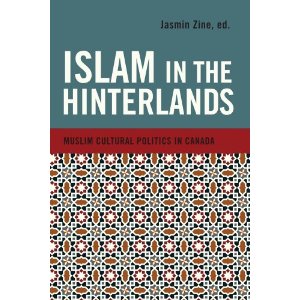
Cover of Islam in the Hinterlands. Image via Amazon.
In the following section, “Media and Representation,” Yasmin Jiwani examines articles following the events of 9/11 from Canada’s two major national daily newspapers, the Globe and Mail and the National Post. She argues that, although these papers are commonly seen as ideologically distinct, they both reinforced certain images of Muslims, and neglected to analyse other elements of the political context. Next, a chapter by Meena Sharify-Funk focuses on the differences between how “moderate Muslim” Raheel Raza and “Muslim refusenik” Irshad Manji portray themselves and their agendas for reform in their respective books, Their Jihad… Not My Jihad! and The Trouble with Islam Today. Aliaa Dakroury’s chapter looks at media policy and principles of media inclusion in Canada, taking Little Mosque on the Prairie as an example of a positive step in the representations of Muslims in Canadian media.
The book’s third section, “Education,” starts off with a chapter by Nadeem Memon that looks at the history of Islamic schools in Canada, explaining their development in terms of the relationship between ideological leanings and political engagements, and identifying four main categories of Islamic education: traditional madrassas, weekend or after-school Islamic programs, full-time Islamic schools, and alternative schools. In the next chapter, Zine shares her ethnographic work among Muslim girls in a Toronto-area Islamic school, pointing to the gendered dimensions of Islamophobia as it affects Muslim girls in Canada, and linking this to the ways that these students negotiate beliefs and expectations around veiling and religious clothing more broadly.
In the final section, “Security,” Jacqueline Flatt writes about media constructions around the use of security certificates in Canada, looking at how Canada’s main newspapers constructed Muslims as potential threats, and drew boundaries around the category of “Canadianness.” Finally, Shaista Patel writes about Canada’s Anti-Terrorism Act, also known as Bill C-36, using an anti-colonial, anti-racist feminist perspective to explain how this law, while framed as a neutral political document, reinforces colonial myths of the Canadian nation, as well as Orientalist depictions of those defined as terrorists.
Although the research in the book is specific to the Canadian context, much of it would be relevant elsewhere; for example, Bullock’s contribution on the many dimensions of political engagement, Syed’s framework for understanding how Muslim women are often positioned in discussions related to Islamic law, and Memon’s typology of the different histories and ideologies among Islamic schools in would all be interesting to apply to contexts outside of Canada as well.
One area where this research needs to be extended is in its geographic diversity. Although some of the chapters within this book are not linked to a specific geographic location, those that are focus on studies in Ontario, and there is much less attention given to the localised experiences of Muslims elsewhere in Canada. Especially noticeable is the lack of chapters related to Quebec, and of French-language sources informing the research. Zine does acknowledge this absence in her introduction, and her suggestion that the topic of Muslim cultural politics in Quebec should really be a whole book on its own is a good one. The reason this struck me particularly is that there are a number of Quebec examples that get used to frame analyses of Islamophobia in Canada as a whole, but are only ever briefly expanded to take into account the distinct cultural history and context of Quebec. At the same time, the case studies in the book do reflect the English-language research happening when it comes to Muslim cultural politics in Canada, and the absence of in-depth research on Muslims in other parts of Canada is likely reflective of the field as a whole, and not a weakness of only this collection.
This book does an excellent job of analysing the gendered dimensions of Islamophobia as it relates to Muslim women, and this analysis is present in several chapters; although there is a section of the book dedicated to questions of gender, this analysis is integrated throughout all of the other sections as well. Syed’s chapter is particularly strong here, with her nuanced examination of the complicated positioning of Muslim women within Ontario’s sharia debates, and Zine’s chapter on her ethnographic work with girls in an Islamic school provides a thoughtful reflection on questions of veiling, racism, and religious identity. That said, I was disappointed that the analyses of the role of gender seem framed as only encompassing women, as if it’s only women who possess gender. Muslim men are talked about too, but they are rarely talked about as men within a gendered analysis; indeed, Zine defines “gendered Islamophobia” as “specific forms of ethno-religious and racialized discrimination levelled at Muslim women that proceed from historically contextualized negative stereotypes that inform individual and systemic forms of oppression” (p. 210). And yet, it seems obvious that racism against Muslim men – portraying them as dangerous, barbaric, and volatile – is also deeply gendered. Jiwani’s chapter touches on the gendered dimensions of Islamophobia against Muslim men, and Patel looks specifically at how Muslim men are constructed as irrational and uncivilised, but I would have been interested to see more attention to this dimension, particularly in a volume so aware of the gendered nuances of Islamophobia as it targets Muslim women.
Overall, Islam in the Hinterlands is fascinating and relevant, full of interdisciplinary perspectives and critical analysis on some key moments and institutions relating to Muslims in Canada, and certainly something I would recommend to others interested and engaged in these topics.
Islam in the Hinterlands: Muslim Cultural Politics in Canada is available through UBC Press.
Previous Post

September 26, 2012
Marriages in Pakistan: More than just a gamble
Next Post

September 28, 2012 Friday Links | September 28, 2012
Browse Our Archives
Select a Category Advertisements Art/Theater Books/Magazines Cinema Comics/Cartoons Culture/Society Events Fashion Film Friday Links Merchandise/Commodities MMW Announcements MMW Highlights Music/Radio News Photography Politics Profile Ramadan 2012 Ramadan 2013 Ramadan 2014 Ramadan 2015 Roundtable Satire Social Media Sports Technology/Science Television Uncategorized Video Web
Select a Month November 2015 October 2015 September 2015 August 2015 July 2015 June 2015 May 2015 April 2015 March 2015 January 2015 December 2014 November 2014 October 2014 September 2014 July 2014 June 2014 May 2014 April 2014 March 2014 February 2014 January 2014 December 2013 November 2013 October 2013 September 2013 August 2013 July 2013 June 2013 May 2013 April 2013 March 2013 February 2013 January 2013 December 2012 November 2012 October 2012 September 2012 August 2012 July 2012 June 2012 May 2012 April 2012 March 2012 February 2012 January 2012 December 2011 November 2011 September 2011 August 2011 July 2011 June 2011 May 2011 April 2011 March 2011 February 2011 January 2011 December 2010 November 2010 October 2010 September 2010 August 2010 July 2010 June 2010 May 2010 April 2010 March 2010 February 2010 January 2010 December 2009 November 2009 October 2009 September 2009 August 2009 July 2009 June 2009 May 2009 April 2009 March 2009 February 2009 January 2009 December 2008 November 2008 October 2008 September 2008 August 2008 July 2008 June 2008 May 2008 April 2008 March 2008 February 2008 January 2008 December 2007 November 2007 October 2007 September 2007 August 2007
Follow Us!
TAKE THE
Religious Wisdom Quiz
What year was the Council of Nicea?
Select your answer to see how you score.
325 AD 1054 AD 500 AD 1517 AD
Related posts from Muslimah Media Watch

#PrayforParis, Muslim Women and Third World Violence

Book review: Jewels of Allah by Nina Ansary


TRENDING AT PATHEOS Muslim

25 Years Later: How Much Has Changed for...
As we approach the 25th anniversary of September 11th, I’ve found myself...

Podcast: Third Spaces & The Rise of Yemeni...
In the latest episode of The Artistic Foodies Podcast, hosts Abbas...

HalalFest Picks: Best 60 Halal Spots for Super...
Back in 2016, I came up with a list of 29...

Unity Is America’s Strength — Division Is Its...
by Hidayatullah Ahsan When Valentina Gomez, a Republican candidate for Congress in...

Zohran Mamdani and New York’s Fight Against Islamophobia
This past June, against all odds, Zohran Mamdani won the Democratic primary...

What the Fourth of July Means to a...
As we mark another Fourth of July, millions of Americans will celebrate...
view all Muslim blogs
Ad-Free & Subscriber Log-In Subscription Support
- About Us
- 2026 Calendar
- Videos
- Podcasts
- Library of World Religions
- Faith In Media Tracker
- Advertise With Us
- Write for Us
- Privacy Policy
- Terms of Service
- Do Not Sell My Data
- Contact Us
- Radiant Digital
- Manage Newsletter Subscriptions
- Unsubscribe From Notifications
- Sitemap
Copyright 2008-2026, Patheos. All rights reserved.
Subscription Support Ad-Free & Subscriber Log-In
Follow Patheos