
BuddhistCatholicContemplativeEvangelicalGeneral ChristianHinduJewishLatter-day SaintMuslimNew VisionsProgressive Christian
Beliefs
- Buddhist
- Catholic
- Contemplative
- Evangelical
- General Christian
- Hindu
- Jewish
- Latter-day Saint
- More Voices
- Muslim
- New Visions
- Pagan
- Progressive Christian
Topics
- Religion News
- Food and Religion
- Sports and Religion
- Religious Art
- Religious Music and Entertainment
- Religious Events
- History and Religion
- Style and Religion
- Politics and Religion
- Women in Religion
- Recreation Outdoors and Religion
- Business Finance and Religion
- Careers Workplace and Religion
- Education and Religion
- Family Parenting and Religion
- Health Fitness and Religion
- Home and Religion
- Relationships and Religion
- Technology and Religion
- Travel and Religion
Columnists
- Buddhist Columnists
- Business Finance and Religion Columnists
- Careers Workplace and Religion Columnists
- Catholic Columnists
- Contemplative Columnists
- Education and Religion Columnists
- Evangelists Columnists
- Family Parenting and Religion Columnists
- General Christian Columnists
- Health Fitness and Religion Columnists
- Hindu Columnists
- History and Religion Columnists
- Home and Religion Columnists
- Jewish Columnists
- More Voices Columnists
- Latter Day Columnists
- Muslim Columnists
- New Visions Columnists
- Nonreligious Columnists
- Pagan Columnists
- Politics and Religion Columnists
- Progressive Columnists
- Recreation Outdoors and Religion Columnists
- Relationships and Religion Columnists
- Religion News Columnists
- Religious Art Columnists
- Religious Events Columnists
- Religious Music and Entertainment Columnists
- Sports and Religion Columnists
- Style and Religion Columnists
- Technology and Religion Columnists
- Travel and Religion Columnists
- Women in Religion Columnists
Resource Library
- 2026 Calendar
- Library of World Religions
- The 100 Most Holy Places on Earth
- Patheos Answers
- Podcasts
- Videos
- Faith Leaders Database
- Anglican Episcopalian
- Bahai
- Baptist
- Buddhism
- Christianity
- Confucianism
- Eastern Orthodoxy
- Hinduism
- Holiness and Pentecostal
- ISKCON
- Islam
- Judaism
- Lutheran
- Methodist
- The Church of Jesus Christ of Latter-day Saints
- New Age
- Paganism
- Presbytarian and Reformed
- Protestantism
- Religion Behind the Scenes
- Roman Catholic
- Scientology
- Shia Islam
- Sikhism
- Sufism
- Sunni Islam
- Taoism
- Zen
- See all religions
Research Tools
 Ad-Free & Subscriber Log-In Subscription Support
Ad-Free & Subscriber Log-In Subscription Support
Follow Patheos 

- Trending:
- Forgiveness
- |
- Marriage
- |
- Consciousness
- |
- Death Penalty
- |
- Election
- |
- Halloween
 Muslimah Media Watch
- Home
- Muslim
- Religion News
- Mexican-Lebanese Ramadan Food
Mexican-Lebanese Ramadan Food
Last updated on: July 29, 2012 at 8:56 pm by eren
Mexican-Lebanese Ramadan Food 2012-07-29T20:56:43-04:00 eren
Patheos Explore the world's faith through different perspectives on religion and spirituality! Patheos has the views of the prevalent religions and spiritualities of the world.
Growing up in Mexico City, one of my first interactions with Arabs and Muslims was through the Lebanese community in Mexico. Although Mexico is a largely multicultural country and its cuisine has been largely recognized as a mix of different cultures, the dominant identity discourse these days is the mix between Indigenous peoples and the Spanish colonizers (mestizaje).
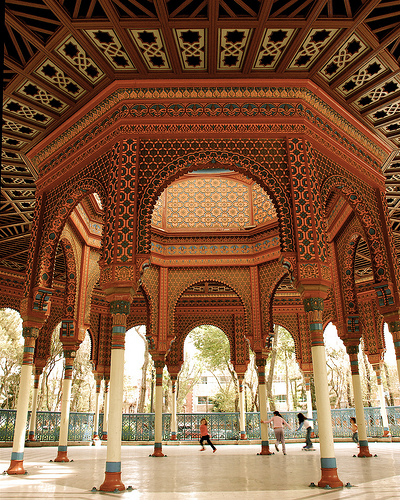
Múdejar Style kiosk in Santa Maria la Ribera, Mexico City. Image via Mil y Una Formas de Perder una Partida Ganada.
The term mestizaje has constantly been challenged for a number of reasons including the fact that it selectively highlights some identities (i.e. Aztec and Spanish) over others. In addition, much of the rhetoric around identity in Mexico also overlooks the great influence that other immigrant populations brought along (i.e. African communities, Chinese immigrants, and Palestinian refugees, to mention a few).
Although the Arab population in Mexico is largely composed of Lebanese, Syrians and Palestinians, the Lebanese immigrant community of the early 20th century is, until this day, the most influential. Some of the only Arab places to eat in Mexico City are Lebanese restaurants run by second or third generation Lebanese or Mexican-Lebanese families (interracial marriages and their offspring). One of the most common names attached to this community is Carlos Slim, Mexico’s richest man and one of the richest of the world.
Although Mexico is constantly identified as a Catholic country many other denominations and religious groups have flourished, among them Islam. The National Institute of Statistics and Geography reports that even though Islam is the fastest religion globally, it is still a minority in the country. The Institute’s statistics indicate that in 2000, there were only 1500 Muslims in Mexico, and most of them resided in Mexico City. This number has increased, and in 2010 it was reported that there were 3,760 Muslims, of which the majority are men. Yet, in Mexico City it is quite uncommon to see or even hear about Muslims. Perhaps the time when Islam became prominent in the Mexican media was after 9/11. Nonetheless, there is a small Sufi community and a small Salafi community in Mexico City. Although in Mexico it may be a common assumption that Arabs equal Muslims and vice versa, it has also been recorded that many Arabs in Mexico are Christians and some indigenous populations have been reported to practice Islam, especially in the southern state of Chiapas.
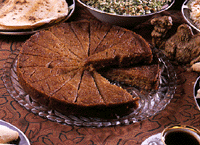
Kibbeh charola. Image via enlacejudio.com.
My favorite Lebanese restaurant in Mexico City was located right in downtown. The restaurant, which does not exist anymore, was located in an older building and had balconies that looked down right into a pedestrian street. My dad used to bring me here to celebrate special occasions, and I soon started to associate this place with people of what, back then, I considered the Middle East. One of the things I remember the most was the coffee. There was only one man, and older gentleman, that could prepare it. No other employee was allowed to touch the coffee. The older man would “bake” the coffee until it was ready to be called “Arabic coffee.” While my dad really enjoyed this, my favorite dish was their famous kibbeh charola. While many of us are familiar with the term “kibbeh,” this Mexican variation refers to a flat “kibbeh.” “Charola” literally means “tray,” and it refers to the circular shape of the flat meat dish. During Ramadan this would be the restaurant’s special… although I doubt most people would know what Ramadan was…
I hope that you enjoy this recipe as much as I do!
Kibbeh Charola
Ingredients:
500 gr. Extra lean ground beef or lamb
1 cup of corn semolina
Half an onion diced
Salt (according to taste)
2 table spoons of olive oil
1/3 cup of pine nuts
2 table spoons of pomegranate molasses (if you don’t find them just use one spoon of regular molasses and one spoon of pomegranate juice)
½ cup of fresh mint
Black pepper to season
Directions:
1- Mix the meat with the salt and the pepper. Divide the meat in two balls.
2- Fry the onion in the olive oil and add the molasses.
3- Take one of the balls of meat and add the semolina and the pine nuts.
4- Fry the meat mixed with the pine nuts, along with the onion and the molasses, until golden. This is your filling.
5- Prepare a round baking pan and make a thin layer with part of the second half of the meat (you will use the rest to cover the filling).
6- Put the filling on top of the first layer of meat. Make sure it is well distributed.
7- Cover the filling with the rest of the second ball of meat.
8- Sprinkle a bit of pepper at the top.
9- Pre-heat your oven to 375 F (180 C).
10- Bake the kibbeh for 40 minutes or until well cooked.
11- Sprinkle with fresh mint and serve warm.
Edited to Add: For more on Ramadan, and to read the rest of the posts in MMW’s Ramadan 2012 series, click here.
Previous Post

July 25, 2012
Ramadan in Egypt
Next Post

July 27, 2012 Friday Links | July 27, 2012
Browse Our Archives
Select a Category Advertisements Art/Theater Books/Magazines Cinema Comics/Cartoons Culture/Society Events Fashion Film Friday Links Merchandise/Commodities MMW Announcements MMW Highlights Music/Radio News Photography Politics Profile Ramadan 2012 Ramadan 2013 Ramadan 2014 Ramadan 2015 Roundtable Satire Social Media Sports Technology/Science Television Uncategorized Video Web
Select a Month November 2015 October 2015 September 2015 August 2015 July 2015 June 2015 May 2015 April 2015 March 2015 January 2015 December 2014 November 2014 October 2014 September 2014 July 2014 June 2014 May 2014 April 2014 March 2014 February 2014 January 2014 December 2013 November 2013 October 2013 September 2013 August 2013 July 2013 June 2013 May 2013 April 2013 March 2013 February 2013 January 2013 December 2012 November 2012 October 2012 September 2012 August 2012 July 2012 June 2012 May 2012 April 2012 March 2012 February 2012 January 2012 December 2011 November 2011 September 2011 August 2011 July 2011 June 2011 May 2011 April 2011 March 2011 February 2011 January 2011 December 2010 November 2010 October 2010 September 2010 August 2010 July 2010 June 2010 May 2010 April 2010 March 2010 February 2010 January 2010 December 2009 November 2009 October 2009 September 2009 August 2009 July 2009 June 2009 May 2009 April 2009 March 2009 February 2009 January 2009 December 2008 November 2008 October 2008 September 2008 August 2008 July 2008 June 2008 May 2008 April 2008 March 2008 February 2008 January 2008 December 2007 November 2007 October 2007 September 2007 August 2007
Follow Us!
TAKE THE
Religious Wisdom Quiz
What does Proverbs 22:6 say about training a child?
Select your answer to see how you score.
Children should be seen and not heard. Train up a child in the way he should go, and when he is old he will not depart from it. Guide the young, and they will not stumble. Teach a child discipline, and he will live in wisdom.
Related posts from Muslimah Media Watch

#PrayforParis, Muslim Women and Third World Violence

Ramadan Thoughts On Muslimness and Indigeneity

A Letter to Mona Eltahawy on “Headscarves and...

TRENDING AT PATHEOS Muslim

25 Years Later: How Much Has Changed for...
As we approach the 25th anniversary of September 11th, I’ve found myself...

Podcast: Third Spaces & The Rise of Yemeni...
In the latest episode of The Artistic Foodies Podcast, hosts Abbas...

HalalFest Picks: Best 60 Halal Spots for Super...
Back in 2016, I came up with a list of 29...

Unity Is America’s Strength — Division Is Its...
by Hidayatullah Ahsan When Valentina Gomez, a Republican candidate for Congress in...

Zohran Mamdani and New York’s Fight Against Islamophobia
This past June, against all odds, Zohran Mamdani won the Democratic primary...

What the Fourth of July Means to a...
As we mark another Fourth of July, millions of Americans will celebrate...
view all Muslim blogs
Ad-Free & Subscriber Log-In Subscription Support
- About Us
- 2026 Calendar
- Videos
- Podcasts
- Library of World Religions
- Faith In Media Tracker
- Advertise With Us
- Write for Us
- Privacy Policy
- Terms of Service
- Do Not Sell My Data
- Contact Us
- Radiant Digital
- Manage Newsletter Subscriptions
- Unsubscribe From Notifications
- Sitemap
Copyright 2008-2026, Patheos. All rights reserved.
Subscription Support Ad-Free & Subscriber Log-In
Follow Patheos