
BuddhistCatholicContemplativeEvangelicalGeneral ChristianHinduJewishLatter-day SaintMuslimNew VisionsProgressive Christian
Beliefs
- Buddhist
- Catholic
- Contemplative
- Evangelical
- General Christian
- Hindu
- Jewish
- Latter-day Saint
- More Voices
- Muslim
- New Visions
- Pagan
- Progressive Christian
Topics
- Religion News
- Food and Religion
- Sports and Religion
- Religious Art
- Religious Music and Entertainment
- Religious Events
- History and Religion
- Style and Religion
- Politics and Religion
- Women in Religion
- Recreation Outdoors and Religion
- Business Finance and Religion
- Careers Workplace and Religion
- Education and Religion
- Family Parenting and Religion
- Health Fitness and Religion
- Home and Religion
- Relationships and Religion
- Technology and Religion
- Travel and Religion
Columnists
- Buddhist Columnists
- Business Finance and Religion Columnists
- Careers Workplace and Religion Columnists
- Catholic Columnists
- Contemplative Columnists
- Education and Religion Columnists
- Evangelists Columnists
- Family Parenting and Religion Columnists
- General Christian Columnists
- Health Fitness and Religion Columnists
- Hindu Columnists
- History and Religion Columnists
- Home and Religion Columnists
- Jewish Columnists
- More Voices Columnists
- Latter Day Columnists
- Muslim Columnists
- New Visions Columnists
- Nonreligious Columnists
- Pagan Columnists
- Politics and Religion Columnists
- Progressive Columnists
- Recreation Outdoors and Religion Columnists
- Relationships and Religion Columnists
- Religion News Columnists
- Religious Art Columnists
- Religious Events Columnists
- Religious Music and Entertainment Columnists
- Sports and Religion Columnists
- Style and Religion Columnists
- Technology and Religion Columnists
- Travel and Religion Columnists
- Women in Religion Columnists
Resource Library
- 2026 Calendar
- Library of World Religions
- The 100 Most Holy Places on Earth
- Patheos Answers
- Podcasts
- Videos
- Faith Leaders Database
- Anglican Episcopalian
- Bahai
- Baptist
- Buddhism
- Christianity
- Confucianism
- Eastern Orthodoxy
- Hinduism
- Holiness and Pentecostal
- ISKCON
- Islam
- Judaism
- Lutheran
- Methodist
- The Church of Jesus Christ of Latter-day Saints
- New Age
- Paganism
- Presbytarian and Reformed
- Protestantism
- Religion Behind the Scenes
- Roman Catholic
- Scientology
- Shia Islam
- Sikhism
- Sufism
- Sunni Islam
- Taoism
- Zen
- See all religions
Research Tools
 Ad-Free & Subscriber Log-In Subscription Support
Ad-Free & Subscriber Log-In Subscription Support
Follow Patheos 

- Trending:
- Forgiveness
- |
- Marriage
- |
- Consciousness
- |
- Death Penalty
- |
- Election
- |
- Halloween
 Muslimah Media Watch
- Home
- Muslim
- Religion News
- Iftar in a Nigerian Home
Iftar in a Nigerian Home
Last updated on: July 29, 2012 at 8:57 pm by anike
Iftar in a Nigerian Home 2012-07-29T20:57:09-04:00 anike
Patheos Explore the world's faith through different perspectives on religion and spirituality! Patheos has the views of the prevalent religions and spiritualities of the world.
I am usually not good at taking pictures of food because I tend to have eaten halfway through before remembering to take a photo. Therefore, this is a rare photo of a typical iftar at home, that is, at my mother’s.
Starting from the cup of water, which is at the bottom right, and moving anti-clockwise:
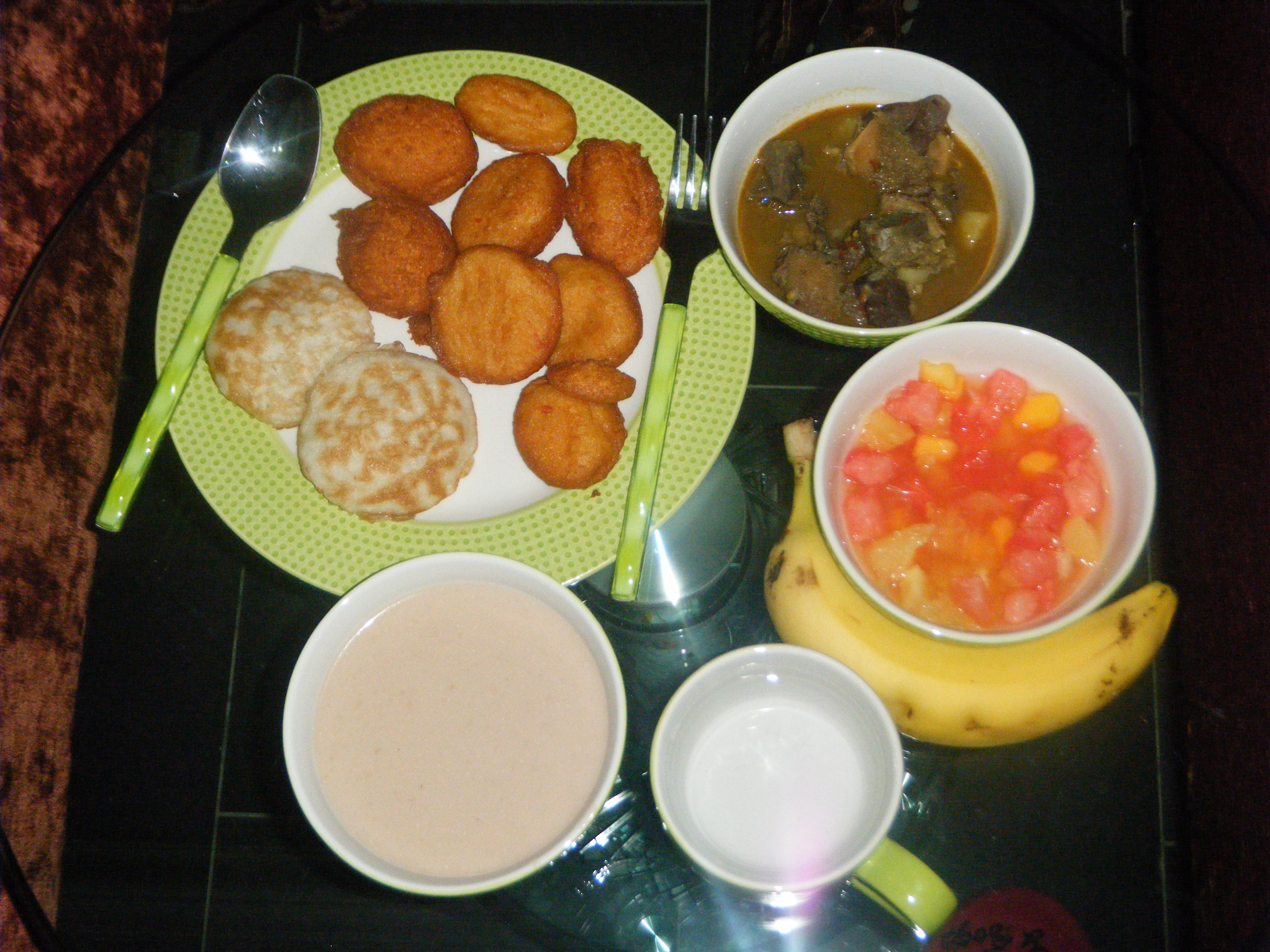
Iftar in a Nigerian home.
– A banana
– Some fruit salad
– Pepper soup
– A plate of bean cakes (akara) and rice cakes (masa)
– Kunun gyada (a type of gruel made from groundnuts)
This is also the procession in which they are eaten.
Once it is time to break our fast, or “shi inu” which in Yoruba literally means “to open one’s mouth”, we start with a cup of water then move on to the fruit. For my family, a typical fruit salad has watermelons, pineapples, oranges, and pawpaw (papaya).
Upon eating the fruits, there is a break for prayer.
When we return, it is time for the pepper soup. The one in the photo above, I recall, had offal, intestines and tripe. I am not a big fan of offal, but I really enjoy cow leg and skin in pepper soup. As the name suggests, pepper soup is fiery and spicy.
Next to pepper soup are two kinds of cake: the brown is akara and is made from blending beans (black eyed peas or Nigerian brown beans), with red pepper and chillies. I am in charge of making akara for iftar because I have managed to convince everyone that I make it best. Akara is made by mixing the blended beans and then frying it. I add an egg to the mixture in order make the akara fluffy; that is my secret to excellent akara. Next to the bean cakes are rice cakes, otherwise known as masa. Masa is usually sweet and just slightly oily. I love it best when it is burnt and crispy around the edges. We do not make masa at home but by it in bulk and freeze it so that it lasts for the whole month of Ramadan.
The final dish is kunun gyada, I had some trouble translating this to English, but I am pretty certain it is a gruel. Kunun gyada is made with a type of spiced groundnut paste. When we make kunun gyada we thicken the groundnut paste with another paste for what we call “pap” (pap is essentially another kind of gruel). My mother grinds grains such as millet and guinea-corn to make the paste for pap. Both the nut and cereal pastes are boiled in water before the final, and best in my opinion, ingredient is added. This ingredient is tamarind; kunun gyada just does not taste the same without it. Sugar is also added to kunun gyada, which when prepared is a wonderful blend of groundnut and cereal, and tastes sweet and sour.
The kunun gyada goes great with the akara, while the masa goes great with the pepper soup. By the time all this food is eaten, it is already time to pray isha.
Edited to Add: For more on Ramadan, and to read the rest of the posts in MMW’s Ramadan 2012 series, click here.
Previous Post

July 23, 2012
Ramadan (Food) and the Working Girl
Next Post

July 25, 2012 Ramadan in Egypt
Browse Our Archives
Select a Category Advertisements Art/Theater Books/Magazines Cinema Comics/Cartoons Culture/Society Events Fashion Film Friday Links Merchandise/Commodities MMW Announcements MMW Highlights Music/Radio News Photography Politics Profile Ramadan 2012 Ramadan 2013 Ramadan 2014 Ramadan 2015 Roundtable Satire Social Media Sports Technology/Science Television Uncategorized Video Web
Select a Month November 2015 October 2015 September 2015 August 2015 July 2015 June 2015 May 2015 April 2015 March 2015 January 2015 December 2014 November 2014 October 2014 September 2014 July 2014 June 2014 May 2014 April 2014 March 2014 February 2014 January 2014 December 2013 November 2013 October 2013 September 2013 August 2013 July 2013 June 2013 May 2013 April 2013 March 2013 February 2013 January 2013 December 2012 November 2012 October 2012 September 2012 August 2012 July 2012 June 2012 May 2012 April 2012 March 2012 February 2012 January 2012 December 2011 November 2011 September 2011 August 2011 July 2011 June 2011 May 2011 April 2011 March 2011 February 2011 January 2011 December 2010 November 2010 October 2010 September 2010 August 2010 July 2010 June 2010 May 2010 April 2010 March 2010 February 2010 January 2010 December 2009 November 2009 October 2009 September 2009 August 2009 July 2009 June 2009 May 2009 April 2009 March 2009 February 2009 January 2009 December 2008 November 2008 October 2008 September 2008 August 2008 July 2008 June 2008 May 2008 April 2008 March 2008 February 2008 January 2008 December 2007 November 2007 October 2007 September 2007 August 2007
Follow Us!
TAKE THE
Religious Wisdom Quiz
Why did God command the Israelites to eat unleavened bread?
Select your answer to see how you score.
It was the only bread they knew how to make They had to leave Egypt quickly It was a symbol of humility Yeast was considered unclean
Related posts from Muslimah Media Watch



There is Baraka in Receiving the Gift: On...
TRENDING AT PATHEOS Muslim

25 Years Later: How Much Has Changed for...
As we approach the 25th anniversary of September 11th, I’ve found myself...

Podcast: Third Spaces & The Rise of Yemeni...
In the latest episode of The Artistic Foodies Podcast, hosts Abbas...

HalalFest Picks: Best 60 Halal Spots for Super...
Back in 2016, I came up with a list of 29...

Unity Is America’s Strength — Division Is Its...
by Hidayatullah Ahsan When Valentina Gomez, a Republican candidate for Congress in...

Zohran Mamdani and New York’s Fight Against Islamophobia
This past June, against all odds, Zohran Mamdani won the Democratic primary...

What the Fourth of July Means to a...
As we mark another Fourth of July, millions of Americans will celebrate...
view all Muslim blogs
Ad-Free & Subscriber Log-In Subscription Support
- About Us
- 2026 Calendar
- Videos
- Podcasts
- Library of World Religions
- Faith In Media Tracker
- Advertise With Us
- Write for Us
- Privacy Policy
- Terms of Service
- Do Not Sell My Data
- Contact Us
- Radiant Digital
- Manage Newsletter Subscriptions
- Unsubscribe From Notifications
- Sitemap
Copyright 2008-2026, Patheos. All rights reserved.
Subscription Support Ad-Free & Subscriber Log-In
Follow Patheos