
BuddhistCatholicContemplativeEvangelicalGeneral ChristianHinduJewishLatter-day SaintMuslimNew VisionsProgressive Christian
Beliefs
- Buddhist
- Catholic
- Contemplative
- Evangelical
- General Christian
- Hindu
- Jewish
- Latter-day Saint
- More Voices
- Muslim
- New Visions
- Pagan
- Progressive Christian
Topics
- Religion News
- Food and Religion
- Sports and Religion
- Religious Art
- Religious Music and Entertainment
- Religious Events
- History and Religion
- Style and Religion
- Politics and Religion
- Women in Religion
- Recreation Outdoors and Religion
- Business Finance and Religion
- Careers Workplace and Religion
- Education and Religion
- Family Parenting and Religion
- Health Fitness and Religion
- Home and Religion
- Relationships and Religion
- Technology and Religion
- Travel and Religion
Columnists
- Buddhist Columnists
- Business Finance and Religion Columnists
- Careers Workplace and Religion Columnists
- Catholic Columnists
- Contemplative Columnists
- Education and Religion Columnists
- Evangelists Columnists
- Family Parenting and Religion Columnists
- General Christian Columnists
- Health Fitness and Religion Columnists
- Hindu Columnists
- History and Religion Columnists
- Home and Religion Columnists
- Jewish Columnists
- More Voices Columnists
- Latter Day Columnists
- Muslim Columnists
- New Visions Columnists
- Nonreligious Columnists
- Pagan Columnists
- Politics and Religion Columnists
- Progressive Columnists
- Recreation Outdoors and Religion Columnists
- Relationships and Religion Columnists
- Religion News Columnists
- Religious Art Columnists
- Religious Events Columnists
- Religious Music and Entertainment Columnists
- Sports and Religion Columnists
- Style and Religion Columnists
- Technology and Religion Columnists
- Travel and Religion Columnists
- Women in Religion Columnists
Resource Library
- 2026 Calendar
- Library of World Religions
- The 100 Most Holy Places on Earth
- Patheos Answers
- Podcasts
- Videos
- Faith Leaders Database
- Anglican Episcopalian
- Bahai
- Baptist
- Buddhism
- Christianity
- Confucianism
- Eastern Orthodoxy
- Hinduism
- Holiness and Pentecostal
- ISKCON
- Islam
- Judaism
- Lutheran
- Methodist
- The Church of Jesus Christ of Latter-day Saints
- New Age
- Paganism
- Presbytarian and Reformed
- Protestantism
- Religion Behind the Scenes
- Roman Catholic
- Scientology
- Shia Islam
- Sikhism
- Sufism
- Sunni Islam
- Taoism
- Zen
- See all religions
Research Tools
 Ad-Free & Subscriber Log-In Subscription Support
Ad-Free & Subscriber Log-In Subscription Support
Follow Patheos 

- Trending:
- Forgiveness
- |
- Marriage
- |
- Consciousness
- |
- Death Penalty
- |
- Election
- |
- Halloween
 Muslimah Media Watch
- Home
- Muslim
- Religion News
- Words of Witness: Women Journalists Document Egypt’s Revolution
Words of Witness: Women Journalists Document Egypt’s Revolution
Last updated on: June 28, 2012 at 2:00 am by diana
Words of Witness: Women Journalists Document Egypt’s Revolution 2012-06-27T16:50:35-04:00 diana
Patheos Explore the world's faith through different perspectives on religion and spirituality! Patheos has the views of the prevalent religions and spiritualities of the world.
Amidst masses of anxious men stands a woman in a grey and pink headscarf, armed with a to-do-list doubling as a journalist’s notepad, and a pink pen. This woman is 22-year-old Heba Afify and she is determined to document the voice of her people.

Heba Afify. Image via Words of Witness.
Afify is the charming protagonist of a documentary titled “Words of Witness.” Part of the Human Rights Watch Film Festival, the 68-minute film by filmmaker Mai Iskander follows Heba Afify as she captures the stories of citizens during the Egyptian Revolution for Al-Masry Al-Youm, a daily independent newspaper.
What seemed at its conception to have been a documentary about the revolution and its turmoil, turned out to be a telling story about a woman and perhaps about women.
After interviewing half a dozen women journalists in Egypt, and moved by Heba Afify’s “commitment to her work and her courage,” Mai Iskander chose to follow Afify as she took to the streets, documenting the thoughts and emotions of Egyptian citizens during the revolution, after the ousting of then dictator Hosni Mubarak, and even up to the recent elections.
The final product, premiering in New York just a week after learning the outcome of Egypt’s first presidential election post-revolution, gives a rare look at the emotional roll coaster that the people of Egypt went through during the revolution, from the excitement at its onset to the feelings of disillusionment and skepticism towards the previously revered army.
My take-away, however, was a broader glimpse of the challenges young women journalists face, and specifically the challenges Muslim women journalists, who are bound by societal, cultural, and familial norms, face as they confront these sorts of coming-of-age moments.
As Afify continues to venture out into the streets to cover the events unfolding around her, her mother constantly reminded her, “I know you are a journalist, but you’re still a girl!” The back-and-forth tiffs between Afify and her mother reminded me of similar conversations unfolding in Muslim, Arab, and South Asian households around the world. Even for those of us who, as children of first-generation immigrants, we are displaced from the land of our mothers and fathers, at dinner tables, during after-work couch conversations, and amidst family discussions, we find ourselves never escaping the grasps of our culture.
In fact, throughout the documentary, it seems that the only place where the women in Afify’s household are free to escape the clutches of cultural norms is in the virtual world. The documentary interestingly showed how, through social-media such as Twitter and Facebook, Afify and the other women in her family are allowed to “safely” (according to her mother’s standards) enter and dominate what are commonly known as “men only spaces.” In the virtual world, women, young and old, are free to leave political commentary and be outspoken participants and leaders in the revolution.
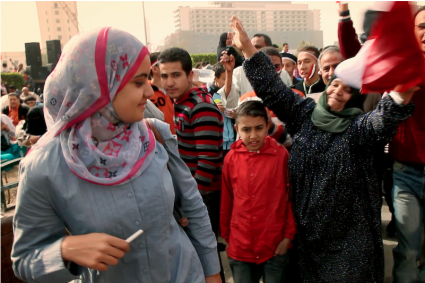
Image from Words of Witness. Via Telegraph21.
However, they are unapologetically forcing themselves into the real world too. At a time when change is so visibly in front of them, Afify and the other women journalists depicted in the film all realize that they, “can’t abide by the rules of being a ‘good Egyptian girl’” if they want to have a hand in the revolution. They all challenge the status quo at a significant time.
Something that stuck with me was the comments that director Mai Iskander made in the Q&A after the film was shown. When asked if she thought the film was more about women, or the revolution itself, she said that she didn’t want to make a film focusing on women as victims. Instead, she feels stories about women don’t necessarily need to focus on women’s issues.
This was a story about life, revolution, change, turmoil, passion, journalism. These were the words of a witness, who also happened to be a Muslim woman. I wish there were more stories like these told.
Human Rights Watch Film Festival
Previous Post

June 27, 2012
The “Muslim Kristallnacht” and a Swiss Twittergate
Next Post

June 29, 2012 Friday Links | June 29, 2012
Browse Our Archives
Select a Category Advertisements Art/Theater Books/Magazines Cinema Comics/Cartoons Culture/Society Events Fashion Film Friday Links Merchandise/Commodities MMW Announcements MMW Highlights Music/Radio News Photography Politics Profile Ramadan 2012 Ramadan 2013 Ramadan 2014 Ramadan 2015 Roundtable Satire Social Media Sports Technology/Science Television Uncategorized Video Web
Select a Month November 2015 October 2015 September 2015 August 2015 July 2015 June 2015 May 2015 April 2015 March 2015 January 2015 December 2014 November 2014 October 2014 September 2014 July 2014 June 2014 May 2014 April 2014 March 2014 February 2014 January 2014 December 2013 November 2013 October 2013 September 2013 August 2013 July 2013 June 2013 May 2013 April 2013 March 2013 February 2013 January 2013 December 2012 November 2012 October 2012 September 2012 August 2012 July 2012 June 2012 May 2012 April 2012 March 2012 February 2012 January 2012 December 2011 November 2011 September 2011 August 2011 July 2011 June 2011 May 2011 April 2011 March 2011 February 2011 January 2011 December 2010 November 2010 October 2010 September 2010 August 2010 July 2010 June 2010 May 2010 April 2010 March 2010 February 2010 January 2010 December 2009 November 2009 October 2009 September 2009 August 2009 July 2009 June 2009 May 2009 April 2009 March 2009 February 2009 January 2009 December 2008 November 2008 October 2008 September 2008 August 2008 July 2008 June 2008 May 2008 April 2008 March 2008 February 2008 January 2008 December 2007 November 2007 October 2007 September 2007 August 2007
Follow Us!
TAKE THE
Religious Wisdom Quiz
Who was the first king anointed by Samuel?
Select your answer to see how you score.
Jonathan Saul David Solomon
Related posts from Muslimah Media Watch




TRENDING AT PATHEOS Muslim

25 Years Later: How Much Has Changed for...
As we approach the 25th anniversary of September 11th, I’ve found myself...

Podcast: Third Spaces & The Rise of Yemeni...
In the latest episode of The Artistic Foodies Podcast, hosts Abbas...

HalalFest Picks: Best 60 Halal Spots for Super...
Back in 2016, I came up with a list of 29...

Unity Is America’s Strength — Division Is Its...
by Hidayatullah Ahsan When Valentina Gomez, a Republican candidate for Congress in...

Zohran Mamdani and New York’s Fight Against Islamophobia
This past June, against all odds, Zohran Mamdani won the Democratic primary...

What the Fourth of July Means to a...
As we mark another Fourth of July, millions of Americans will celebrate...
view all Muslim blogs
Ad-Free & Subscriber Log-In Subscription Support
- About Us
- 2026 Calendar
- Videos
- Podcasts
- Library of World Religions
- Faith In Media Tracker
- Advertise With Us
- Write for Us
- Privacy Policy
- Terms of Service
- Do Not Sell My Data
- Contact Us
- Radiant Digital
- Manage Newsletter Subscriptions
- Unsubscribe From Notifications
- Sitemap
Copyright 2008-2026, Patheos. All rights reserved.
Subscription Support Ad-Free & Subscriber Log-In
Follow Patheos