
BuddhistCatholicContemplativeEvangelicalGeneral ChristianHinduJewishLatter-day SaintMuslimNew VisionsProgressive Christian
Beliefs
- Buddhist
- Catholic
- Contemplative
- Evangelical
- General Christian
- Hindu
- Jewish
- Latter-day Saint
- More Voices
- Muslim
- New Visions
- Pagan
- Progressive Christian
Topics
- Religion News
- Food and Religion
- Sports and Religion
- Religious Art
- Religious Music and Entertainment
- Religious Events
- History and Religion
- Style and Religion
- Politics and Religion
- Women in Religion
- Recreation Outdoors and Religion
- Business Finance and Religion
- Careers Workplace and Religion
- Education and Religion
- Family Parenting and Religion
- Health Fitness and Religion
- Home and Religion
- Relationships and Religion
- Technology and Religion
- Travel and Religion
Columnists
- Buddhist Columnists
- Business Finance and Religion Columnists
- Careers Workplace and Religion Columnists
- Catholic Columnists
- Contemplative Columnists
- Education and Religion Columnists
- Evangelists Columnists
- Family Parenting and Religion Columnists
- General Christian Columnists
- Health Fitness and Religion Columnists
- Hindu Columnists
- History and Religion Columnists
- Home and Religion Columnists
- Jewish Columnists
- More Voices Columnists
- Latter Day Columnists
- Muslim Columnists
- New Visions Columnists
- Nonreligious Columnists
- Pagan Columnists
- Politics and Religion Columnists
- Progressive Columnists
- Recreation Outdoors and Religion Columnists
- Relationships and Religion Columnists
- Religion News Columnists
- Religious Art Columnists
- Religious Events Columnists
- Religious Music and Entertainment Columnists
- Sports and Religion Columnists
- Style and Religion Columnists
- Technology and Religion Columnists
- Travel and Religion Columnists
- Women in Religion Columnists
Resource Library
- 2026 Calendar
- Library of World Religions
- The 100 Most Holy Places on Earth
- Patheos Answers
- Podcasts
- Videos
- Faith Leaders Database
- Anglican Episcopalian
- Bahai
- Baptist
- Buddhism
- Christianity
- Confucianism
- Eastern Orthodoxy
- Hinduism
- Holiness and Pentecostal
- ISKCON
- Islam
- Judaism
- Lutheran
- Methodist
- The Church of Jesus Christ of Latter-day Saints
- New Age
- Paganism
- Presbytarian and Reformed
- Protestantism
- Religion Behind the Scenes
- Roman Catholic
- Scientology
- Shia Islam
- Sikhism
- Sufism
- Sunni Islam
- Taoism
- Zen
- See all religions
Research Tools
 Ad-Free & Subscriber Log-In Subscription Support
Ad-Free & Subscriber Log-In Subscription Support
Follow Patheos 

- Trending:
- Forgiveness
- |
- Marriage
- |
- Consciousness
- |
- Death Penalty
- |
- Election
- |
- Halloween
 Muslimah Media Watch
- Home
- Muslim
- Religion News
- #UAEDressCode: A Tool for Judgement, or Education?
#UAEDressCode: A Tool for Judgement, or Education?
Last updated on: June 14, 2012 at 2:00 pm by samya
#UAEDressCode: A Tool for Judgement, or Education? 2012-06-13T16:27:19-04:00 samya
Patheos Explore the world's faith through different perspectives on religion and spirituality! Patheos has the views of the prevalent religions and spiritualities of the world.
A few years back, when shopping malls turned into major destination for shoppers and tourists in the United Arab Emirates, the issue of how men and women appear in public began to gain greater attention. Mall entrances have come to carry signs and instructions relating not only to pets, trash, bicycles and skaters, but dress codes as well. In a cosmopolitan society, the idea of modesty does not have a clear definition; it just refers to wearing clothes that do not resemble wearing a swimming suit. One sign, for example, asks people to wear “respectful clothing,” and specifies that “shoulders and knees should be covered.” But so as not to portray Dubai only as a strict conservative society, it is worth mentioning the fact that in certain areas, such as bars and night clubs, people can wear whatever they want, and there is no one that polices them. On beaches, on the other hand, people who wear full clothes are not allowed to just sit and watch beach goers, because it is obvious that their goal is to watch rather than swim (this refers mainly to men watching women), and this is considered an invasion of people’s privacy.
Among other things, dress code signs encourage modesty in clothing out of respect for Arab-Islamic traditions that define life in the UAE. But as it turned out later, many mall visitors seem to have either missed on noticing those signs or have ignored them by putting on more revealing clothes that certainly go counter to what was suggested by those signs.
In reaction to what seems like a rising dress code violations in public places, two Emirati ladies, Hanan Al Rayes and Asma Al Muhairi, decided to launch a Twitter campaign to prod people to respect certain norms around clothing.
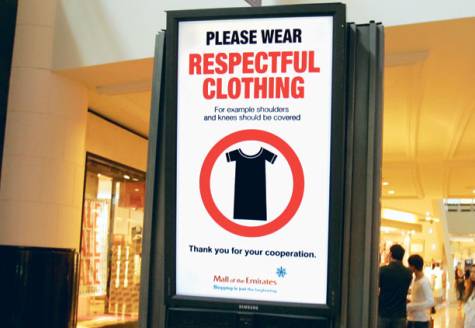
The hashtag #UAEDressCode has attracted around 1500 followers, stirring an argument in the local media about whether foreigners in particular should abide by such rules, or whether such an issue is that of personal freedom, and everyone should be free to do whatever they want in a city that opened its doors to every nationality in the world. In a way, I see the hashtag #UAEDressCode’s value in seeking to educate the public on local traditions more than in enforcing dress codes and regulations on the part of foreign tourists and resident expatriates. And in order to give sustainability to such efforts, wider-scale intercultural communications that go beyond the promotion of physical touristic features are needed.
Whether agree or disagree with the act of policing people’s clothing, such a campaign seems unique because it is not launched by a governmental authority, but by two private persons, and their tool of communication is not conventional media like broadcasting and the press, but rather Twitter.
One interesting fact that we have to look carefully at is the differentiation between the law and such a personal initiative. Unlike laws issued in countries such as France, which ban certain clothing such as the veil and niqab, the aim of this campaign is to educate people about the local culture in the Emirates, and leave the door open for them to follow such campaign, and adapt to the culture with less revealing clothes. No one gets punished for not following the rules in public places at these malls, but following such rules can be a form of respect expressed towards the country and the culture in specific.
However, this campaign does not seem to be changing people’s actions for the time being, since it was just launched a few weeks ago; as a result, it is hard to judge the outcomes of this campaign now.
While the tweets keep stressing on the point that “the campaign aims for respecting the culture and dressing decently,” it has to some extent used a discourse that feels racist and sexist towards women and foreign women in particular. Using words such as “repulsive” and “uncivilized” brings the question of how women are looked at in this part of the world, giving the sense that they are judged from the outside, something that the ladies who worked on the campaign need to pay attention to. So rather than focusing on how “immodest” women’s clothes appear, it would more sense to stress on the openness of the Arab-Islamic culture in the UAE, and the tolerant nature of the community here, and how important it is for everyone to understand the values and culture of the other. Instead of using an “offensive” campaign that represents women in “an unpleasant way,” it would be much better to use a discourse that attracts people to the culture rather than creating hatred for it.
It also looks like the campaign does not call for “women’s modesty” only, but also men’s. In a reply to a tweet dated on the 12th June, user @UAEDressCode says: “men are included to apply the dress code. Not apparently topless for example.”
As I followed the dress code drive on Twitter, I could tell that the campaign has provoked both positive and negative reactions. A number of local newspaper columnists encouraged such campaigns. In his column from June 1, Mishaal Al Gergawi writes: “Whatever your views, the campaign message remains valid: expatriates should respect the UAE’s cultural values when in public spaces. This is especially resonant when it comes to public places.”
Al Gergawi adds that:
“Of course, people can’t be held accountable for what they don’t know. My sense is that the main trigger of the campaign is caused by tourists rather than residents. Tourists are rarely given information on cultural sensitivities. There is a role for immigration and airport authorities to play in informing visitors — via brochures — of the appropriate dress code to corresponding spaces. The travel agencies must be required by the tourism authority to explain such sensitivities to tourists prior to arrival.”
Some expatriates and tourists seem to agree with Al Gergawi that lack of education is causing the problem. In an article published on June 1 in the Emirati Gulf News, Caroline D’Souza writes:
“It is the responsibility of the host country to ensure that its guests understand what citizens expect in terms of behavior, says Neil Payne, a practicing British Muslim and Managing Director of Kwintessential Arabia, specializing in cross-cultural communications and cultural awareness trainings in Dubai.””Do not expect people to come looking for this guidance; it needs to be given to them through travel companies, airlines, local employers, at airports and so on. It’s also important that the right tone is used in explaining why such dress code exists,” he says.”
Of course, we don’t expect such social media campaigns to have immediate effects on foreign tourists coming to the UAE. Many tourists actually choose the UAE as their destination because they were exposed to huge promotional campaigns highlighting the country’s exotic sand dunes, sunny beaches, luxurious hotels, and world-class infrastructures. But little information seems to be trickling about the UAE cultural values and traditions. The Twitter campaign is just an eye-opener for those tourists who happen to come across such social media conversations about the UAE.
The real challenge is how to turn those few tweets into a huge intercultural and touristic awareness campaign about the country’s culture. But the main objective here is that such campaigns should try not to push things too far for visitors, and create an environment that is hostile towards its people, but to have a tolerant atmosphere, in which everyone understands other people’s cultures and values, be it Emiratis, or any other nationality. That is why I believe pushing for any law that defines what people should wear in public is not a going to lead to great results, because at the end of the day, the Emirate does not want to turn in to a strict ruled city, as this would affect its commercial and touristic image worldwide. The UAE has made impressive headways in its touristic destination promotions worldwide. It is high time that it was also able to convey its culture and traditions in a widespread and respectful way.

Next Post

June 15, 2012 Friday Links | June 15, 2012
Browse Our Archives
Select a Category Advertisements Art/Theater Books/Magazines Cinema Comics/Cartoons Culture/Society Events Fashion Film Friday Links Merchandise/Commodities MMW Announcements MMW Highlights Music/Radio News Photography Politics Profile Ramadan 2012 Ramadan 2013 Ramadan 2014 Ramadan 2015 Roundtable Satire Social Media Sports Technology/Science Television Uncategorized Video Web
Select a Month November 2015 October 2015 September 2015 August 2015 July 2015 June 2015 May 2015 April 2015 March 2015 January 2015 December 2014 November 2014 October 2014 September 2014 July 2014 June 2014 May 2014 April 2014 March 2014 February 2014 January 2014 December 2013 November 2013 October 2013 September 2013 August 2013 July 2013 June 2013 May 2013 April 2013 March 2013 February 2013 January 2013 December 2012 November 2012 October 2012 September 2012 August 2012 July 2012 June 2012 May 2012 April 2012 March 2012 February 2012 January 2012 December 2011 November 2011 September 2011 August 2011 July 2011 June 2011 May 2011 April 2011 March 2011 February 2011 January 2011 December 2010 November 2010 October 2010 September 2010 August 2010 July 2010 June 2010 May 2010 April 2010 March 2010 February 2010 January 2010 December 2009 November 2009 October 2009 September 2009 August 2009 July 2009 June 2009 May 2009 April 2009 March 2009 February 2009 January 2009 December 2008 November 2008 October 2008 September 2008 August 2008 July 2008 June 2008 May 2008 April 2008 March 2008 February 2008 January 2008 December 2007 November 2007 October 2007 September 2007 August 2007
Follow Us!
TAKE THE
Religious Wisdom Quiz
Who said, 'The Lord gives and the Lord takes away'?
Select your answer to see how you score.
David Job Solomon Moses
Related posts from Muslimah Media Watch

#PrayforParis, Muslim Women and Third World Violence


Hate Crimes and Mother Tongues

Interview with Comedian Eman El Husseini
TRENDING AT PATHEOS Muslim

25 Years Later: How Much Has Changed for...
As we approach the 25th anniversary of September 11th, I’ve found myself...

Podcast: Third Spaces & The Rise of Yemeni...
In the latest episode of The Artistic Foodies Podcast, hosts Abbas...

HalalFest Picks: Best 60 Halal Spots for Super...
Back in 2016, I came up with a list of 29...

Unity Is America’s Strength — Division Is Its...
by Hidayatullah Ahsan When Valentina Gomez, a Republican candidate for Congress in...

Zohran Mamdani and New York’s Fight Against Islamophobia
This past June, against all odds, Zohran Mamdani won the Democratic primary...

What the Fourth of July Means to a...
As we mark another Fourth of July, millions of Americans will celebrate...
view all Muslim blogs
Ad-Free & Subscriber Log-In Subscription Support
- About Us
- 2026 Calendar
- Videos
- Podcasts
- Library of World Religions
- Faith In Media Tracker
- Advertise With Us
- Write for Us
- Privacy Policy
- Terms of Service
- Do Not Sell My Data
- Contact Us
- Radiant Digital
- Manage Newsletter Subscriptions
- Unsubscribe From Notifications
- Sitemap
Copyright 2008-2026, Patheos. All rights reserved.
Subscription Support Ad-Free & Subscriber Log-In
Follow Patheos