
BuddhistCatholicContemplativeEvangelicalGeneral ChristianHinduJewishLatter-day SaintMuslimNew VisionsProgressive Christian
Beliefs
- Buddhist
- Catholic
- Contemplative
- Evangelical
- General Christian
- Hindu
- Jewish
- Latter-day Saint
- More Voices
- Muslim
- New Visions
- Pagan
- Progressive Christian
Topics
- Religion News
- Food and Religion
- Sports and Religion
- Religious Art
- Religious Music and Entertainment
- Religious Events
- History and Religion
- Style and Religion
- Politics and Religion
- Women in Religion
- Recreation Outdoors and Religion
- Business Finance and Religion
- Careers Workplace and Religion
- Education and Religion
- Family Parenting and Religion
- Health Fitness and Religion
- Home and Religion
- Relationships and Religion
- Technology and Religion
- Travel and Religion
Columnists
- Buddhist Columnists
- Business Finance and Religion Columnists
- Careers Workplace and Religion Columnists
- Catholic Columnists
- Contemplative Columnists
- Education and Religion Columnists
- Evangelists Columnists
- Family Parenting and Religion Columnists
- General Christian Columnists
- Health Fitness and Religion Columnists
- Hindu Columnists
- History and Religion Columnists
- Home and Religion Columnists
- Jewish Columnists
- More Voices Columnists
- Latter Day Columnists
- Muslim Columnists
- New Visions Columnists
- Nonreligious Columnists
- Pagan Columnists
- Politics and Religion Columnists
- Progressive Columnists
- Recreation Outdoors and Religion Columnists
- Relationships and Religion Columnists
- Religion News Columnists
- Religious Art Columnists
- Religious Events Columnists
- Religious Music and Entertainment Columnists
- Sports and Religion Columnists
- Style and Religion Columnists
- Technology and Religion Columnists
- Travel and Religion Columnists
- Women in Religion Columnists
Resource Library
- 2026 Calendar
- Library of World Religions
- The 100 Most Holy Places on Earth
- Patheos Answers
- Podcasts
- Videos
- Faith Leaders Database
- Anglican Episcopalian
- Bahai
- Baptist
- Buddhism
- Christianity
- Confucianism
- Eastern Orthodoxy
- Hinduism
- Holiness and Pentecostal
- ISKCON
- Islam
- Judaism
- Lutheran
- Methodist
- The Church of Jesus Christ of Latter-day Saints
- New Age
- Paganism
- Presbytarian and Reformed
- Protestantism
- Religion Behind the Scenes
- Roman Catholic
- Scientology
- Shia Islam
- Sikhism
- Sufism
- Sunni Islam
- Taoism
- Zen
- See all religions
Research Tools
 Ad-Free & Subscriber Log-In Subscription Support
Ad-Free & Subscriber Log-In Subscription Support
Follow Patheos 

- Trending:
- Forgiveness
- |
- Marriage
- |
- Consciousness
- |
- Death Penalty
- |
- Election
- |
- Halloween
 Muslimah Media Watch
- Home
- Muslim
- Religion News
- Are We So Different: A Documentary Short Film That Falls Short of Telling Women’s Stories
Are We So Different: A Documentary Short Film That Falls Short of Telling Women’s Stories
Last updated on: June 19, 2012 at 2:00 am by diana
Are We So Different: A Documentary Short Film That Falls Short of Telling Women’s Stories 2012-06-18T23:48:28-04:00 diana
Patheos Explore the world's faith through different perspectives on religion and spirituality! Patheos has the views of the prevalent religions and spiritualities of the world.
Taking the title of “Best Documentary Short Film 2012” in the third Mumbai International Queer Film Festival is the telling documentary, “Amra Ki Etoi Bhinno.” The KASHISH – Mumbai International Queer Film Festival, an annual event held in Mumbai, India since 2010, screens films related to gay, lesbian, bisexual, transgendered, and queer issues India and around the world.
“Amra Ki Etoi Bhinno” or “Are We So Different” is a film that follows hijras — a South Asian term for physiological males who identify with the feminine gender, wear women’s clothing, or take on other feminine gender roles — as well as bisexual and gay men living in Bangladesh. In doing so, it attempts to document their struggles as members of marginalized communities and their unique experiences of managing the not-so-welcoming environments around them.
http://www.youtube.com/watch?v=x-TUnilAE9A&feature=plcp
The variety of gendered realities and sexual practices displayed in this short film makes it a candid representation, as it illustrates the diverse and intricate distinctions between gendered and sexual identities. For example, the film portrays a couple, Badol and Sohel, who are living together. Sohel is a gay man, while Badol is a hijra. When being interviewed, Badol says that his family’s problem is not with his sexual desires towards men, but rather with his identification with female gender roles and wearing of female clothing. This difference is telling of the historical social acceptance of same-sex desires within some cultures, so long as these desires are easily hidden and do not pose a threat to the patriarchal societal structure.
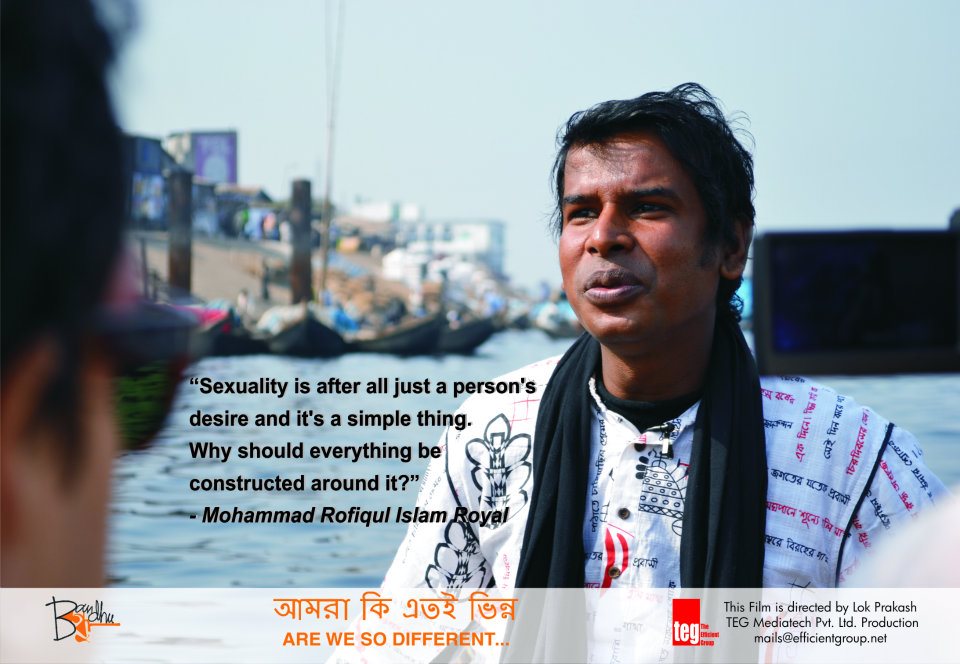
Still image from the film, via its Facebook page.
The film also depicts the reality of men who are either bisexual or gay, but choose to enter into a heterosexual marriage while having other relations on the side. Some are forced into marriage to hide their sexuality, while some others see heterosexual marriage as a way to “ensure the next generation.”
One of the more hard-hitting realities displayed in brief glimpses throughout the film is that, because of severe marginalization, young boys who are disowned by their families, for not fitting the expected sexual norms, are often taken advantage of within isolated groups, either raped, left to beg, or forced into prostitution.
While I do appreciate the subtle distinctions made in the film and the candid nature in which the stories were told, I am disappointed to see women left out of the picture. With regards to topics that are deemed “queer issues” or “trans issues” it seems that LGBT women are constantly sidelined, their stories unheard, their depictions left to the fantasies of heterosexual men, and their struggles left to the agendas of “Western feminists.”
I have speculated as to why this is the case, specifically within conversations on queer issues that occur amongst members of South East Asian, Arab, or Muslim communities. It’s surely not for the lack of LGBT Muslim women, but perhaps more broadly attributed to the much greater attention paid to the religious prohibition of same-sex intercourse between males versus the ambiguity of same-sex sexual acts between females. Maybe it is the perceived threat to patriarchal social order that makes it harder to speak openly about or as queer women? Still, it could be attributed to the symbol status that has been heaved upon Muslim women, which makes them cultural signifiers [symbols of piety, honor, and religiosity] and thus silences them by deeming the topic out of bounds.
Whatever the case, the multidimensional marginalization that they must face—as women and also as members of LGBT communities—makes it more important that the stories of LGBT Muslim women are told. It also makes painfully clear that the social position of the female sex within any given society goes hand-and–hand with that societies treatment of other minority communities, be they LGBT, poor, or religious minorities.
In light of Film Festivals such as the one this film was featured in, and recent advancements in civil rights legislation in other South East Asian countries that would allow transgendered citizens to identify as such when registering to vote, it seems that the space is being widened for broader conversations regarding sexuality and gender identity to occur safely. I only hope women will be included in these conversations.
KASHISH - Mumbai International Queer Film Festival
Previous Post
June 18, 2012
The Case of Södertälje: “Immigrants Can Be Racist Too”
Next Post
June 20, 2012 Book Review: More Than a Prayer
Browse Our Archives
Select a Category Advertisements Art/Theater Books/Magazines Cinema Comics/Cartoons Culture/Society Events Fashion Film Friday Links Merchandise/Commodities MMW Announcements MMW Highlights Music/Radio News Photography Politics Profile Ramadan 2012 Ramadan 2013 Ramadan 2014 Ramadan 2015 Roundtable Satire Social Media Sports Technology/Science Television Uncategorized Video Web
Select a Month November 2015 October 2015 September 2015 August 2015 July 2015 June 2015 May 2015 April 2015 March 2015 January 2015 December 2014 November 2014 October 2014 September 2014 July 2014 June 2014 May 2014 April 2014 March 2014 February 2014 January 2014 December 2013 November 2013 October 2013 September 2013 August 2013 July 2013 June 2013 May 2013 April 2013 March 2013 February 2013 January 2013 December 2012 November 2012 October 2012 September 2012 August 2012 July 2012 June 2012 May 2012 April 2012 March 2012 February 2012 January 2012 December 2011 November 2011 September 2011 August 2011 July 2011 June 2011 May 2011 April 2011 March 2011 February 2011 January 2011 December 2010 November 2010 October 2010 September 2010 August 2010 July 2010 June 2010 May 2010 April 2010 March 2010 February 2010 January 2010 December 2009 November 2009 October 2009 September 2009 August 2009 July 2009 June 2009 May 2009 April 2009 March 2009 February 2009 January 2009 December 2008 November 2008 October 2008 September 2008 August 2008 July 2008 June 2008 May 2008 April 2008 March 2008 February 2008 January 2008 December 2007 November 2007 October 2007 September 2007 August 2007
Follow Us!
TAKE THE
Religious Wisdom Quiz
According to 1 John, what commandment have we had from the beginning?
Select your answer to see how you score.
To keep the Sabbath holy To forgive our enemies To believe in Jesus Christ To love one another
Related posts from Muslimah Media Watch

#PrayforParis, Muslim Women and Third World Violence


Hate Crimes and Mother Tongues

Interview with Comedian Eman El Husseini
TRENDING AT PATHEOS Muslim

25 Years Later: How Much Has Changed for...
As we approach the 25th anniversary of September 11th, I’ve found myself...

Podcast: Third Spaces & The Rise of Yemeni...
In the latest episode of The Artistic Foodies Podcast, hosts Abbas...

HalalFest Picks: Best 60 Halal Spots for Super...
Back in 2016, I came up with a list of 29...

Unity Is America’s Strength — Division Is Its...
by Hidayatullah Ahsan When Valentina Gomez, a Republican candidate for Congress in...

Zohran Mamdani and New York’s Fight Against Islamophobia
This past June, against all odds, Zohran Mamdani won the Democratic primary...

What the Fourth of July Means to a...
As we mark another Fourth of July, millions of Americans will celebrate...
view all Muslim blogs
Ad-Free & Subscriber Log-In Subscription Support
- About Us
- 2026 Calendar
- Videos
- Podcasts
- Library of World Religions
- Faith In Media Tracker
- Advertise With Us
- Write for Us
- Privacy Policy
- Terms of Service
- Do Not Sell My Data
- Contact Us
- Radiant Digital
- Manage Newsletter Subscriptions
- Unsubscribe From Notifications
- Sitemap
Copyright 2008-2026, Patheos. All rights reserved.
Subscription Support Ad-Free & Subscriber Log-In
Follow Patheos