
BuddhistCatholicContemplativeEvangelicalGeneral ChristianHinduJewishLatter-day SaintMuslimNew VisionsProgressive Christian
Beliefs
- Buddhist
- Catholic
- Contemplative
- Evangelical
- General Christian
- Hindu
- Jewish
- Latter-day Saint
- More Voices
- Muslim
- New Visions
- Pagan
- Progressive Christian
Topics
- Religion News
- Food and Religion
- Sports and Religion
- Religious Art
- Religious Music and Entertainment
- Religious Events
- History and Religion
- Style and Religion
- Politics and Religion
- Women in Religion
- Recreation Outdoors and Religion
- Business Finance and Religion
- Careers Workplace and Religion
- Education and Religion
- Family Parenting and Religion
- Health Fitness and Religion
- Home and Religion
- Relationships and Religion
- Technology and Religion
- Travel and Religion
Columnists
- Buddhist Columnists
- Business Finance and Religion Columnists
- Careers Workplace and Religion Columnists
- Catholic Columnists
- Contemplative Columnists
- Education and Religion Columnists
- Evangelists Columnists
- Family Parenting and Religion Columnists
- General Christian Columnists
- Health Fitness and Religion Columnists
- Hindu Columnists
- History and Religion Columnists
- Home and Religion Columnists
- Jewish Columnists
- More Voices Columnists
- Latter Day Columnists
- Muslim Columnists
- New Visions Columnists
- Nonreligious Columnists
- Pagan Columnists
- Politics and Religion Columnists
- Progressive Columnists
- Recreation Outdoors and Religion Columnists
- Relationships and Religion Columnists
- Religion News Columnists
- Religious Art Columnists
- Religious Events Columnists
- Religious Music and Entertainment Columnists
- Sports and Religion Columnists
- Style and Religion Columnists
- Technology and Religion Columnists
- Travel and Religion Columnists
- Women in Religion Columnists
Resource Library
- 2026 Calendar
- Library of World Religions
- The 100 Most Holy Places on Earth
- Patheos Answers
- Podcasts
- Videos
- Faith Leaders Database
- Anglican Episcopalian
- Bahai
- Baptist
- Buddhism
- Christianity
- Confucianism
- Eastern Orthodoxy
- Hinduism
- Holiness and Pentecostal
- ISKCON
- Islam
- Judaism
- Lutheran
- Methodist
- The Church of Jesus Christ of Latter-day Saints
- New Age
- Paganism
- Presbytarian and Reformed
- Protestantism
- Religion Behind the Scenes
- Roman Catholic
- Scientology
- Shia Islam
- Sikhism
- Sufism
- Sunni Islam
- Taoism
- Zen
- See all religions
Research Tools
 Ad-Free & Subscriber Log-In Subscription Support
Ad-Free & Subscriber Log-In Subscription Support
Follow Patheos 

- Trending:
- Forgiveness
- |
- Marriage
- |
- Consciousness
- |
- Death Penalty
- |
- Election
- |
- Halloween
 Muslimah Media Watch
- Home
- Muslim
- Religion News
- In the Name of the Caliphate: What the “Islamic State” Seems to Mean for Muslim Women
In the Name of the Caliphate: What the “Islamic State” Seems to Mean for Muslim Women
Last updated on: May 21, 2012 at 2:00 am by eren
In the Name of the Caliphate: What the “Islamic State” Seems to Mean for Muslim Women 2012-05-21T00:04:02-04:00 eren
Patheos Explore the world's faith through different perspectives on religion and spirituality! Patheos has the views of the prevalent religions and spiritualities of the world.
If you ever wondered about “Islamization” and the so-called return to the Caliphate, recent debates arising from a number of Muslim countries regarding the “Islamization” and the status of Muslim women bring important questions to the table. First of all, it raises the question of what really is the “Islamic state” and what describes it. Most of us have heard about “ideal” visions of Islamic statehood (here, here and here). Yet, I would dare to say that we have seen none in modern times.
Nonetheless, a return to ideal Islamic governance, and “Islamization,” concepts that could either be posed as opposites or could be conflated, has been raised numerous times in contemporary political movements. In a recent piece by the Chronicle Herald, Egypt’s Muslim Brotherhood’s stance on “Islamization” was reviewed. The article emphasized the Muslim Brotherhood’s rhetoric referring to the implementation of Shari’ah and people’s support for “God’s law.”
“Islamization,” which is often described in the West through words such as jihad, extremism, totalitarianism and violations of human rights, and represented by dark-skinned men with big beards, is perhaps not the same concept for some Muslims, who may be referring to a “return to the Caliphate” when discussing Islam and the state. Visions of a modern caliphate, its elements and viability have been broadly discussed in the past few years. The (theoretical) Caliphate could mean unity, individual and communal freedom, economic development, and political accountability. Even so, in many instances, a state’s closeness to political Islam or Islamic governance is portrayed to mean the automatic violation of human and women’s rights; advocating for a state or community’s “Islamization,” such as Chechnya, poses a broader debate on issues relating to the status of women.
For instance, in the case of Egypt, “Islamization,” which is often framed as a real possibility in view of the upcoming elections, could mean not only the merging of politics, religion and the state, but also the revision of “secular” laws such as women’s right to divorce. Similarly, a government’s preference for the so-called “Islamic” rule, has often meant, around the world, restrictions on women’s clothing, ambivalent stands on honor killings, negligence of gender-based violence, and persecution of LGTBQ Muslims, among others.
Although Western media coverage often alarms readers by associating violation of women’s rights with Islam and proponents of the caliphate, it cannot be said that this is altogether unfounded. Even though there are a few countries that are officially Islamic, meaning that Islam is not only the religion of the majority of the population, but also the base of legal rule and the state (like Saudi Arabia, or Iran), other states and independent republics have endorsed their own ideas of what it means to be “Islamic.” In some instances, “Islamic” has served to justify ultra-conservative interpretations of Islam such as the Taliban rule. Debates surrounding the “Islamization” of law and government, in Muslim and Western sources, do not necessarily explain what being an “Islamic” state entails other than the implementation of Shari’ah, which is often times consider static and unchanging. Beyond that, we are left to wonder what else is in there.
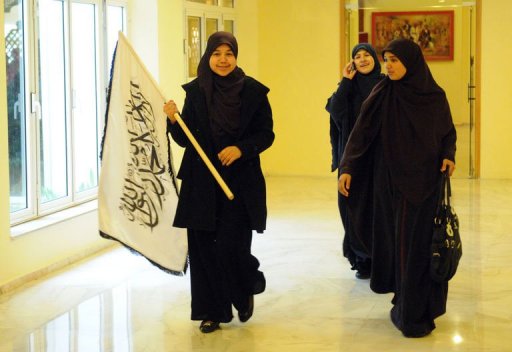
Tunisian women advocating in favour of an Islamic state. Image via Your Middle East.
Fatima Mernissi does an excellent job in looking at the historical developments of the caliphate, and to some degree political Islam, and their implications beyond shari’ah. In two of her books, The Veil and the Male Elite and The Forgotten Queens of Islam, Mernissi critiques the development of the different caliphates. For her, the historical and patriarchal aspects of the caliphate as institution, from the first Muslim caliphate, were troubling not only in political terms but also for their implications in matters of gender and sexuality. Similarly, following the developments of twentieth century political Islam, she warns readers against the realities of religious discourses in politics and their effects on gender relations and restrictions of sexuality. Yet, she also acknowledges women’s own involvement in these movements and institutions. From early Muslim queens to figures like Benazir Bhutto, Mernissi describes women’s active participation in both the caliphate and political Islam. Interestingly, in some instances like in Tunisia, some women have argued for a new caliphate in search for guaranteed rights at the same time as in the West the “troubling” aspects of Islamization and the spread of Islam are discussed.
Then, perhaps talks about a return to “real” Islam or Islamization (as some would call it), is not really about Islam, but rather about politics. Similarly, women’s involvement in these developments is political. Women can be harmed by the restrictions imposed to them by political Islam, oftentimes exercised by men, but they can also benefit from imposing those restrictions on others and perhaps even on themselves. This is not unique to Muslim women’s interactions with political Islam and the Islamic state. We, either way, also interact with the secular state and democracy, which can be as restrictive and gendered.
At the end of the day, when we refer to the “Islamization” of government, law or the state, we are not talking about spirituality or even theology. Rather, we are talking about a way in which “we” or “they” make politics. Islamization does not necessarily entail the violation of women’s rights, but it does require women’s participation as with any political and nationalist movement. And while we can refer to the patriarchal and gendered aspects of politics and law, we also find those paradoxical cases in which Muslim women call for the caliphate, Islamization, and what might even be considered the restriction of their own freedom.
Previous Post

May 18, 2012
Friday Links | May 18, 2012
Next Post

May 22, 2012 Change Is Now? No, Not Yet: Manuel Valls as France's New Interior Minister
Browse Our Archives
Select a Category Advertisements Art/Theater Books/Magazines Cinema Comics/Cartoons Culture/Society Events Fashion Film Friday Links Merchandise/Commodities MMW Announcements MMW Highlights Music/Radio News Photography Politics Profile Ramadan 2012 Ramadan 2013 Ramadan 2014 Ramadan 2015 Roundtable Satire Social Media Sports Technology/Science Television Uncategorized Video Web
Select a Month November 2015 October 2015 September 2015 August 2015 July 2015 June 2015 May 2015 April 2015 March 2015 January 2015 December 2014 November 2014 October 2014 September 2014 July 2014 June 2014 May 2014 April 2014 March 2014 February 2014 January 2014 December 2013 November 2013 October 2013 September 2013 August 2013 July 2013 June 2013 May 2013 April 2013 March 2013 February 2013 January 2013 December 2012 November 2012 October 2012 September 2012 August 2012 July 2012 June 2012 May 2012 April 2012 March 2012 February 2012 January 2012 December 2011 November 2011 September 2011 August 2011 July 2011 June 2011 May 2011 April 2011 March 2011 February 2011 January 2011 December 2010 November 2010 October 2010 September 2010 August 2010 July 2010 June 2010 May 2010 April 2010 March 2010 February 2010 January 2010 December 2009 November 2009 October 2009 September 2009 August 2009 July 2009 June 2009 May 2009 April 2009 March 2009 February 2009 January 2009 December 2008 November 2008 October 2008 September 2008 August 2008 July 2008 June 2008 May 2008 April 2008 March 2008 February 2008 January 2008 December 2007 November 2007 October 2007 September 2007 August 2007
Follow Us!
TAKE THE
Religious Wisdom Quiz
What does "Selah," found often in Psalms, likely mean?
Select your answer to see how you score.
Give thanks Pause or reflect Sing loudly Forever
Related posts from Muslimah Media Watch

#PrayforParis, Muslim Women and Third World Violence



Why British MP’s statements defending Muslim women do...
TRENDING AT PATHEOS Muslim

25 Years Later: How Much Has Changed for...
As we approach the 25th anniversary of September 11th, I’ve found myself...

Podcast: Third Spaces & The Rise of Yemeni...
In the latest episode of The Artistic Foodies Podcast, hosts Abbas...

HalalFest Picks: Best 60 Halal Spots for Super...
Back in 2016, I came up with a list of 29...

Unity Is America’s Strength — Division Is Its...
by Hidayatullah Ahsan When Valentina Gomez, a Republican candidate for Congress in...

Zohran Mamdani and New York’s Fight Against Islamophobia
This past June, against all odds, Zohran Mamdani won the Democratic primary...

What the Fourth of July Means to a...
As we mark another Fourth of July, millions of Americans will celebrate...
view all Muslim blogs
Ad-Free & Subscriber Log-In Subscription Support
- About Us
- 2026 Calendar
- Videos
- Podcasts
- Library of World Religions
- Faith In Media Tracker
- Advertise With Us
- Write for Us
- Privacy Policy
- Terms of Service
- Do Not Sell My Data
- Contact Us
- Radiant Digital
- Manage Newsletter Subscriptions
- Unsubscribe From Notifications
- Sitemap
Copyright 2008-2026, Patheos. All rights reserved.
Subscription Support Ad-Free & Subscriber Log-In
Follow Patheos