
BuddhistCatholicContemplativeEvangelicalGeneral ChristianHinduJewishLatter-day SaintMuslimNew VisionsProgressive Christian
Beliefs
- Buddhist
- Catholic
- Contemplative
- Evangelical
- General Christian
- Hindu
- Jewish
- Latter-day Saint
- More Voices
- Muslim
- New Visions
- Pagan
- Progressive Christian
Topics
- Religion News
- Food and Religion
- Sports and Religion
- Religious Art
- Religious Music and Entertainment
- Religious Events
- History and Religion
- Style and Religion
- Politics and Religion
- Women in Religion
- Recreation Outdoors and Religion
- Business Finance and Religion
- Careers Workplace and Religion
- Education and Religion
- Family Parenting and Religion
- Health Fitness and Religion
- Home and Religion
- Relationships and Religion
- Technology and Religion
- Travel and Religion
Columnists
- Buddhist Columnists
- Business Finance and Religion Columnists
- Careers Workplace and Religion Columnists
- Catholic Columnists
- Contemplative Columnists
- Education and Religion Columnists
- Evangelists Columnists
- Family Parenting and Religion Columnists
- General Christian Columnists
- Health Fitness and Religion Columnists
- Hindu Columnists
- History and Religion Columnists
- Home and Religion Columnists
- Jewish Columnists
- More Voices Columnists
- Latter Day Columnists
- Muslim Columnists
- New Visions Columnists
- Nonreligious Columnists
- Pagan Columnists
- Politics and Religion Columnists
- Progressive Columnists
- Recreation Outdoors and Religion Columnists
- Relationships and Religion Columnists
- Religion News Columnists
- Religious Art Columnists
- Religious Events Columnists
- Religious Music and Entertainment Columnists
- Sports and Religion Columnists
- Style and Religion Columnists
- Technology and Religion Columnists
- Travel and Religion Columnists
- Women in Religion Columnists
Resource Library
- 2026 Calendar
- Library of World Religions
- The 100 Most Holy Places on Earth
- Patheos Answers
- Podcasts
- Videos
- Faith Leaders Database
- Anglican Episcopalian
- Bahai
- Baptist
- Buddhism
- Christianity
- Confucianism
- Eastern Orthodoxy
- Hinduism
- Holiness and Pentecostal
- ISKCON
- Islam
- Judaism
- Lutheran
- Methodist
- The Church of Jesus Christ of Latter-day Saints
- New Age
- Paganism
- Presbytarian and Reformed
- Protestantism
- Religion Behind the Scenes
- Roman Catholic
- Scientology
- Shia Islam
- Sikhism
- Sufism
- Sunni Islam
- Taoism
- Zen
- See all religions
Research Tools
 Ad-Free & Subscriber Log-In Subscription Support
Ad-Free & Subscriber Log-In Subscription Support
Follow Patheos 

- Trending:
- Forgiveness
- |
- Marriage
- |
- Consciousness
- |
- Death Penalty
- |
- Election
- |
- Halloween
 Muslimah Media Watch
- Home
- Muslim
- Religion News
- Imran Khan on Women
Imran Khan on Women
Last updated on: May 2, 2012 at 2:00 am by merium
Imran Khan on Women 2012-05-01T17:14:55-04:00 merium
Patheos Explore the world's faith through different perspectives on religion and spirituality! Patheos has the views of the prevalent religions and spiritualities of the world.
With general elections expected in May 2013, Imran Khan’s political party, Pakistan Tehreek-e-Insaf (PTI) or Pakistan Movement for Justice is said to be gaining momentum, if its massive October 2011 political rally is any indicator. Buoyed by popular support from an empowered youth demographic (36 million people in Pakistan are between 15-24 years old) and women from varying cross sections of society, many Pakistanis are excited about the impending political change that Khan and PTI represent. Khan falls into the centre right on the political spectrum with a strong emphasis on anti-corruption, judicial reforms, rights for religious and ethnic minorities, women’s empowerment and education.
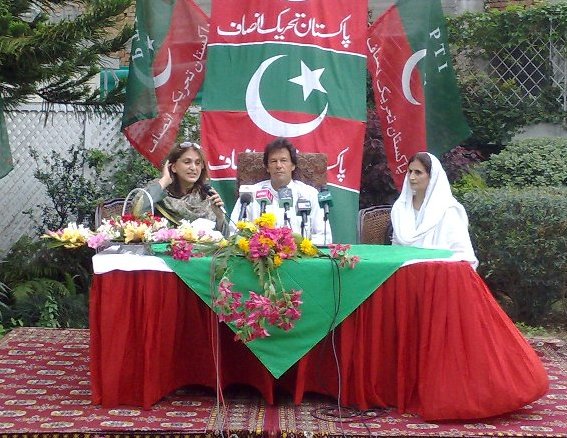
Imran Khan with women from the PTI chapter in Islamabad. Image via the PTI website.
For those unfamiliar with Imran Khan, he is an Oxford-educated former Pakistani cricketer, who led Pakistan to its one and only World Cup victory in 1992. After retiring from cricket he pursued a number of charitable causes of which Shaukat Khanum Memorial Cancer Hospital is the crowning glory. Named after his mother who died of colon cancer, Shaukat Khanum is said to provide comprehensive care free of cost to thousands of cancer patients. Imran Khan was a Member of Parliament from the Mianwali district from 2002-2007 where he also helped establish Namal College in 2008. He has also made headlines in the past for dating socialites and is alleged to have had a daughter out of wedlock. Despite this, Khan is still widely celebrated for his cricket, social work and now as the celebrated head of PTI.
Although PTI has been around for approximately 15 years, it has only recently gained political traction, with the October 2011 rally finally cementing PTI as a viable political party. Much of the popular support for PTI is a response to the worsening situation when it comes to rule of law, corruption, and human rights abuses (women and minorities), as well as the mismanagement of basic amenities and the ongoing conflict in the Northern Areas of Pakistan. Khan predicts that his centrist party can fix the country’s problems in just 90 days, something his critics suggest reflects his lack of political experience.
With overwhelming support from female voters (PTI has a dedicated women’s wing), it is important to consider some of the rhetoric associated with Khan’s stance on women’s issues in Pakistan. According to the PTI manifesto, the present dismal state of women and children in terms of their access to health care, nutrition, and education cannot be ignored. To overcome these development challenges, Khan aims to provide free education to girls up to Matric (10th grade), introduce scholarships for graduation in pursuit of higher education in computer sciences, medicine, management, and engineering, create social awareness against un-Islamic customs and cruel practices such as sawarra in NWFP and karo kari in Sindh and enforce laws to eradicate such practices.
He has also promised to provide housing and child care assistance to working women, encourage the active involvement of women in the management of community based rural development initiatives, develop a national programme for vocational and skill-based training for income generation, design and implement special functional literacy programmes for women, legislate and enforce laws for in-camera trial of molestation and rape cases, establish separate “women support cells” in each police station at tehsil (city/town) level, which are managed and run by women to support and process criminal cases in which women are the accused, and legislate and enforce a special law on violence against women.
So, on paper, the PTI strategy on women appears worthy and seems to address gaps in policy and programmes geared at Pakistani women. However, whether PTI will be able to raise the political will and commitment necessary to implement such specialized programmes for women is still open to debate.
In a recent video, Khan responded to a query on the type of “revolution” he would bring about for the women in Pakistan. He made two references to education and rule of law, both of which would benefit not just women but the population at large, in a country with approximately 50 percent literacy (with female literacy at 36 percent compared to men at 63 percent). Basically, Khan is enforcing what development researchers have been stating for years, that gender inequality in education and employment has a detrimental impact on economic growth in addition to higher fertility and child mortality rates.
Critics of Imran Khan label him (and his generalized rhetoric and stance) as “Taliban Khan,” or the “Fundofication of PTI,” or “Taliban Apologist.” Much of this is in response to his strategy for dealing with the Taliban and other Islamic militants which has led to charges that he is soft on extremists. Some go so far as to label him a “Ziast” referring to President Zia-ul-Haq who was known for his intolerance, and who was responsible for steering Pakistan through its Islamization period amid the backdrop of the war in Afghanistan. President Zia in particular is known to have introduced the prejudicial ordinances that reduced women’s legal rights. However another author suggests that we should instead view PTI’s Islamism not through the lens of General Zia’s violent Islamization campaign of the 1980s, but through the wider prism of Pakistani history where politicians have used Islam for their respective political gains. But more importantly, does this criticism of Islamist political ties imply a softening and/or a compromise on women’s issues in a country experiencing increasing levels of religious intolerance and Islamization? Nothing concrete can be stated until Khan takes office and is shown to be able to push for the development issues advocated by his party’s platform. A comment on PBS’s News Hour may, however address in part his need to maintain reconciliatory links with conservative factions:
“We have more radicals in this society. I am considered probably the only nationalist who has credibility here. I’m petrified. If I utter one word, which could be perceived as anti-Islamic or anti-jihad, one word, my life is at risk.”
Can Imran Khan deliver on his message of empowerment, not just for women but for every Pakistani wanting to make a difference? Given that other political parties have a mixed record on women’s rights issues, would I vote for him in the upcoming elections? In an ideal setting, yes, I would cast my vote for Khan, because his ideals on the confluence of Islam and democracy and human rights including women’s rights are largely in accordance with my own. However, although Imran Khan may be gaining the necessary political traction to become the next Prime Minister of Pakistan, widespread criticism of his political ties may hurt him in the polls. There is much at stake, as I am learning, and success is not guaranteed.
Previous Post
May 1, 2012
Responsibility as Representatives: A Need for Honest Reflection
Next Post
May 3, 2012 In the Name of Honour: The Free Aafia Siddiqui Campaign in South Africa
Browse Our Archives
Select a Category Advertisements Art/Theater Books/Magazines Cinema Comics/Cartoons Culture/Society Events Fashion Film Friday Links Merchandise/Commodities MMW Announcements MMW Highlights Music/Radio News Photography Politics Profile Ramadan 2012 Ramadan 2013 Ramadan 2014 Ramadan 2015 Roundtable Satire Social Media Sports Technology/Science Television Uncategorized Video Web
Select a Month November 2015 October 2015 September 2015 August 2015 July 2015 June 2015 May 2015 April 2015 March 2015 January 2015 December 2014 November 2014 October 2014 September 2014 July 2014 June 2014 May 2014 April 2014 March 2014 February 2014 January 2014 December 2013 November 2013 October 2013 September 2013 August 2013 July 2013 June 2013 May 2013 April 2013 March 2013 February 2013 January 2013 December 2012 November 2012 October 2012 September 2012 August 2012 July 2012 June 2012 May 2012 April 2012 March 2012 February 2012 January 2012 December 2011 November 2011 September 2011 August 2011 July 2011 June 2011 May 2011 April 2011 March 2011 February 2011 January 2011 December 2010 November 2010 October 2010 September 2010 August 2010 July 2010 June 2010 May 2010 April 2010 March 2010 February 2010 January 2010 December 2009 November 2009 October 2009 September 2009 August 2009 July 2009 June 2009 May 2009 April 2009 March 2009 February 2009 January 2009 December 2008 November 2008 October 2008 September 2008 August 2008 July 2008 June 2008 May 2008 April 2008 March 2008 February 2008 January 2008 December 2007 November 2007 October 2007 September 2007 August 2007
Follow Us!
TAKE THE
Religious Wisdom Quiz
Which book of the Bible contains the Ten Plagues of Egypt?
Select your answer to see how you score.
Genesis Leviticus Deuteronomy Exodus
Related posts from Muslimah Media Watch

#PrayforParis, Muslim Women and Third World Violence


Hate Crimes and Mother Tongues

Interview with Comedian Eman El Husseini
TRENDING AT PATHEOS Muslim

25 Years Later: How Much Has Changed for...
As we approach the 25th anniversary of September 11th, I’ve found myself...

Podcast: Third Spaces & The Rise of Yemeni...
In the latest episode of The Artistic Foodies Podcast, hosts Abbas...

HalalFest Picks: Best 60 Halal Spots for Super...
Back in 2016, I came up with a list of 29...

Unity Is America’s Strength — Division Is Its...
by Hidayatullah Ahsan When Valentina Gomez, a Republican candidate for Congress in...

Zohran Mamdani and New York’s Fight Against Islamophobia
This past June, against all odds, Zohran Mamdani won the Democratic primary...

What the Fourth of July Means to a...
As we mark another Fourth of July, millions of Americans will celebrate...
view all Muslim blogs
Ad-Free & Subscriber Log-In Subscription Support
- About Us
- 2026 Calendar
- Videos
- Podcasts
- Library of World Religions
- Faith In Media Tracker
- Advertise With Us
- Write for Us
- Privacy Policy
- Terms of Service
- Do Not Sell My Data
- Contact Us
- Radiant Digital
- Manage Newsletter Subscriptions
- Unsubscribe From Notifications
- Sitemap
Copyright 2008-2026, Patheos. All rights reserved.
Subscription Support Ad-Free & Subscriber Log-In
Follow Patheos