
BuddhistCatholicContemplativeEvangelicalGeneral ChristianHinduJewishLatter-day SaintMuslimNew VisionsProgressive Christian
Beliefs
- Buddhist
- Catholic
- Contemplative
- Evangelical
- General Christian
- Hindu
- Jewish
- Latter-day Saint
- More Voices
- Muslim
- New Visions
- Pagan
- Progressive Christian
Topics
- Religion News
- Food and Religion
- Sports and Religion
- Religious Art
- Religious Music and Entertainment
- Religious Events
- History and Religion
- Style and Religion
- Politics and Religion
- Women in Religion
- Recreation Outdoors and Religion
- Business Finance and Religion
- Careers Workplace and Religion
- Education and Religion
- Family Parenting and Religion
- Health Fitness and Religion
- Home and Religion
- Relationships and Religion
- Technology and Religion
- Travel and Religion
Columnists
- Buddhist Columnists
- Business Finance and Religion Columnists
- Careers Workplace and Religion Columnists
- Catholic Columnists
- Contemplative Columnists
- Education and Religion Columnists
- Evangelists Columnists
- Family Parenting and Religion Columnists
- General Christian Columnists
- Health Fitness and Religion Columnists
- Hindu Columnists
- History and Religion Columnists
- Home and Religion Columnists
- Jewish Columnists
- More Voices Columnists
- Latter Day Columnists
- Muslim Columnists
- New Visions Columnists
- Nonreligious Columnists
- Pagan Columnists
- Politics and Religion Columnists
- Progressive Columnists
- Recreation Outdoors and Religion Columnists
- Relationships and Religion Columnists
- Religion News Columnists
- Religious Art Columnists
- Religious Events Columnists
- Religious Music and Entertainment Columnists
- Sports and Religion Columnists
- Style and Religion Columnists
- Technology and Religion Columnists
- Travel and Religion Columnists
- Women in Religion Columnists
Resource Library
- 2026 Calendar
- Library of World Religions
- The 100 Most Holy Places on Earth
- Patheos Answers
- Podcasts
- Videos
- Faith Leaders Database
- Anglican Episcopalian
- Bahai
- Baptist
- Buddhism
- Christianity
- Confucianism
- Eastern Orthodoxy
- Hinduism
- Holiness and Pentecostal
- ISKCON
- Islam
- Judaism
- Lutheran
- Methodist
- The Church of Jesus Christ of Latter-day Saints
- New Age
- Paganism
- Presbytarian and Reformed
- Protestantism
- Religion Behind the Scenes
- Roman Catholic
- Scientology
- Shia Islam
- Sikhism
- Sufism
- Sunni Islam
- Taoism
- Zen
- See all religions
Research Tools
 Ad-Free & Subscriber Log-In Subscription Support
Ad-Free & Subscriber Log-In Subscription Support
Follow Patheos 

- Trending:
- Forgiveness
- |
- Marriage
- |
- Consciousness
- |
- Death Penalty
- |
- Election
- |
- Halloween
 Muslimah Media Watch
- Home
- Muslim
- Religion News
- Book Review: Rughum & Najda by Samar Habib
Book Review: Rughum & Najda by Samar Habib
Last updated on: May 8, 2012 at 10:14 am by nicole
Book Review: Rughum & Najda by Samar Habib 2012-05-08T10:14:30-04:00 nicole
Patheos Explore the world's faith through different perspectives on religion and spirituality! Patheos has the views of the prevalent religions and spiritualities of the world.
Rughum & Najda by Samar Habib is a fictional love story set in ninth-century Baghdad. Rughum, a Muslim woman, meets Najda, a witch who was raised with a Manichean family. Rughum and Najda’s love story is the main story around the stories of several lesbian (or “tharifa”) women in the book. Besides Rughum and Najda, we have Bathal, who because a woman of high rank and property when one of her male admirers bought her freedom; Qureisha, who lives with Bathal; and many others.
According to a press release from the book’s publisher, Habib wrote the book in part because of a lack of other fiction writing on the topic; in her words, “There has not been to date, a ficto-historical novel dealing with same-sex love among women set during the golden age of Islam.” Her engagement with the topic is based on her own background as a historian, specialising in “Arab history and civilizations” and “lives of homosexual women in the Middle Ages and antiquity.”
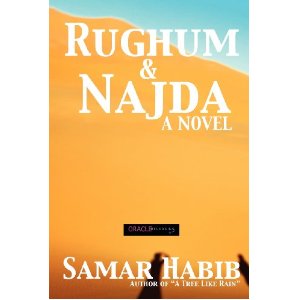
Cover of Rughum & Najda. Image via Amazon.
I don’t want to give too many spoilers; the book follows the twists and turns and ups and downs of Rughum and Najda’s relationships, both with each other and with other women, through exile, court cases, disguises and death threats. Being a known lesbian is a dangerous thing in this story. Rughum’s inabililty to consummate her marriage with her elderly husband costs her the security of family. Najda, bearing the double burden of being a tharifa and not being of the People of the Book, constantly has to watch her back and is never safe anywhere. Bathal too, despite having a certain status and wealth in society, has her life threatened by a judge.
These are all women whose sexuality came very close to costing them their lives. I couldn’t help feeling an impending sense of danger as I turned the pages – these women are not safe. I can’t imagine living in that kind of stress and pain and societal pressure to conform. I know that for some women, the case remains the same today. This book does a very good job at describing the feelings of these women regarding their sexuality and how they have to learn to navigate their world without having close relationships with men. Because men become husbands and protectors and mahrams. Because sleeping with men makes you “normal.” Because when men “fall in love” you are supposed to reciprocate.
So for me there are two takeaways: it is dangerous to be a lesbian and it is dangerous not to sleep with men. Sex is power, even back then, and when you take yourself out of the game with men, you put yourself in danger as a woman.
I have one small criticism of the book, which may be due more to my ignorance than anything else: it’s not blatantly obvious, especially in the first few pages, what time period we are in and where exactly the book’s events take place. So I was sucked into a kind of Thousand and One Nights time warp until I did some googling. So if you aren’t up on your history it might take some time to get into Rughum & Najda, but once you do it is a fast, captivating read. I read the book in only two or three sittings without getting bored or flipping pages. I really enjoyed Habib’s engaging writing style and the insight she gave me into a world I don’t know.
Finally, I don’t want this review to become the starting point of yet another discussion of whether or not homosexuality is permitted in Islam or ZOMG MMW is trying to “normalize” homosexuality AGAIN. As far as the permissibility of homosexuality in Islam goes, I think we need to stop with the “is it halal” discussions for everything (headscarves another good example), and understand that there is a spectrum in Muslim experience and practice. Instead of wasting time and energy endlessly debating permissibility, let’s leave that to scholars and accept that human beings have free will and usually make the decisions they feel are right based on their unique sets of personal circumstances. As far as “normalization” goes, I think it is intellectually irresponsible and borderline dangerous to pretend that homosexuality is not part of our history. The stories of LGBT Muslims are not often told. Rughum & Najda thus fills a gap in the telling of our stories.
Rughum & Najda is published by Oracle Releasing and is available at Amazon and Barnes and Noble.
Previous Post

May 7, 2012
“More Islamic than the Islamists”: Claiming the Female Body for a Nation
Next Post

May 10, 2012 Dead Muslim Women As Opportunities
Browse Our Archives
Select a Category Advertisements Art/Theater Books/Magazines Cinema Comics/Cartoons Culture/Society Events Fashion Film Friday Links Merchandise/Commodities MMW Announcements MMW Highlights Music/Radio News Photography Politics Profile Ramadan 2012 Ramadan 2013 Ramadan 2014 Ramadan 2015 Roundtable Satire Social Media Sports Technology/Science Television Uncategorized Video Web
Select a Month November 2015 October 2015 September 2015 August 2015 July 2015 June 2015 May 2015 April 2015 March 2015 January 2015 December 2014 November 2014 October 2014 September 2014 July 2014 June 2014 May 2014 April 2014 March 2014 February 2014 January 2014 December 2013 November 2013 October 2013 September 2013 August 2013 July 2013 June 2013 May 2013 April 2013 March 2013 February 2013 January 2013 December 2012 November 2012 October 2012 September 2012 August 2012 July 2012 June 2012 May 2012 April 2012 March 2012 February 2012 January 2012 December 2011 November 2011 September 2011 August 2011 July 2011 June 2011 May 2011 April 2011 March 2011 February 2011 January 2011 December 2010 November 2010 October 2010 September 2010 August 2010 July 2010 June 2010 May 2010 April 2010 March 2010 February 2010 January 2010 December 2009 November 2009 October 2009 September 2009 August 2009 July 2009 June 2009 May 2009 April 2009 March 2009 February 2009 January 2009 December 2008 November 2008 October 2008 September 2008 August 2008 July 2008 June 2008 May 2008 April 2008 March 2008 February 2008 January 2008 December 2007 November 2007 October 2007 September 2007 August 2007
Follow Us!
TAKE THE
Religious Wisdom Quiz
What Christian group commonly uses the Book of Common Prayer?
Select your answer to see how you score.
Lutherans Presbyterians Methodists Anglicans
Related posts from Muslimah Media Watch

Book review: Jewels of Allah by Nina Ansary

Book Review: Faïza Zerouala's Voices Behind the Veil

Making Sense of “the Other”: A Review of...

TRENDING AT PATHEOS Muslim

25 Years Later: How Much Has Changed for...
As we approach the 25th anniversary of September 11th, I’ve found myself...

Podcast: Third Spaces & The Rise of Yemeni...
In the latest episode of The Artistic Foodies Podcast, hosts Abbas...

HalalFest Picks: Best 60 Halal Spots for Super...
Back in 2016, I came up with a list of 29...

Unity Is America’s Strength — Division Is Its...
by Hidayatullah Ahsan When Valentina Gomez, a Republican candidate for Congress in...

Zohran Mamdani and New York’s Fight Against Islamophobia
This past June, against all odds, Zohran Mamdani won the Democratic primary...

What the Fourth of July Means to a...
As we mark another Fourth of July, millions of Americans will celebrate...
view all Muslim blogs
Ad-Free & Subscriber Log-In Subscription Support
- About Us
- 2026 Calendar
- Videos
- Podcasts
- Library of World Religions
- Faith In Media Tracker
- Advertise With Us
- Write for Us
- Privacy Policy
- Terms of Service
- Do Not Sell My Data
- Contact Us
- Radiant Digital
- Manage Newsletter Subscriptions
- Unsubscribe From Notifications
- Sitemap
Copyright 2008-2026, Patheos. All rights reserved.
Subscription Support Ad-Free & Subscriber Log-In
Follow Patheos