
BuddhistCatholicContemplativeEvangelicalGeneral ChristianHinduJewishLatter-day SaintMuslimNew VisionsProgressive Christian
Beliefs
- Buddhist
- Catholic
- Contemplative
- Evangelical
- General Christian
- Hindu
- Jewish
- Latter-day Saint
- More Voices
- Muslim
- New Visions
- Pagan
- Progressive Christian
Topics
- Religion News
- Food and Religion
- Sports and Religion
- Religious Art
- Religious Music and Entertainment
- Religious Events
- History and Religion
- Style and Religion
- Politics and Religion
- Women in Religion
- Recreation Outdoors and Religion
- Business Finance and Religion
- Careers Workplace and Religion
- Education and Religion
- Family Parenting and Religion
- Health Fitness and Religion
- Home and Religion
- Relationships and Religion
- Technology and Religion
- Travel and Religion
Columnists
- Buddhist Columnists
- Business Finance and Religion Columnists
- Careers Workplace and Religion Columnists
- Catholic Columnists
- Contemplative Columnists
- Education and Religion Columnists
- Evangelists Columnists
- Family Parenting and Religion Columnists
- General Christian Columnists
- Health Fitness and Religion Columnists
- Hindu Columnists
- History and Religion Columnists
- Home and Religion Columnists
- Jewish Columnists
- More Voices Columnists
- Latter Day Columnists
- Muslim Columnists
- New Visions Columnists
- Nonreligious Columnists
- Pagan Columnists
- Politics and Religion Columnists
- Progressive Columnists
- Recreation Outdoors and Religion Columnists
- Relationships and Religion Columnists
- Religion News Columnists
- Religious Art Columnists
- Religious Events Columnists
- Religious Music and Entertainment Columnists
- Sports and Religion Columnists
- Style and Religion Columnists
- Technology and Religion Columnists
- Travel and Religion Columnists
- Women in Religion Columnists
Resource Library
- 2026 Calendar
- Library of World Religions
- The 100 Most Holy Places on Earth
- Patheos Answers
- Podcasts
- Videos
- Faith Leaders Database
- Anglican Episcopalian
- Bahai
- Baptist
- Buddhism
- Christianity
- Confucianism
- Eastern Orthodoxy
- Hinduism
- Holiness and Pentecostal
- ISKCON
- Islam
- Judaism
- Lutheran
- Methodist
- The Church of Jesus Christ of Latter-day Saints
- New Age
- Paganism
- Presbytarian and Reformed
- Protestantism
- Religion Behind the Scenes
- Roman Catholic
- Scientology
- Shia Islam
- Sikhism
- Sufism
- Sunni Islam
- Taoism
- Zen
- See all religions
Research Tools
 Ad-Free & Subscriber Log-In Subscription Support
Ad-Free & Subscriber Log-In Subscription Support
Follow Patheos 

- Trending:
- Forgiveness
- |
- Marriage
- |
- Consciousness
- |
- Death Penalty
- |
- Election
- |
- Halloween
 Muslimah Media Watch
- Home
- Muslim
- Religion News
- Shahrazad and Dhat al Himmah: Epics, Storytellers and Warrior Women
Shahrazad and Dhat al Himmah: Epics, Storytellers and Warrior Women
Last updated on: April 10, 2012 at 2:00 am by tasnim
Shahrazad and Dhat al Himmah: Epics, Storytellers and Warrior Women 2012-04-09T20:46:42-04:00 tasnim
Patheos Explore the world's faith through different perspectives on religion and spirituality! Patheos has the views of the prevalent religions and spiritualities of the world.
The Thousand and One Nights is by far the most famous collection of Arab popular narratives. Its heroine Shahrazad has become the symbol of the complex interactions of gender and power as they relate to the region, from those who see her as a positive agent of change, as in Suzanne Gauch’s interestingly titled Liberating Shahrazad, in which ”A long-silenced literary figure speaks for modern Muslim women,” to the negative, such as Joumana Haddad’s I Killed Sheherazade, or Hisham Matar’s In the Country of Men, where the hero explains why the tale of Shahrazad angers his mother: “Shahrazad was a coward who accepted slavery over death.”
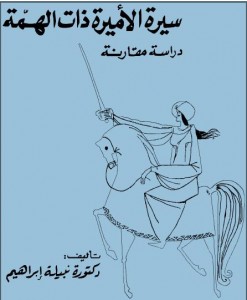
The Saga of Princess Dhat al Himmah, a comparative study by Dr. Nabilah Ibrahim. Via maktbtna2211.com.
Although The Thousand and One Nights is, of course, legendary, it is only one of many sagas and chivalric epics, (a fun rundown of some of the tropes of “Arabian Hero Cycles” is found here.)
Another saga is the romance of the poet cavalier Antarah and his struggles to win his beloved Ablah, an episode of which Rimsky-Korsakov made the subject of the early orchestral work Antar. The child of a tribal chief and a black slave, Antar is ostracised until his bravery earns him respect. When Ablah’s father refuses the idea of a union between Antar and Ablah, the stage is set for an almost endlessly expandable saga that narrates the Herculean tasks Antar has to carry out and the impossible obstacles he has to overcome in order to marry Ablah. In the meantime, the heroine undergoes parallel trials which involve capture and confinement, although her resistance is restricted to scathing speeches.
In contrast to Ablah’s rhetorical resistance, the saga of Princess Dhat al Himma offers a typology of the warrior woman in the Arabic epic. As Gavin Hambly notes in Women in the Medieval Islamic world:
The epic tradition, just as Arabic popular narrative in general, abounds in themes and motifs that rarely occur in other Arab literary genres. This type of material may thus offer a fresh view on literary representation. The role of women is a good example: popular narrative casts them in roles different from those accorded to women in the high literary tradition…female versions of knightly warriors are among the stock character of Arabic (and for that matter Persian and Turkish) epic literature.
In Islam and the Heroic Image: Themes in Literature and the Visual Arts, John Renard argues that these women in Islamic epic literature “invariably function as links to the outside world, to the lands and peoples beyond those of the principal heroes.” This is probably true of figures such as the Princess Nura in the Dhat al Himma tale, but one of the exceptions is Amirah Fatima aka Dhat al Himma herself, whose name literally means ”She who is possessed of resolve.”
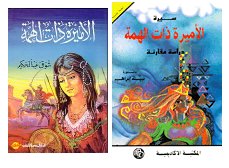
Covers of the story of Dhat al Himmah. Via Nil wa furat and Wahatalmorot.
Dhat al Himmah’s saga is summarized in M C Lyon’s The Arabian Epic, and begins some time before the birth of the heroine; and you can also read the first part here in Arabic, or samples of one manuscript.
Citing the saga in To Speak or Be Silent: The Paradox of Disobedience in the Lives of Women, Lena Ross points out that “The rebellion of Dhat al-Himma must be viewed against the background of her great-grandmother’s oppressed existence.” Like Antarah, Dhat al Himmah’s rise to power begins from ostracism. Initially abandoned by a father who wanted a son, she avoids marraige, but is then drugged and seduced by the machinations of one of the villains in the story. In another echo of the Antar saga, linking gender, race and disempowerment, the son she bears, Abd al Wahhab, is black, and the two of them fight together. As Renard notes, “Unlike most other heroes, Abd al Wahhab learns the martial arts from his mother rather than from a male mentor.” Mother and son then embark on a series of battles against seven Byzantium castles, inhabited by the seven sons of King Aqritash.
As Roger Allen notes in The Arabic Literary Heritage:
The context of the narrative is the period during the Umawi and Abbasi caliphates when Islam was expanding its domains and thus confronting not only other communities of faithful such as Christians of Byzantium but also questions of belief within the Muslim community itself.
Today, the saga of Dhat al Himmah is embalmed in the kind of inert nostalgia which is only effective through irony and subversion, such as in Sonallah Ibrahim’s 1992 novel Zaat (or Dhat) where the ”female protagonist locks herself up in her bathroom and cries after all her attempts at protest are defeated.”

Zaat by Sonallah Ibrahim. Via Amazon.
As the Egyptian critic Ibrahim Fathi pointed out, the female protagonist Dhat inverts the mythical Dhat al Himma who “fought against the Romans and defended the forts during the early Abbassid period, a period characterized by negligence on the part of the rulers and the rise to power within the court of corrupt officials, thieves and frauds the likes of the infamous Sheikh ’Uqba who later became a minister.”
In Zaat, in contrast, as Samia Mehrez puts it, “the verbal noun is dropped from the title of the novel.” While Dhat does try to resist, “her resistance collapses in the face of the general tide of social reality. Unlike the princess, Dhat al Himmah, our Dhat’s ultimate heroic deed in the text is to try to report the green grocer who sold her an olive can with an expired date of consumption. She goes through the ordeals of the Egyptian bureaucracy, aided by her friend Himmat, to no avail, and fails to accomplish her heroic deed.” Dhat is detached from Himma, self without resolve.
But, returning to Shahrazad as the legendary story-teller, we might ask why the prototypical heroine of Arab popular narrative collectives remains so pervasive, even when it is recognised that, as Elfriede Jelinek put it in her review of Joumana Haddad’s I Killed Sheherazade,”Scheherazade has to die to be able to tell her own story: that is, to become a human being.”
Haddad writes, in her book,
“I’ve never been a big fan of Scheherazade who, to make matters worse, is nauseatingly cherished by the Orientalists even though I really loved reading and re-reading The Arabian Nights. a conspiracy against Arab women in particular, and women in general. I’ve had just enough people (especially in the West, but in the Arab world as well) turning her into a heroine, the symbol of Arab cultural female opposition and struggle against men’s injustice, cruelty and discrimination. She’s just a sweet gal with a huge imagination and good negotiation skills. Things simply needed to be put in their right perspective. Thus, I killed her.”
But how many times must the Orientalist’s Shahrazad be put to death? Instead of refuting the “false” Shahrazad, or rediscovering the “real” Shahrazad, perhaps we should be finding the Himmah/Resolve that has, somewhere along the way, become detached from Dhat/Self. If Muslim women need, as Gauch says, “a long-silenced literary figure” to speak for them – if they will always be given one, whether or not they need her – perhaps a change of spokesperson is needed.
Next Post

April 11, 2012 Islamophobia in Transnational Feminist Discourses
Browse Our Archives
Select a Category Advertisements Art/Theater Books/Magazines Cinema Comics/Cartoons Culture/Society Events Fashion Film Friday Links Merchandise/Commodities MMW Announcements MMW Highlights Music/Radio News Photography Politics Profile Ramadan 2012 Ramadan 2013 Ramadan 2014 Ramadan 2015 Roundtable Satire Social Media Sports Technology/Science Television Uncategorized Video Web
Select a Month November 2015 October 2015 September 2015 August 2015 July 2015 June 2015 May 2015 April 2015 March 2015 January 2015 December 2014 November 2014 October 2014 September 2014 July 2014 June 2014 May 2014 April 2014 March 2014 February 2014 January 2014 December 2013 November 2013 October 2013 September 2013 August 2013 July 2013 June 2013 May 2013 April 2013 March 2013 February 2013 January 2013 December 2012 November 2012 October 2012 September 2012 August 2012 July 2012 June 2012 May 2012 April 2012 March 2012 February 2012 January 2012 December 2011 November 2011 September 2011 August 2011 July 2011 June 2011 May 2011 April 2011 March 2011 February 2011 January 2011 December 2010 November 2010 October 2010 September 2010 August 2010 July 2010 June 2010 May 2010 April 2010 March 2010 February 2010 January 2010 December 2009 November 2009 October 2009 September 2009 August 2009 July 2009 June 2009 May 2009 April 2009 March 2009 February 2009 January 2009 December 2008 November 2008 October 2008 September 2008 August 2008 July 2008 June 2008 May 2008 April 2008 March 2008 February 2008 January 2008 December 2007 November 2007 October 2007 September 2007 August 2007
Follow Us!
TAKE THE
Religious Wisdom Quiz
What did Moses' staff turn into before Pharaoh?
Select your answer to see how you score.
A bird A serpent A stone A pillar of fire
Related posts from Muslimah Media Watch

#PrayforParis, Muslim Women and Third World Violence


Book review: Jewels of Allah by Nina Ansary

Hate Crimes and Mother Tongues
TRENDING AT PATHEOS Muslim

25 Years Later: How Much Has Changed for...
As we approach the 25th anniversary of September 11th, I’ve found myself...

Podcast: Third Spaces & The Rise of Yemeni...
In the latest episode of The Artistic Foodies Podcast, hosts Abbas...

HalalFest Picks: Best 60 Halal Spots for Super...
Back in 2016, I came up with a list of 29...

Unity Is America’s Strength — Division Is Its...
by Hidayatullah Ahsan When Valentina Gomez, a Republican candidate for Congress in...

Zohran Mamdani and New York’s Fight Against Islamophobia
This past June, against all odds, Zohran Mamdani won the Democratic primary...

What the Fourth of July Means to a...
As we mark another Fourth of July, millions of Americans will celebrate...
view all Muslim blogs
Ad-Free & Subscriber Log-In Subscription Support
- About Us
- 2026 Calendar
- Videos
- Podcasts
- Library of World Religions
- Faith In Media Tracker
- Advertise With Us
- Write for Us
- Privacy Policy
- Terms of Service
- Do Not Sell My Data
- Contact Us
- Radiant Digital
- Manage Newsletter Subscriptions
- Unsubscribe From Notifications
- Sitemap
Copyright 2008-2026, Patheos. All rights reserved.
Subscription Support Ad-Free & Subscriber Log-In
Follow Patheos