
BuddhistCatholicContemplativeEvangelicalGeneral ChristianHinduJewishLatter-day SaintMuslimNew VisionsProgressive Christian
Beliefs
- Buddhist
- Catholic
- Contemplative
- Evangelical
- General Christian
- Hindu
- Jewish
- Latter-day Saint
- More Voices
- Muslim
- New Visions
- Pagan
- Progressive Christian
Topics
- Religion News
- Food and Religion
- Sports and Religion
- Religious Art
- Religious Music and Entertainment
- Religious Events
- History and Religion
- Style and Religion
- Politics and Religion
- Women in Religion
- Recreation Outdoors and Religion
- Business Finance and Religion
- Careers Workplace and Religion
- Education and Religion
- Family Parenting and Religion
- Health Fitness and Religion
- Home and Religion
- Relationships and Religion
- Technology and Religion
- Travel and Religion
Columnists
- Buddhist Columnists
- Business Finance and Religion Columnists
- Careers Workplace and Religion Columnists
- Catholic Columnists
- Contemplative Columnists
- Education and Religion Columnists
- Evangelists Columnists
- Family Parenting and Religion Columnists
- General Christian Columnists
- Health Fitness and Religion Columnists
- Hindu Columnists
- History and Religion Columnists
- Home and Religion Columnists
- Jewish Columnists
- More Voices Columnists
- Latter Day Columnists
- Muslim Columnists
- New Visions Columnists
- Nonreligious Columnists
- Pagan Columnists
- Politics and Religion Columnists
- Progressive Columnists
- Recreation Outdoors and Religion Columnists
- Relationships and Religion Columnists
- Religion News Columnists
- Religious Art Columnists
- Religious Events Columnists
- Religious Music and Entertainment Columnists
- Sports and Religion Columnists
- Style and Religion Columnists
- Technology and Religion Columnists
- Travel and Religion Columnists
- Women in Religion Columnists
Resource Library
- 2026 Calendar
- Library of World Religions
- The 100 Most Holy Places on Earth
- Patheos Answers
- Podcasts
- Videos
- Faith Leaders Database
- Anglican Episcopalian
- Bahai
- Baptist
- Buddhism
- Christianity
- Confucianism
- Eastern Orthodoxy
- Hinduism
- Holiness and Pentecostal
- ISKCON
- Islam
- Judaism
- Lutheran
- Methodist
- The Church of Jesus Christ of Latter-day Saints
- New Age
- Paganism
- Presbytarian and Reformed
- Protestantism
- Religion Behind the Scenes
- Roman Catholic
- Scientology
- Shia Islam
- Sikhism
- Sufism
- Sunni Islam
- Taoism
- Zen
- See all religions
Research Tools
 Ad-Free & Subscriber Log-In Subscription Support
Ad-Free & Subscriber Log-In Subscription Support
Follow Patheos 

- Trending:
- Forgiveness
- |
- Marriage
- |
- Consciousness
- |
- Death Penalty
- |
- Election
- |
- Halloween
 Muslimah Media Watch
- Home
- Muslim
- Religion News
- Hayv Kahraman: ”Telling Tales of Horror with a Demure Grace”
Hayv Kahraman: ”Telling Tales of Horror with a Demure Grace”
Last updated on: March 19, 2012 at 8:46 am by tasnim
Hayv Kahraman: ”Telling Tales of Horror with a Demure Grace” 2012-03-19T08:46:35-04:00 tasnim
Patheos Explore the world's faith through different perspectives on religion and spirituality! Patheos has the views of the prevalent religions and spiritualities of the world.
Hayv Kahraman is an Iraqi artist whose work reflects on issues of gender, looking at the victimization of women during war, and the effects of practices such as honor killings and genital mutilation, as well as alienation, marginalization, and displacement. Kahraman addresses these contemporary issues through paintings which have a classical and timeless feel to them, her delicate and elegant work in tension with the complex issues and painful real-world realities which she often takes as her subject. As the Saatchi Gallery describes her work, “Kahraman tells…tales of horror with a demure grace through her stunningly beautiful paintings.”
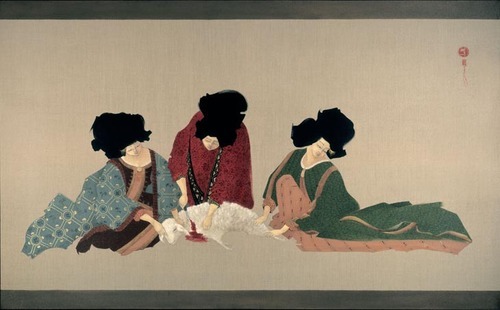
Hayv Kahraman, Collective Cut, via Art Slant
Born in Iraq in 1981, Kahraman moved to Sweden while a child, and later moved to Italy, before returning to Sweden in 2006 to study at the University of Umeå, and later moving to the United States. Having taken up oil painting at twelve, she extends her work beyond drawing and painting to sculpture and design, and the stylistic references her works evoke are wide-ranging. Her influences include Persian miniature art, Arabic calligraphy, traditional Japanese prints, art nouveau, and fashion illustrations, and she introduces elements of the uncanny and bizarre as her way of applying “the background of Islamic art and calligraphy to the traditions of western Europe and the Renaissance.” Kahraman’s precise technique and flattened perspective gives her work a minimalist sparseness and a compelling iconic feel, all the more evident in paintings where she employs religious symbolism. In one series, for example she illustrates the scriptural story of the Sacrifice of The Lamb, with the figures recast as women. The title, “Collective Cut,” suggests that the sacrificed lamb “might also be metaphorically understood in relation to the practice of ‘honour’ killings.” In another painting, unambiguously titled “Honor Killings,” she depicts women hanging from a tree, and in another work, she reinterprets matryoshka dolls through an unveiling process.
Kahraman’s characters are often depicted with elongated necks, representing the archetypical image of the swan, emphasized by the way her figures are often caked in a waxen white color, objectified women with expressionless eyes. As one article puts it,
Her women look like Modiglianis, and have that melancholy serenity about them; plaintive, dreamy-eyed and ethereal in their suffering. They are glimpsed behind closed doors, sumptuously arrayed in harems; exquisite creatures wrapped in fine shawls and lounging on rugs.
This description highlights the elements of orientalist imagery blended into Kahraman’s use of fairy-tale and surrealism as codes in her metaphorical representations of women’s struggles, making her work comparable to artists such as Laylah Ali and Shirin Neshat. Kahraman describes the latter as an inspiration and as “a pioneer in her field.” Kahraman goes on to say that “It’s an exciting time for female artists from the Middle East right now. Many are emerging with a powerful visual language and history is being made.”
This raises some of the issues of political agendas, and how artists from the “Middle East” are often brought into the limelight depending on the international interest in certain facets of their subject matter – in Kahraman’s case, her exploration of the “subject of female oppression with particular reference to war in the Middle East and specifically in her home land of Iraq.”
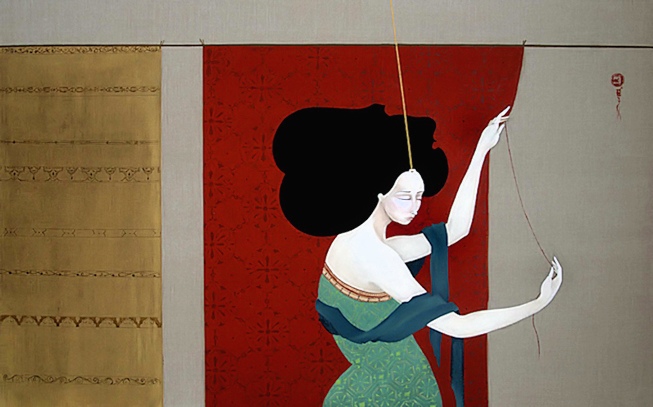
Hanging Sheet, Marionettes Series, via Escape into Life
Kahrman’s series Marionettes could be seen as the embodiment of this theme of women as victims, with their passivity literalized through strings controlling their movements. At the same time, however, Kahraman turns her attention to women as either complicit in or agents of their own repression. In this sense, Kahraman’s work is “a deliberative observation of women being wronged, and women enlisted as agents to perpetuate these wrongs.” Many of her works illustrate an obsession with the maintenance of beauty, with voluntary acts of collective grooming verging on the horrific; images of plucking, waxing, and tweezing become extended into acts of physical mutilation, cutting off tongues and branding, to suit the demands of society or tradition, representing “unflinching depictions of women enslaved to the foibles of the beauty myth.”
In her series Pins and Needles, Kahraman takes this further, reflecting on the alteration of personal appearance as a children’s game, where bodies becomes mapped through the outlining of areas of flesh to be surgically adjusted. Kahraman relates this to her interest in body alteration practices ranging from botox injections and needles to girdles and corsets to foot-binding and breast irons. As Kahraman puts it, “It’s about the maintenance of the body and the excesses this can lead to…We all do it. It’s a personal dilemma.” In the sense that “we all do it” Kahraman’s work becomes a broad feminist critique “creating an excessive cycle of endless outreach towards the unattainable ideal” implanted and perpetuated in an unbroken chain.
As Kahraman writes , her work is about the hope of redemption in a world where civilization and degradation are not opposites but often mirror each other. “Born in a land that is ironically the cradle of civilization and presently the ultimate embodiment of human degradation, Iraq, I have of necessity inherited a host of issues that find expression in my work. Female oppression, honor killings and war continue to claim my attention.”
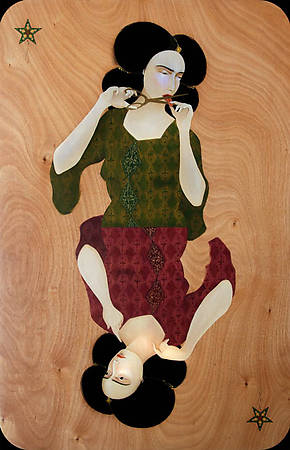
Migrant, via Khtt.net
In addition to the host of issues she has inherited, as an uprooted Iraqi, Kahraman’s work exhibits an interest in immigration and the struggles of the Iraqi diaspora. For example in one exhibition titled “Waraq” she focuses on the struggles of assimilation and alienation through paintings which she intended to reproduce as a set of cards. In her project “Malwiya,” she created a hanging installation reproducing an inverted model of the 9th-century spiraling Abbasid Malwiya tower in Iraq. Partially destroyed by war, the tower remains a cultural landmark, and its the 52-meter height is reflected in the project using the deck of 52 cards. In representing it as inverted, tornado-like, Kahraman reflects on the trauma and loss symbolized in the destruction of Iraq’s heritage. The basis of this project goes back to 2007, when Kahraman sent what she referred to as “Archaeology Awareness Playing Cards,” to US troops in Iraq and Afghanistan. Of course, the deck of cards also refers to the “most-wanted” cards which accompanied the Iraq invasion, juxtaposing the rhetoric of liberation with the dislocation of the migrant figures and the destruction of Iraqi heritage.
In her interview with ArtSlant, Kahraman explicitly embraces this dichotomy of bluntly political messages conveyed through delicate and subtle art, arguing that while admiring the idea of “art for art’s sake”, she is “drawn to injecting meaning in my work,” and quoting Robert Hughes: “If art can’t tell us about the world we live in then there is not much point in having it.” From her archetypal stylized women figures, caught in a liminal space of self-inflicted and perpetual victimhood, to the migrant displaced figures caught between homeland and exile, Kahraman’s simplified imagery condenses and intensify complex issues which interweave local and global human stories.
Previous Post

March 16, 2012
Friday Links | March 16, 2012
Next Post
March 20, 2012 Saudi Female Students Spark a Revolution
Browse Our Archives
Select a Category Advertisements Art/Theater Books/Magazines Cinema Comics/Cartoons Culture/Society Events Fashion Film Friday Links Merchandise/Commodities MMW Announcements MMW Highlights Music/Radio News Photography Politics Profile Ramadan 2012 Ramadan 2013 Ramadan 2014 Ramadan 2015 Roundtable Satire Social Media Sports Technology/Science Television Uncategorized Video Web
Select a Month November 2015 October 2015 September 2015 August 2015 July 2015 June 2015 May 2015 April 2015 March 2015 January 2015 December 2014 November 2014 October 2014 September 2014 July 2014 June 2014 May 2014 April 2014 March 2014 February 2014 January 2014 December 2013 November 2013 October 2013 September 2013 August 2013 July 2013 June 2013 May 2013 April 2013 March 2013 February 2013 January 2013 December 2012 November 2012 October 2012 September 2012 August 2012 July 2012 June 2012 May 2012 April 2012 March 2012 February 2012 January 2012 December 2011 November 2011 September 2011 August 2011 July 2011 June 2011 May 2011 April 2011 March 2011 February 2011 January 2011 December 2010 November 2010 October 2010 September 2010 August 2010 July 2010 June 2010 May 2010 April 2010 March 2010 February 2010 January 2010 December 2009 November 2009 October 2009 September 2009 August 2009 July 2009 June 2009 May 2009 April 2009 March 2009 February 2009 January 2009 December 2008 November 2008 October 2008 September 2008 August 2008 July 2008 June 2008 May 2008 April 2008 March 2008 February 2008 January 2008 December 2007 November 2007 October 2007 September 2007 August 2007
Follow Us!
TAKE THE
Religious Wisdom Quiz
True or False: Hebrews teaches that Jesus is the mediator of a new covenant.
Select your answer to see how you score.
TRUE FALSE
Related posts from Muslimah Media Watch



When Arab Women Artists "Revisit The Harem"
TRENDING AT PATHEOS Muslim

25 Years Later: How Much Has Changed for...
As we approach the 25th anniversary of September 11th, I’ve found myself...

Podcast: Third Spaces & The Rise of Yemeni...
In the latest episode of The Artistic Foodies Podcast, hosts Abbas...

HalalFest Picks: Best 60 Halal Spots for Super...
Back in 2016, I came up with a list of 29...

Unity Is America’s Strength — Division Is Its...
by Hidayatullah Ahsan When Valentina Gomez, a Republican candidate for Congress in...

Zohran Mamdani and New York’s Fight Against Islamophobia
This past June, against all odds, Zohran Mamdani won the Democratic primary...

What the Fourth of July Means to a...
As we mark another Fourth of July, millions of Americans will celebrate...
view all Muslim blogs
Ad-Free & Subscriber Log-In Subscription Support
- About Us
- 2026 Calendar
- Videos
- Podcasts
- Library of World Religions
- Faith In Media Tracker
- Advertise With Us
- Write for Us
- Privacy Policy
- Terms of Service
- Do Not Sell My Data
- Contact Us
- Radiant Digital
- Manage Newsletter Subscriptions
- Unsubscribe From Notifications
- Sitemap
Copyright 2008-2026, Patheos. All rights reserved.
Subscription Support Ad-Free & Subscriber Log-In
Follow Patheos