
BuddhistCatholicContemplativeEvangelicalGeneral ChristianHinduJewishLatter-day SaintMuslimNew VisionsProgressive Christian
Beliefs
- Buddhist
- Catholic
- Contemplative
- Evangelical
- General Christian
- Hindu
- Jewish
- Latter-day Saint
- More Voices
- Muslim
- New Visions
- Pagan
- Progressive Christian
Topics
- Religion News
- Food and Religion
- Sports and Religion
- Religious Art
- Religious Music and Entertainment
- Religious Events
- History and Religion
- Style and Religion
- Politics and Religion
- Women in Religion
- Recreation Outdoors and Religion
- Business Finance and Religion
- Careers Workplace and Religion
- Education and Religion
- Family Parenting and Religion
- Health Fitness and Religion
- Home and Religion
- Relationships and Religion
- Technology and Religion
- Travel and Religion
Columnists
- Buddhist Columnists
- Business Finance and Religion Columnists
- Careers Workplace and Religion Columnists
- Catholic Columnists
- Contemplative Columnists
- Education and Religion Columnists
- Evangelists Columnists
- Family Parenting and Religion Columnists
- General Christian Columnists
- Health Fitness and Religion Columnists
- Hindu Columnists
- History and Religion Columnists
- Home and Religion Columnists
- Jewish Columnists
- More Voices Columnists
- Latter Day Columnists
- Muslim Columnists
- New Visions Columnists
- Nonreligious Columnists
- Pagan Columnists
- Politics and Religion Columnists
- Progressive Columnists
- Recreation Outdoors and Religion Columnists
- Relationships and Religion Columnists
- Religion News Columnists
- Religious Art Columnists
- Religious Events Columnists
- Religious Music and Entertainment Columnists
- Sports and Religion Columnists
- Style and Religion Columnists
- Technology and Religion Columnists
- Travel and Religion Columnists
- Women in Religion Columnists
Resource Library
- 2026 Calendar
- Library of World Religions
- The 100 Most Holy Places on Earth
- Patheos Answers
- Podcasts
- Videos
- Faith Leaders Database
- Anglican Episcopalian
- Bahai
- Baptist
- Buddhism
- Christianity
- Confucianism
- Eastern Orthodoxy
- Hinduism
- Holiness and Pentecostal
- ISKCON
- Islam
- Judaism
- Lutheran
- Methodist
- The Church of Jesus Christ of Latter-day Saints
- New Age
- Paganism
- Presbytarian and Reformed
- Protestantism
- Religion Behind the Scenes
- Roman Catholic
- Scientology
- Shia Islam
- Sikhism
- Sufism
- Sunni Islam
- Taoism
- Zen
- See all religions
Research Tools
 Ad-Free & Subscriber Log-In Subscription Support
Ad-Free & Subscriber Log-In Subscription Support
Follow Patheos 

- Trending:
- Forgiveness
- |
- Marriage
- |
- Consciousness
- |
- Death Penalty
- |
- Election
- |
- Halloween
 Muslimah Media Watch
- Home
- Muslim
- Religion News
- FundaMattel: Sub-Satrapi Bollocks Masquerading as Art
FundaMattel: Sub-Satrapi Bollocks Masquerading as Art
Last updated on: March 26, 2012 at 2:00 am by Lara Alamad
FundaMattel: Sub-Satrapi Bollocks Masquerading as Art 2012-03-25T20:45:54-04:00 Lara Alamad
Patheos Explore the world's faith through different perspectives on religion and spirituality! Patheos has the views of the prevalent religions and spiritualities of the world.
Burqa, burqa, burqa. Will we ever reach the stage where there is nothing more to say on the subject? Sometimes I think we’ve covered every angle of critique, but then there comes yet idiocy to be challenged. Worse still, this is idiocy in the name of art. Witness artist Rachel Joy’s latest work.
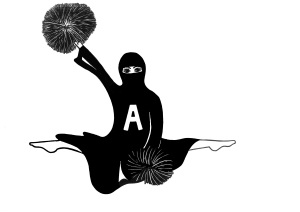
Image via Rachel Joy's blog.
“FundaMattel: If Barbie Wore A Burqua explores fundamentalism (in its many guises), materialism and constructions of femininity. Mattel is the home of Barbie, an extremist representation of women. If Barbie was a real woman she would fall over because her proportions would make it impossible for her to stand. Barbie, in all her incarnations, is impossible and the burqua makes it equally impossible for women to choose a physically active lifestyle. FundaMattel tries to draw attention to a continuum of fundamentalism where barbie and the burqua both represent extreme constructions of what it means to be female. The project aims to ask questions about these constructed female identities and uses humour as a way of exposing the farce. I hope people will consider where the true power lies in these constructions of femininity.”
What FundaMattel: If Barbie Wore A Burqua consists of are ten black-and-white lino cut prints of, in order: a women in a burqa playing the guitar, a women in a burqa going mountain walking, a group of women in burqas making peace gestures and holding a sign saying “freedom” in Arabic, a woman in a burqa on a motorbike, a woman in a burqa on horseback, a goalkeeper in a burqa, a woman in a burqa cooking a barbeque, three women in burqas doing synchronised swimming, a woman in a burqa playing roller derby, a woman in a burqa cheerleading.
First point. The word “burqa” usuall refers to an all-covering garment, with a mesh covering the eyes. None of the women featured in Joy’s work have their eyes obscured, so one can easily conclude that they are wearing niqab + hijab + abaya. So Joy hasn’t even got the name of the garment right.
Now onto meatier issues, the Barbie/Burqa dichotomy. This oft used trope needs to die in a fire, not just because it is a hideous cliche (although it is), but because it is really, really offensive to compare Muslim women to dolls, that is, inanimate objects with no agency, voice, feelings or humanity.
Yes, there is the whole “representation of femininity” argument, but to equate Muslim women to a toy on the ground of their clothing is reductive and insulting. A Barbie is a manufactured item which cannot speak for itself… does it really need to be spelled out why there is such a huge difference?
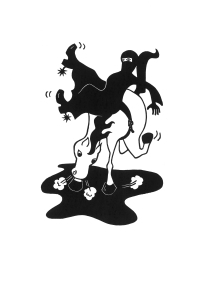
Image via Rachel Joy's blog.
Further teeth gnashing can be had at the statement that “Barbie[…] is impossible and a burqa makes it equally impossible for women to choose a physically active lifestyle.” Having already discussed the crassness of the Barbie/Burqa comparison, let’s examine where Joy got her concept of the sporting lives of Muslim women. Joy is apparently an ESL teacher; she states that some of the women in burqas she taught were “very spirited” (intriguingly, this adjective tends to be used about children), “yet it seemed the burqa was a hindrance to their physical expression.” “It seemed?” So did she ask them their thoughts on niqab wearing and physicality, or did she just assume? In her lengthy blog post describing her work, there are no direct quotes from Muslim women whatsoever. We don’t know what her supposed muses’ thoughts were on the matter, nor their reaction to her work.
Joy does acknowledge that, in her words,
“I have never felt entirely comfortable with the idea that women who wear the burqua choose to do so out of blind religious faith or compliance with patriarchal codes of behaviour, that they are experiencing some sort of false consciousness seems to me rather patronising and simplistic.”
And yet she follows this by “[trying] to imagine what they might become were they not so encumbered,” still assuming them to be “encumbered” in ways that they might not (or might, we don’t know) describe themselves.
When discussing the actual images, Joy states that some of the images are very funny, though apparently this humour is meant to unveil (bad-dum -tish) Western attitudes about the burqa and the burqa’s limiting effect on women’s choices. In case you were hiding in a Fortress of Infinite Solitude somewhere and have missed the not only the endless discussion upon the evils of the burqa, but also, the legislation enacted against Muslim women’s face coverings.
However, considering the lack of input from Muslim women, I am unsure how Joy can claim to not be laughing at Muslim women. While there are indeed cultural, social, economic, political and safety issues that impede some Muslim women’s access to certain sport and leisure activities, whether they wear a burqa or not, the idea that pointing with amusement at Muslim women undertaking sporting activities is somehow going to empower them is badly misplaced. One only has to look at the reaction to Mecca Laalaa’s appointment as a Australian lifeguard while wearing a burqini, to see that such outside attention can swiftly turn into hostile mockery and even if well intended, is an unwanted burden in Muslim women’s lives.
One print in particular emphases Joy’s lack of knowledge: print number 4, the “Arab Spring Burqa.” Is she unaware of the protests of women in Yemen, where women with covered faces did go on the streets and demand their freedom? Or that in Syria, women protesters are using face coverings to protect their identities?
It is nigh on impossible to say anything positive about these pieces. One could mention that no doubt her intentions were good, but 1) Intentions are not magic and 2) A non-Muslim using “humour” to posit the discussed-to-the-point-of-tooth-erosion opinion that face coverings are restrictive is a dubious endeavour, like any other assumption about Muslim women that does not centre us or our voices. How can “laughter be subversive” when Muslim women aren’t in on the joke?
Even the artwork itself seems to be incredibly derivative of Mariane Satrapi’s work, to which Joy denies as using as a direct influence, but concedes there may be stylistic similarities.
Finally, in one last misfire, Joy uses the quote “Women is the n***** of the world,” stating that it “is still true today.” Latoya Peterson has already done a pretty solid take-down of this claim in a different context; as she points out, this statement is rather problematic and offensive from a racial angle, but those are the mistakes made when you talk about people and not to them.
Previous Post

March 23, 2012
Friday Links | March 23, 2012
Next Post
March 27, 2012 From Images of Piety to the Arab Spring and Anonymous Women in Burkas
Browse Our Archives
Select a Category Advertisements Art/Theater Books/Magazines Cinema Comics/Cartoons Culture/Society Events Fashion Film Friday Links Merchandise/Commodities MMW Announcements MMW Highlights Music/Radio News Photography Politics Profile Ramadan 2012 Ramadan 2013 Ramadan 2014 Ramadan 2015 Roundtable Satire Social Media Sports Technology/Science Television Uncategorized Video Web
Select a Month November 2015 October 2015 September 2015 August 2015 July 2015 June 2015 May 2015 April 2015 March 2015 January 2015 December 2014 November 2014 October 2014 September 2014 July 2014 June 2014 May 2014 April 2014 March 2014 February 2014 January 2014 December 2013 November 2013 October 2013 September 2013 August 2013 July 2013 June 2013 May 2013 April 2013 March 2013 February 2013 January 2013 December 2012 November 2012 October 2012 September 2012 August 2012 July 2012 June 2012 May 2012 April 2012 March 2012 February 2012 January 2012 December 2011 November 2011 September 2011 August 2011 July 2011 June 2011 May 2011 April 2011 March 2011 February 2011 January 2011 December 2010 November 2010 October 2010 September 2010 August 2010 July 2010 June 2010 May 2010 April 2010 March 2010 February 2010 January 2010 December 2009 November 2009 October 2009 September 2009 August 2009 July 2009 June 2009 May 2009 April 2009 March 2009 February 2009 January 2009 December 2008 November 2008 October 2008 September 2008 August 2008 July 2008 June 2008 May 2008 April 2008 March 2008 February 2008 January 2008 December 2007 November 2007 October 2007 September 2007 August 2007
Follow Us!
TAKE THE
Religious Wisdom Quiz
What Persian king chose Esther as queen?
Select your answer to see how you score.
Cyrus Artaxerxes Xerxes (Ahasuerus) Darius
Related posts from Muslimah Media Watch


When Arab Women Artists "Revisit The Harem"
When Bridging Between Cultures Doesn’t Help
TRENDING AT PATHEOS Muslim

25 Years Later: How Much Has Changed for...
As we approach the 25th anniversary of September 11th, I’ve found myself...

Podcast: Third Spaces & The Rise of Yemeni...
In the latest episode of The Artistic Foodies Podcast, hosts Abbas...

HalalFest Picks: Best 60 Halal Spots for Super...
Back in 2016, I came up with a list of 29...

Unity Is America’s Strength — Division Is Its...
by Hidayatullah Ahsan When Valentina Gomez, a Republican candidate for Congress in...

Zohran Mamdani and New York’s Fight Against Islamophobia
This past June, against all odds, Zohran Mamdani won the Democratic primary...

What the Fourth of July Means to a...
As we mark another Fourth of July, millions of Americans will celebrate...
view all Muslim blogs
Ad-Free & Subscriber Log-In Subscription Support
- About Us
- 2026 Calendar
- Videos
- Podcasts
- Library of World Religions
- Faith In Media Tracker
- Advertise With Us
- Write for Us
- Privacy Policy
- Terms of Service
- Do Not Sell My Data
- Contact Us
- Radiant Digital
- Manage Newsletter Subscriptions
- Unsubscribe From Notifications
- Sitemap
Copyright 2008-2026, Patheos. All rights reserved.
Subscription Support Ad-Free & Subscriber Log-In
Follow Patheos