
BuddhistCatholicContemplativeEvangelicalGeneral ChristianHinduJewishLatter-day SaintMuslimNew VisionsProgressive Christian
Beliefs
- Buddhist
- Catholic
- Contemplative
- Evangelical
- General Christian
- Hindu
- Jewish
- Latter-day Saint
- More Voices
- Muslim
- New Visions
- Pagan
- Progressive Christian
Topics
- Religion News
- Food and Religion
- Sports and Religion
- Religious Art
- Religious Music and Entertainment
- Religious Events
- History and Religion
- Style and Religion
- Politics and Religion
- Women in Religion
- Recreation Outdoors and Religion
- Business Finance and Religion
- Careers Workplace and Religion
- Education and Religion
- Family Parenting and Religion
- Health Fitness and Religion
- Home and Religion
- Relationships and Religion
- Technology and Religion
- Travel and Religion
Columnists
- Buddhist Columnists
- Business Finance and Religion Columnists
- Careers Workplace and Religion Columnists
- Catholic Columnists
- Contemplative Columnists
- Education and Religion Columnists
- Evangelists Columnists
- Family Parenting and Religion Columnists
- General Christian Columnists
- Health Fitness and Religion Columnists
- Hindu Columnists
- History and Religion Columnists
- Home and Religion Columnists
- Jewish Columnists
- More Voices Columnists
- Latter Day Columnists
- Muslim Columnists
- New Visions Columnists
- Nonreligious Columnists
- Pagan Columnists
- Politics and Religion Columnists
- Progressive Columnists
- Recreation Outdoors and Religion Columnists
- Relationships and Religion Columnists
- Religion News Columnists
- Religious Art Columnists
- Religious Events Columnists
- Religious Music and Entertainment Columnists
- Sports and Religion Columnists
- Style and Religion Columnists
- Technology and Religion Columnists
- Travel and Religion Columnists
- Women in Religion Columnists
Resource Library
- 2026 Calendar
- Library of World Religions
- The 100 Most Holy Places on Earth
- Patheos Answers
- Podcasts
- Videos
- Faith Leaders Database
- Anglican Episcopalian
- Bahai
- Baptist
- Buddhism
- Christianity
- Confucianism
- Eastern Orthodoxy
- Hinduism
- Holiness and Pentecostal
- ISKCON
- Islam
- Judaism
- Lutheran
- Methodist
- The Church of Jesus Christ of Latter-day Saints
- New Age
- Paganism
- Presbytarian and Reformed
- Protestantism
- Religion Behind the Scenes
- Roman Catholic
- Scientology
- Shia Islam
- Sikhism
- Sufism
- Sunni Islam
- Taoism
- Zen
- See all religions
Research Tools
 Ad-Free & Subscriber Log-In Subscription Support
Ad-Free & Subscriber Log-In Subscription Support
Follow Patheos 

- Trending:
- Forgiveness
- |
- Marriage
- |
- Consciousness
- |
- Death Penalty
- |
- Election
- |
- Halloween
 Muslimah Media Watch
- Home
- Muslim
- Religion News
- From Images of Piety to the Arab Spring and Anonymous Women in Burkas
From Images of Piety to the Arab Spring and Anonymous Women in Burkas
Last updated on: March 27, 2012 at 2:00 am by eren
From Images of Piety to the Arab Spring and Anonymous Women in Burkas 2012-03-25T21:58:53-04:00 eren
Patheos Explore the world's faith through different perspectives on religion and spirituality! Patheos has the views of the prevalent religions and spiritualities of the world.
The World Press Photo contest is a competition where the best professional photographers have a chance to showcase their work. The contest focuses on photojournalism and features photographers from all over the world.
Last year the controversial photo of Bibi Aisha, taken by Jodi Bieber and featured in Time Magazine (which MMW covered here), won first prize in the Portraits/Singles category.
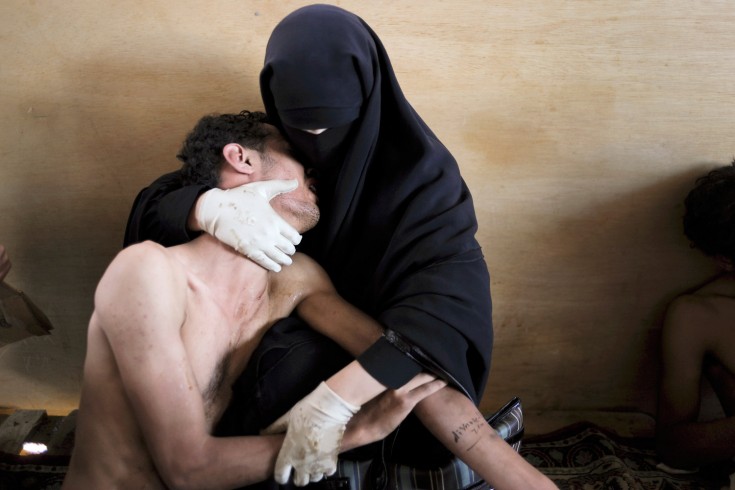
Fatima al-Qaws is pictured holding her injured son in the World Press Photo of 2011. Image via (Notes on) Politics, Theory and Photography.
This year’s contest featured over 5000 photographers and more than 100,000 photos. Due to the number of political issues arising from (mainly Arab) Muslim countries in 2011, quite a few pictures of Muslim women made it into the selection and won prizes. Stephanie Sinclair won first prize in the Contemporary Issues/Stories category for her photo of child brides, taken in Yemen, and Simona Ghizzoni won third place in the Contemporary Issues/Singles category for her picture of Jamila, a Gaza resident injured during an Israeli operation. The World Press Photo of the Year (2011) was Samuel Aranda’s picture featuring Fatima al-Qaws cradling her son after being attacked with tear gas during a demonstration in Sanaa, Yemen.
The photograph shows a niqabi woman wearing latex gloves and holding a shirtless injured man. At the beginning, shortly after the picture was taken, the identity of mother and son remained anonymous. The scene, which is surrounded by a dramatic atmosphere, resembles the image of Michelangelo’s pietà (which depicts Virgin Mary holding Jesus’ body), and has been compared to a Renaissance painting.
Samuel Aranda, a Spanish freelance photographer, saw this picture as a way to remind the world about Yemen’s situation. However, it’s hard to know how much this photo really does tell us about Yemen. In the past few months, the image has stirred some controversy, along with interesting interpretations that are not always related to the specific context in which the picture was taken.
At the forefront of the selection process, a World Press Photo jury member said that the image speaks for “the entire region” (i.e. Yemen, Egypt, Tunisia) and legitimizes women’s participation in the movement. Another jury member, Aidan Sullivan, felt that the picture was an image capturing the compassion and courage of those participating in the revolution. Yet his comments on the mystery of the woman’s identity emphasize how al-Qaws has been described in terms of niqabs, burqas and black robes. Sullivan has been quoted as saying:
“We might never know who this woman is, cradling an injured relative, but together they become a living image of the courage of ordinary people that helped create an important chapter in the history of the Middle East.”
While describing the picture, the Huffington Post emphasized the unknown identity of the woman and instead described her in relation to her “black robes.” In addition, there was not much on al-Qaws’ participation in the revolution (as is described here), thus reducing the picture into a discussion about the “anonymous niqabi” showing compassion for “a relative” and contributing to an imagery of Middle Eastern Muslim women as only anonymous women covered in black.
For some others, the parallel with Christian iconography is what seems to appeal to Western audiences, although they say this is not what the picture is about. The (Notes on) Politics, Theory & Photography blog analyzes the image carefully, only to conclude that the image does not depict the Arab Spring, due to the personal nature of the moment, that it does not depict the role of women as “beyond” caregivers, but instead reinforces gender roles. Finally, it argues that the image only promotes the identification of niqabs and burqas with Christian iconography.
The problem with this photo is not the image itself. This, as some critics have pointed out, is an intimate moment in a setting of conflict. The issue is what the image has been said to depict and to represent. Trying to look for symbols and interpret them in particular ways is not always a good idea, because symbols are not universal. Personally, what I find problematic with this image is the fact that it has been interpreted and reinterpreted in order to find meaning, as if a niqabi woman cradling an injured man needed more explanation. The comparisons with religious imagery seem to be an attempt to normalize and neutralize the moment and to fit it into our preconceived notions of what women’s roles in conflict are.
While I am not a qualified art critic, and I think the picture is beautiful on its own, I wonder: why all this need to find a satisfying deeper meaning or to link it to what we expect it to represent?
Previous Post

March 26, 2012
FundaMattel: Sub-Satrapi Bollocks Masquerading as Art
Next Post
March 28, 2012 Which Muslim Women Should Every Person Know?
Browse Our Archives
Select a Category Advertisements Art/Theater Books/Magazines Cinema Comics/Cartoons Culture/Society Events Fashion Film Friday Links Merchandise/Commodities MMW Announcements MMW Highlights Music/Radio News Photography Politics Profile Ramadan 2012 Ramadan 2013 Ramadan 2014 Ramadan 2015 Roundtable Satire Social Media Sports Technology/Science Television Uncategorized Video Web
Select a Month November 2015 October 2015 September 2015 August 2015 July 2015 June 2015 May 2015 April 2015 March 2015 January 2015 December 2014 November 2014 October 2014 September 2014 July 2014 June 2014 May 2014 April 2014 March 2014 February 2014 January 2014 December 2013 November 2013 October 2013 September 2013 August 2013 July 2013 June 2013 May 2013 April 2013 March 2013 February 2013 January 2013 December 2012 November 2012 October 2012 September 2012 August 2012 July 2012 June 2012 May 2012 April 2012 March 2012 February 2012 January 2012 December 2011 November 2011 September 2011 August 2011 July 2011 June 2011 May 2011 April 2011 March 2011 February 2011 January 2011 December 2010 November 2010 October 2010 September 2010 August 2010 July 2010 June 2010 May 2010 April 2010 March 2010 February 2010 January 2010 December 2009 November 2009 October 2009 September 2009 August 2009 July 2009 June 2009 May 2009 April 2009 March 2009 February 2009 January 2009 December 2008 November 2008 October 2008 September 2008 August 2008 July 2008 June 2008 May 2008 April 2008 March 2008 February 2008 January 2008 December 2007 November 2007 October 2007 September 2007 August 2007
Follow Us!
TAKE THE
Religious Wisdom Quiz
Who said, "To obey is better than sacrifice"?
Select your answer to see how you score.
Solomon Samuel David Isaiah
Related posts from Muslimah Media Watch



Why British MP’s statements defending Muslim women do...
Niqab as an #Elxn42 Issue? Ridiculous
TRENDING AT PATHEOS Muslim

25 Years Later: How Much Has Changed for...
As we approach the 25th anniversary of September 11th, I’ve found myself...

Podcast: Third Spaces & The Rise of Yemeni...
In the latest episode of The Artistic Foodies Podcast, hosts Abbas...

HalalFest Picks: Best 60 Halal Spots for Super...
Back in 2016, I came up with a list of 29...

Unity Is America’s Strength — Division Is Its...
by Hidayatullah Ahsan When Valentina Gomez, a Republican candidate for Congress in...

Zohran Mamdani and New York’s Fight Against Islamophobia
This past June, against all odds, Zohran Mamdani won the Democratic primary...

What the Fourth of July Means to a...
As we mark another Fourth of July, millions of Americans will celebrate...
view all Muslim blogs
Ad-Free & Subscriber Log-In Subscription Support
- About Us
- 2026 Calendar
- Videos
- Podcasts
- Library of World Religions
- Faith In Media Tracker
- Advertise With Us
- Write for Us
- Privacy Policy
- Terms of Service
- Do Not Sell My Data
- Contact Us
- Radiant Digital
- Manage Newsletter Subscriptions
- Unsubscribe From Notifications
- Sitemap
Copyright 2008-2026, Patheos. All rights reserved.
Subscription Support Ad-Free & Subscriber Log-In
Follow Patheos