
BuddhistCatholicContemplativeEvangelicalGeneral ChristianHinduJewishLatter-day SaintMuslimNew VisionsProgressive Christian
Beliefs
- Buddhist
- Catholic
- Contemplative
- Evangelical
- General Christian
- Hindu
- Jewish
- Latter-day Saint
- More Voices
- Muslim
- New Visions
- Pagan
- Progressive Christian
Topics
- Religion News
- Food and Religion
- Sports and Religion
- Religious Art
- Religious Music and Entertainment
- Religious Events
- History and Religion
- Style and Religion
- Politics and Religion
- Women in Religion
- Recreation Outdoors and Religion
- Business Finance and Religion
- Careers Workplace and Religion
- Education and Religion
- Family Parenting and Religion
- Health Fitness and Religion
- Home and Religion
- Relationships and Religion
- Technology and Religion
- Travel and Religion
Columnists
- Buddhist Columnists
- Business Finance and Religion Columnists
- Careers Workplace and Religion Columnists
- Catholic Columnists
- Contemplative Columnists
- Education and Religion Columnists
- Evangelists Columnists
- Family Parenting and Religion Columnists
- General Christian Columnists
- Health Fitness and Religion Columnists
- Hindu Columnists
- History and Religion Columnists
- Home and Religion Columnists
- Jewish Columnists
- More Voices Columnists
- Latter Day Columnists
- Muslim Columnists
- New Visions Columnists
- Nonreligious Columnists
- Pagan Columnists
- Politics and Religion Columnists
- Progressive Columnists
- Recreation Outdoors and Religion Columnists
- Relationships and Religion Columnists
- Religion News Columnists
- Religious Art Columnists
- Religious Events Columnists
- Religious Music and Entertainment Columnists
- Sports and Religion Columnists
- Style and Religion Columnists
- Technology and Religion Columnists
- Travel and Religion Columnists
- Women in Religion Columnists
Resource Library
- 2026 Calendar
- Library of World Religions
- The 100 Most Holy Places on Earth
- Patheos Answers
- Podcasts
- Videos
- Faith Leaders Database
- Anglican Episcopalian
- Bahai
- Baptist
- Buddhism
- Christianity
- Confucianism
- Eastern Orthodoxy
- Hinduism
- Holiness and Pentecostal
- ISKCON
- Islam
- Judaism
- Lutheran
- Methodist
- The Church of Jesus Christ of Latter-day Saints
- New Age
- Paganism
- Presbytarian and Reformed
- Protestantism
- Religion Behind the Scenes
- Roman Catholic
- Scientology
- Shia Islam
- Sikhism
- Sufism
- Sunni Islam
- Taoism
- Zen
- See all religions
Research Tools
 Ad-Free & Subscriber Log-In Subscription Support
Ad-Free & Subscriber Log-In Subscription Support
Follow Patheos 

- Trending:
- Forgiveness
- |
- Marriage
- |
- Consciousness
- |
- Death Penalty
- |
- Election
- |
- Halloween
 Muslimah Media Watch
- Home
- Muslim
- Religion News
- Zenocrate and Zabina in Marlowe’s Tamburlaine
Zenocrate and Zabina in Marlowe’s Tamburlaine
Last updated on: February 21, 2012 at 2:00 am by tasnim
Zenocrate and Zabina in Marlowe’s Tamburlaine 2012-02-20T17:21:24-04:00 tasnim
Patheos Explore the world's faith through different perspectives on religion and spirituality! Patheos has the views of the prevalent religions and spiritualities of the world.
The two parts of Christopher Marlowe’s play Tamburlaine, loosely based on the life of the Central Asian emperor Timur the Lame, tell the story of the Scythian shepherd who becomes a conqueror of kings. Although this play was written in the 1588, it gives us an insight into representations of Muslim women at the time of writing, and has some relevance for today, as is evidenced by the proliferation of studies of early modern “Turk” and “Moor” plays. As one review of DC’s Shakespeare Theatre Company’s production puts it:
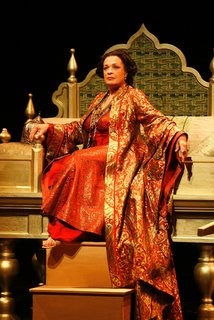
Franchelle Stewart Dorn as Zabina, Empress of Turkey, via scene4.com
Tamburlaine’s landscape, brutality, and clash with Moslem countries give currency to today’s American audience who live with involvement in brutal wars in Iraq and Afghanistan that impact relations with Iran and other Moslem countries.
Perhaps the most famous line in Marlowe’s Tamburlaine, “And shall I die and this unconquered?” encapsulates the story of Tamburlaine’s continuously chasing conquest, “Threat’ning the world with high astounding terms/And scourging kingdoms with his conquering sword.” As those conquests sweep from central Asia through Persia to Turkey, the play explores not only issues of ambition and hubris, but also appeals to anti-Turkish sentiments felt around Europe at a time when, as Richard Knolles writes, the Turks had “grown to the height of majesty and power, as that it hath in contempt all the rest.”
One of the most interesting aspects of the play is the utilizing of national anxieties reflected in Tamburlaine’s victory over the Turkish Emperor Bajazeth. While Bajazeth proclaims “Now shalt thou feel the force of / Turkish Arms, /Which lately made all Europe quake for fear,” Tamburlaine asserts, “Tush, Turks are full of brags/And menace more than they can perform.” These dynamics make Tamburlaine a complex text when it comes to the question of how Islam was represented within the human geography of the world on the Renaissance stage, a question which has recently seen a resurgence of interest, but which goes back almost a hundred years to Louis Wann’s ‘The Oriental in Elizabethan Drama’ (1915) and Warner Grenelle Rice’s ‘Turk, Moor, and Persian in English Literature’ (1927).
But Tamburlaine is equally interesting for its construction of gender roles, especially in the first part, given Zenocrate’s transformation from being the daughter of the Sultan and the betrothed of the Prince of Arabia, to being Tamburlaine’s captive, to Queen of Persia. In the beginning, Zenocrate’s speech is a constant reminder of her status, which forms a distinction between her and Bajazeth’s wife, Zabina. As Lamiya Almas points out, while both are captives, “Zabina is an empress by association and not by birth, but Zenocrate, also an empress, is an absolute monarch by birth, and through her marriage Tamburlaine’s territories and hers will be united.”
Soon, Zenocrate begins to compare herself with Juno through her connection with Tamburlaine, retorting: “Call’st thou me concubine, that am betrothed/unto the great and mighty Tamburlaine?” The text seems to offer some autonomy to Zenocrate here, yet this could be seen as underlining Zenocrate’s trophy position. As Mohja Kahf puts it in her book Western representations of the Muslim woman: From Termagant to Odalisque, “Whether wives, mothers, maids or concubines, the women in Tamburlaine are trophies and accessories to men and rarely budge from rather wooden roles.”
There is, however, an openness to other interpretations, depending on whether Zenocrate is portrayed as a dissident voice against violence later on in the play. Some of her lines do conflict with the dominant narrative, in her plea for her father’s kingdom, her grief for the virgins whose execution Tamburlaine orders, and her lament over Bajazeth and Zabina’s suicide. But it could equally be argued that the rise and triumph of Tamburlaine is paralleled by the suppression of Zenocrate, who becomes increasingly silent towards the end of the first part, whether this is interpreted as the “silent treatment” or as Sara Deats sees it, a progression through which Zenocrate, “interpellated into female passivity and silence by the end of Part I, petrifies into the figure of the ideal wife and mother in Part II.”
Is there an aspect of Zenocrate’s portrayal that is specific to the play’s Islamic context? Kahf argues that in fact, Zenocrate’s representation utilizes familiar tropes from the maiden in distress to the loyal wife, which do not relate to “conventional Muslim woman material.”
Just as Tamburlaine is represented in human terms rather than in terms of the literary conventions of the Muslim/pagan Other, Zenocrate, Zabina, their maids, Olympia, the Virgins of Damasucs and the Turkish concubines are represented as a function of the simple difference of female gender and not the complex difference of Islamic Other/female gender.
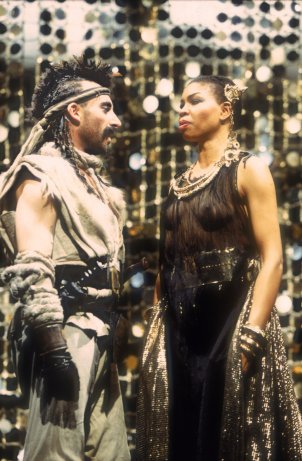
Zenocrate (Claire Benedict) in Tamburlaine directed by Terry Hands in 1993. Photo by Reg Wilson © RSC
If this is so, how have recent productions represented this material, given the context of the last two decades, from the rise of the paradigm of the Clash of Civilizations during the 90’s to the War on Terror? In his review of Tamburlaine in performance, David Fuller notes that during the 1990s, productions played up issues of cultural otherness. In Terry Hand’s production, African chants were performed by the group Welcome Msomi, which Fuller notes might not have been the appropriate alien culture but did convey otherness and racial difference, further reinforced through Zenocrate being played by Claire Benedict, who is black. Fuller goes on to note that Bajazeth’s costume included curved flaps on the head that suggested elephant tusks, a use of animalistic imagery that matched the Turks’ elephant-like screaming during their confrontation with Tamburlaine.
In 2005, there was a brief controversy over the climactic Quran burning scene in the second part of the play, which it was claimed, was censored in one production, though the director responded that this was “complete nonsense.”
Tamburlaine did burn the Qur’an centre-stage in an old petrol drum – but I wanted to make it very clear that his act was a giant two fingers to the entire theological system…His act was a hubristic and nihilistic defiant scream at what he saw as an empty universe.
Tamburlaine’s speech during this scene is reminiscent of Zabina’s lament, describing the world bereft of meaning, “Then is there left no Mahomet, no God/No fiend, no Fortune, nor no hope of end/To our infamous, monstrous slaveries.” Bindu Malieckal relates Zabina (perhaps the first Ottoman woman represented on the stage) to her historical counterparts, women such as Nur Banu and Safiye, “Turkish” women of Christian and European origins who were “first and foremost Ottoman agents,” presenting contradictory characteristics, “slaves and queens, Christians and Muslims, European, African, and Ottoman, defeated yet decisive.”
In the play, Zabina is no foil character, but is represented as “a woman with authority and honor” who chooses to commit suicide with her husband rather than continue to be enslaved. In her lament just before her suicide she depicts a hell on earth and a sense of abandonment by faith which reinforces Tamburlaine’s claim to being the scourge of mankind. But the force of the scene becomes clear with Zenocrate’s discovery of their bodies as she reflects:
Wretched Zenocrate! that liv’st to see
Damascus walls dyed with Egyptians’ blood,
Thy father’s subjects and thy countrymen;
Thy streets strowed with dissevered joints of men
And wounded bodies gasping yet for life
Zenocrate’s sympathy for Zabina, turned from “enemy” to “empress,” is a pivotal scene in terms of her character’s development, and its force derives from its break from the play’s dominant ethos of violence, a break which in a sense bring us full circle in its echo of that other famous line of Tamburlaine, spoken early on by the defeated King of Persia: “Accursed be he that first invented war.”
Previous Post

February 20, 2012
Muhteşem Yüzyıl: Traditional Women Roles in the Age of Emancipation
Next Post
February 22, 2012 Playing on Old Fears: Coverage of Iran’s Female Ninjas
Browse Our Archives
Select a Category Advertisements Art/Theater Books/Magazines Cinema Comics/Cartoons Culture/Society Events Fashion Film Friday Links Merchandise/Commodities MMW Announcements MMW Highlights Music/Radio News Photography Politics Profile Ramadan 2012 Ramadan 2013 Ramadan 2014 Ramadan 2015 Roundtable Satire Social Media Sports Technology/Science Television Uncategorized Video Web
Select a Month November 2015 October 2015 September 2015 August 2015 July 2015 June 2015 May 2015 April 2015 March 2015 January 2015 December 2014 November 2014 October 2014 September 2014 July 2014 June 2014 May 2014 April 2014 March 2014 February 2014 January 2014 December 2013 November 2013 October 2013 September 2013 August 2013 July 2013 June 2013 May 2013 April 2013 March 2013 February 2013 January 2013 December 2012 November 2012 October 2012 September 2012 August 2012 July 2012 June 2012 May 2012 April 2012 March 2012 February 2012 January 2012 December 2011 November 2011 September 2011 August 2011 July 2011 June 2011 May 2011 April 2011 March 2011 February 2011 January 2011 December 2010 November 2010 October 2010 September 2010 August 2010 July 2010 June 2010 May 2010 April 2010 March 2010 February 2010 January 2010 December 2009 November 2009 October 2009 September 2009 August 2009 July 2009 June 2009 May 2009 April 2009 March 2009 February 2009 January 2009 December 2008 November 2008 October 2008 September 2008 August 2008 July 2008 June 2008 May 2008 April 2008 March 2008 February 2008 January 2008 December 2007 November 2007 October 2007 September 2007 August 2007
Follow Us!
TAKE THE
Religious Wisdom Quiz
Before feeding 5,000 people with five loaves and two fish, what did Jesus do first?
Select your answer to see how you score.
Passed the food out Gave thanks Taught Blessed the Children
Related posts from Muslimah Media Watch


When Arab Women Artists "Revisit The Harem"
When Bridging Between Cultures Doesn’t Help
“Allah Makes Muslims, Allah Makes Queers”: A Interview...
TRENDING AT PATHEOS Muslim

25 Years Later: How Much Has Changed for...
As we approach the 25th anniversary of September 11th, I’ve found myself...

Podcast: Third Spaces & The Rise of Yemeni...
In the latest episode of The Artistic Foodies Podcast, hosts Abbas...

HalalFest Picks: Best 60 Halal Spots for Super...
Back in 2016, I came up with a list of 29...

Unity Is America’s Strength — Division Is Its...
by Hidayatullah Ahsan When Valentina Gomez, a Republican candidate for Congress in...

Zohran Mamdani and New York’s Fight Against Islamophobia
This past June, against all odds, Zohran Mamdani won the Democratic primary...

What the Fourth of July Means to a...
As we mark another Fourth of July, millions of Americans will celebrate...
view all Muslim blogs
Ad-Free & Subscriber Log-In Subscription Support
- About Us
- 2026 Calendar
- Videos
- Podcasts
- Library of World Religions
- Faith In Media Tracker
- Advertise With Us
- Write for Us
- Privacy Policy
- Terms of Service
- Do Not Sell My Data
- Contact Us
- Radiant Digital
- Manage Newsletter Subscriptions
- Unsubscribe From Notifications
- Sitemap
Copyright 2008-2026, Patheos. All rights reserved.
Subscription Support Ad-Free & Subscriber Log-In
Follow Patheos