
BuddhistCatholicContemplativeEvangelicalGeneral ChristianHinduJewishLatter-day SaintMuslimNew VisionsProgressive Christian
Beliefs
- Buddhist
- Catholic
- Contemplative
- Evangelical
- General Christian
- Hindu
- Jewish
- Latter-day Saint
- More Voices
- Muslim
- New Visions
- Pagan
- Progressive Christian
Topics
- Religion News
- Food and Religion
- Sports and Religion
- Religious Art
- Religious Music and Entertainment
- Religious Events
- History and Religion
- Style and Religion
- Politics and Religion
- Women in Religion
- Recreation Outdoors and Religion
- Business Finance and Religion
- Careers Workplace and Religion
- Education and Religion
- Family Parenting and Religion
- Health Fitness and Religion
- Home and Religion
- Relationships and Religion
- Technology and Religion
- Travel and Religion
Columnists
- Buddhist Columnists
- Business Finance and Religion Columnists
- Careers Workplace and Religion Columnists
- Catholic Columnists
- Contemplative Columnists
- Education and Religion Columnists
- Evangelists Columnists
- Family Parenting and Religion Columnists
- General Christian Columnists
- Health Fitness and Religion Columnists
- Hindu Columnists
- History and Religion Columnists
- Home and Religion Columnists
- Jewish Columnists
- More Voices Columnists
- Latter Day Columnists
- Muslim Columnists
- New Visions Columnists
- Nonreligious Columnists
- Pagan Columnists
- Politics and Religion Columnists
- Progressive Columnists
- Recreation Outdoors and Religion Columnists
- Relationships and Religion Columnists
- Religion News Columnists
- Religious Art Columnists
- Religious Events Columnists
- Religious Music and Entertainment Columnists
- Sports and Religion Columnists
- Style and Religion Columnists
- Technology and Religion Columnists
- Travel and Religion Columnists
- Women in Religion Columnists
Resource Library
- 2026 Calendar
- Library of World Religions
- The 100 Most Holy Places on Earth
- Patheos Answers
- Podcasts
- Videos
- Faith Leaders Database
- Anglican Episcopalian
- Bahai
- Baptist
- Buddhism
- Christianity
- Confucianism
- Eastern Orthodoxy
- Hinduism
- Holiness and Pentecostal
- ISKCON
- Islam
- Judaism
- Lutheran
- Methodist
- The Church of Jesus Christ of Latter-day Saints
- New Age
- Paganism
- Presbytarian and Reformed
- Protestantism
- Religion Behind the Scenes
- Roman Catholic
- Scientology
- Shia Islam
- Sikhism
- Sufism
- Sunni Islam
- Taoism
- Zen
- See all religions
Research Tools
 Ad-Free & Subscriber Log-In Subscription Support
Ad-Free & Subscriber Log-In Subscription Support
Follow Patheos 

- Trending:
- Forgiveness
- |
- Marriage
- |
- Consciousness
- |
- Death Penalty
- |
- Election
- |
- Halloween
 Muslimah Media Watch
- Home
- Muslim
- Religion News
- Revisiting the Revolution: How Far Have Egyptian Women Come?
Revisiting the Revolution: How Far Have Egyptian Women Come?
Last updated on: February 2, 2012 at 2:00 am by diana
Revisiting the Revolution: How Far Have Egyptian Women Come? 2012-01-30T18:29:15-04:00 diana
Patheos Explore the world's faith through different perspectives on religion and spirituality! Patheos has the views of the prevalent religions and spiritualities of the world.
Tuesday, January 25th, 2011: the day thousands of Egyptians—Christians and Muslims, men and women, young and old—lined the streets of Tahrir Square in non-violent, civil-resistance in attempt to overthrow the regime of then President, Hosni Mubarak.
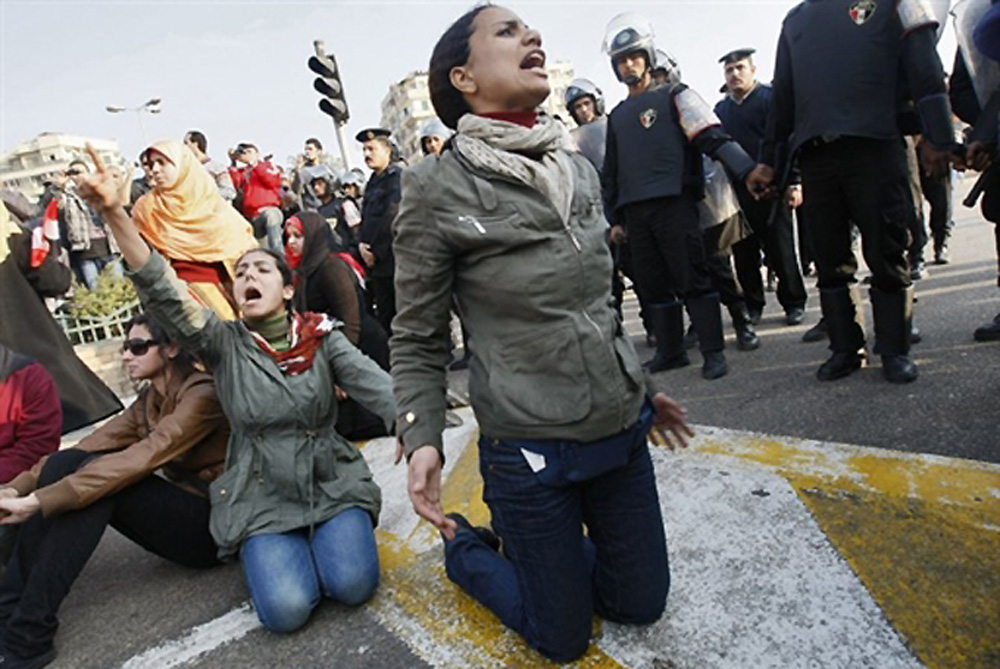
Women protest in Tahrir Square on January 25, 2011. Photo via Al Jazeera.
A year later, Wikipedia hosts a page titled “2011 Egyptian Revolution;” Egyptians mourn the loss of their sons, brothers, and husbands; and Americans have moved on to follow the never-ceasing Republican debates with hardly an indication of Egypt on their radar.
On the other hand, as the newly, democratically elected Egyptian Parliament convenes, citizens once again swell around Tahrir square. This has been deemed a moment of renewed uprising against the military council, a remembrance of the 1,000 protestors killed over the past year, and a celebration of the move forward. Meanwhile, news sources have gone to task speculating about the state of women in Egypt post-revolution.
Preoccupation with the future of Egyptian women and how women’s status might be impacted as a result of the recent elections has prompted extensive coverage on the issue in the past week. The analysis is varied, perhaps as much as the opinions of Egyptian women regarding their current status or impending fate under the new Parliament.
There are largely two camps of opinions amongst media speculators regarding the progress, or lack thereof, made in the past year and what the newly elected, “conservative” government envisages for the future of women’s rights in Egypt.
Some are cynical, or perhaps just prudent, drawing on the stagnancy—in some cases regression—regarding women rights in the past year, as an ominous sign of things to come. Others are optimistic, saying instead that the mere placement of women in the public sphere of Egypt’s civic life is indicative of a new way forward for women.
Al-Arabiya News author Najat Al-Saeid examines these sentiments. Noting the incident that unfolded last December, where a female protestor was chased, dragged, beaten, and stripped by Egyptian troops, Al-Saeid is one of those who believe that the revolution has not and will not result in any improvement in women’s status. She says, Arab women must establish a union or organization, which spans beyond just one country, to protect and strengthen their rights—and it must start with Egypt.
In spite of the newly, democratically elected parliament, columnist Raghida Dergham, in an article for the Huffington Post, questions the legitimacy of this democratic process saying,
“…democracy has been abortive as a result of excluding women and the youth from decision-making, and there are dangerous indications that the personal freedoms of Arab women and religious minorities are being undermined…”
The Al-Nour Party and the Muslim Brotherhood’s Freedom and Justice Party won about 70 percent of the seats in the new parliament. Though democratically elected, they seem to be endorsing ideas such as segregation of sexes and veiling, and putting the more pressing issues of divorce laws and violence against women on the backburner.
As reported by NPR, Dalia Abdel Hamid, the gender officer at the Egyptian Initiative for Human Rights said, “After the revolution everyone wanted to be represented and to have their voices heard but … women are just being marginalized by all the parties.”
Others seem to be singing a different tune, noting that the mere presence of women in public spaces in such large numbers is, in of itself, telling. A student protestor present in the demonstrations last week was asked if things are any better. She said that, at least for now, women can publicly campaign for their rights—albeit at a risk to their safety.
Victoria Hightower, assistant professor of history at North Georgia College & State University, says that “Women have been active in all of these protest movements in direct contradiction to the stereotype of the oppressed Muslim woman.” She thinks that the mere involvement of women in the revolution is cause for “cautious optimism.”
While women have historically been involved in revolutions, they are often brushed aside afterwards. Hightower says that the difference in the case of Egypt is that Egyptian women are highly aware of this possibility and therefore, aren’t willing to be pushed aside without a struggle. She cites an incident where a group of Egyptian women physically beat a group of young men who told them to dress more modestly, as evidence of this resilience.
Further evidence can perhaps be seen in the occurrence of a “Million Woman” march in late December to expose the military’s sexual violence against female demonstrators. These women chanted slogans, demanding the violence against women stop, as civilian men formed a protective circle around the female marchers so that they would not be assaulted by military police.
While I generally disagree with an overwhelming sentiment expressed in numerous articles, which is that one cannot be an Islamist while also being an empowered woman, the skepticism regarding the newly elected parliament’s ability to champion women’s rights issues is perhaps warranted.
In light of the fact that these “empowered” women seem to be operating in heavily male-dominated spaces, there is the concern that perhaps their voices will be hushed by men and their seats will become worthless quota signifiers.
Mohamed Abla, a well-known painter and vocal critic of the military council, puts it perfectly saying, “We didn’t win…The revolution has moved into another stage now, and it seems we still have to fight and fight and fight.”
The take away: the revolution is by no means over—at least not for women. The hope is that after the democratically-induced euphoria fades, the voices of Egyptian women who remember that democracy isn’t always synonymous with justice and equality, will still reach the rungs of government.
Previous Post

February 1, 2012
On Female Scholars (But Not Feminism): Reviewing Al-Muhaddithat
Next Post
February 3, 2012 Friday Links | February 3, 2012
Browse Our Archives
Select a Category Advertisements Art/Theater Books/Magazines Cinema Comics/Cartoons Culture/Society Events Fashion Film Friday Links Merchandise/Commodities MMW Announcements MMW Highlights Music/Radio News Photography Politics Profile Ramadan 2012 Ramadan 2013 Ramadan 2014 Ramadan 2015 Roundtable Satire Social Media Sports Technology/Science Television Uncategorized Video Web
Select a Month November 2015 October 2015 September 2015 August 2015 July 2015 June 2015 May 2015 April 2015 March 2015 January 2015 December 2014 November 2014 October 2014 September 2014 July 2014 June 2014 May 2014 April 2014 March 2014 February 2014 January 2014 December 2013 November 2013 October 2013 September 2013 August 2013 July 2013 June 2013 May 2013 April 2013 March 2013 February 2013 January 2013 December 2012 November 2012 October 2012 September 2012 August 2012 July 2012 June 2012 May 2012 April 2012 March 2012 February 2012 January 2012 December 2011 November 2011 September 2011 August 2011 July 2011 June 2011 May 2011 April 2011 March 2011 February 2011 January 2011 December 2010 November 2010 October 2010 September 2010 August 2010 July 2010 June 2010 May 2010 April 2010 March 2010 February 2010 January 2010 December 2009 November 2009 October 2009 September 2009 August 2009 July 2009 June 2009 May 2009 April 2009 March 2009 February 2009 January 2009 December 2008 November 2008 October 2008 September 2008 August 2008 July 2008 June 2008 May 2008 April 2008 March 2008 February 2008 January 2008 December 2007 November 2007 October 2007 September 2007 August 2007
Follow Us!
TAKE THE
Religious Wisdom Quiz
Who said, "Let there be light"?
Select your answer to see how you score.
Paul Moses God Elijah
Related posts from Muslimah Media Watch

#PrayforParis, Muslim Women and Third World Violence



Why British MP’s statements defending Muslim women do...
TRENDING AT PATHEOS Muslim

25 Years Later: How Much Has Changed for...
As we approach the 25th anniversary of September 11th, I’ve found myself...

Podcast: Third Spaces & The Rise of Yemeni...
In the latest episode of The Artistic Foodies Podcast, hosts Abbas...

HalalFest Picks: Best 60 Halal Spots for Super...
Back in 2016, I came up with a list of 29...

Unity Is America’s Strength — Division Is Its...
by Hidayatullah Ahsan When Valentina Gomez, a Republican candidate for Congress in...

Zohran Mamdani and New York’s Fight Against Islamophobia
This past June, against all odds, Zohran Mamdani won the Democratic primary...

What the Fourth of July Means to a...
As we mark another Fourth of July, millions of Americans will celebrate...
view all Muslim blogs
Ad-Free & Subscriber Log-In Subscription Support
- About Us
- 2026 Calendar
- Videos
- Podcasts
- Library of World Religions
- Faith In Media Tracker
- Advertise With Us
- Write for Us
- Privacy Policy
- Terms of Service
- Do Not Sell My Data
- Contact Us
- Radiant Digital
- Manage Newsletter Subscriptions
- Unsubscribe From Notifications
- Sitemap
Copyright 2008-2026, Patheos. All rights reserved.
Subscription Support Ad-Free & Subscriber Log-In
Follow Patheos