
BuddhistCatholicContemplativeEvangelicalGeneral ChristianHinduJewishLatter-day SaintMuslimNew VisionsProgressive Christian
Beliefs
- Buddhist
- Catholic
- Contemplative
- Evangelical
- General Christian
- Hindu
- Jewish
- Latter-day Saint
- More Voices
- Muslim
- New Visions
- Pagan
- Progressive Christian
Topics
- Religion News
- Food and Religion
- Sports and Religion
- Religious Art
- Religious Music and Entertainment
- Religious Events
- History and Religion
- Style and Religion
- Politics and Religion
- Women in Religion
- Recreation Outdoors and Religion
- Business Finance and Religion
- Careers Workplace and Religion
- Education and Religion
- Family Parenting and Religion
- Health Fitness and Religion
- Home and Religion
- Relationships and Religion
- Technology and Religion
- Travel and Religion
Columnists
- Buddhist Columnists
- Business Finance and Religion Columnists
- Careers Workplace and Religion Columnists
- Catholic Columnists
- Contemplative Columnists
- Education and Religion Columnists
- Evangelists Columnists
- Family Parenting and Religion Columnists
- General Christian Columnists
- Health Fitness and Religion Columnists
- Hindu Columnists
- History and Religion Columnists
- Home and Religion Columnists
- Jewish Columnists
- More Voices Columnists
- Latter Day Columnists
- Muslim Columnists
- New Visions Columnists
- Nonreligious Columnists
- Pagan Columnists
- Politics and Religion Columnists
- Progressive Columnists
- Recreation Outdoors and Religion Columnists
- Relationships and Religion Columnists
- Religion News Columnists
- Religious Art Columnists
- Religious Events Columnists
- Religious Music and Entertainment Columnists
- Sports and Religion Columnists
- Style and Religion Columnists
- Technology and Religion Columnists
- Travel and Religion Columnists
- Women in Religion Columnists
Resource Library
- 2026 Calendar
- Library of World Religions
- The 100 Most Holy Places on Earth
- Patheos Answers
- Podcasts
- Videos
- Faith Leaders Database
- Anglican Episcopalian
- Bahai
- Baptist
- Buddhism
- Christianity
- Confucianism
- Eastern Orthodoxy
- Hinduism
- Holiness and Pentecostal
- ISKCON
- Islam
- Judaism
- Lutheran
- Methodist
- The Church of Jesus Christ of Latter-day Saints
- New Age
- Paganism
- Presbytarian and Reformed
- Protestantism
- Religion Behind the Scenes
- Roman Catholic
- Scientology
- Shia Islam
- Sikhism
- Sufism
- Sunni Islam
- Taoism
- Zen
- See all religions
Research Tools
 Ad-Free & Subscriber Log-In Subscription Support
Ad-Free & Subscriber Log-In Subscription Support
Follow Patheos 

- Trending:
- Forgiveness
- |
- Marriage
- |
- Consciousness
- |
- Death Penalty
- |
- Election
- |
- Halloween
 Muslimah Media Watch
- Home
- Muslim
- Religion News
- How are Muslim Women Doing in Political Cartoons?
How are Muslim Women Doing in Political Cartoons?
Last updated on: January 30, 2012 at 11:23 am by eren
How are Muslim Women Doing in Political Cartoons? 2012-01-30T11:23:40-04:00 eren
Patheos Explore the world's faith through different perspectives on religion and spirituality! Patheos has the views of the prevalent religions and spiritualities of the world.
After having written my undergraduate dissertation on depictions on Mexican First Ladies in political cartoons, I gained some insight into what it means to be a woman portrayed in editorial cartoons. Despite how funny political cartoons may be, they might also carry very strong messages, and these are often gendered.
Political cartoons are a powerful medium because, although they are not news, they facilitate the delivery of specific messages. Political cartoons work in two ways: they reflect particular ideas and/or aspects of pop culture, and they influence the audience’s own views. Due to their simple approach (drawings and funny dialogue), they are often more accessible than regular newspaper coverage or even TV.

Image via the Baochi Banter.
Yet, because political cartoons tend to be a safe mode of expression, they can easily become influenced by gendered stereotypes. This is not because cartoonists are evil misogynists (although some might fit this description), but because they need to connect with particular cultural-accepted views on gender and gender relations. Women are treated differently than men, in that they tend to be taken less seriously, they rarely have agency, they are often hyper-sexualized and many times examined under a “virgin-whore” framework.
When it comes to Muslim women as represented in political cartoons catered to non-Muslim Western audiences, a few prevalent themes can be easily identified. I tend to collect political cartoons of Muslim women, posted on Facebook and elsewhere online. The themes I mention in this post are pretty representative of many other cartoons out there, and the images included here are just a sample. Muslim women seem to look the same, and usually wear hijabs, niqabs and/or abaayas (the blacker, the better!) When it comes to the niqab in political cartoons, it tends to serve the purpose of deleting the women’s presence, voice and agency. This resonates with the idea that niqabi women are already oppressed, so why depict them with an agency that they do not have?

Image via the LA Times.
Another theme present in political cartoons is the prevalent attention to Muslim women’s bodies. While Western women (such as female politicians) tend to be hyper-sexualized through sexy clothing, over-done makeup, and high heels, Muslim women are hyper-sexualized through the cartoonists’ obsession with their “exotic” way of covering. This reflects the “covered vs. uncovered” dichotomy that is often discussed in the Western media where uncovering is equated with freedom and covering with oppression (see Sex and the City 2). It is also commonly expressed that Muslim women’s bodies are not their own, but someone else’s (like the state, their male relatives, secular and religious institutions, or the media).
Muslim women are not only “the other,” as we have explored in a previous post, but they are only a source of objectification and appropriation. Let me explain. Depictions of Muslim women in recent political cartoons serve mainly two purposes: they are political commentary (on terrorism, “barbarism,” extremism), and they are also a resource in the politics of fear. Muslim women are drawn in a way that encourages distrust and that alerts the observer. They are shown as hiding something behind all that clothing; therefore, they are a security concern. In an era of securitization, this is a very powerful commentary.
In addition to being scary beings, Muslim women are also shown as both weak and oppressed subjects (often by men) that have to be exposed to the Western ideal of freedom. Nonetheless, despite their weakness, they must also be controlled (we don’t want the extremists getting them first!) Both of these themes discourage the audience from thinking critically about Muslim women and encourage fear, rage or simply mockery.
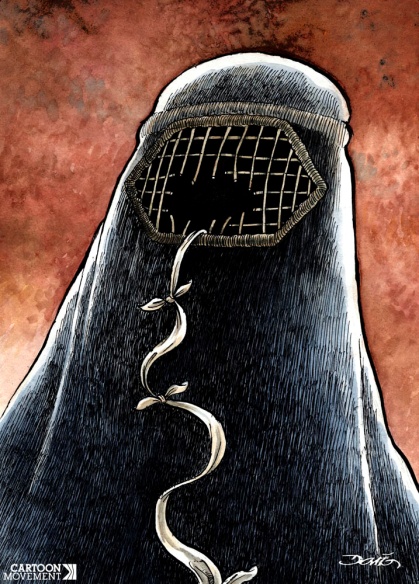
Cartoon by Dario Castillejos. Image via Cartoonmovement.com.
Muslim girls in political cartoons in the West are rarely agents. They are rather characters that serve a secondary purpose. They are either behind men (sometimes with multiple children), ridiculed by Western characters, or carrying bombs. They are rarely depicted saying anything smart or “liberating.” They are also portrayed as hyper-religious, which makes them the object of jokes in highly “secularized” political cartoons.
So how are we doing in political cartoons? Very often, cartoons are gendered and present very particular, sometimes even racist, views on what Muslim women as “the other” look like. What is more, Muslim women are largely just the shadow in the picture that makes an important political commentary about males in either the West or the East, even when discussing issues relevant to women. Although there some Muslim women cartoonists like Omayya Joha and Nigar Nazar, political cartoons in major Western papers are male, and women cartoonists are often treated as the other (which would make it even harder for a Muslim woman cartoonist, a “double-other,” to enter the field).
Is this the way Muslim women continue to be presented and explained to Western audiences, through the eyes of mainly white Western men? And what are the consequences of this? Depiction of Muslim women in the Western media and much of the internet are highly problematic. We do not only face the same problems as non-Muslim women in editorial cartoons, but we also face the post 9/11 era. Perhaps it is time for more skilled artist sisters to step up and present a different, non-monolithic view on Muslim women!
Editor’s Note: Some of the images originally included in this post have been removed.
Previous Post

January 18, 2012
For Arab Women, Change in the Digital Reality is Coming, but Slowly
Next Post
January 20, 2012 Friday Links | January 20, 2012
Browse Our Archives
Select a Category Advertisements Art/Theater Books/Magazines Cinema Comics/Cartoons Culture/Society Events Fashion Film Friday Links Merchandise/Commodities MMW Announcements MMW Highlights Music/Radio News Photography Politics Profile Ramadan 2012 Ramadan 2013 Ramadan 2014 Ramadan 2015 Roundtable Satire Social Media Sports Technology/Science Television Uncategorized Video Web
Select a Month November 2015 October 2015 September 2015 August 2015 July 2015 June 2015 May 2015 April 2015 March 2015 January 2015 December 2014 November 2014 October 2014 September 2014 July 2014 June 2014 May 2014 April 2014 March 2014 February 2014 January 2014 December 2013 November 2013 October 2013 September 2013 August 2013 July 2013 June 2013 May 2013 April 2013 March 2013 February 2013 January 2013 December 2012 November 2012 October 2012 September 2012 August 2012 July 2012 June 2012 May 2012 April 2012 March 2012 February 2012 January 2012 December 2011 November 2011 September 2011 August 2011 July 2011 June 2011 May 2011 April 2011 March 2011 February 2011 January 2011 December 2010 November 2010 October 2010 September 2010 August 2010 July 2010 June 2010 May 2010 April 2010 March 2010 February 2010 January 2010 December 2009 November 2009 October 2009 September 2009 August 2009 July 2009 June 2009 May 2009 April 2009 March 2009 February 2009 January 2009 December 2008 November 2008 October 2008 September 2008 August 2008 July 2008 June 2008 May 2008 April 2008 March 2008 February 2008 January 2008 December 2007 November 2007 October 2007 September 2007 August 2007
Follow Us!
TAKE THE
Religious Wisdom Quiz
Who became jealous and tried to kill David several times?
Select your answer to see how you score.
Abiathar Samuel Saul Abner
Related posts from Muslimah Media Watch


Rejected (Muslim) Princesses: awesomely offbeat women in history
TED Talks and Superheroes: New Representations of Muslim...

When Bridging Between Cultures Doesn’t Help
TRENDING AT PATHEOS Muslim

25 Years Later: How Much Has Changed for...
As we approach the 25th anniversary of September 11th, I’ve found myself...

Podcast: Third Spaces & The Rise of Yemeni...
In the latest episode of The Artistic Foodies Podcast, hosts Abbas...

HalalFest Picks: Best 60 Halal Spots for Super...
Back in 2016, I came up with a list of 29...

Unity Is America’s Strength — Division Is Its...
by Hidayatullah Ahsan When Valentina Gomez, a Republican candidate for Congress in...

Zohran Mamdani and New York’s Fight Against Islamophobia
This past June, against all odds, Zohran Mamdani won the Democratic primary...

What the Fourth of July Means to a...
As we mark another Fourth of July, millions of Americans will celebrate...
view all Muslim blogs
Ad-Free & Subscriber Log-In Subscription Support
- About Us
- 2026 Calendar
- Videos
- Podcasts
- Library of World Religions
- Faith In Media Tracker
- Advertise With Us
- Write for Us
- Privacy Policy
- Terms of Service
- Do Not Sell My Data
- Contact Us
- Radiant Digital
- Manage Newsletter Subscriptions
- Unsubscribe From Notifications
- Sitemap
Copyright 2008-2026, Patheos. All rights reserved.
Subscription Support Ad-Free & Subscriber Log-In
Follow Patheos