
BuddhistCatholicContemplativeEvangelicalGeneral ChristianHinduJewishLatter-day SaintMuslimNew VisionsProgressive Christian
Beliefs
- Buddhist
- Catholic
- Contemplative
- Evangelical
- General Christian
- Hindu
- Jewish
- Latter-day Saint
- More Voices
- Muslim
- New Visions
- Pagan
- Progressive Christian
Topics
- Religion News
- Food and Religion
- Sports and Religion
- Religious Art
- Religious Music and Entertainment
- Religious Events
- History and Religion
- Style and Religion
- Politics and Religion
- Women in Religion
- Recreation Outdoors and Religion
- Business Finance and Religion
- Careers Workplace and Religion
- Education and Religion
- Family Parenting and Religion
- Health Fitness and Religion
- Home and Religion
- Relationships and Religion
- Technology and Religion
- Travel and Religion
Columnists
- Buddhist Columnists
- Business Finance and Religion Columnists
- Careers Workplace and Religion Columnists
- Catholic Columnists
- Contemplative Columnists
- Education and Religion Columnists
- Evangelists Columnists
- Family Parenting and Religion Columnists
- General Christian Columnists
- Health Fitness and Religion Columnists
- Hindu Columnists
- History and Religion Columnists
- Home and Religion Columnists
- Jewish Columnists
- More Voices Columnists
- Latter Day Columnists
- Muslim Columnists
- New Visions Columnists
- Nonreligious Columnists
- Pagan Columnists
- Politics and Religion Columnists
- Progressive Columnists
- Recreation Outdoors and Religion Columnists
- Relationships and Religion Columnists
- Religion News Columnists
- Religious Art Columnists
- Religious Events Columnists
- Religious Music and Entertainment Columnists
- Sports and Religion Columnists
- Style and Religion Columnists
- Technology and Religion Columnists
- Travel and Religion Columnists
- Women in Religion Columnists
Resource Library
- 2026 Calendar
- Library of World Religions
- The 100 Most Holy Places on Earth
- Patheos Answers
- Podcasts
- Videos
- Faith Leaders Database
- Anglican Episcopalian
- Bahai
- Baptist
- Buddhism
- Christianity
- Confucianism
- Eastern Orthodoxy
- Hinduism
- Holiness and Pentecostal
- ISKCON
- Islam
- Judaism
- Lutheran
- Methodist
- The Church of Jesus Christ of Latter-day Saints
- New Age
- Paganism
- Presbytarian and Reformed
- Protestantism
- Religion Behind the Scenes
- Roman Catholic
- Scientology
- Shia Islam
- Sikhism
- Sufism
- Sunni Islam
- Taoism
- Zen
- See all religions
Research Tools
 Ad-Free & Subscriber Log-In Subscription Support
Ad-Free & Subscriber Log-In Subscription Support
Follow Patheos 

- Trending:
- Forgiveness
- |
- Marriage
- |
- Consciousness
- |
- Death Penalty
- |
- Election
- |
- Halloween
 Muslimah Media Watch
- Home
- Muslim
- Religion News
- For Arab Women, Change in the Digital Reality is Coming, but Slowly
For Arab Women, Change in the Digital Reality is Coming, but Slowly
Last updated on: January 18, 2012 at 2:00 am by samya
For Arab Women, Change in the Digital Reality is Coming, but Slowly 2012-01-17T16:42:39-04:00 samya
Patheos Explore the world's faith through different perspectives on religion and spirituality! Patheos has the views of the prevalent religions and spiritualities of the world.
By all standards, 2011 was quite an exceptional year for men and women in the Arab world. It was a year of dramatic transitions marked by the so-called Arab Spring of political democratization and social emancipation. It all started in Tunisia, going through Egypt and Libya in the West, and continuing to drag on in both Yemen and Syria in the East. An interesting facet of those transitions related to the role of social media platforms as drivers of revolutions, giving rise to different perspectives about the role of Facebook and Twitter in bringing climatic changes to an already destabilized region. One such perspective related to how social-media-driven revolutions have empowered two main sectors of the population to speak out and have their voice heard: young people and women. In Tunisia and Egypt, some of the key players in demonstrations and protests were young women aspiring for better civic and political opportunities.
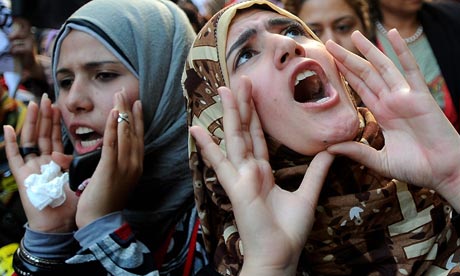
Women protesting in Egypt. Image via The Guardian.
The awarding of the Nobel Prize to Yemeni female activist Tawakul Karman attests to the growing role of women in the socio-political transitions. But according to a recent report by the Dubai School of Government, rising women’s activism in the current transitions is not associated with rising female social media usage. In significant ways, this finding provokes questions about how women could be further engaged in the social media revolution as active users to cope with their real-life role as agents of change in their communities. (It should also provoke some questions about how much credit we should give social media for these changes, since they were clearly not the only factor in these revolutions.)
The survey found that, while the numbers of male and female users of Facebook worldwide are roughly equal, women are only a third of Facebook users in the Arab world. The report puts forward a number of barriers limiting social media usages by women. Those include social and cultural constraints placed on women in the region, access to ICT, and lack of relevant content for women. The report also notes that Arab women who do use social media platforms use them to achieve numerous purposes like networking, accessing information and jobs, and activism.
It is clear that some of the reasons keeping women from using social media more are external, suggesting that they can be fixed and worked on by the community. One way to address this issue is to launch more IT and social media training programs to enhance women IT literacy skills and knowledge at universities, schools, and even at home.
On another level, more work should focus on producing content that is relevant to Arab women. This is not only limited to informing women about fashion and beauty, but also about educating them on their rights and responsibilities in their respective communities. Media content should also address different aspects in relation to women like education, health, economics, technology, and so on.
Online content should not only aim at enriching Arab women’s knowledge, but it should also seek to enhance appreciation of their psychological and social concerns listening to them, through different social interaction platforms.
Women-related content should become part of the mainstream news media sites, because statistics show that visitors mainly use the internet to get news. Online media need to do more towards educating both men and women about self development, and encouraging them to obtain their right positions in society.
Online activism and movements have proven to play a significant role in bringing about concrete changes on the ground. The Egyptian and Tunisian experiences have offered ample evidence that through coordinated networking, social and political mobilization would be possible. Of course, for a region long marked by conservative views of women role in building their communities, getting women engaged online may not look like a short-term target. But through systematic education and social empowerment, a greater presence of Arab women in cyberspace could be quite possible in the coming years.
Next Post

January 19, 2012 How are Muslim Women Doing in Political Cartoons?
Browse Our Archives
Select a Category Advertisements Art/Theater Books/Magazines Cinema Comics/Cartoons Culture/Society Events Fashion Film Friday Links Merchandise/Commodities MMW Announcements MMW Highlights Music/Radio News Photography Politics Profile Ramadan 2012 Ramadan 2013 Ramadan 2014 Ramadan 2015 Roundtable Satire Social Media Sports Technology/Science Television Uncategorized Video Web
Select a Month November 2015 October 2015 September 2015 August 2015 July 2015 June 2015 May 2015 April 2015 March 2015 January 2015 December 2014 November 2014 October 2014 September 2014 July 2014 June 2014 May 2014 April 2014 March 2014 February 2014 January 2014 December 2013 November 2013 October 2013 September 2013 August 2013 July 2013 June 2013 May 2013 April 2013 March 2013 February 2013 January 2013 December 2012 November 2012 October 2012 September 2012 August 2012 July 2012 June 2012 May 2012 April 2012 March 2012 February 2012 January 2012 December 2011 November 2011 September 2011 August 2011 July 2011 June 2011 May 2011 April 2011 March 2011 February 2011 January 2011 December 2010 November 2010 October 2010 September 2010 August 2010 July 2010 June 2010 May 2010 April 2010 March 2010 February 2010 January 2010 December 2009 November 2009 October 2009 September 2009 August 2009 July 2009 June 2009 May 2009 April 2009 March 2009 February 2009 January 2009 December 2008 November 2008 October 2008 September 2008 August 2008 July 2008 June 2008 May 2008 April 2008 March 2008 February 2008 January 2008 December 2007 November 2007 October 2007 September 2007 August 2007
Follow Us!
TAKE THE
Religious Wisdom Quiz
Who built the Ark of the Covenant?
Select your answer to see how you score.
Joshua Aaron Moses Bezalel
Related posts from Muslimah Media Watch

#PrayforParis, Muslim Women and Third World Violence



Why British MP’s statements defending Muslim women do...
TRENDING AT PATHEOS Muslim

25 Years Later: How Much Has Changed for...
As we approach the 25th anniversary of September 11th, I’ve found myself...

Podcast: Third Spaces & The Rise of Yemeni...
In the latest episode of The Artistic Foodies Podcast, hosts Abbas...

HalalFest Picks: Best 60 Halal Spots for Super...
Back in 2016, I came up with a list of 29...

Unity Is America’s Strength — Division Is Its...
by Hidayatullah Ahsan When Valentina Gomez, a Republican candidate for Congress in...

Zohran Mamdani and New York’s Fight Against Islamophobia
This past June, against all odds, Zohran Mamdani won the Democratic primary...

What the Fourth of July Means to a...
As we mark another Fourth of July, millions of Americans will celebrate...
view all Muslim blogs
Ad-Free & Subscriber Log-In Subscription Support
- About Us
- 2026 Calendar
- Videos
- Podcasts
- Library of World Religions
- Faith In Media Tracker
- Advertise With Us
- Write for Us
- Privacy Policy
- Terms of Service
- Do Not Sell My Data
- Contact Us
- Radiant Digital
- Manage Newsletter Subscriptions
- Unsubscribe From Notifications
- Sitemap
Copyright 2008-2026, Patheos. All rights reserved.
Subscription Support Ad-Free & Subscriber Log-In
Follow Patheos