
BuddhistCatholicContemplativeEvangelicalGeneral ChristianHinduJewishLatter-day SaintMuslimNew VisionsProgressive Christian
Beliefs
- Buddhist
- Catholic
- Contemplative
- Evangelical
- General Christian
- Hindu
- Jewish
- Latter-day Saint
- More Voices
- Muslim
- New Visions
- Pagan
- Progressive Christian
Topics
- Religion News
- Food and Religion
- Sports and Religion
- Religious Art
- Religious Music and Entertainment
- Religious Events
- History and Religion
- Style and Religion
- Politics and Religion
- Women in Religion
- Recreation Outdoors and Religion
- Business Finance and Religion
- Careers Workplace and Religion
- Education and Religion
- Family Parenting and Religion
- Health Fitness and Religion
- Home and Religion
- Relationships and Religion
- Technology and Religion
- Travel and Religion
Columnists
- Buddhist Columnists
- Business Finance and Religion Columnists
- Careers Workplace and Religion Columnists
- Catholic Columnists
- Contemplative Columnists
- Education and Religion Columnists
- Evangelists Columnists
- Family Parenting and Religion Columnists
- General Christian Columnists
- Health Fitness and Religion Columnists
- Hindu Columnists
- History and Religion Columnists
- Home and Religion Columnists
- Jewish Columnists
- More Voices Columnists
- Latter Day Columnists
- Muslim Columnists
- New Visions Columnists
- Nonreligious Columnists
- Pagan Columnists
- Politics and Religion Columnists
- Progressive Columnists
- Recreation Outdoors and Religion Columnists
- Relationships and Religion Columnists
- Religion News Columnists
- Religious Art Columnists
- Religious Events Columnists
- Religious Music and Entertainment Columnists
- Sports and Religion Columnists
- Style and Religion Columnists
- Technology and Religion Columnists
- Travel and Religion Columnists
- Women in Religion Columnists
Resource Library
- 2026 Calendar
- Library of World Religions
- The 100 Most Holy Places on Earth
- Patheos Answers
- Podcasts
- Videos
- Faith Leaders Database
- Anglican Episcopalian
- Bahai
- Baptist
- Buddhism
- Christianity
- Confucianism
- Eastern Orthodoxy
- Hinduism
- Holiness and Pentecostal
- ISKCON
- Islam
- Judaism
- Lutheran
- Methodist
- The Church of Jesus Christ of Latter-day Saints
- New Age
- Paganism
- Presbytarian and Reformed
- Protestantism
- Religion Behind the Scenes
- Roman Catholic
- Scientology
- Shia Islam
- Sikhism
- Sufism
- Sunni Islam
- Taoism
- Zen
- See all religions
Research Tools
 Ad-Free & Subscriber Log-In Subscription Support
Ad-Free & Subscriber Log-In Subscription Support
Follow Patheos 

- Trending:
- Forgiveness
- |
- Marriage
- |
- Consciousness
- |
- Death Penalty
- |
- Election
- |
- Halloween
 Muslimah Media Watch
- Home
- Muslim
- Religion News
- Book Review: Progressive Muslim Identities
Book Review: Progressive Muslim Identities
Last updated on: January 23, 2012 at 2:00 am by Krista
Book Review: Progressive Muslim Identities 2012-01-22T14:20:18-04:00 Krista
Patheos Explore the world's faith through different perspectives on religion and spirituality! Patheos has the views of the prevalent religions and spiritualities of the world.
Progressive Muslim Identities: Personal Stories from the U.S. and Canada is a recently-published anthology, edited by Vanessa Karam, Olivia Samad, and Ani Zonneveld. As described by Zonneveld in the book’s introduction,
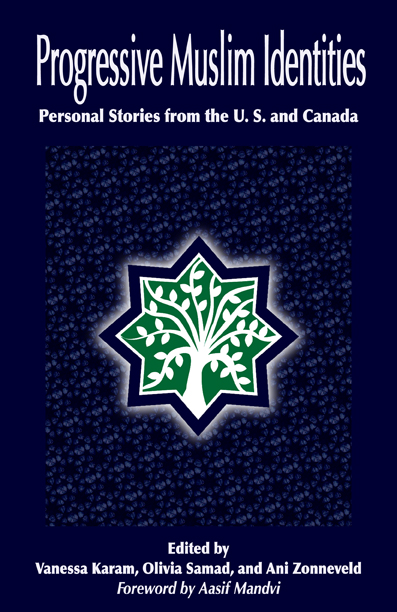
Cover of Progressive Muslim Identities. Image via MPV.
“This is not a book of Islamic theology or history; a reader looking for that has other sources. This book is a snapshot that captures the brave face of individual progressive Muslims at this point in time. Their personal and honest narratives give readers a look into the lives of progressive Muslims in the United States and Canada. For the most part, the contributors are not professional writers or ‘famous Muslims.’ They are the voices you never get to hear.”
The writing included in the book represents an impressive diversity of ethnic backgrounds and religious upbringings, and it does indeed highlight stories of people generally not seen as representative of Islam or of Muslims. It’s not the first to do so, although I think it’s the first such anthology that I’ve read that includes perspectives from Muslim men. Books like Living Islam Out Loud, Voices of Resistance, and Shattering the Stereotypes, for example, all present some similar perspectives and personal narratives (even if they are not all framed explicitly as “progressive”), but are focused on Muslim women. (I haven’t read Omid Safi’s Progressive Muslims, which might bring in the male experience more clearly, although its focus is less personal.) Proceeds from the book go to Muslims for Progressive Values (MPV), and there’s a fact sheet about MPV and its principles in the back of the book.
I particularly liked Tynan Power’s reflections on his son’s work as a young “spokes-Muslim” post 9/11. Dizery Salim’s piece captures some tender and perplexing snapshots of her Muslim childhood; on the other hand, her concluding reflection that “Islam is difficult in a world that is not Muslim” could have used some further explanation. The chapters by Sahira Traband, Sumaya Cole, and Daaiyee Abdullah also included some particularly moving observations and experiences, although all seemed to drag at points, and would likely have been better if they’d been a bit shorter. There are, of course, people who will feel uncomfortable with some of the ways that Islam is interpreted within these stories (and I certainly had my own disagreements with some of them), but I think they convey the complexities of trying to find ways of living Islam in a culturally relevant and ethical way.
One thing that really impressed me – and I’m not sure this is a comment that I would have ever made (or thought to make) about any other book – is that the glossary is really well done. A lot of glossaries are just there to give quick translations of terminology that might be used, but this one takes the time to give explanations in paragraphs, exploring the meanings in much more depth, and acknowledging the variety of spellings of some of the words.
Overall, the writing itself is a mixed bag. Some of the pieces are poignant and eloquently written; others are, well, less so. There’s a recurring theme of life trajectories, often coming from rigid ideas of Islam towards something more progressive, and it starts to feel repetitive. I don’t mean to knock the validity of the stories and experiences shared here, but this kind of general memoir-style writing is most interesting when the person writing is either well-known or exceptional in some way, and given that this anthology is deliberately compiled from the stories of everyday, non-famous Muslims, there’s often nothing particularly unusual about their lives. In other words, the stories are often very honest and human, but (especially in chapters when the writing is weaker) they just aren’t always that interesting to read. At times, the book reads more like a series of testimonials about how people ended up finding a home with Muslim for Progressive Values, and some of the pieces would probably be better off on the organisation’s website than in a book about progressive Muslim stories.
I actually think this anthology would have worked better as a collection of more focused stories or reflective pieces on particular aspects of Islam, rather than looking so generally at the writers’ life paths as they relate to Islam. Mona Eltahawy’s piece, for example, takes as a starting point a moment while teaching that led her and her students to reflect on issues of sexual purity in conservative Christian and Muslim communities. This serves as a much more engaging chapter to read than some of the other “life story”-type pieces, and I would have liked to see more written in that style. I also would have been interested in hearing more about progressive communities aside from MPV, or about struggles or tensions within progressive groups. (I can’t be the only one who’s experienced that, right?)
Zonneveld writes in the book’s introduction that
“It is very likely that you have met many Muslims like us before. We are your neighbours and colleagues. And maybe, through the stories presented here, you will see yourself in us.”
Although the writing could have been improved, Progressive Muslim Identities reflects lives of a group of Muslims living and understanding Islam in unorthodox and imperfect ways, and challenges assumptions (from inside and outside of Muslim communities) about what it means to be Muslim.
Muslims for Progressive Values
Previous Post

January 20, 2012
Friday Links | January 20, 2012
Next Post
January 24, 2012 Choose Your Caption: Niqab as Illustrative of, Well, Everything
Browse Our Archives
Select a Category Advertisements Art/Theater Books/Magazines Cinema Comics/Cartoons Culture/Society Events Fashion Film Friday Links Merchandise/Commodities MMW Announcements MMW Highlights Music/Radio News Photography Politics Profile Ramadan 2012 Ramadan 2013 Ramadan 2014 Ramadan 2015 Roundtable Satire Social Media Sports Technology/Science Television Uncategorized Video Web
Select a Month November 2015 October 2015 September 2015 August 2015 July 2015 June 2015 May 2015 April 2015 March 2015 January 2015 December 2014 November 2014 October 2014 September 2014 July 2014 June 2014 May 2014 April 2014 March 2014 February 2014 January 2014 December 2013 November 2013 October 2013 September 2013 August 2013 July 2013 June 2013 May 2013 April 2013 March 2013 February 2013 January 2013 December 2012 November 2012 October 2012 September 2012 August 2012 July 2012 June 2012 May 2012 April 2012 March 2012 February 2012 January 2012 December 2011 November 2011 September 2011 August 2011 July 2011 June 2011 May 2011 April 2011 March 2011 February 2011 January 2011 December 2010 November 2010 October 2010 September 2010 August 2010 July 2010 June 2010 May 2010 April 2010 March 2010 February 2010 January 2010 December 2009 November 2009 October 2009 September 2009 August 2009 July 2009 June 2009 May 2009 April 2009 March 2009 February 2009 January 2009 December 2008 November 2008 October 2008 September 2008 August 2008 July 2008 June 2008 May 2008 April 2008 March 2008 February 2008 January 2008 December 2007 November 2007 October 2007 September 2007 August 2007
Follow Us!
TAKE THE
Religious Wisdom Quiz
How old was Abraham when Sarah died?
Select your answer to see how you score.
117 years 137 years 127 years 147 years
Related posts from Muslimah Media Watch

Book review: Jewels of Allah by Nina Ansary

Book Review: Faïza Zerouala's Voices Behind the Veil

Making Sense of “the Other”: A Review of...

TRENDING AT PATHEOS Muslim

25 Years Later: How Much Has Changed for...
As we approach the 25th anniversary of September 11th, I’ve found myself...

Podcast: Third Spaces & The Rise of Yemeni...
In the latest episode of The Artistic Foodies Podcast, hosts Abbas...

HalalFest Picks: Best 60 Halal Spots for Super...
Back in 2016, I came up with a list of 29...

Unity Is America’s Strength — Division Is Its...
by Hidayatullah Ahsan When Valentina Gomez, a Republican candidate for Congress in...

Zohran Mamdani and New York’s Fight Against Islamophobia
This past June, against all odds, Zohran Mamdani won the Democratic primary...

What the Fourth of July Means to a...
As we mark another Fourth of July, millions of Americans will celebrate...
view all Muslim blogs
Ad-Free & Subscriber Log-In Subscription Support
- About Us
- 2026 Calendar
- Videos
- Podcasts
- Library of World Religions
- Faith In Media Tracker
- Advertise With Us
- Write for Us
- Privacy Policy
- Terms of Service
- Do Not Sell My Data
- Contact Us
- Radiant Digital
- Manage Newsletter Subscriptions
- Unsubscribe From Notifications
- Sitemap
Copyright 2008-2026, Patheos. All rights reserved.
Subscription Support Ad-Free & Subscriber Log-In
Follow Patheos