
BuddhistCatholicContemplativeEvangelicalGeneral ChristianHinduJewishLatter-day SaintMuslimNew VisionsProgressive Christian
Beliefs
- Buddhist
- Catholic
- Contemplative
- Evangelical
- General Christian
- Hindu
- Jewish
- Latter-day Saint
- More Voices
- Muslim
- New Visions
- Pagan
- Progressive Christian
Topics
- Religion News
- Food and Religion
- Sports and Religion
- Religious Art
- Religious Music and Entertainment
- Religious Events
- History and Religion
- Style and Religion
- Politics and Religion
- Women in Religion
- Recreation Outdoors and Religion
- Business Finance and Religion
- Careers Workplace and Religion
- Education and Religion
- Family Parenting and Religion
- Health Fitness and Religion
- Home and Religion
- Relationships and Religion
- Technology and Religion
- Travel and Religion
Columnists
- Buddhist Columnists
- Business Finance and Religion Columnists
- Careers Workplace and Religion Columnists
- Catholic Columnists
- Contemplative Columnists
- Education and Religion Columnists
- Evangelists Columnists
- Family Parenting and Religion Columnists
- General Christian Columnists
- Health Fitness and Religion Columnists
- Hindu Columnists
- History and Religion Columnists
- Home and Religion Columnists
- Jewish Columnists
- More Voices Columnists
- Latter Day Columnists
- Muslim Columnists
- New Visions Columnists
- Nonreligious Columnists
- Pagan Columnists
- Politics and Religion Columnists
- Progressive Columnists
- Recreation Outdoors and Religion Columnists
- Relationships and Religion Columnists
- Religion News Columnists
- Religious Art Columnists
- Religious Events Columnists
- Religious Music and Entertainment Columnists
- Sports and Religion Columnists
- Style and Religion Columnists
- Technology and Religion Columnists
- Travel and Religion Columnists
- Women in Religion Columnists
Resource Library
- 2026 Calendar
- Library of World Religions
- The 100 Most Holy Places on Earth
- Patheos Answers
- Podcasts
- Videos
- Faith Leaders Database
- Anglican Episcopalian
- Bahai
- Baptist
- Buddhism
- Christianity
- Confucianism
- Eastern Orthodoxy
- Hinduism
- Holiness and Pentecostal
- ISKCON
- Islam
- Judaism
- Lutheran
- Methodist
- The Church of Jesus Christ of Latter-day Saints
- New Age
- Paganism
- Presbytarian and Reformed
- Protestantism
- Religion Behind the Scenes
- Roman Catholic
- Scientology
- Shia Islam
- Sikhism
- Sufism
- Sunni Islam
- Taoism
- Zen
- See all religions
Research Tools
 Ad-Free & Subscriber Log-In Subscription Support
Ad-Free & Subscriber Log-In Subscription Support
Follow Patheos 

- Trending:
- Forgiveness
- |
- Marriage
- |
- Consciousness
- |
- Death Penalty
- |
- Election
- |
- Halloween
 Muslimah Media Watch
- Home
- Muslim
- Religion News
- “A Country and a Continent”: Fatimah Tuggar and the Politics of Montage
“A Country and a Continent”: Fatimah Tuggar and the Politics of Montage
Last updated on: January 20, 2012 at 8:40 pm by tasnim
“A Country and a Continent”: Fatimah Tuggar and the Politics of Montage 2012-01-20T20:40:29-04:00 tasnim
Patheos Explore the world's faith through different perspectives on religion and spirituality! Patheos has the views of the prevalent religions and spiritualities of the world.
Fatimah Tuggar is one of the artists Jiwa has discussed, in his article on Imaging, imagining and representation: Muslim visual artists in NYC. As Munir Jiwa has pointed out, the past couple of decades have seen “the larger tropes of Islam/Muslims—terrorism, violence, veiling, patriarchy, the Middle East—become the normative frames and images within and against which Muslim artists do their work”.
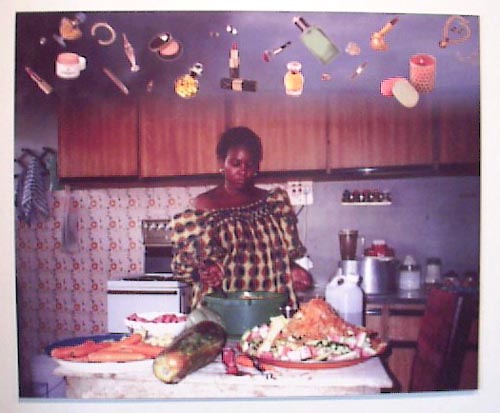
Fatimah Tuggar, Daydream
In her own work, however, Nigerian-born Tuggar has had little engagement with either the contemporary theopolitical maelstrom of “Islam and the West” or with the earlier Orientalism.
Her interest lies rather in exploring the economic and technological impact of “the developed world” and how it interacts with local cultures in postcolonial African societies. She explores this subject through interactive media installations and images, which combine modern and traditional objects. Tuggar uses her own photographs as well as advertising and other found images from magazines and archival footage. The resulting hybrid objects and collages are eye-popping, witty and unexpected.
Often, her works are described as clever, amusing, or light-hearted, in the positive sense of not being “ideologically loaded,” and the constant tropes in her collages leads many to see her work as “the American dream meets the African village.”
Although it is true that Tuggar uses vintage and modern ads, popular culture, and other forms of Western excess consumerism from magazines, and contrasts this with archive or contemporary photography from Africa, the artist points out that she brings together images from many different cultures, including Asia. She also remarks on the fallacy of equating “a country and a continent,” a jarring juxtaposition in itself, which underscores the problems she explores in her work.
Lennie Bennet at first found the juxtapositions
hilarious. Then you take in the archival postcard photo from the Smithsonian Institution displayed nearby showing 19th century Africans trying to emulate Westerners dressed in top hats, tails and long white dresses and you realize Tuggar’s work is also sad. And angry. We don’t need your suburban aspirations, she suggests, so why do we want them?
While those who praise Tuggar for being “non-ideological” often impute a simplistic or didactic message to her work, in explaining her own, work Tuggar must speak about first one object and then the next, which inevitably elides the dynamic in the collage and its ability to convey tension.
An example of this is Tuggar explaining that West Africans, due to unstable electricity, switch between modern convenient appliances and traditional tools. This statement of fact becomes an illustration of parallel existance through her work Fan, traditional maficichi woven fans attached to a white electrical ceiling fan, or Broom, a bundle of tsintia that makes a “swish” sound when a button is pressed.
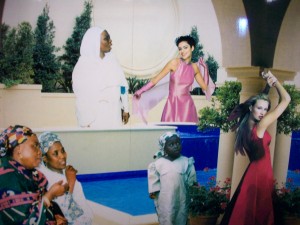
Fatimah Tuggar, Dancing by the Poolside
It’s interesting to compare Tuggar’s own interpretations of her work Dancing by the Poolside which she says is about excess in both western and nonwestern cultures, with this interpretation, which clearly sees the work as judgmental or didactic:
Here, some Nonwestern women wearing Islamic headscarves look confused and somewhat disturbed at the sudden appearance of two dancing women in relatively revealing dresses. These two dancing women are clearly out of place. Through this image, Tuggar is thus telling us that sometimes the spread of Western cultural phenomena is not necessarily a good thing, for other cultures are content as they are and are not interested in merging with the fast, liberal way of life that exists in the West.
In contrast, Tuggar herself remarks on how the collage reflects excess in “no matter what culture” and the public expression of excess during weddings held in “lavish venues”, noting how the collage includes both western dressed bridesmaids and the tradition of throwing money over a dancing woman and leaving it for musicians to pick up. The interpretation of Dancing by the Poolside which sees it as condemning “the fast, liberal way of life that exists in the West” implicitly seems to equate anti-globalization with a picturesque authenticity and lack of development which would be destroyed by encounter with westernization.
Another example of seeing the artists work as defending “other cultures” against the encroachment of westernization is Tuggar’s collage Daydream, which is described by Paul Laster as a woman who “possesses a table full of treasures” that are “components of a large meal” but daydreams instead of “material possesions” and “feminine objects.” Like Lister’s comment on “suburban aspirations,” and the Poolside interpretation, this reads as though the work condemns a portrayed or implicit longing for the Western dream. This comes close to a dismissal of the dream, which suggests that West African women should be happy being able to feed their family, rather than thinking of me-time with scented candles and jewelry, which are “material desires to alter her identity and eventually her way of life.” Essentially, this would mean picturesque poverty is preferable to a globalized world.
Yet this could only be extrapolated; the work itself offers the dynamic between food and cosmetics, reality and daydream, without seeming to be tilted in favor of the former as more material or vital, just as Dancing by the Poolside represents different expressions of wedding excess side by side, as cultural variations of the same phenomenon.
Instead of choosing a side, meaning for Tuggar seems to lie in exploring how media affects our daily lives, conflating ideas about race, gender and class through art that challenges our accepted ways of seeing, and requires us to look again.
Previous Post

January 16, 2012
Reading Too Much into Veenagate
Next Post
January 18, 2012 For Arab Women, Change in the Digital Reality is Coming, but Slowly
Browse Our Archives
Select a Category Advertisements Art/Theater Books/Magazines Cinema Comics/Cartoons Culture/Society Events Fashion Film Friday Links Merchandise/Commodities MMW Announcements MMW Highlights Music/Radio News Photography Politics Profile Ramadan 2012 Ramadan 2013 Ramadan 2014 Ramadan 2015 Roundtable Satire Social Media Sports Technology/Science Television Uncategorized Video Web
Select a Month November 2015 October 2015 September 2015 August 2015 July 2015 June 2015 May 2015 April 2015 March 2015 January 2015 December 2014 November 2014 October 2014 September 2014 July 2014 June 2014 May 2014 April 2014 March 2014 February 2014 January 2014 December 2013 November 2013 October 2013 September 2013 August 2013 July 2013 June 2013 May 2013 April 2013 March 2013 February 2013 January 2013 December 2012 November 2012 October 2012 September 2012 August 2012 July 2012 June 2012 May 2012 April 2012 March 2012 February 2012 January 2012 December 2011 November 2011 September 2011 August 2011 July 2011 June 2011 May 2011 April 2011 March 2011 February 2011 January 2011 December 2010 November 2010 October 2010 September 2010 August 2010 July 2010 June 2010 May 2010 April 2010 March 2010 February 2010 January 2010 December 2009 November 2009 October 2009 September 2009 August 2009 July 2009 June 2009 May 2009 April 2009 March 2009 February 2009 January 2009 December 2008 November 2008 October 2008 September 2008 August 2008 July 2008 June 2008 May 2008 April 2008 March 2008 February 2008 January 2008 December 2007 November 2007 October 2007 September 2007 August 2007
Follow Us!
TAKE THE
Religious Wisdom Quiz
True or False: David killed Goliath with a sword.
Select your answer to see how you score.
TRUE FALSE
Related posts from Muslimah Media Watch




When Arab Women Artists "Revisit The Harem"
TRENDING AT PATHEOS Muslim

25 Years Later: How Much Has Changed for...
As we approach the 25th anniversary of September 11th, I’ve found myself...

Podcast: Third Spaces & The Rise of Yemeni...
In the latest episode of The Artistic Foodies Podcast, hosts Abbas...

HalalFest Picks: Best 60 Halal Spots for Super...
Back in 2016, I came up with a list of 29...

Unity Is America’s Strength — Division Is Its...
by Hidayatullah Ahsan When Valentina Gomez, a Republican candidate for Congress in...

Zohran Mamdani and New York’s Fight Against Islamophobia
This past June, against all odds, Zohran Mamdani won the Democratic primary...

What the Fourth of July Means to a...
As we mark another Fourth of July, millions of Americans will celebrate...
view all Muslim blogs
Ad-Free & Subscriber Log-In Subscription Support
- About Us
- 2026 Calendar
- Videos
- Podcasts
- Library of World Religions
- Faith In Media Tracker
- Advertise With Us
- Write for Us
- Privacy Policy
- Terms of Service
- Do Not Sell My Data
- Contact Us
- Radiant Digital
- Manage Newsletter Subscriptions
- Unsubscribe From Notifications
- Sitemap
Copyright 2008-2026, Patheos. All rights reserved.
Subscription Support Ad-Free & Subscriber Log-In
Follow Patheos