
BuddhistCatholicContemplativeEvangelicalGeneral ChristianHinduJewishLatter-day SaintMuslimNew VisionsProgressive Christian
Beliefs
- Buddhist
- Catholic
- Contemplative
- Evangelical
- General Christian
- Hindu
- Jewish
- Latter-day Saint
- More Voices
- Muslim
- New Visions
- Pagan
- Progressive Christian
Topics
- Religion News
- Food and Religion
- Sports and Religion
- Religious Art
- Religious Music and Entertainment
- Religious Events
- History and Religion
- Style and Religion
- Politics and Religion
- Women in Religion
- Recreation Outdoors and Religion
- Business Finance and Religion
- Careers Workplace and Religion
- Education and Religion
- Family Parenting and Religion
- Health Fitness and Religion
- Home and Religion
- Relationships and Religion
- Technology and Religion
- Travel and Religion
Columnists
- Buddhist Columnists
- Business Finance and Religion Columnists
- Careers Workplace and Religion Columnists
- Catholic Columnists
- Contemplative Columnists
- Education and Religion Columnists
- Evangelists Columnists
- Family Parenting and Religion Columnists
- General Christian Columnists
- Health Fitness and Religion Columnists
- Hindu Columnists
- History and Religion Columnists
- Home and Religion Columnists
- Jewish Columnists
- More Voices Columnists
- Latter Day Columnists
- Muslim Columnists
- New Visions Columnists
- Nonreligious Columnists
- Pagan Columnists
- Politics and Religion Columnists
- Progressive Columnists
- Recreation Outdoors and Religion Columnists
- Relationships and Religion Columnists
- Religion News Columnists
- Religious Art Columnists
- Religious Events Columnists
- Religious Music and Entertainment Columnists
- Sports and Religion Columnists
- Style and Religion Columnists
- Technology and Religion Columnists
- Travel and Religion Columnists
- Women in Religion Columnists
Resource Library
- 2026 Calendar
- Library of World Religions
- The 100 Most Holy Places on Earth
- Patheos Answers
- Podcasts
- Videos
- Faith Leaders Database
- Anglican Episcopalian
- Bahai
- Baptist
- Buddhism
- Christianity
- Confucianism
- Eastern Orthodoxy
- Hinduism
- Holiness and Pentecostal
- ISKCON
- Islam
- Judaism
- Lutheran
- Methodist
- The Church of Jesus Christ of Latter-day Saints
- New Age
- Paganism
- Presbytarian and Reformed
- Protestantism
- Religion Behind the Scenes
- Roman Catholic
- Scientology
- Shia Islam
- Sikhism
- Sufism
- Sunni Islam
- Taoism
- Zen
- See all religions
Research Tools
 Ad-Free & Subscriber Log-In Subscription Support
Ad-Free & Subscriber Log-In Subscription Support
Follow Patheos 

- Trending:
- Forgiveness
- |
- Marriage
- |
- Consciousness
- |
- Death Penalty
- |
- Election
- |
- Halloween
 Muslimah Media Watch
- Home
- Muslim
- Religion News
- Robin Wright’s Rock the Casbah: Pink Hijabi, Counter Jihadi
Robin Wright’s Rock the Casbah: Pink Hijabi, Counter Jihadi
Last updated on: December 15, 2011 at 2:00 am by tasnim
Robin Wright’s Rock the Casbah: Pink Hijabi, Counter Jihadi 2011-12-14T09:23:52-04:00 tasnim
Patheos Explore the world's faith through different perspectives on religion and spirituality! Patheos has the views of the prevalent religions and spiritualities of the world.
Robin Wright’s Rock the Casbah Rage and Rebellion Across the Islamic World describes what Wright calls “the counter-jihad, which is unfolding in the wider Islamic bloc of fifty-seven countries as well as among Muslim minorities worldwide.” A decade after 9/11, Wright argues that “the Islamic world is now in the throes of a counterjihad” which “will define the next decade as thoroughly as the extremists dominated the last one.”
According to Wright, this change is driven by three factors: the demographics of a youthful population, the fact that the majority of the population are now literate, and improved access to technology. Wright cites a 2010 Pew Global Attitudes survey which found that far more people in Muslim countries “identified with modernizers — by two to six times — than with fundamentalists.” Although the reporting for the book was largely conducted before the popular uprisings that have swept the Arab world, Wright takes the recent tumult as a sign that people in the region are rejecting both autocratic regimes and religious extremism.
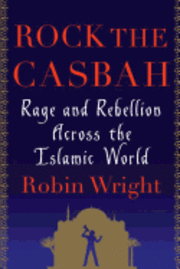
Cover of Rock the Casbah by Robin Wright.
Setting out to reveal these changing attitudes by examining their cultural manifestations, Wright portrays a generation ”at the vanguard of a sweeping and seductive cultural revolution,” in one reviewer’s words, structuring Rock the Casbah around profiles of poets, playwrights, activists, satellite sheikhs, comedians, and artists who use rap “to lash back at both extremists and autocrats.” In attempting to “show us that Islam can be compatible with modernity and democracy” Wright provides many portraits of Muslim women, many of whom will be familiar to readers of Muslimah Media Watch, such as Saudi feminist Wajeha al Huwaider, Islamic feminist Amina Wadud and “amateur Saudi poet and mother of four” Hissa Hilal, whose poem “The Chaos of Fatwas” was briefly acclaimed for its attack on extremist clerics – tellingly, Hillal, so often labelled a housewife, is in fact a published poet and newspaper editor.
The figure who has been most remarked on in the reviews however, is Dalia Ziada:
“a 29-year-old Egyptian blogger and human rights activist who at the age of 8 underwent female genital mutilation (a practice that, as Wright points out, dates back to the age of the pharaohs in Egypt, long before Islam). Ziada, who is devout and wears the Islamic head scarf, started a blog in 2006 and joined a burgeoning movement nicknamed the “pink hijabis” — observant Muslim women campaigning against domestic violence, female genital mutilation and other social problems rooted in misogynistic interpretations of Islam.”
Wright’s other inspiring examples include clerics who are part of the Saudi government’s de-radicalization program, and the American Muslim comedians who formed the “Axis of Evil” comedy tour. What binds these rather diverse characters together is Wright’s argument that, as she puts it, “The new confrontation is effectively a jihad against the Jihad.” In the small letter jihad/campaign against the venomous big-letter Jihad, the small-letter jihad takes such cool and creative forms as Yussef El Guindi’s post-9/11 comedy Jihad Jones and the Kalashnikov Babes.
Wright asserts that “even as the outside world tried to segregate Muslims as ‘others,’ particularly after 9/11, most Muslims were increasingly trying to integrate into, if not imitate, a globalizing world.” Yet she remarks that the past decade has been marked by fear of “everything from a global clash of civilizations to a new neighborhood mosque.” The roots of Rock the Casbah can be traced back to a well-intentioned effort to provide a reassuring antidote to this fear, an attempt to push readers to relate to Muslims, to get them to think “Oh, they’re just like us.” That is, it is not written with Muslim readers in mind; it is about them, and it is an exercise in reassurance:
“A growing number of Muslims now want to use their faith as a means to an end, rather than an end in itself — or as a way to find answers rather than being the answer itself. For them, Islam is often more about identity than piety, about Muslim values rather than Islamic ideology. Islam is a comfortable space and a legitimate vehicle to search for solutions compatible with global trends; it is no longer about creating an ideal Islamic state or even voting for Islamic parties.”
So, when Wright mentions that this generation wears their hijab with sequins and feathers and even in the flamenco inspired “Spanish Wrap,” what she seems to be saying is: these Muslims are fashion-conscious, hence familiar, hence friendly.
And yet, how reassuring can pink hijab be? As this reviewer makes clear, non-Muslim feminists have “qualms,” and Western observers are wary:
their balancing act between religion and modernity can make Western observers uncomfortable. Her depiction of young Muslim women, “committed to their faith, firm about their femininity, and resolute about their rights,” will spark some qualms in non-Muslim feminists. They may find themselves cynical about the assertion that “hejab is now about liberation, not confinement.”
This passage had me reaching for Madhu Kishwar’s Why I Do Not Call Myself a Feminist and the point that feminism becomes “a tool of cultural imperialism” where Third World women are “expected to be the echo of what are assumed to be more advanced women’s movements in the West.” The idea that Muslim women are at a lower stage of development in their struggle for equality always seems to involve an appeal to a myth of universal sisterhood. The Muslim woman appears to be following in the footsteps of the (Non-Muslim) Feminist Woman who through her journey established a universal pattern which women elsewhere must follow to be truly free. Looking back to the exclusionary inception of feminism as a term designed/defined by white women, Ama Ata Aidoo points out rather acerbically that the women who rioted against the colonial regime in Nigeria in the 1920’s “didn’t seek permission from Woolf.” Adapting this slightly, see Fatima Al-Fihri, Shagrat al-Durr, Wallada bint al-Mustakfi.
The qualms are telling, however: they reveal that the Pink Hijabi/Counter Jihadi remains troubling. Reviewers point to the anecdotal nature of the book, and ask whether these few inspiring individuals are truly representative. The question is inevitable, since Wright’s portraits are presented in an ahistorical vacuum, without reference to the history of reformist movements in their religion and/or region. Instead, they are presented as characters always framed by their faith, engaged not in a clash with other civilizations but ”a struggle within the faith itself to rescue Islam’s central values from a small but virulent minority.”
This claim is familiar – familiar enough that Martin Amis declared it outmoded in his book Second Plane:
Until recently it was being said that what we are confronted with, here, is ‘a civil war’ within Islam. That’s what all this was supposed to be: not a clash of civilisations or anything like that, but a civil war within Islam. Well, the civil war appears to be over. And Islamism won it.
Where Amis claimed the Islamists were winning, Wright claims that “the counter-jihad is the most pivotal trend in the Islamic world.” Yet both are couched equally narrowly. Portraying the whole ”Islamic world” as caught up in either a radicalizing or deradicalizing ”trend” through readings premised on whether this or that represents a step back or forward for “the West” in the “War on Terror” will always be inherently limiting as a premise for understanding 23% of the world’s population.
Next Post

December 16, 2011 Friday Links | December 16, 2011
Browse Our Archives
Select a Category Advertisements Art/Theater Books/Magazines Cinema Comics/Cartoons Culture/Society Events Fashion Film Friday Links Merchandise/Commodities MMW Announcements MMW Highlights Music/Radio News Photography Politics Profile Ramadan 2012 Ramadan 2013 Ramadan 2014 Ramadan 2015 Roundtable Satire Social Media Sports Technology/Science Television Uncategorized Video Web
Select a Month November 2015 October 2015 September 2015 August 2015 July 2015 June 2015 May 2015 April 2015 March 2015 January 2015 December 2014 November 2014 October 2014 September 2014 July 2014 June 2014 May 2014 April 2014 March 2014 February 2014 January 2014 December 2013 November 2013 October 2013 September 2013 August 2013 July 2013 June 2013 May 2013 April 2013 March 2013 February 2013 January 2013 December 2012 November 2012 October 2012 September 2012 August 2012 July 2012 June 2012 May 2012 April 2012 March 2012 February 2012 January 2012 December 2011 November 2011 September 2011 August 2011 July 2011 June 2011 May 2011 April 2011 March 2011 February 2011 January 2011 December 2010 November 2010 October 2010 September 2010 August 2010 July 2010 June 2010 May 2010 April 2010 March 2010 February 2010 January 2010 December 2009 November 2009 October 2009 September 2009 August 2009 July 2009 June 2009 May 2009 April 2009 March 2009 February 2009 January 2009 December 2008 November 2008 October 2008 September 2008 August 2008 July 2008 June 2008 May 2008 April 2008 March 2008 February 2008 January 2008 December 2007 November 2007 October 2007 September 2007 August 2007
Follow Us!
TAKE THE
Religious Wisdom Quiz
For all have _____ and come short of the glory of God.
Select your answer to see how you score.
Believed Sinned Prayed Tried
Related posts from Muslimah Media Watch

Book review: Jewels of Allah by Nina Ansary

Book Review: Faïza Zerouala's Voices Behind the Veil

Making Sense of “the Other”: A Review of...

TRENDING AT PATHEOS Muslim

25 Years Later: How Much Has Changed for...
As we approach the 25th anniversary of September 11th, I’ve found myself...

Podcast: Third Spaces & The Rise of Yemeni...
In the latest episode of The Artistic Foodies Podcast, hosts Abbas...

HalalFest Picks: Best 60 Halal Spots for Super...
Back in 2016, I came up with a list of 29...

Unity Is America’s Strength — Division Is Its...
by Hidayatullah Ahsan When Valentina Gomez, a Republican candidate for Congress in...

Zohran Mamdani and New York’s Fight Against Islamophobia
This past June, against all odds, Zohran Mamdani won the Democratic primary...

What the Fourth of July Means to a...
As we mark another Fourth of July, millions of Americans will celebrate...
view all Muslim blogs
Ad-Free & Subscriber Log-In Subscription Support
- About Us
- 2026 Calendar
- Videos
- Podcasts
- Library of World Religions
- Faith In Media Tracker
- Advertise With Us
- Write for Us
- Privacy Policy
- Terms of Service
- Do Not Sell My Data
- Contact Us
- Radiant Digital
- Manage Newsletter Subscriptions
- Unsubscribe From Notifications
- Sitemap
Copyright 2008-2026, Patheos. All rights reserved.
Subscription Support Ad-Free & Subscriber Log-In
Follow Patheos