
BuddhistCatholicContemplativeEvangelicalGeneral ChristianHinduJewishLatter-day SaintMuslimNew VisionsProgressive Christian
Beliefs
- Buddhist
- Catholic
- Contemplative
- Evangelical
- General Christian
- Hindu
- Jewish
- Latter-day Saint
- More Voices
- Muslim
- New Visions
- Pagan
- Progressive Christian
Topics
- Religion News
- Food and Religion
- Sports and Religion
- Religious Art
- Religious Music and Entertainment
- Religious Events
- History and Religion
- Style and Religion
- Politics and Religion
- Women in Religion
- Recreation Outdoors and Religion
- Business Finance and Religion
- Careers Workplace and Religion
- Education and Religion
- Family Parenting and Religion
- Health Fitness and Religion
- Home and Religion
- Relationships and Religion
- Technology and Religion
- Travel and Religion
Columnists
- Buddhist Columnists
- Business Finance and Religion Columnists
- Careers Workplace and Religion Columnists
- Catholic Columnists
- Contemplative Columnists
- Education and Religion Columnists
- Evangelists Columnists
- Family Parenting and Religion Columnists
- General Christian Columnists
- Health Fitness and Religion Columnists
- Hindu Columnists
- History and Religion Columnists
- Home and Religion Columnists
- Jewish Columnists
- More Voices Columnists
- Latter Day Columnists
- Muslim Columnists
- New Visions Columnists
- Nonreligious Columnists
- Pagan Columnists
- Politics and Religion Columnists
- Progressive Columnists
- Recreation Outdoors and Religion Columnists
- Relationships and Religion Columnists
- Religion News Columnists
- Religious Art Columnists
- Religious Events Columnists
- Religious Music and Entertainment Columnists
- Sports and Religion Columnists
- Style and Religion Columnists
- Technology and Religion Columnists
- Travel and Religion Columnists
- Women in Religion Columnists
Resource Library
- 2026 Calendar
- Library of World Religions
- The 100 Most Holy Places on Earth
- Patheos Answers
- Podcasts
- Videos
- Faith Leaders Database
- Anglican Episcopalian
- Bahai
- Baptist
- Buddhism
- Christianity
- Confucianism
- Eastern Orthodoxy
- Hinduism
- Holiness and Pentecostal
- ISKCON
- Islam
- Judaism
- Lutheran
- Methodist
- The Church of Jesus Christ of Latter-day Saints
- New Age
- Paganism
- Presbytarian and Reformed
- Protestantism
- Religion Behind the Scenes
- Roman Catholic
- Scientology
- Shia Islam
- Sikhism
- Sufism
- Sunni Islam
- Taoism
- Zen
- See all religions
Research Tools
 Ad-Free & Subscriber Log-In Subscription Support
Ad-Free & Subscriber Log-In Subscription Support
Follow Patheos 

- Trending:
- Forgiveness
- |
- Marriage
- |
- Consciousness
- |
- Death Penalty
- |
- Election
- |
- Halloween
 Muslimah Media Watch
- Home
- Muslim
- Religion News
- The “Symbolic Step” of Women’s Political Participation in A New Libya
The “Symbolic Step” of Women’s Political Participation in A New Libya
Last updated on: November 28, 2011 at 2:00 am by tasnim
The “Symbolic Step” of Women’s Political Participation in A New Libya 2011-11-27T18:56:16-04:00 tasnim
Patheos Explore the world's faith through different perspectives on religion and spirituality! Patheos has the views of the prevalent religions and spiritualities of the world.
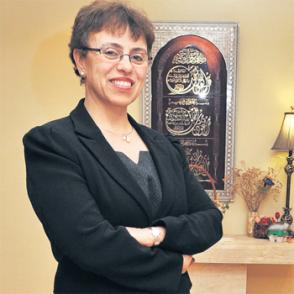
New Libyan Health Minister Dr. Fatima Hamroush, photo from the Irish Independent
Libya’s new interim government, which was announced on November 22, has been tasked with preparing for elections scheduled for next June, when voters will select an assembly to write the new constitution. As expected, given the challenges of rebuilding the country after four decades of dictatorship and nine months of war, the choice of ministers has come under scrutiny. International media coverage took an angle that suggested some fears had been allayed, noting that Prime Minister Abdulrahman Keib’s cabinet seems to be chosen on the basis of regional rather than ideological affiliation. In particular, the fact that two women were appointed has been described as significant for post-Gaddafi Libya:
“In a symbolic step for Libya, a deeply conservative Muslim society, the cabinet included two women, heading the ministries of health and social affairs. El-Keib said those appointments showed women enjoyed more equality than ever before.”
The issue of women’s rights in Libya as a “deeply conservative Muslim society” was placed under a spotlight in the wake of controversial comments made by NTC chairman Mustafa Abdel Jalil. Jalil’s declaration that the constitution will be based on Islamic law, using polygamy as an example, prompted claims such as “TNC Rewards Rebels with Polygamy,” a response that feeds fears that the Arab revolutions are falling into the hands of frightening Islamists, overlooking the fact that polygamy, though increasingly rare in Libya, had always been practised under Muammar Gaddafi’s regime. This not-insignficant fact was easily brushed aside in part due to the revolutionary narrative, which takes the “winds of change” metaphors of the so-called Arab Spring at their word, often presenting the actions of new governments as complete breaks from the previous regime, when those actions need to be read within a historical context.
In Libya, for example, women have been able to vote since the sixties and have served in government since the late eighties, following the regional model where a few notable women occupy prominent positions, without this having much effect on the empowerment of women in the general popualtion. The nature of women’s political participation in the Arab world has generally been symbolic and conditional, where it exists at all. Earlier this year, for example, when Lebanon’s cabinet was announced, the 30 appointees did not include a single woman.
In Libya the appointment of Fatima Hamroush as the minister of health and Mabruka al-Sherif Jibril as the minister of social affairs is symbolic in a sense: two women ministers is not a high number. However, in one of the two cases at least, the charge that the appointment is only a symbolic step, or more symbolic than substantive, does not hold up. While in the Arab world women’s political roles are often limited to smaller portfolios, newly liberated Libya’s first minister for health will have a lot on her plate. The challenges will need to address include the rampant corruption in Libya’s medical sector, which she defines as one of her priorities, to say nothing of the sensitive issue of care for those wounded in the war, which has sparked protests across the country, with relatives calling for more to be done by the interim government to help the injured.
The appointment of Dr. Hamroush, a Libyan opthalmologist with Irish citizenship, has prompted some criticism that she may be out of touch with the day-to-day of Libyan hospitals after 15 years outside the country. However, Dr. Hamroush has gained a lot of recognition and praise both in the country and abroad for her efforts in delivering aid during the war and in co-ordinating efforts to bring Libyans wounded in the conflict to Ireland for treatment. Media coverage of Dr. Hamroush’s appointment, in particular in Ireland, has highlighted her work as the director of Irish-Libyan Emergency Aid and head of the Libyan Health Office in Ireland. In a radio interview after Gaddafi’s death, Dr. Hamroush noted that her role in the standalone entity of the Libyan Health Office would be equivalent to a health attache if Ireland had a Libyan embassy. Dr. Hamroush is quoted as saying that she felt she could not turn down the opportunity to be part of the transitional government: “I couldn’t refuse this challenge, it would be like a soldier refusing to go to the battlefield.”
This idea of civic duty has been central to the broader debate on the greater inclusion of women in the political process in Libya. The regional Arab women’s NGO Karama recently organized a meeting of the Libya Peace Platform, a diverse group of Libyan women who gathered in Cairo to set strategies to promote women’s political participation, with the hope of convening Peace Platform bodies in five key Libyan cities that will work to empower women as politically engaged citizens who can work to change their communities. Zahra Langhi, founder of Friends of Free Libya, pointed out that:
Women have played a pivotal role in the Libyan Revolution. In fact, Libyan women (as mothers, wives and sisters of the victims of notorious prison of Abu Sileem) were the first to come out and protest on the 15th of Feb, crying out ‘Rise up Benghazi. This is the day we have been waiting for!’
The question of how to ensure women’s political participation post-revolution has to face the paradox that in portraying women’s political participation as a symbolic sign of democracy, women’s rights may continue to be used as a democratic facade, as cosmetic signs of change, as with the autocratic secular regimes who manipulated these issues for their own political interest. For this reason, covering women’s participation as a “symbolic step” needs to be framed by questions about how Arab women can narrate their responsibilities as political actors, representing women’s political participation as a prerequisite for and inseparable from any Arab awakening.
Previous Post

November 25, 2011
Friday Links | November 25, 2011
Next Post
November 28, 2011 Jezebel and the Broken Jihad Record
Browse Our Archives
Select a Category Advertisements Art/Theater Books/Magazines Cinema Comics/Cartoons Culture/Society Events Fashion Film Friday Links Merchandise/Commodities MMW Announcements MMW Highlights Music/Radio News Photography Politics Profile Ramadan 2012 Ramadan 2013 Ramadan 2014 Ramadan 2015 Roundtable Satire Social Media Sports Technology/Science Television Uncategorized Video Web
Select a Month November 2015 October 2015 September 2015 August 2015 July 2015 June 2015 May 2015 April 2015 March 2015 January 2015 December 2014 November 2014 October 2014 September 2014 July 2014 June 2014 May 2014 April 2014 March 2014 February 2014 January 2014 December 2013 November 2013 October 2013 September 2013 August 2013 July 2013 June 2013 May 2013 April 2013 March 2013 February 2013 January 2013 December 2012 November 2012 October 2012 September 2012 August 2012 July 2012 June 2012 May 2012 April 2012 March 2012 February 2012 January 2012 December 2011 November 2011 September 2011 August 2011 July 2011 June 2011 May 2011 April 2011 March 2011 February 2011 January 2011 December 2010 November 2010 October 2010 September 2010 August 2010 July 2010 June 2010 May 2010 April 2010 March 2010 February 2010 January 2010 December 2009 November 2009 October 2009 September 2009 August 2009 July 2009 June 2009 May 2009 April 2009 March 2009 February 2009 January 2009 December 2008 November 2008 October 2008 September 2008 August 2008 July 2008 June 2008 May 2008 April 2008 March 2008 February 2008 January 2008 December 2007 November 2007 October 2007 September 2007 August 2007
Follow Us!
TAKE THE
Religious Wisdom Quiz
In 1 Thessalonians, what does Paul say about the dead in Christ when the Lord returns?
Select your answer to see how you score.
They will rise last They will rise first They will be judged They will be caught up in glory
Related posts from Muslimah Media Watch

#PrayforParis, Muslim Women and Third World Violence



Why British MP’s statements defending Muslim women do...
TRENDING AT PATHEOS Muslim

25 Years Later: How Much Has Changed for...
As we approach the 25th anniversary of September 11th, I’ve found myself...

Podcast: Third Spaces & The Rise of Yemeni...
In the latest episode of The Artistic Foodies Podcast, hosts Abbas...

HalalFest Picks: Best 60 Halal Spots for Super...
Back in 2016, I came up with a list of 29...

Unity Is America’s Strength — Division Is Its...
by Hidayatullah Ahsan When Valentina Gomez, a Republican candidate for Congress in...

Zohran Mamdani and New York’s Fight Against Islamophobia
This past June, against all odds, Zohran Mamdani won the Democratic primary...

What the Fourth of July Means to a...
As we mark another Fourth of July, millions of Americans will celebrate...
view all Muslim blogs
Ad-Free & Subscriber Log-In Subscription Support
- About Us
- 2026 Calendar
- Videos
- Podcasts
- Library of World Religions
- Faith In Media Tracker
- Advertise With Us
- Write for Us
- Privacy Policy
- Terms of Service
- Do Not Sell My Data
- Contact Us
- Radiant Digital
- Manage Newsletter Subscriptions
- Unsubscribe From Notifications
- Sitemap
Copyright 2008-2026, Patheos. All rights reserved.
Subscription Support Ad-Free & Subscriber Log-In
Follow Patheos